



DevOps teams and their innovative approach have changed how software gets built and shipped to the end users. Leveraging DevOps practices typically speeds up development cycles and breaks down walls between different parts of the product team. However, many companies using traditional DevOps methods discover a critical flaw too late: their focus on speed often pushes security concerns to the background. This rush to market creates openings for critical vulnerabilities that slip through undetected.
Enter DevSecOps: a solution designed to fix this exact problem by weaving security directly into the development workflow. But when taking a closer look at the classical DevOps and DevSecOps, you’ll quickly notice that security is not the only difference. As an experienced DevOps automation service provider, we, at ELITEX, know how various teams implement these two approaches in real-world scenarios, and we have what to say about it. In today’s DevOps vs DevSecOps comparison, we’ll show the key differences between these two approaches and reveal which one actually works and can help you save more money in the long run. But let’s take everything in order!
What is DevOps?
Let’s begin our DevOps vs DevSecOps comparison with a clear definition.

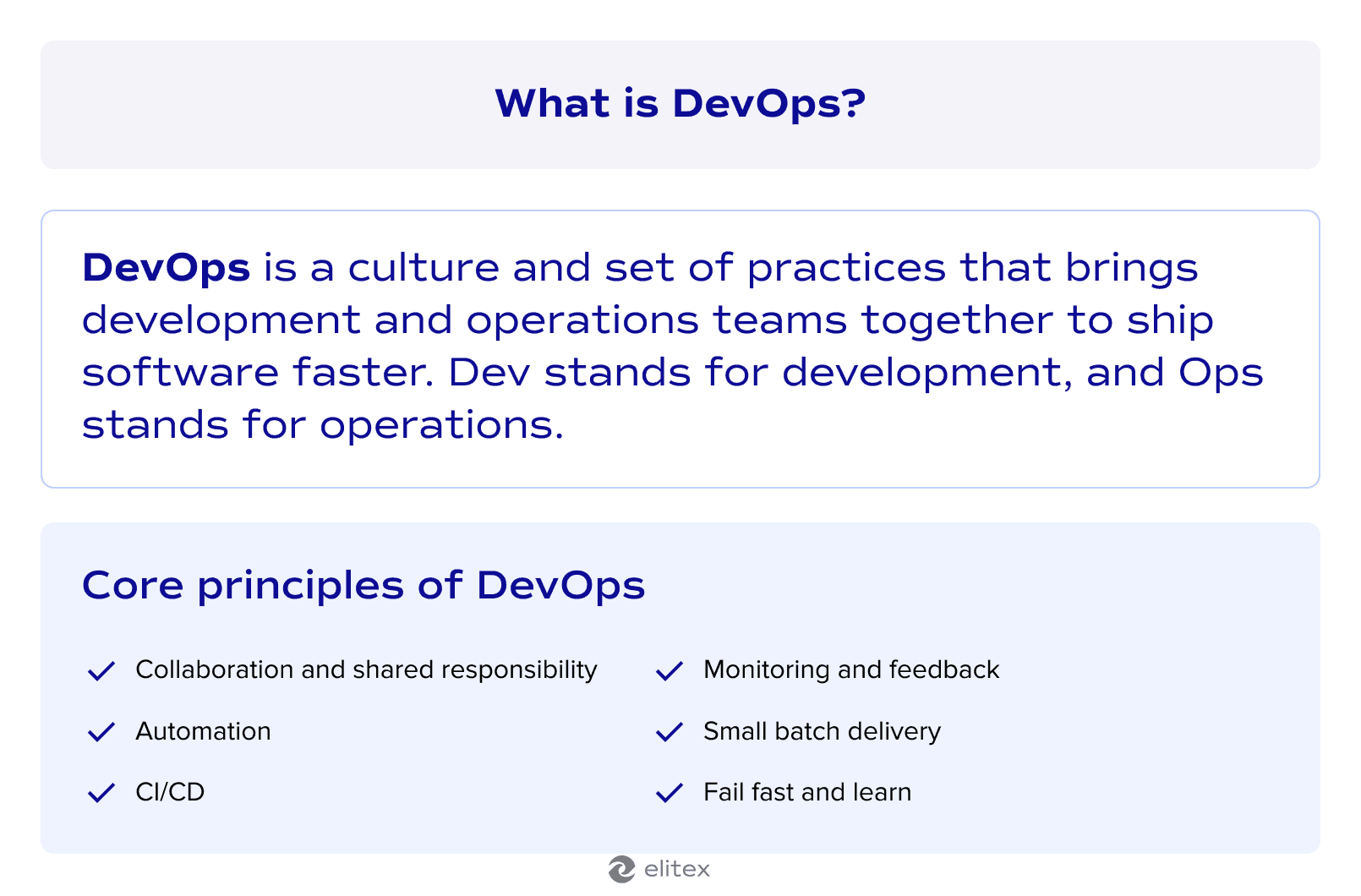
DevOps is a culture and set of practices that brings development and operations teams together to build and ship software faster. In its very core, DevOps consists of development (Dev) and operations (Ops), both working together as a single unit.
This approach focuses on eliminating the traditional wall between developers who write code and operations engineers who deploy it in the following way: DevOps uses continuous integration to merge code changes frequently and continuous delivery to automate deployments through pipelines. If this approach is implemented well, the result compresses the software development lifecycle from months to days.
Core Principles of DevOps
- Collaboration and shared responsibility: In the DevOps lifecycle, operations and development teams work together throughout the entire software development. The primary goal of this is eliminating silos that create additional bottlenecks and miscommunications between parts of the product teams;
- Automation: DevOps focuses on automating repetitive tasks in the development pipeline to reduce human errors and increase speed. DevOps automation typically includes areas such as testing, deployment, monitoring, alerting, infrastructure management, etc. Here we write a separate article about DevOps automation, so don’t hesitate to check it.
- Continuous integration (CI): CI merges code changes frequently to catch conflicts early. With the DevOps approach, teams typically integrate small changes multiple times per day rather than large batches once in a while.
- Continuous delivery (CD): Teams adopting DevOps keep software in a deployable state at all times. Every code change moves through automated testing and can reach production rapidly.
- Monitoring and feedback: DevOps fosters tracking application performance and user behavior in real-time. Fast feedback loops help teams identify and fix issues before they impact users.
- Fail fast and learn: DevOps endorses identifying problems early when they’re cheaper to fix. Development teams embrace failures as learning opportunities rather than blame sources.
- Infrastructure as Code: DevOps also endorses managing servers and environments through code rather than manual processes. It ensures consistency and reduces configuration drift.
- Customer-centric focus: Adopting DevOps typically means building features based on actual user needs and feedback. Delivering value to end users is prioritized over internal preferences.
Benefits of DevOps
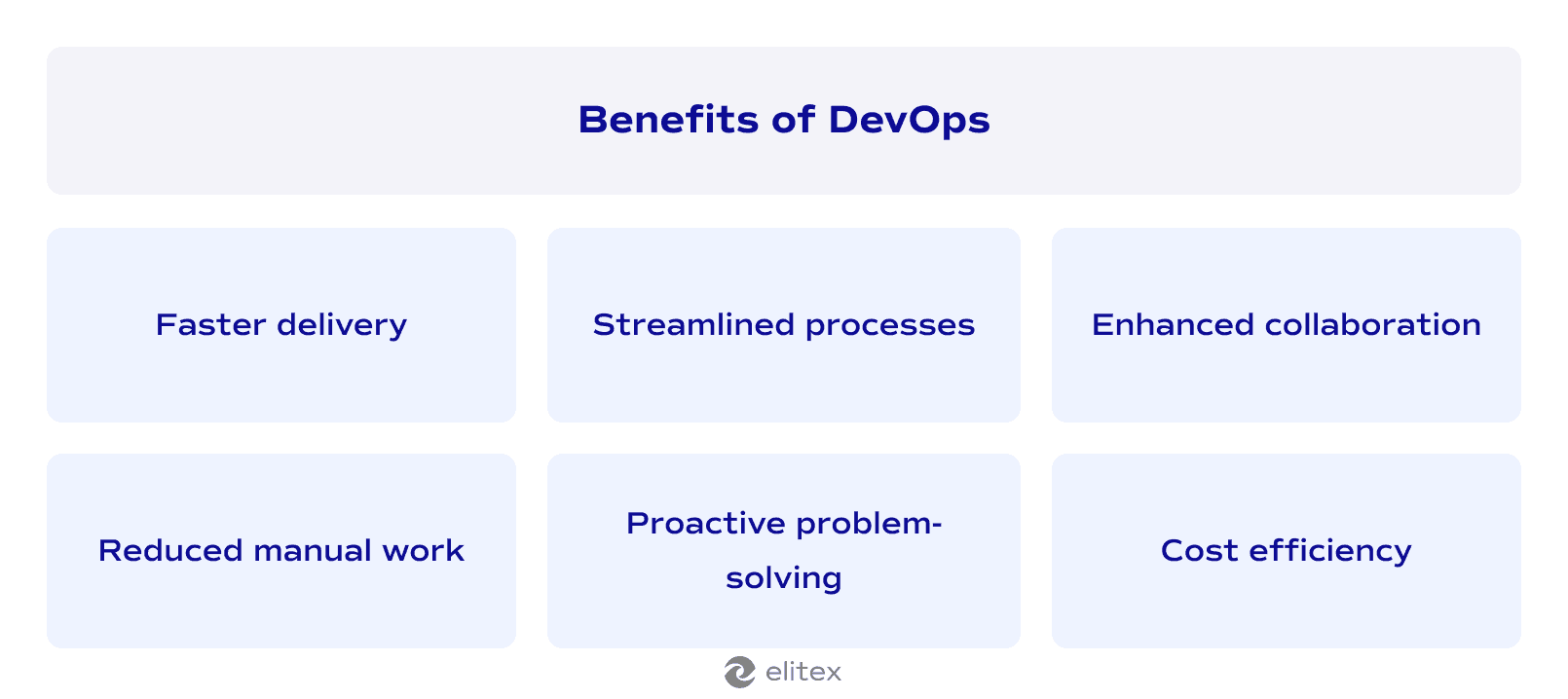
- Faster delivery: DevOps ecosystem enables faster deployments by automating the entire pipeline from code commit to production.
- Reduced manual work: DevOps reduces manual intervention through automated testing, deployment, and infrastructure management.
- Streamlined processes: DevOps streamlines the software delivery process by eliminating handoffs between development and operations teams.
- Proactive problem-solving: With DevOps, organizations adopt a proactive approach to identifying and fixing issues before they impact users.
- Enhanced collaboration: DevOps focuses on enhancing collaboration and improving communication. This plays a key role in breaking down silos.
- Cost efficiency: With DevOps, companies achieve significant cost savings through reduced downtime and more efficient resource utilization.
What is DevSecOps?
DevSecOps is basically DevOps plus security built into every step of the process, where Dev still stands for development, Ops for operations, and Sec for security. With DevSecOps, teams catch security issues early instead of discovering them in production. This approach maintains a constant focus on security without slowing down development speed. Security testing runs automatically alongside code deployment, making protection everyone’s responsibility rather than just the security team’s job.
Simply put, unlike DevOps, DevSecOps focuses on preventing security problems instead of fixing them later.
Core principles of DevSecOps
DevSecOps inherits most DevOps principles: collaboration and shared responsibility, automation, continuous delivery, monitoring and feedback, etc. But comparing DevSecOps vs DevOps principles, we’ll see that in the case of DevSecOps, security becomes a key component woven through every practice rather than bolted on at the end.
Here are some security-specific principles of DevSecOps:
- Shift left security: Security teams bring security processes into early development stages. It's often called DevOps shift left. With DevSecOps, problems get caught when they’re cheaper to fix.
- Security as Code: Security policies live in version control alongside application code. Teams manage security rules the same way they handle other configurations.
- Shared security responsibility: Under the DevSecOps paradigm, developers, operations, and security teams all own security outcomes. No single team carries the entire security burden.
- Automated compliance checks: With DevSecOps, compliance requirements run automatically in the pipeline. Every release meets regulatory standards without manual reviews. Read more in our article about specific healthcare compliance automation case.
- Continuous security monitoring: With DevSecOps, threat detection runs constantly alongside performance monitoring. Security alerts integrate into the same feedback loops teams already use.
- Threat modeling integration: With DevSecOps, teams identify security risks during design phases. This prevents security vulnerabilities instead of patching them after deployment.
Benefits of DevSecOps
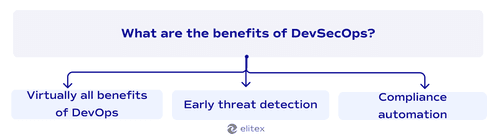
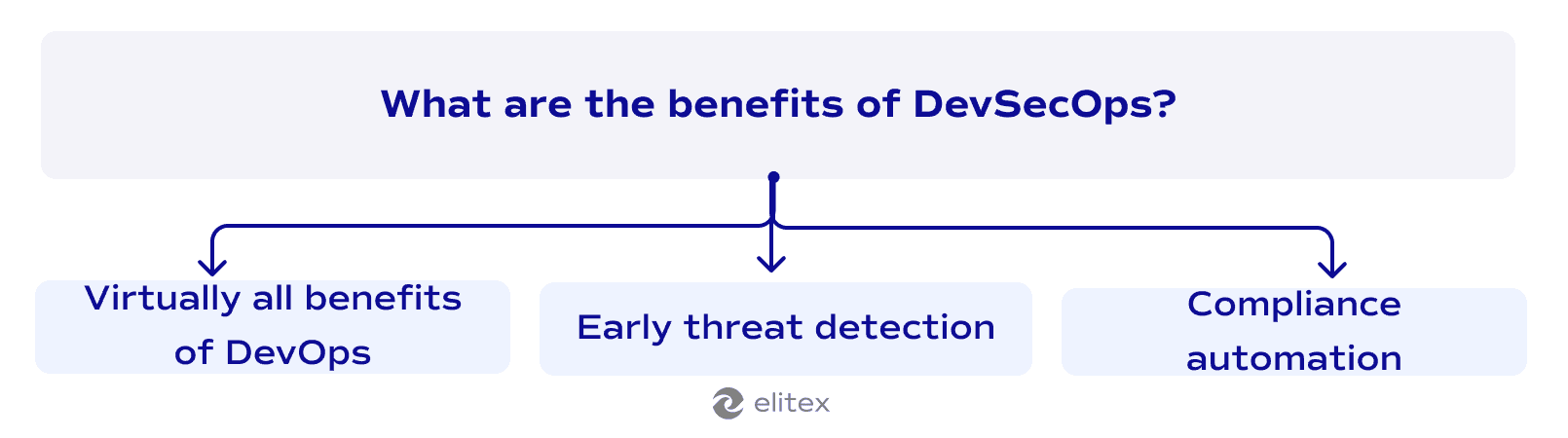
- Virtually all DevOps benefits: When implemented properly, DevSecOps delivers almost all the advantages of DevOps, including faster deployments, reduced manual work, and enhanced collaboration.
- Early threat detection: Security vulnerabilities get identified and fixed during development rather than after deployment.
- Compliance automation: Regulatory requirements become automated checks that run continuously throughout the pipeline.
Also, read our article about DevOps maturity level.
DevOps vs DevSecOps: Differences beyond security
| Aspect | Traditional DevOps | Traditional DevSecOps |
| Primary focus | Speed and operational efficiency | Security integration alongside speed and efficiency |
| Security approach | Security considerations postponed until the deployment phase | Security is baked into every stage of application development |
| Tool integration | Standard DevOps automation tools for CI/CD and deployment | Extended toolchain including security scanners and compliance platforms |
| Monitoring strategy | Performance and uptime tracking | Security threat detection plus performance monitoring through continuous monitoring |
| Team structure | Development and operations teams only | Security teams added to development and operations |
| Risk management | Operational risks and delivery bottlenecks | Security vulnerabilities and compliance failures prioritized in risk management |
| Cloud environments | Speed-optimized deployment to cloud environments | Security-hardened deployment with built-in controls for cloud environments |
| Development speed | Maximum velocity with minimal checkpoints | Security checkpoints that can slow initial deployment |
| Compliance | End-of-cycle manual reviews | Automated compliance throughout development pipeline |
| Cost structure | Minimal upfront investment | Significant security tooling and training costs |
| Ideal use cases | Internal tools and rapid market entry | Regulated industries and sensitive data applications |
| Learning curve | DevOps practices and culture | DevOps expertise plus security domain knowledge |
Juxtaposing DevOps vs DevSecOps: What derives from what?
DevSecOps derives directly from DevOps—it’s an evolution, not a revolution. DevOps emerged first around 2008-2009, establishing a DevOps culture that focuses on collaboration between development and operations teams. By 2012-2015, teams realized their software development process had a critical gap: security was getting left behind in the rush to deploy fast. DevSecOps solved this by taking all core DevOps practices—automation, CI/CD, collaboration—and adding integration of security throughout the DevOps pipeline. Instead of treating security as a final checkpoint, DevSecOps makes it everyone’s headache from day one:)
DevSecOps vs DevOps: How are things going in 2026?
But that’s all the theory. What do we, at ELITEX, see in practice in 2026?!
The lines between DevOps and DevSecOps have blurred significantly after more than a decade of evolution. These approaches have essentially merged in practice. Most DevOps specialists now possess security knowledge as a standard skill rather than a specialty add-on.
Security integration has become the default expectation rather than an advanced feature. Companies rarely need to choose between DevOps and DevSecOps anymore—they simply implement DevOps with security built in from the start. The original DevSecOps movement succeeded so well that its core principles now define modern DevOps practice. What once required dedicated security teams and specialized training has become part of standard developer and operations training curricula.
Also, with the wide spread of machine learning and AI development, MLOps, a special brunch of DevOps for ML projects aappeared (read more about it in our dedicated MLOps vs DevOps article)
Use cases: How DevOps and DevSecOps co-exist in real-life scenarios
Let’s see how the modern DevOps with integrated security looks:
Case #1: Digital publishing platform
STM Integrity Hub is a cloud-based platform that helps publishers screen manuscripts for research integrity violations. The platform maintains strict data privacy between competing organizations. The product team implemented a DevOps workflow using AWS microservices with Lambda functions. Deployment pipelines and DataDog monitoring tracked system health throughout development. Security requirements shaped each stage of development. Automated vulnerability detection and compliance monitoring were woven directly into the DevOps process. STM's case shows how security and speed work together seamlessly. Automated security tests run within deployment pipelines. Real-time threat detection operates alongside performance monitoring. This ensures both objectives are met without compromise.
Case #2: E-commerce platform
Smartrr is a subscription platform for DTC Shopify brands that transforms one-time buyers into brand champions. The platform uses integrated loyalty and analytics tools for this exact purpose. The product team’s approach to development involved migrating from monolithic architecture to Cloud Run microservices. They implemented automated scaling and created TypeScript-based administration DevOps tools for efficient software development. The DevOps approach strengthened database security and enhanced infrastructure protection. The platform shows how security and DevOps teams work toward common goals. Automated scaling operates alongside enhanced security protocols. This proves that robust protection and development speed strengthen each other rather than compete.
Case #3: AI startup
This healthcare AI platform automates insurance verification calls for medical clinics, eliminating manual phone processes that previously consumed hours of staff time. The product team’s approach to development involved implementing automated CI/CD pipelines, migrating to AWS ECS with Docker containers, and replacing manual SSH deployments with automated scaling capabilities for efficient software development. Security measures focused on HIPAA compliance requirements, implementing security hardening protocols, and enhanced monitoring systems to protect sensitive patient data throughout the infrastructure. The project shows how DevOps and security work together seamlessly - automated scaling operates within strict compliance frameworks, proving that healthcare regulations and development speed reinforce rather than conflict with each other.
Also read our recent article about DevOps in healthcare.
DevOps vs. DevSecOps: Which one to choose?
The choice between DevOps vs DevSecOps isn’t really a choice at all: DevOps and DevSecOps aren’t mutually exclusive. Modern software development demands both speed and security, making this debate largely academic. For everyone interested in DevOps services, the real question becomes finding a software development company with proven experience in building robust yet secure platforms cost-efficiently. This matters more than getting caught up in theoretical DevOps vs DevSecOps debates. Look for teams that understand your industry’s specific compliance requirements and can integrate security into development without sacrificing velocity.
At ELITEX, we don’t compare DevOps vs DevSecOps because we merge the best of them straight from day one of development. Our decade of experience in security check automation shows that DevOps and DevSecOps work best when combined seamlessly throughout the entire development process. At ELITEX, we know how to deliver security and speed cost-efficiently. Strong UI expertise, a decade of DevOps expertise, and a culture of honest and transparent collaboration make us an ideal candidate for your next project. Whether you’re building a strong HIPAA-compliant healthcare system or making your e-commerce platform GDPR-friendly, at ELITEX, DevSecOps consulting company, we know how to deal with it.
Contact ELITEX today to get the best from DevOps and DevSecOps for your project. Get the speed you need with the security you can’t afford to skip with the industry professionals!
FAQs
What is the difference between DevSecOps and DevOps?
The difference between DevSecOps and DevOps lies in security integration timing. DevOps focuses on collaboration between development and operations teams to accelerate software delivery. DevSecOps takes the same approach but weaves security throughout the entire development process from day one, rather than treating it as a final checkpoint. Both share identical automation and CI/CD practices, but DevSecOps makes security everyone’s responsibility instead of a separate team’s concern.
What are the main similarities between DevOps vs DevSecOps?
Both approaches prioritize collaboration between developers and operations teams within the same DevOps environment. They share identical automation principles, CI/CD practices, and monitoring strategies. Our DevOps vs DevSecOps comparison shows both use the same foundation for current workflow (as of 2025): breaking down silos, automating deployments, maintaining fast feedback loops, and emphasizing continuous improvement. The core difference between DevOps and DevSecOps is timing: traditional DevOps adds security at the end, while DevSecOps integrates it throughout, but both rely on the same collaborative culture and automation tools.
Is the transition from DevOps to DevSecOps possible?
It depends on what we're talking about. If you're a development team, you can absolutely shift the paradigm and adopt DevSecOps practices moving forward. However, if you're looking to change a project already under development, it's practically impossible. Traditional DevSecOps requires implementing security from the very beginning of the process, not retrofitting it later. The good news? These concepts are merging rapidly. Most DevOps specialists nowadays implement strong security standards throughout the development process by default, making the distinction less relevant in practice.
What is DevSecOps vs DevOps in terms of team structure?
Classical DevOps involves development and operations teams collaborating. DevSecOps adds security professionals to this collaboration, making security a shared responsibility across all team members from project start.
What’s the main difference in DevOps vs DevSecOps implementation?
DevOps implements security checks at deployment. DevSecOps builds security into every development stage. This difference in DevOps vs DevSecOps means vulnerabilities get caught earlier in the second case.
How do DevOps and DevSecOps handle compliance requirements?
DevOps handles compliance through manual end-stage reviews. DevOps and DevSecOps differ here - DevSecOps automates compliance checks throughout the pipeline, ensuring continuous regulatory adherence without slowing development.
POSTED IN: