



- TL;DR: Healthcare organizations struggle to meet HIPAA, SOC 2, HITECH, and GDPR requirements while maintaining rapid development cycles.
- Manual compliance consumes weeks of effort and creates bottlenecks that slow product delivery.
- DevOps culture and pipeline optimizations provide a foundation for sustainable compliance automation at scale.
- Healthcare compliance automation combined with DevOps embeds regulatory checks directly into development workflows, catching violations before production.
- This guide covers six steps to implement DevOps-based healthcare compliance automation to your project, from mapping regulations to pipelines to enabling continuous monitoring.
- We explore best practices for healthcare compliance automation and review industry-specific tools designed for healthcare.
- Also, we provide a case study dissecting a real-world example of healthcare compliance automation from our practice.
Every healthcare or health insurance organization struggles with a familiar problem: meeting strict regulatory standards while delivering quality patient care. Regulations like HIPAA, HITECH, SOC 2 Type II, and GDPR create constant headaches for development teams who face them daily, especially for teams stuck in manual processes.
In case your development team fully understands this headache, healthcare compliance automation may be a solution. It embeds the regulatory requirements directly into development workflows, catching violations before they reach production. With automation, you get consistent adherence without the manual overhead.
There are different approaches to healthcare compliance automation. But as experts in DevOps automation services and solutions, we, at ELITEX, believe that adoption of DevOps culture and development/delivery pipeline optimization already creates the solid foundation for any sustainable automated compliance at scale.
Why healthcare compliance needs automation
Modern healthcare systems generate massive volumes of sensitive patient data. This information contains medical histories, treatment plans, insurance details, and genetic profiles that require strict protection under regulations like HIPAA. Traditional IT security measures fall behind when deployment cycles accelerate and threat patterns shift.
DevOps-based healthcare compliance automation embeds security and compliance checks directly into your development process. With DevOps, development teams catch configuration drift, access control gaps, and data exposure risks at the coding and testing stage. It allows them to fix problems before deployment, not after. Manual audits became only the backup verification method, not the primary defence, saving weeks of review time while strengthening overall security posture.
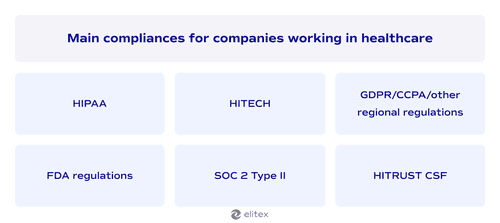
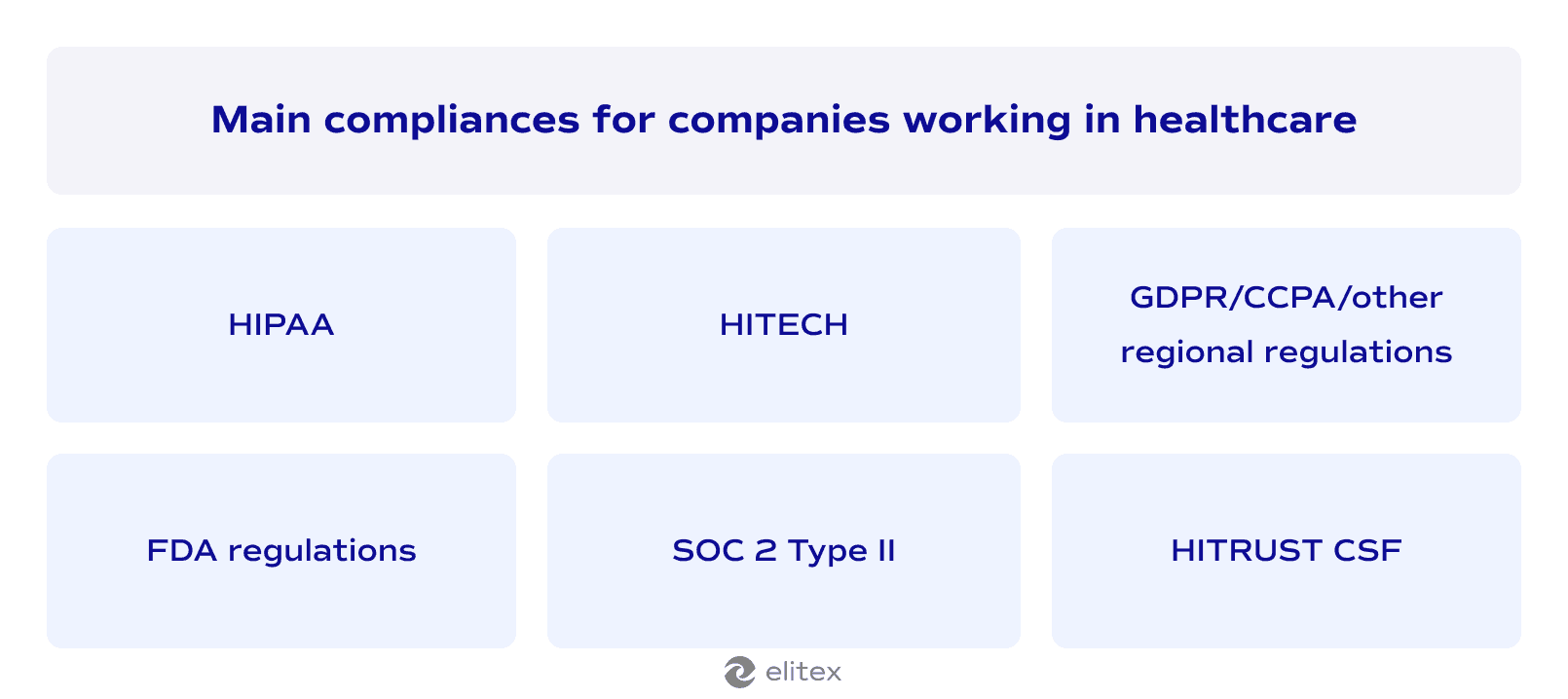
Here’s the list of the most common regulations and compliances for companies working in the healthcare industry:
Now, let’s see why manual audits aren’t the best choice for complying with these regulations.
Challenges of manual audits
- HIPAA. The alpha and omega of healthcare compliance. Manual HIPAA audits require teams to document every access control, encryption method, audit log, and data handling procedure across your infrastructure. With manual processes, you spend weeks preparing audit trails, tracking who accessed what patient data, and proving your security measures meet technical safeguard requirements. In the case of HIPAA, even a single missing log file or undocumented configuration change can trigger a compliance violation.
- HITECH. HITECH adds breach notification requirements that manual processes are simply unable to track. Under the HITECH regulations, your team needs to identify every potential breach within specific timeframes, document the scope of exposed data, and notify affected patients. Unlike DevOps observability, manual monitoring makes it hard to catch unauthorized access patterns quickly enough to meet reporting deadlines.
- GDPR/CCPA/other regional regulations. This kind of regulation demands records of data processing activities, consent management, and the ability to delete user data on request. Manual compliance becomes almost impossible when you factor in the variety of regional privacy regulations, such as CCPA in California, GDPR in Europe/UK, LGPD in Brazil, and others, that each have different requirements for data residency, transfer mechanisms, and user rights.
- FDA Regulations. FDA compliance for medical devices and software requires extensive documentation of your development process, testing procedures, and change control mechanisms. In the case of the FDA, manual audits mean recreating paper trails for every code change, proving validation testing occurred, and demonstrating traceability between requirements and implementation.
- SOC 2 Type II. SOC 2 audits examine your security controls over a specific period, requiring continuous evidence collection. Manual processes force you to gather screenshots, export logs, compile reports, and track control changes that prove your controls operated effectively throughout the audit period. Most SOC 2 Type II auditors expect to see automated evidence, not spreadsheets.
- HITRUST CSF. HITRUST combines requirements from multiple frameworks, creating over 100 control objectives that your team needs to validate. Manual assessments mean cross-referencing controls against HIPAA, NIST, ISO, and PCI DSS standards simultaneously. The annual reassessment process becomes a full-time job for compliance staff who manually verify each control still functions as documented.
The best choice for most of these regulations is to embed compliance automation directly into your development pipeline. Healthcare compliance automation with DevOps lets you validate your controls continuously instead of scrambling before audit deadlines.
Step-by-step guide: How to automate healthcare compliance with DevOps
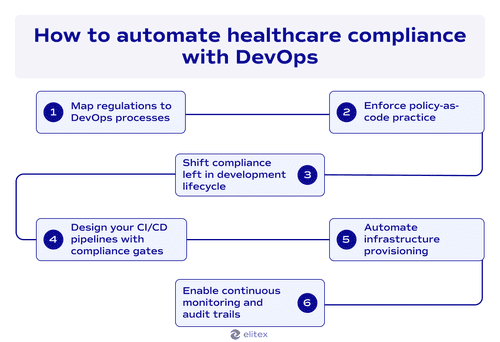
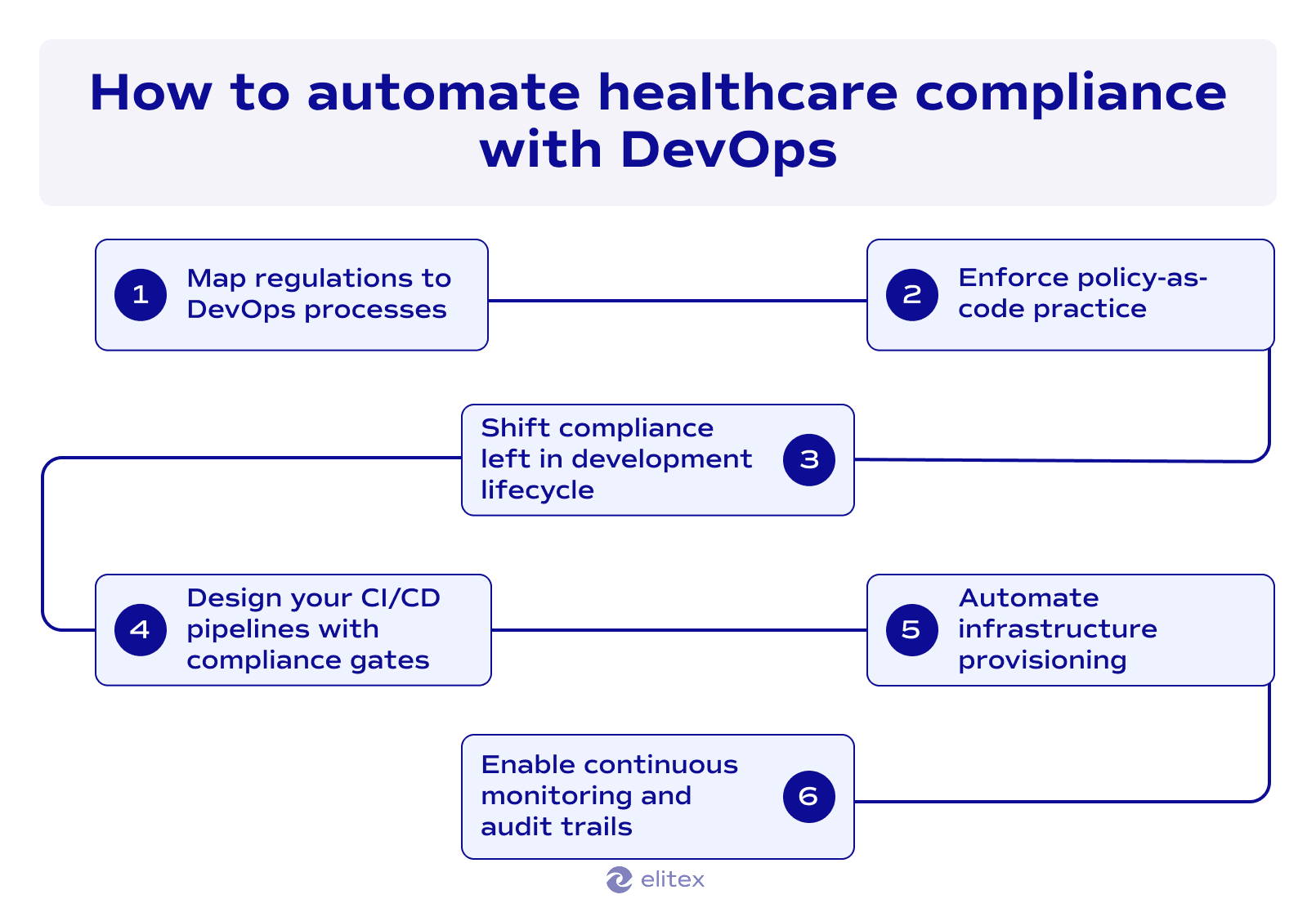
However, healthcare compliance automation through DevOps requires a well-structured approach. You can’t just add a few security tools and call it done. Here’s how we, at ELITEX, break down an average automation integration process into six steps:
Map regulations to DevOps processes
The very first step is always towards understanding which exact regulations you need to comply with and what they mean. We’ve previously covered HIPAA, HITECH, GDPR, FDA, SOC 2 Type II, and HITRUST CSF, as these compliance frameworks are the most common ones. Your team needs to identify which ones apply to your specific context. However, remember that different regulations demand different technical implementations, and trying to automate everything at once leads nowhere.
Once you know your compliance frameworks, break down each framework into a list of clear requirements that consist of one or two simple steps. Then, map each specific requirement to a specific DevOps process stage. Eventually, DevOps healthcare compliance connects audit readiness requirements to actual pipeline steps where validation happens. For instance, HIPAA requires encrypted standards to be checked during build time. Access control requirements for various regulations should be validated before deployment. Data retention policies should be enforced through automated backup procedures.
Such a mapping creates a clear picture of where compliance checks fit into your existing workflows. This, in turn, makes audit readiness part of your daily operations, not a separate burden.
Enforce policy as code
Policy as code in healthcare defines your compliance requirements as executable rules that run against your infrastructure. Your team writes policies specifying encryption standards, access controls, network boundaries, and data handling rules. These policies validate configurations during deployments and scan running systems for drift. When violations occur, the system blocks changes or alerts your teams depending on pre-defined severity thresholds. Later, auditors can review the policy code itself as documentation of your compliance standards.
Shift compliance left in the development lifecycle
After mapping regulatory requirements to your automated DevOps pipeline and building policy as code approach, the next step points towards moving security controls earlier in development. Shifting left means developers check compliance during coding without waiting for pre-deployment audits. Now, your team should run automated scans validating encryption implementation, test access permissions, check authentication configurations, and verify data handling practices, all while writing code. Early detection improves your security posture because problems get resolved before they compound across multiple deployments or reach production systems, where regulatory requirements become harder to retrofit.
Build your CI/CD pipeline with compliance gates
Shifting left sets the foundations, but your pipeline still needs enforcement mechanisms to automate healthcare compliance at scale. Compliance gates block deployments that fail security or regulatory checks. With these compliance gates, your CI/CD pipeline becomes a checkpoint system where code must pass validation before moving to the next stage.
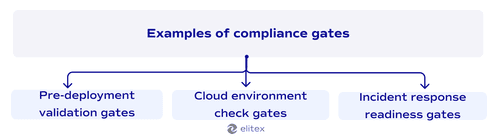
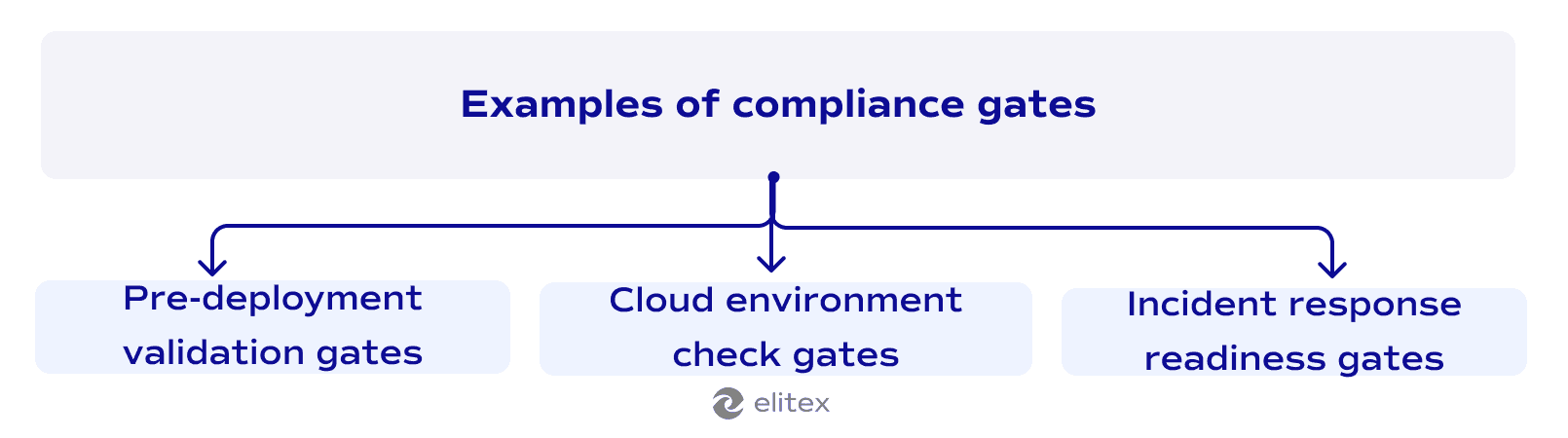
- Pre-deployment validation: In pre-deployment, gates act as enforcement checkpoints that block code from advancing through your pipeline stages. When tests fail security thresholds or detect regulatory violations, the deployment stops automatically. Your team fixes issues in the current environment rather than rolling back from production, which reduces the blast radius of compliance issues and keeps violation costs down
- Cloud environments check: In most cases, you should also validate configurations specific to cloud environments. Create gates that verify that network segmentations, storage encryption, backup procedures, and logging mechanisms are properly configured. With cloud environment gates, misconfigured cloud resources get caught before they expose patient data or create compliance gaps.
- Incident response readiness: Here, gates should confirm that incident response procedures are configured and accessible throughout your infrastructure. They check alert routing, notification systems, breach detection mechanisms, and escalation paths work as documented. Deployments without proper incident response capabilities get blocked until the team fixes the gaps.
Automate infrastructure provisioning
Infrastructure automation implementation is one of the important parts of the DevOps culture. In our case, infrastructure-as-code for healthcare compliance means your servers, databases, networks, and storage get deployed from templates that already embed compliance policies. Your team defines infrastructure configurations once, validates them against regulatory requirements, and then reuses these approved templates across your environments.
Manual infrastructure setup creates configuration drift where the production environment diverges from documented standards. Automated provisioning eliminates this drift because every deployment uses the same tested configuration. Your infrastructure becomes reproducible and auditable by default, which cuts preparation time when auditors ask how your systems meet data protection requirements.
Enable continuous compliance monitoring and audit trails
Then, the last step is the implementation of real-time monitoring. This monitoring tracks every system interaction, user access attempt, data query, and infrastructure change as events happen. With it, your team gets real-time visibility into security patterns that manual reviews miss, like repeated failed login attempts or unexpected data transfers. Continuous risk assessment analyzes these events to flag potential breaches or policy violations while response options remain available. Continuous compliance reporting pulls directly from these automated logs instead of requiring manual evidence gathering. With real-time monitoring, auditors query your infrastructure history through centralized dashboards rather than waiting for compiled reports.
Best practices for healthcare compliance automation
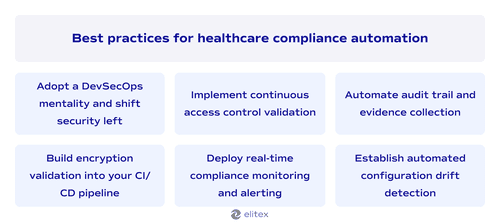
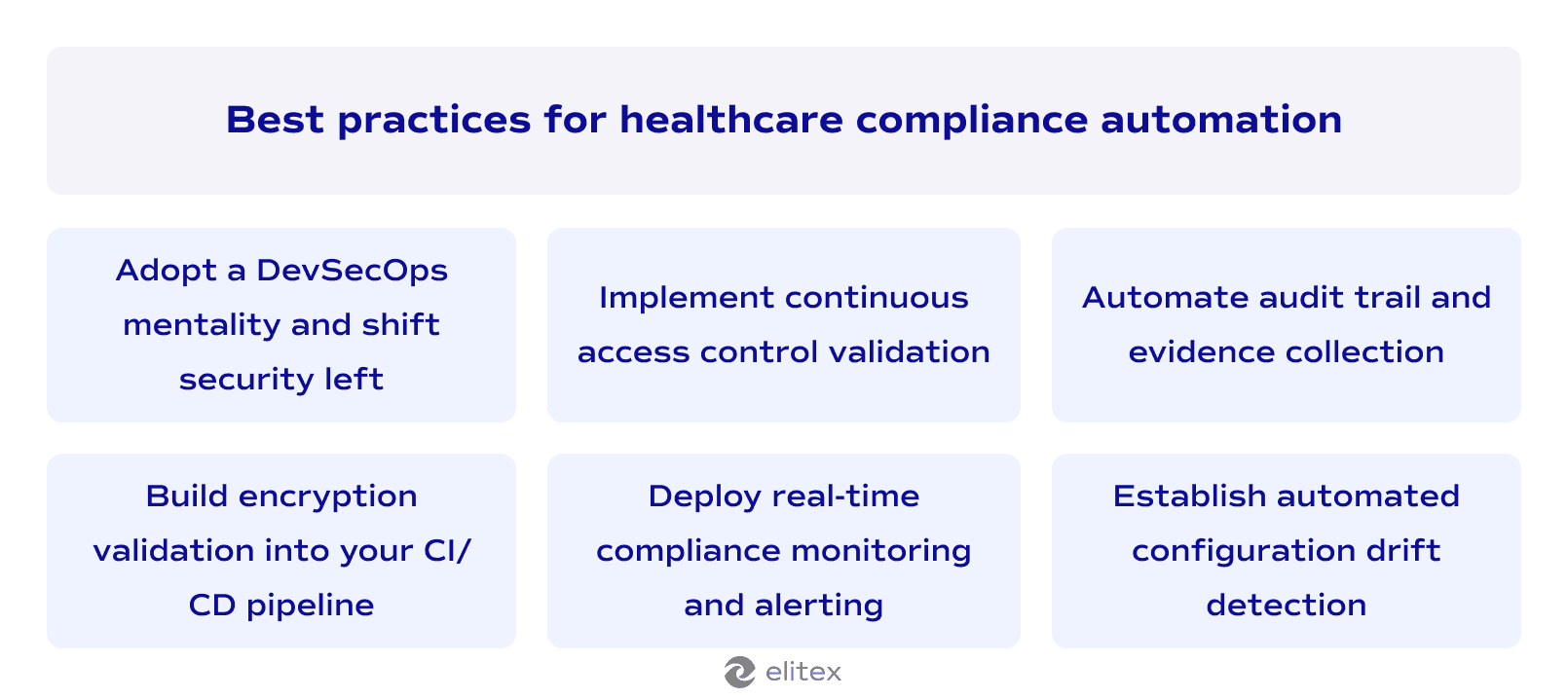
- Adopt a DevSecOps mentality and shift security left: Shift security left by integrating regulatory controls into the earliest development stages, just as written above. Pay special attention to the DevSecOps approach (we’ve explained it in detail in our DevSecOps vs DevOps comparison).
- Implement continuous access control validation: Test who can access data, especially health information, with every deployment. Design your system so that automated checks verify that permission levels match regulatory requirements. Build a system where unauthorized access attempts trigger immediate alerts.
- Automate audit trail and evidence collection: ELITEX recommend setting up automation software (connect Vanta/Drata/Secureframe to your CI/CD through native integrations with GitHub, GitLab, or Azure DevOps—we’ll return to it in the following sections) that captures compliance proof automatically as code moves through your pipeline. This automated evidence collection eliminates tonnes of manual documentation work. As a result, audit management fades into the background.
- Build encryption validation into your CI/CD pipeline: Your development team should check encryption standards during build and deployment phases. If code stores or transmits unencrypted patient data, the pipeline rejects it outright. This is a good example of how DevOps helps with HIPAA compliance, blocking violations before they reach the production environment.
- Deploy real-time compliance monitoring and alerting: Real-time monitoring is of utmost importance. Beyond typical DevOps monitoring, you should set up dashboards that track compliance status across your infrastructure. When configuration drifts from approved baselines, your teams receive instant notifications. This means risk assessment happens continuously, not quarterly.
- Establish automated configuration drift detection: Configuration drift is a big headache in any compliance automation. Build automated checks that compare current configurations against approved templates. When drift occurs, the system triggers automatic remediation or blocks deployments until your teams review changes. This creates a feedback loop where developers learn from real violations in their own code.
Tools and software for healthcare compliance automation
Now, let’s speak about the software that helps with compliance automation in healthcare. Let’s broadly divide this software into two categories: specific DevOps tools for automation and specific healthcare compliance software.
Let’s start with proper DevOps tools. There are a myriad of available DevOps tools for automation that handle various tasks across the development pipelines in 2026. Modern DevOps tools automate CI/CD processes, infrastructure provisioning, configuration management, testing, security, monitoring, and other aspects of your pipeline. GitHub Actions and Jenkins manage continuous integration. Terraform and Ansible provision infrastructure. Kubernetes orchestrates containers. Prometheus and Grafana monitor system health. Here, in our dedicated article, we covered 22 essential DevOps automation tools in detail, breaking down their features, scope of use, and integration capabilities across several core categories. These tools help you build automation systems and drive DevOps transformation for your development workflow.
However, the real art begins when you’re combining the aforementioned DevOps automation tools with compliance automation software, which addresses the specific challenge of meeting regulatory requirements like HIPAA. These platforms track security controls, generate audit evidence, and monitor configuration changes automatically. Here are three compliance automation platforms designed for healthcare developers:
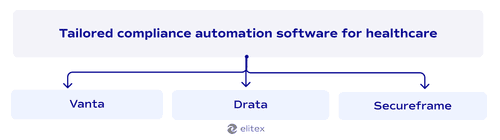
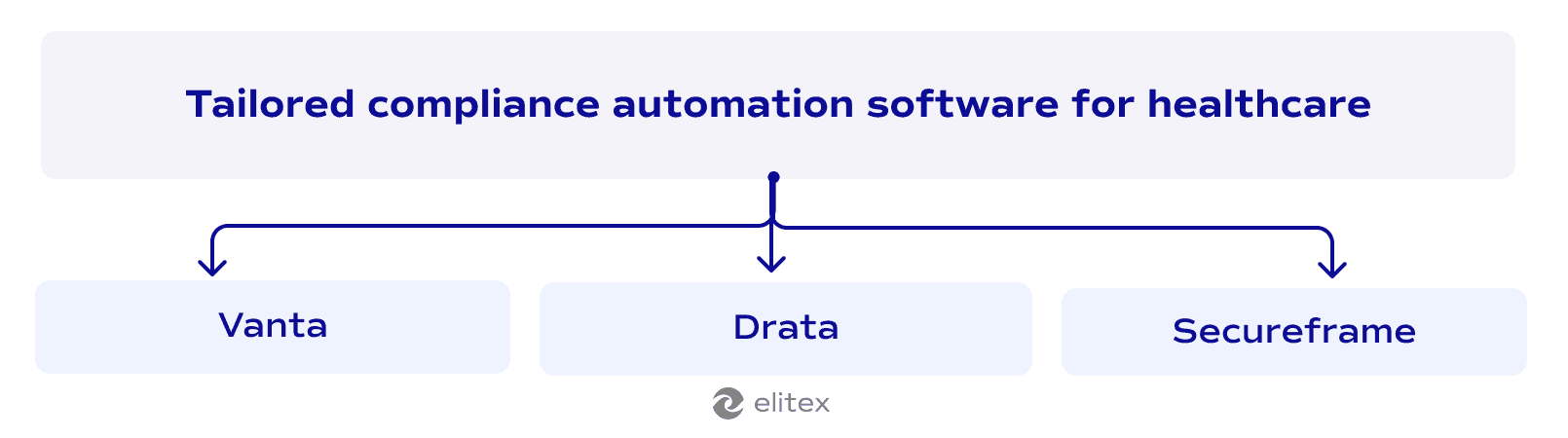
- Vanta: This compliance automation platform connects to your infrastructure and continuously monitors security controls. It generates audit-ready reports and helps teams automate HIPAA compliance through automated evidence collection.
- Drata: Drata maps your technical infrastructure to compliance frameworks. The platform runs continuous checks and alerts teams when controls drift from approved baselines.
- Secureframe: This tool integrates well with version control and other DevOps tools to track compliance status in real time. It automates evidence gathering and reduces manual audit preparation from weeks to days.
Use case of DevOps in healthcare
Now, let’s take a look at our recent practical case of healthcare compliance automation with DevOps.
One of our latest clients, Standard Practice, demonstrates exactly how secure DevOps automation handles healthcare compliance challenges. Their platform processes dozens of thousands of calls weekly and handles sensitive patient data, which triggers strict HIPAA and SOC 2 Type II requirements. The company faced a critical bottleneck: their existing infrastructure relied on manual deployments through SSH connections, which created compliance gaps and slowed their ability to scale. Every code required manual intervention, and the system lacked automated security validation.
ELITEX embedded compliance gates directly into Standard Practice’s CI/CD pipeline during an infrastructure overhaul (implementing compliance-as-a-policy to be more precise). We built automated checkpoints that validate HIPAA encryption standards, test access control, verify data handling procedures, and confirm audit logging mechanisms before any code reaches production. These gates block deployments that fail security thresholds.
Additionally, ELITEX migrated Standard Practice’s services to AWS ECS, implemented automated scaling, and established three separate pipeline environments for development, staging, and production. Each environment runs the same compliance validation checks, which caught configuration drift and access control issues during testing rather than after deployment. The result eliminated manual security reviews and reduced their compliance preparation time while maintaining continuous audit readiness.
As a result: The DevOps transformation delivered 100x faster deployment cycles, cutting release time from hours to minutes. Manual compliance preparation dropped from weeks to days through automated evidence collection. Infrastructure costs decreased through resource-based pricing instead of fixed instances. The platform now handles traffic spikes without manual intervention, and Standard Practice achieved full HIPAA compliance with continuous audit readiness built into every deployment.
Conclusion on how to automate healthcare compliance with DevOps
Healthcare compliance automation through DevOps solves the challenge of meeting HIPAA, SOC 2, HITECH, GDPR, and other compliance requirements. The DevOps-based approach embeds security checks directly into your development pipeline, automating audit evidence. In today’s article, we divided the implementation of the DevOps-based compliance automation approach into six steps and described each in detail. DevOps, especially when combined with the right compliance automation software, gradually cuts audit preparation time, strengthening your security posture.
However, building a DevOps pipeline with integrated healthcare compliance automation requires deep technical expertise. With a decade of successful presence in the tech market and industry-specific experience, ELITEX offers DevOps consulting services focused on healthcare compliance automation. Whether you need to automate HIPAA compliance, reduce manual oversight, or implement complex CI/CD automation that integrates regulatory controls into your workflows, we can handle it! By choosing ELITEX, you choose a tech partner that drives results beyond initial expectations. Contact ELITEX today to discuss your project and receive a free consultation from our DevOps experts!
FAQ
What is compliance automation in healthcare?
Compliance automation in healthcare is the practice of embedding regulatory checks directly into development workflows. It helps development teams in the healthcare industry validate security controls, generate audit evidence, and monitor configurations automatically. Such an approach catches violations before the deployment stage and eliminates manual compliance documentation work.
How does DevOps help with HIPAA compliance?
DevOps can help with HIPAA compliance by embedding automated security checks throughout your CI/CD pipeline. This approach validates encryption standards and access permissions at different pipeline stages while generating audit trails automatically. This catches violations early when they’re easy to fix.
What are the main tools for automating HIPAA compliance?
There are two main categories of software tools that can help you with HIPAA requirement compliance automation: DevOps tools for automation, and highly specific compliance automation tools. From the DevOps side, it can be GitHub Actions, Jenkins, Grafana, Datadog, Kubernetes, Prometheus, Terraform, and dozens of others, while as for specialized platforms, we, at ELITEX, would recommend tools like Vanta, Drat, and Secureframe.
Can CI/CD pipelines for compliance automation block non-compliant code?
Yes, absolutely. Compliance gates stop deployment that fails security checks. When code violates regulatory requirements, the pipeline blocks advancement. That’s how it usually works.
What healthcare compliance automation software should I use?
Combine compliance-specific software like Vanta, Drata, and Secureframe with popular DevOps tools, like GitHub Actions, Jenkins, Grafana, Datadog, Kubernetes, Prometheus, or Terraform. Together, these platforms will both provide a decent level of automation and guarantee compliance.
How does DevOps and healthcare compliance integration prevent data breaches?
DevOps and healthcare compliance integration prevents data breaches through continuous monitoring that identifies unauthorized access patterns. Automated alerts notify teams immediately when issues arise. Configuration drift detection stops unauthorized changes before they expose patient data.
How long does it take to implement DevOps-based compliance automation?
Implementation time varies depending on infrastructure complexity and regulatory scope. Basic CI/CD integration with simple compliance gates takes 2-3 weeks. Full automation with monitoring, implementing a policy-as-code approach, and continuous validation typically requires several months, but experienced DevOps teams like ELITEX accelerate this timeline.
POSTED IN: