

- TL;DR: In this article, we'll talk about continuous compliance and how it differs from periodic audits
- You'll learn why it matters for your security posture, legal exposure, and team sanity
- We'll break down the six core components that make a continuous compliance framework work
- You'll see how the automation operates under the hood, step by step
- We'll walk you through a practical 6-step implementation guide
- You'll understand where continuous compliance fits into the DevSecOps lifecycle
- We'll cover common pitfalls that derail compliance automation projects
- And we'll share how ELITEX approaches continuous compliance for clients across regulated industries
Most software compliance workflows still depend on periodic audits and manual evidence collection. In practice, it means that by the time a gap surfaces, it has already been sitting in production for weeks. Continuous compliance is an approach that changes this equation. It embeds policy checks directly into the development pipeline, so violations get caught at the moment they appear. The result is a compliance posture that stays current without requiring teams to pause their work for audit prep.
At ELITEX, we approach this topic from the engineering side. Our DevOps automation services focus on building infrastructure where compliance controls operate as code, triggered automatically with every deployment. That perspective shapes this article. We won't be talking about compliance as a legal checkbox exercise. We'll walk through the technical architecture, the implementation process, and the mistakes that trip teams up when they try to automate compliance for the first time.
What is continuous compliance?
Continuous compliance is an approach to software development that validates regulatory requirements automatically at every stage of the delivery pipeline. In a traditional setup, teams check compliance at fixed intervals, often quarterly or annually. That gap between audits creates blind spots where compliance issues can accumulate unnoticed. Continuous compliance eliminates that delay by embedding policy checks into every stage of the development lifecycle. So every code change and every deployment gets evaluated against the applicable rules before anything moves forward.
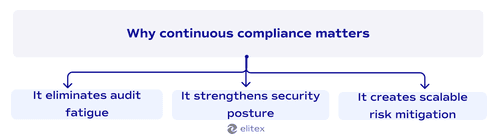
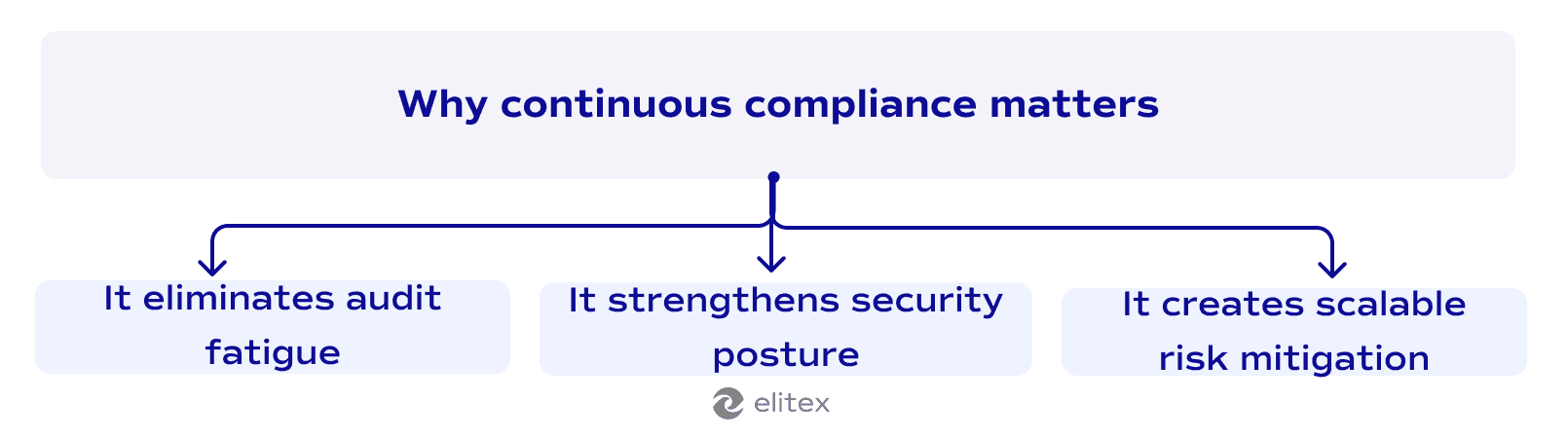
Why continuous compliance matters
However, the importance of continuous compliance goes beyond just passing audits. This approach completely changes how teams handle risk and daily security operations. And here are the key reasons it matters:
Eliminating audit fatigue
Anyone who has lived through a SOC 2 or ISO 27001 audit knows the drill. Weeks of scrambling to gather evidence, reconstruct timelines, and prove that controls were actually in place. Audit fatigue burns out compliance teams and pulls engineers away from product work. Continuous compliance removes that scramble entirely. Evidence collection happens automatically with every pipeline run, so when an auditor asks for proof, it already exists in a structured, exportable format.
Stronger security posture through automated monitoring
When compliance checks run manually, security gaps can persist for months between reviews. Automated monitoring brought by automated compliance checks closes this window. Every configuration change, every access policy update gets evaluated in real time against your compliance standards. That means misconfigurations get flagged within minutes, not during the next scheduled audit. Your security posture stays current because the system never stops watching.
Risk mitigation that actually scales
Periodic compliance creates a false sense of safety. You pass an audit in January, and by March, your environment has drifted in ways nobody has documented. Continuous compliance turns risk mitigation into a background process. Policy violations surface the moment they occur, and your team can respond while the context is still fresh. As your infrastructure grows, automated checks scale with it. Manual reviews do not.
Core components of continuous compliance
Practically, any continuous compliance framework breaks down into 6-8 core components. Each one addresses a different layer of the compliance lifecycle, from writing rules to proving you followed them. Let’s take a look at the simplest model with 6 core components:
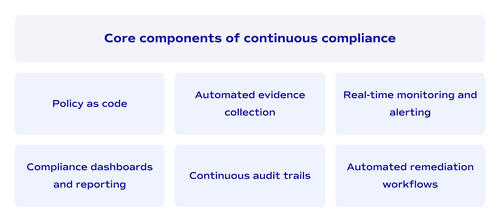
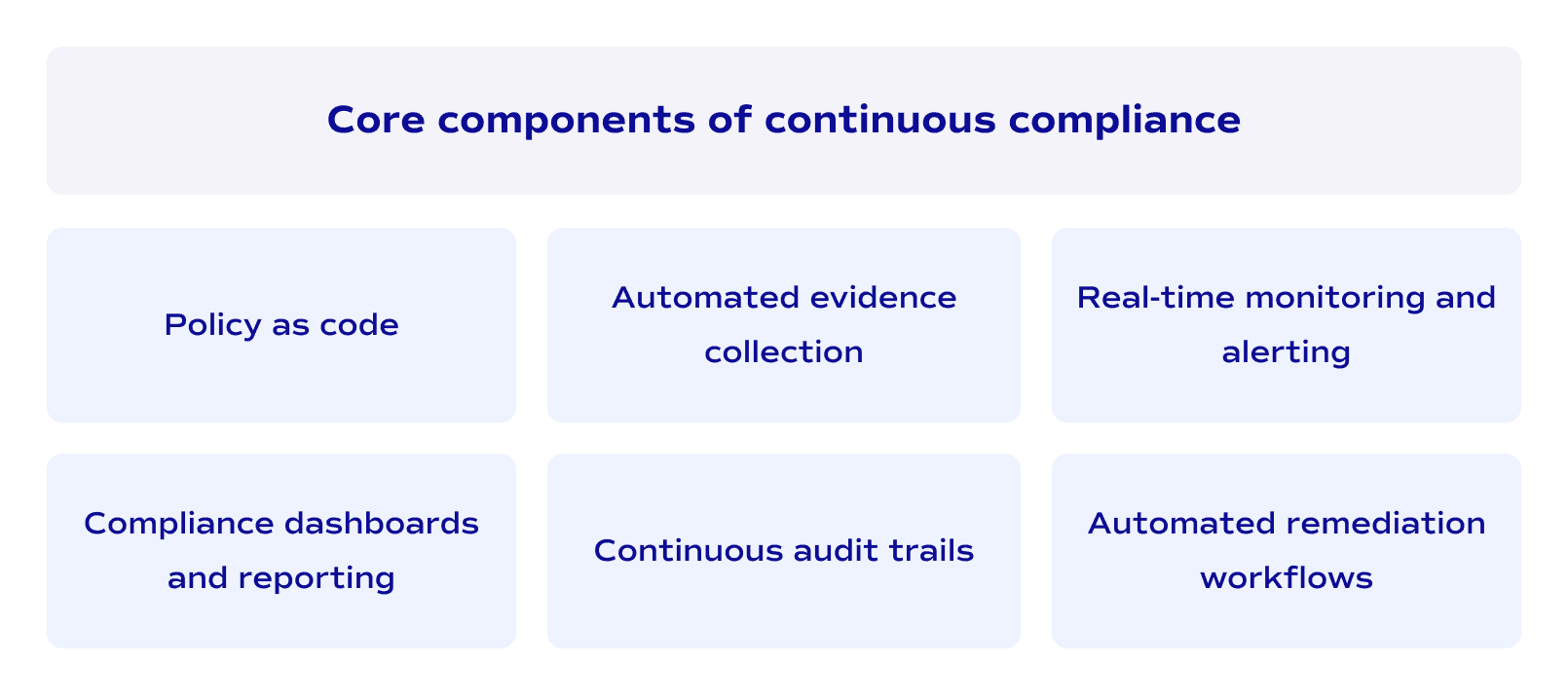
Policy as code
This is the foundation. Policy as code means translating regulatory compliance requirements and internal policies into machine-readable rules that execute automatically inside your pipeline. So when a developer pushes a change that violates an encryption standard or exposes a storage bucket publicly, the pipeline catches it before deployment. No Slack message to the security team. No ticket in a backlog that sits for two sprints. The violation gets blocked at the source. Writing policies as code also makes them version-controlled, peer-reviewed, and testable, which means your compliance logic goes through the same rigor as your application logic.
Automated evidence collection
Auditors don't care what you say you did. They care what you can prove. Automated evidence collection captures every relevant event, every approval, every test result, and stores it in a structured format tied to specific pipeline runs. That eliminates the weeks of forensic reconstruction that teams typically go through before an audit. It also improves operational efficiency because engineers stop spending time screenshotting dashboards and copying logs into spreadsheets.
Also, read our article about healthcare compliance automation with DevOps
Real-time monitoring and alerting
Continuous compliance monitoring, briefly mentioned in previous sections, means your systems are being watched around the clock. The importance of continuous compliance monitoring becomes clear when you consider the alternative: learning about a violation weeks after it happened, when the context is gone, and the damage is done. Real-time monitoring tracks configuration drift, permission changes, and user activities across your infrastructure. When something deviates from your baseline, alerts fire immediately. This is where risk management shifts from reactive to proactive. You learn about security risks while they're still containable, not after a data breach has already made them expensive.
Also, read our article about DevOps observability
Compliance dashboards and reporting
Leadership and auditors need visibility into your compliance posture without digging through logs. Dashboards aggregate the output of your continuous compliance framework into a view that shows current status, historical trends, and outstanding findings. Good reporting also highlights where regulatory practices are maturing and where gaps remain. For teams operating under multiple compliance standards, dashboards become the single place where you can assess your position across all of them at once. You can see whether your posture is improving quarter over quarter or quietly degrading between reviews. That visibility turns compliance from a binary pass/fail event into something your team can actively manage, and it gives leadership the confidence that data breaches aren't hiding behind outdated audit results.
Continuous audit trails
Audit trails document who did what, when, and why. In a continuous compliance setup, these trails generate themselves. Every deployment, every approval, every rollback gets logged automatically with full context. That record becomes your proof of regulatory compliance during external audits. It also serves an internal purpose. When an incident occurs, your team can trace the exact sequence of changes that led to it without relying on anyone's memory.
Automated remediation workflows
Catching a violation is only half the job. Automated remediation takes the next step by either fixing the issue directly or routing it to the right team with full context attached. A misconfigured security group can be reverted automatically. A more nuanced policy violation can trigger a structured workflow that assigns ownership and tracks resolution. This keeps your compliance posture tight without creating a bottleneck where every finding waits for manual triage.
How continuous compliance automation works
So now that we've covered the building blocks, let's see how continuous compliance automation works in practice. Here's what the process looks like from the moment code enters the pipeline to the moment a report lands on your dashboard.
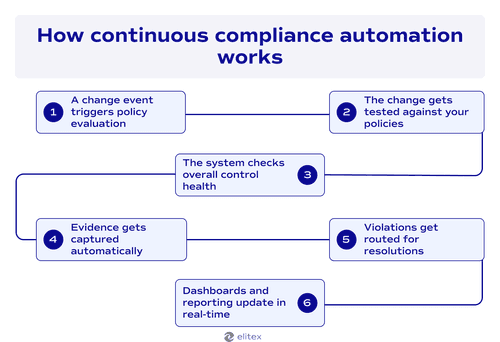
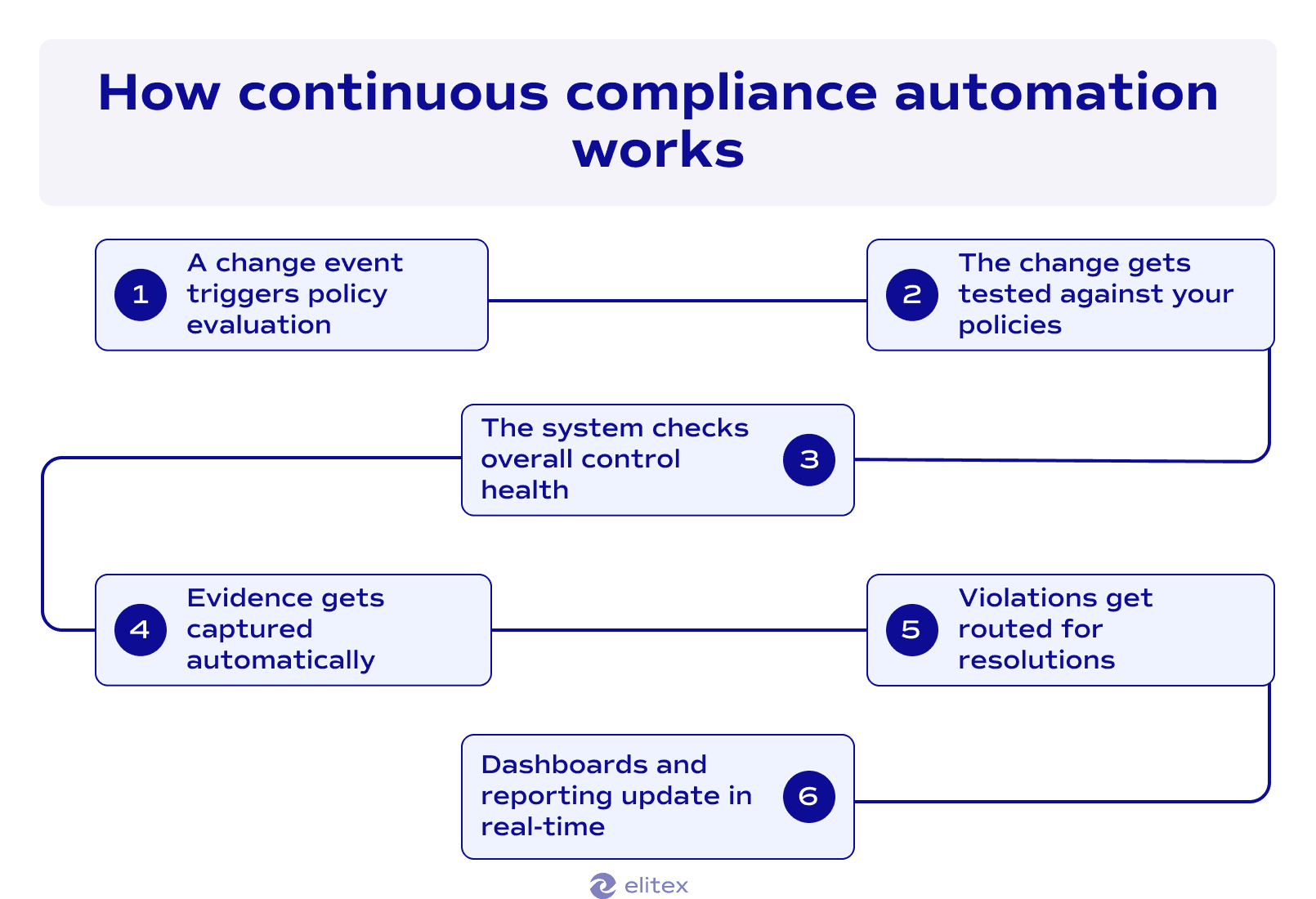
Step 1: A change event triggers policy evaluation. Whenever a developer pushes code, modifies an infrastructure configuration, or updates access permissions, that action generates an event. Continuous compliance tools, the platforms that tie your pipeline to your compliance rules, pick up that event and start evaluating it. It’s like a checkpoint that activates every time something moves.
Step 2: The change gets tested against your policies. This is where continuous compliance testing happens. Earlier, we talked about policies written as code. Now those policies do their job. The system runs the change through every relevant rule. If your regulatory standards require encryption on all storage resources and the new configuration skips it, the test fails. The change gets blocked right there in the pipeline, before it ever reaches production.
Step 3: The system checks overall control health. A single change can affect your broader compliance posture in ways that aren't obvious at first glance. Continuous compliance management accounts for that by evaluating how each event interacts with your existing controls. A new IAM role might pass its own policy test but create a privilege escalation path when combined with an existing role. This step catches such cascading effects.
Step 4: Evidence gets captured automatically. Every evaluation produces a record. Pass or fail, the result gets logged with full context: what changed, who changed it, which policies were checked, and what the outcome was. This record feeds directly into your audit processes. When an auditor asks for proof that a specific control was enforced on a specific date, the answer already exists in structured form.
Step 5: Violations get routed for resolution. When a test fails, the system responds. Some violations are simple enough to fix automatically, like reverting a security group that was opened too broadly. Others require human judgment, and those enter a tracked workflow with ownership assigned. Either way, nothing falls through the cracks.
Step 6: Dashboards and automated reporting update in real time. All of this activity flows into a live view of your compliance posture. Automated reporting aggregates the test results, open violations, and resolution timelines into dashboards that leadership and auditors can access at any time. You don't wait for a quarterly report to know where you stand. The data is always current.
How to implement continuous compliance in 6 steps
Understanding how the mechanism works is one thing. Getting it running inside your organization is a different challenge. Here's a practical sequence for teams that want to move toward continuous automated compliance.
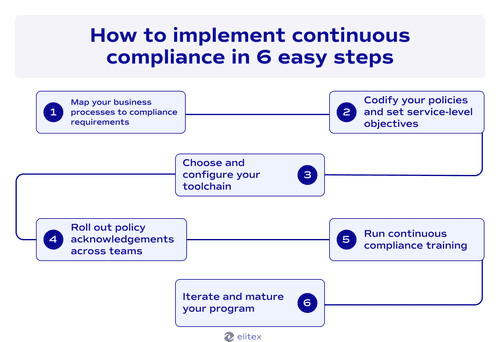
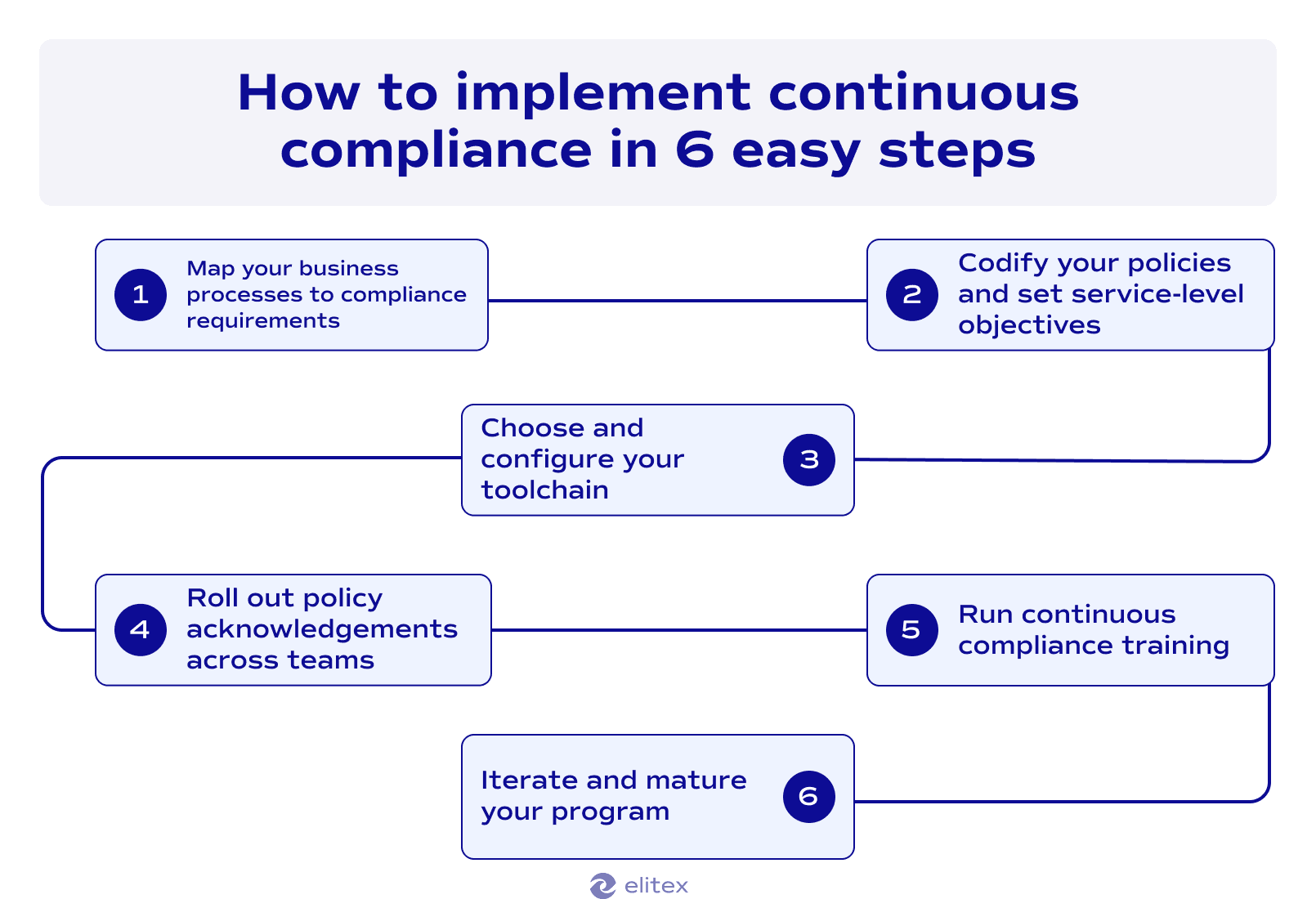
Step 1: Map your business processes to compliance requirements. Before writing a single rule, you need to know which business processes fall under which regulations. Audit your current workflows, identify where sensitive data flows, and document which controls apply at each point. Skipping this step leads to policies that look good on paper but miss actual risk areas.
Step 2: Codify your policies and set service-level objectives. Translate each compliance requirement into an executable rule. At the same time, define service-level objectives for how quickly violations must be detected and resolved. These benchmarks give your team a measurable target, not a vague aspiration.
Step 3: Choose and configure your toolchain. Select tools that integrate with your existing CI/CD pipeline and cloud providers. Align your setup with industry best practices for policy-as-code frameworks, monitoring agents, and evidence storage. Also, when choosing proper tools for your project, remember that a DevOps automation tool that doesn't fit your stack will create more friction than it removes.
Step 4: Roll out policy acknowledgements across teams. Compliance automation fails when engineers don't understand what's being enforced or why. Policy acknowledgements ensure every team member has reviewed the rules that affect their work. This step also surfaces misunderstandings early, before they turn into pipeline failures that frustrate developers.
Step 5: Run continuous compliance training. Tooling changes, regulations update, and teams rotate. Continuous compliance training keeps everyone current on what the automated checks are doing and how to respond when something gets flagged. One onboarding session is not enough. Build training into your regular engineering rhythm.
Step 6: Iterate and mature your program. Your first implementation won't cover everything. Review findings monthly, adjust policies based on real violation patterns, and expand coverage to new environments as your infrastructure evolves. Maturity comes from iteration, not from a perfect launch.
Role of continuous compliance in DevSecOps
As a company with a DevOps focus, we would like to highlight the specific relation between DevOps and compliance practices. Continuous compliance in a DevOps environment means security standards and policy checks are woven into the same automated pipeline that builds and ships code. That’s what we at ELITEX have been doing for over a decade. However, when teams deploy multiple times a day, compliance can't be a gate that opens once a quarter. That's where not DevOps, but DevSecOps enters the picture (learn more about what DevSecOps is in our DevOps vs DevSecOps comparison article).
DevSecOps-based continuous compliance takes automation further by making risk management a shared responsibility across engineering, security, and the compliance team. Nobody reviews changes after the fact. The rules get defined upfront, codified, and enforced automatically on every pipeline run. The compliance team shapes the policies. Engineers build within them. Security validates that both sides hold up under real conditions. And that’s what successful compliance automation in 2026 means.
Here's how exactly continuous compliance reinforces the DevSecOps lifecycle:
- Implements shift-left compliance validation
- Builds automated security and policy gates into the CI/CD pipelines
- Establishes shared ownership between engineering, operation, and compliance teams
- Starts continuous feedback loops on compliance posture
- Enforces IaC policy
- Builds compliance-aware incident response workflows
- Integrates security check automation tied to compliance rules
- Fosters real-time drift detection across environments
Common pitfalls and how to avoid them
| Pitfall | What goes wrong | How to avoid it |
| Treating compliance as a one-time project | Teams invest heavily in an initial audit, then let controls decay until the next review cycle. Drift accumulates silently. | Build compliance checks into your CI/CD pipeline so they run continuously. A passing audit today means nothing if controls degrade next month. |
| Over-relying on manual processes | Engineers spend hours collecting evidence and screenshots. The process is slow, error-prone, and doesn't scale as your infrastructure grows. | Automate evidence collection and policy evaluation. Manual effort should go toward interpreting findings, not gathering them. |
| Writing policies that nobody understands | Compliance rules get codified by one team and enforced on another. When engineers don't understand why a check exists, they work around it. | Pair every automated check with clear documentation. Run policy acknowledgement sessions so engineers know what's being enforced and the reasoning behind it. |
| Ignoring legal risk until something breaks | Without continuous enforcement, violations can persist for months undetected. Compliance automation helps here by flagging regulatory gaps in real time, before they become fines, lawsuits, or breach notifications. Waiting for an incident to expose a gap is the most expensive way to discover it. | Tie your compliance automation directly to your regulatory requirements. Automated checks should map to specific legal obligations so every pipeline run validates your legal exposure. |
| Automating everything on day one | Teams try to cover every regulation across every environment in a single rollout. The result is brittle rules, false positives, and frustrated developers who start ignoring alerts. | Start with your highest-risk controls and expand gradually. DevOps maturity comes from iteration, not from trying to boil the ocean in sprint one. |
| Siloing compliance from engineering | The compliance team writes rules in isolation. Engineers see blocked deployments with no context. Friction builds and trust erodes between both sides. | Make compliance a shared responsibility. Engineers should participate in policy design, and compliance teams should understand the deployment workflow they're gating. |

How ELITEX can help with continuous compliance
At ELITEX, we've been building continuous automated compliance into our clients’ infrastructure long before it became a buzzword. Our DevSecOps consulting services combine deep cross-industry experience with a practical understanding of the business and legal context behind every regulation.
Here’s just the one example: we've helped healthcare organizations automate compliance workflows that would otherwise require dedicated teams to manage manually. That hands-on work across regulated industries gives us a perspective that pure-play DevOps vendors often lack. We also operate with zero bureaucracy, which means your compliance automation project starts moving on day one, not after weeks of procurement cycles. The result is a cost-efficient engagement where every hour goes toward building something that works, not toward managing the relationship itself—by choosing ELITEX, you choose the result beyond your expectations.
FAQs
What is continuous compliance?
Continuous compliance is an automated approach to maintaining regulatory adherence throughout the software development lifecycle. Policies get codified as executable rules that run inside your CI/CD pipeline, so every change is validated against your compliance requirements before it reaches production.
What is the approach to maintain continuous compliance?
The approach starts with mapping your regulatory obligations to specific automated checks. From there, you codify those checks as policy-as-code, integrate them into your pipeline, and set up real-time monitoring with automated evidence collection. The key is iteration. You start with high-risk controls and expand coverage as your program matures.
How does continuous compliance in DevSecOps differ from traditional compliance?
Continuous compliance in DevSecOps embeds policy validation directly into the development workflow. Traditional compliance relies on periodic audits with long gaps between reviews. In a DevSecOps model, compliance is a shared responsibility across engineering and security teams, enforced automatically on every deployment.
What are the best practices for achieving continuous compliance?
Start by codifying your policies so they can be tested automatically. Invest in automated evidence collection early, because it eliminates the audit scramble later. Run policy acknowledgement sessions so engineers understand what's being enforced. Build compliance training into your regular engineering rhythm. And expand your coverage gradually rather than trying to automate every regulation at once.
What tools are needed for continuous compliance?
You need a policy-as-code framework like Open Policy Agent or HashiCorp Sentinel, a monitoring solution that tracks configuration drift and access changes, an evidence storage system tied to your pipeline events, and a reporting layer that surfaces your compliance posture in real time. The specific tools depend on your cloud providers and existing CI/CD stack.
POSTED IN: