



Tl;dr: A DevOps maturity model is a structured framework that evaluates your organization's capabilities across four key dimensions: people, processes, technology, and governance. This article explains how these models work, reviews popular assessment frameworks like DORA and Atlassian, and presents ELITEX's practical matrix to help teams identify their current level and systematically advance their DevOps transformation progress.
DevOps transformation isn’t just a buzzword anymore: it’s a necessity for staying competitive in 2026 for almost any kind of digital product. However, here’s the thing: from our decade-long experience, we’ve noticed that most organizations struggle to determine their actual standing in their journey. That’s where a DevOps maturity model becomes the roadmap. It helps you assess your current capabilities, identify gaps, and create a clear path forward. It’s a key step in moving from reactive DevOps implementation to proactive.
The real challenge isn’t understanding what DevOps is; it’s implementing it effectively at scale. And many teams across various industries get stuck in it. As experts in DevOps services & automation solutions, we at ELITEX have compiled our decade-long experience to prepare an easy way for you to determine your DevOps maturity level and improve systematically based on this assessment. This guide breaks down the complex DevOps transformation process into several actionable steps that will help you avoid common pitfalls and accelerate your journey from basic automation to advanced full-scale DevOps excellence. We’ll take a look at existing assessment models and add a simple and accessible algorithm from us. So, without any further ado, let’s go!
Key benefits of using a DevOps maturity models
Here are several compelling reasons why using the DevOps maturity model is beneficial for almost any business:
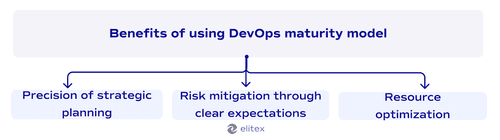
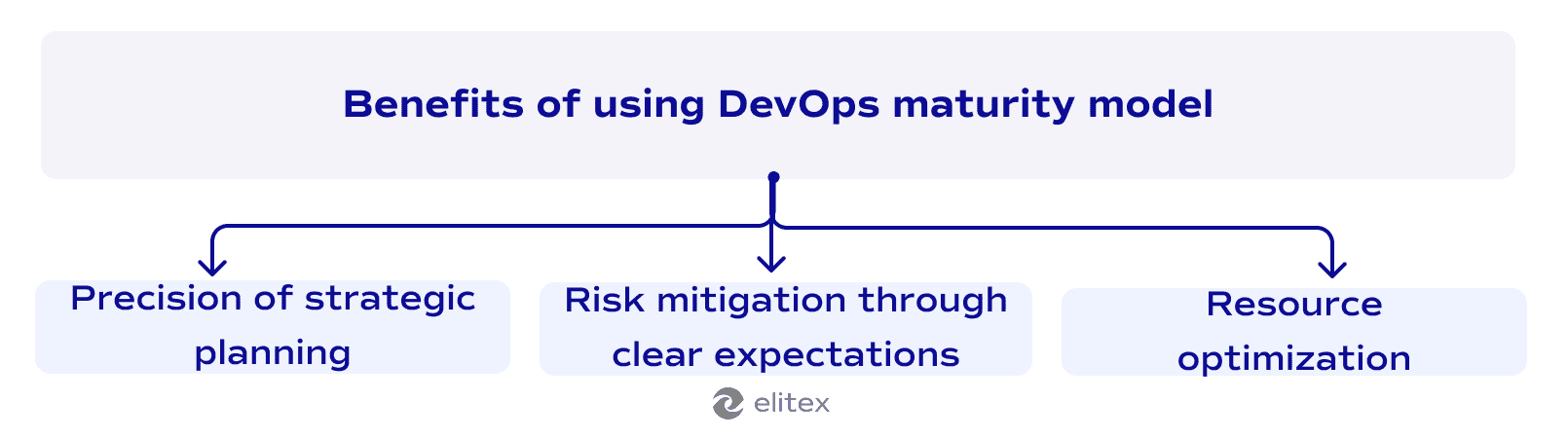
Strategic planning precision
A well-designed DevOps maturity model transforms vague goals into concrete and measurable milestones. Organizations get a detailed roadmap instead of expensive guesswork. Such an approach allows us to eliminate costly trial-and-error approaches that drain budgets without delivering results.
Risk mitigation through clear expectations
A DevOps maturity assessment means you establish success criteria upfront instead of discovering problems mid-transformation. This proactive approach prevents project failures before they happen. Executive teams gain confidence because they know exactly what outcomes to expect and when to expect them.
Resource optimization
With a well-defined strategic plan (which a good DevOps maturity model inherently is), organizations can focus on high-impact improvements. It allows you to eliminate the efforts that don’t move the needle.
What is the DevOps maturity model?
The DevOps maturity model is a structured assessment framework that evaluates your organization’s DevOps capabilities across multiple dimensions. Based on this assessment, it assigns you DevOps maturity levels, typically from basic to advanced or expert, depending on the particular model you leverage. Overall, it’s a good systematic way to benchmark your current state of implementation DevOps, identify potential improvement areas, and track progress over time.
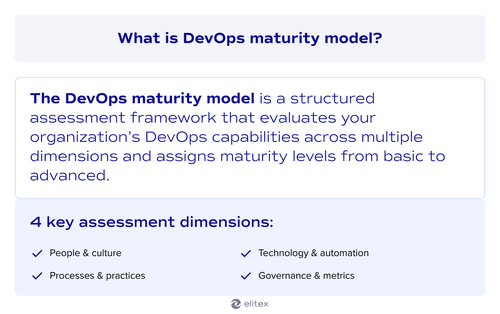
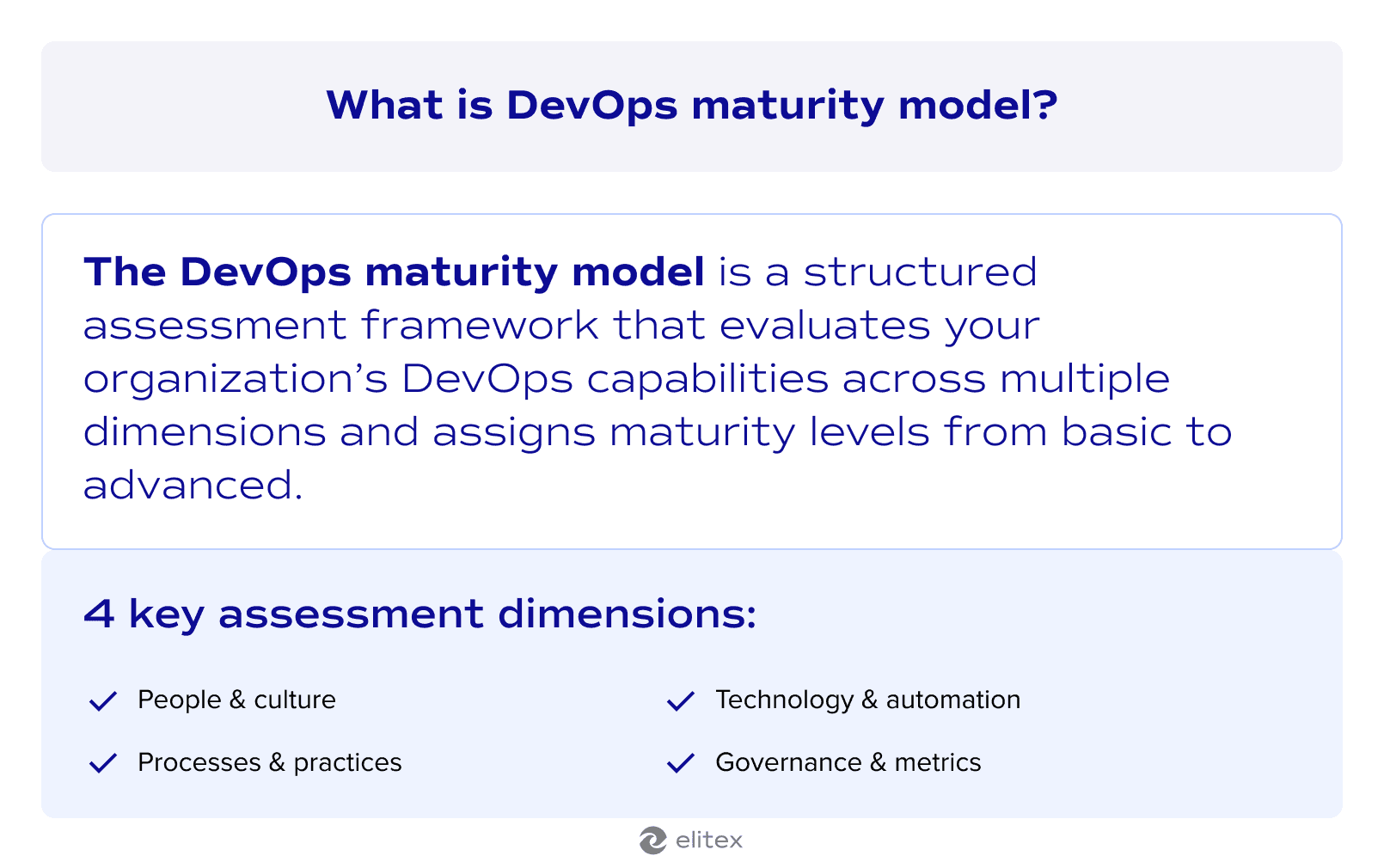
4 key assessment dimensions:
- People & culture: This dimension evaluates team collaboration, shared ownership, and organizational mindset toward continuous improvement.
- Processes & practices: Measures how well your organization implements standardized workflows, change management, and release processes. In this dimension, you can also assess such critical aspects of your DevOps maturity as incident response maturity and change management effectiveness.
- Technology & automation: Evaluates your DevOps toolchain integration and automation coverage across the entire delivery pipeline. This dimension examines how effectively your infrastructure supports rapid and reliable deployments. DevOps maturity models use this assessment area to determine whether technology accelerates your delivery goals or vice versa creates additional bottlenecks.
- Governance & metrics: Assesses how well your organization uses data to drive continuous improvement. Evaluates your oversight capabilities and compliance standards.
Note: Particular assessment dimensions may vary depending on the model you use, but this 4-point model is the most concise way to divide them in our opinion.
People & culture
Without the right cultural foundation, technical and process improvements will fail regardless of how sophisticated your tools become. That’s why the people and culture are considered by ELITEX the first lens to look through for understanding your DevOps maturity level. This dimension is all about your organization’s ability to break down traditional silos that separate teams.
Under the DevOps paradigm, collaboration between development and operations becomes the foundation for successful transformation. Teams with strong cultural maturity share ownership of both successes and failures instead of pointing fingers when problems arise. Collaboration between development teams and other stakeholders determines how effectively DevOps processes can take root and flourish. Organizations with mature people practices create psychological safety where team members feel comfortable experimenting, failing fast, and sharing knowledge across departments.
Processes & practices
Even the most collaborative teams will struggle without well-defined DevOps processes that guide their daily work. Processes and practices form the operational backbone that transforms good intentions into consistent results. This dimension measures how effectively your organization implements standardized workflows that reduce variability and increase predictability across all delivery stages.
The DevOps maturity assessment evaluates your change management maturity and release process sophistication. Teams with mature practices follow consistent approaches for code reviews, testing strategies, and deployment procedures. This dimension also examines how well your organization handles planned changes versus emergency fixes through established protocols.
Here, from this perspective, critical aspects typically include incident response maturity and your ability to learn from failures systematically. Organizations with advanced process maturity treat every incident as a learning opportunity rather than just a problem to solve. Change management effectiveness becomes visible through reduced deployment risks and faster recovery times when issues do occur.
Technology & automation
While people and culture provide the foundation and processes create the framework, technology and automation turn DevOps aspirations into reality. This dimension evaluates your toolchain integration and automation coverage across the entire delivery pipeline. Most DevOps maturity models examine whether your infrastructure accelerates delivery goals or creates bottlenecks that undermine the collaborative culture and standardized processes you’ve built
3 Key technology assessment areas:
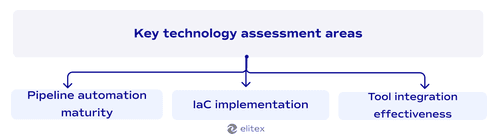
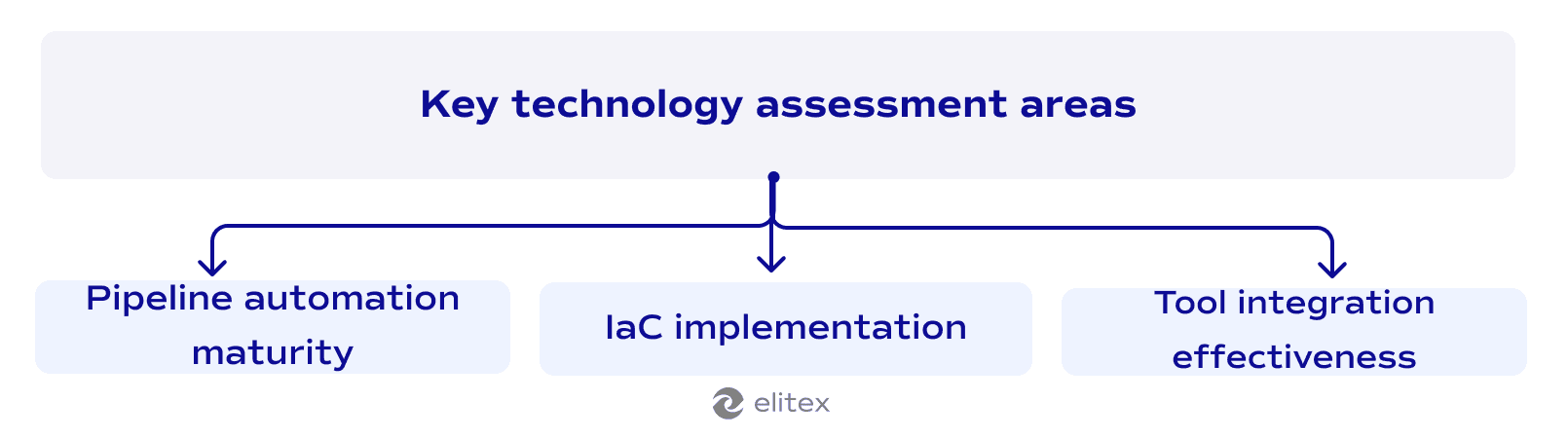
- DevOps pipeline automation maturity measures how much of your delivery process runs without manual intervention, from code commit to production deployment.
- Infrastructure as Code (IaC) implementation evaluates whether your infrastructure can be consistently recreated and managed through code rather than manual configuration.
- Tool integration effectiveness assesses how well your development, testing, monitoring, and deployment tools work together to support the processes and cultural practices established in previous dimensions.
Governance & metrics
The final dimension ties everything together by measuring what actually matters for your business. While culture, processes, and technology create this foundation, governance and metrics determine whether your DevOps transformation delivers real business value. This dimension evaluates how well your organization tracks relevant metrics that drive decision-making rather than just collecting data for the sake of having numbers.
Effective governance balances oversight with team autonomy, ensuring compliance without slowing down delivery. Organizations with mature governance practices use relevant DevOps metrics like deployment frequency and failure rate to continuously optimize their DevOps lifecycle. DevOps success means your organization has moved beyond vanity metrics to focus on measurements that directly correlate with business outcomes and customer satisfaction. This creates a feedback loop where data from all four dimensions informs strategic improvements across people, processes, and technology.
What are the most popular metrics-based, ready-to-use DevOps maturity models?
Now, when we’re done with the theoretical part of what is maturity model, let’s check existing real-world assessment models.
Here are the three most popular DevOps maturity models based on current industry adoption and research, each serving as an industry standard with proven track records of helping organizations assess and improve their DevOps ecosystems:
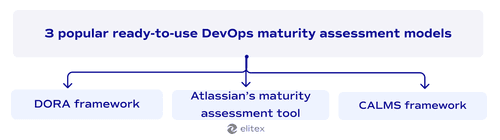
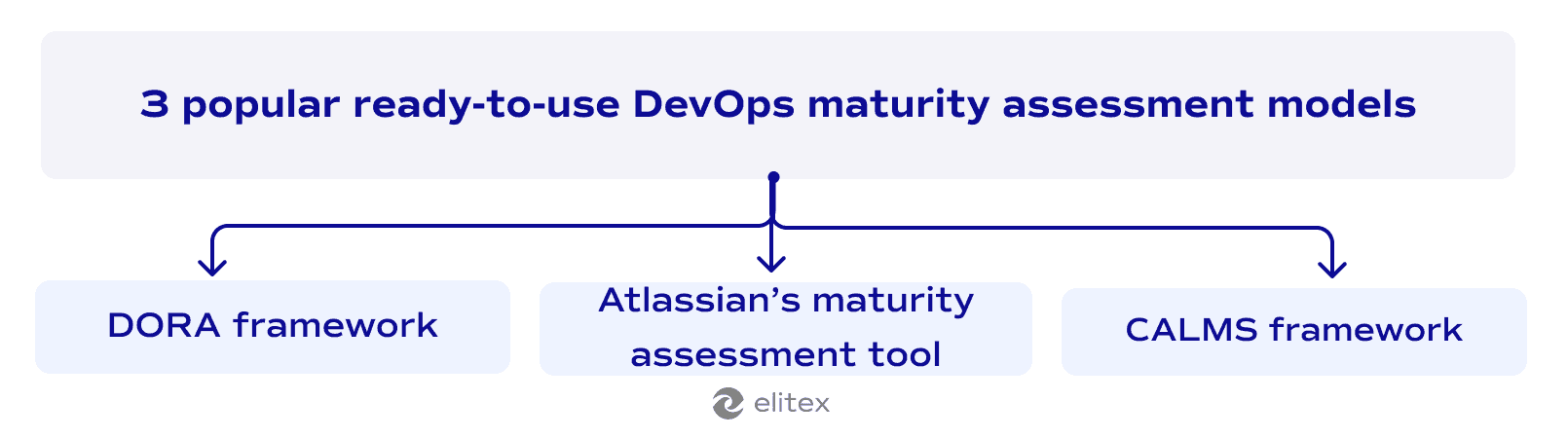
DORA leads with quantitative metrics
The DORA (DevOps Research and Assessment) framework stands as the industry’s gold standard for measuring DevOps performance. Maintained by Google Cloud, DORA represents the largest DevOps research program globally, with over 39,000 professionals surveyed in their 2024 report.
DORA’s four key metrics: deployment frequency, lead time for changes, change failure rate, and mean time to recovery, have become universally recognized across the software industry. Major platforms, including GitLab, AWS, and Atlassian, integrated these metrics into their DevOps assessment tools. Organizations using DORA metrics effectively are twice as likely to exceed their performance goals, making it the most data-driven approach to DevOps maturity assessment.
Practical assessment tools by Atlassian
Atlassian’s DevOps maturity model offers organizations an interactive, stage-based approach to DevOps transformation. This model provides practical guidance for progressing from “Base” to “Expert” levels across multiple DevOps dimensions.
Atlassian’s model demonstrates significant market penetration with over 300,000 companies using their DevOps model across industries. Their recognition as a Leader in Gartner’s 2024 Magic Quadrant for DevOps platforms for two consecutive years underscores the model’s credibility. This framework integrates seamlessly with “The Three Ways of DevOps” principles, focusing on flow, feedback amplification, and continuous learning.
CALMS establishes foundational principles
The CALMS framework (Culture, Automation, Lean, Measurement, Sharing) provides the foundational assessment criteria for DevOps readiness and maturity. CALMS is another go-to framework for organizational DevOps assessment.
CALMS enjoys widespread community recognition as both a readiness assessment and a maturity measurement tool. Featured prominently in “The DevOps Handbook” and other authoritative publications, this framework helps companies evaluate their cultural, technical, and operational readiness for DevOps transformation. Its five pillars serve as comprehensive checkpoints for DevOps maturity across all organizational dimensions.
DevOps maturity matrix from ELITEX
Now that we’ve explored the industry-standard models, let’s examine ELITEX’s DevOps maturity matrix, designed specifically for practical organizational assessment. This matrix combines a proven framework with our decade-long implementation experience for small and medium-sized product teams.
| Maturity Level | People & Culture | Processes & Practices | Technology & Automation | Governance & Metrics |
| Base | Traditional silos exist between dev and ops teams. Minimal collaboration, blame culture prevalent; teams are resistant to change. | Ad-hoc processes with no standardization. Manual deployments, emergency fixes are common; no change management protocols. | Minimal automation, manual builds and deployments. Legacy infrastructure with high maintenance overhead and frequent failures. | Limited or no metrics collection. Reactive decision-making based on incidents rather than data-driven insights. |
| Beginner | Growing awareness of DevOps principles. Initial attempts at cross-team collaboration, but organization silos are still largely intact. | Basic standardized processes emerge. Some documentation exists, initial configuration management, but inconsistent execution. | Introduction of basic automation tools. CI/CD pipeline implementation with manual approval gates and limited DevOps test automation. | Basic metrics collection begins. Simple reporting on deployment frequency and basic performance indicators. |
| Intermediate | Active collaboration between dev and ops teams. Shared responsibility culture is emerging with cross-functional improvement initiatives. | Well-defined processes with consistent execution. Standardized workflows for code reviews, testing, and deployment with proper change management. | Mature CI/CD pipelines with infrastructure as code implementation. Automated testing and monitoring are integrated throughout the delivery process. | Comprehensive metrics tracking, including DORA metrics. Regular reviews and data-driven process improvements with transparency. |
| Advanced | Strong DevOps culture with psychological safety. Teams continuously learn from failures, experiment freely, and share knowledge across the organization. | Optimized processes with a continuous improvement mindset. Advanced incident response, systematic learning from failures, and proactive risk management. | Full DevOps automation across the entire delivery pipeline. Self-healing infrastructure, automated rollbacks, and comprehensive DevOps observability with real-time insights. | Advanced analytics and predictive metrics. Business-aligned KPIs driving strategic decisions with automated reporting and continuous optimization. |
| Expert | DevOps mindset fully integrated into organizational DNA. Innovation-driven culture with autonomous teams and continuous organizational learning. | Industry-leading practices with continuous evolution. Predictive problem resolution, advanced chaos engineering, and seamless business-IT alignment. | Cutting-edge automation with the latest DevOps trends, such as AI/ML integration. Self-optimizing systems, predictive scaling, and fully autonomous deployment capabilities. | Strategic business intelligence with real-time insights. Predictive analytics driving business decisions with comprehensive value stream optimization. |
DevOps maturity levels explained
- Base: Your organization operates with traditional IT practices. Development and operations work in isolation, deployments are risky, and you’re constantly firefighting. Immediate transformation is critical.
- Beginner: You’ve started your DevOps journey with basic automation and initial collaboration efforts. Progress is visible but inconsistent. Focus on standardizing the process and building team alignment.
- Intermediate: Solid DevOps foundation is established. Teams collaborate effectively, processes are standardized, and automation covers most workflows. You’re delivering value consistently with manageable risks.
- Advanced: DevOps excellence achieved across all dimensions. Your organization operates with high efficiency, minimal incidents, and continuous improvement. You’re among industry leaders in delivery performance.
- Expert: Peak DevOps maturity with industry-leading practices. Your systems are self-optimizing, teams are autonomous, and you’re driving innovation. Minimal intervention actually needed—you should rather focus on strategic business growth.
DevOps maturity assessment: How to evaluate your organization on your own?
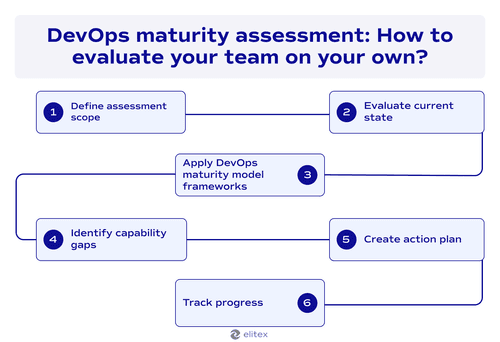
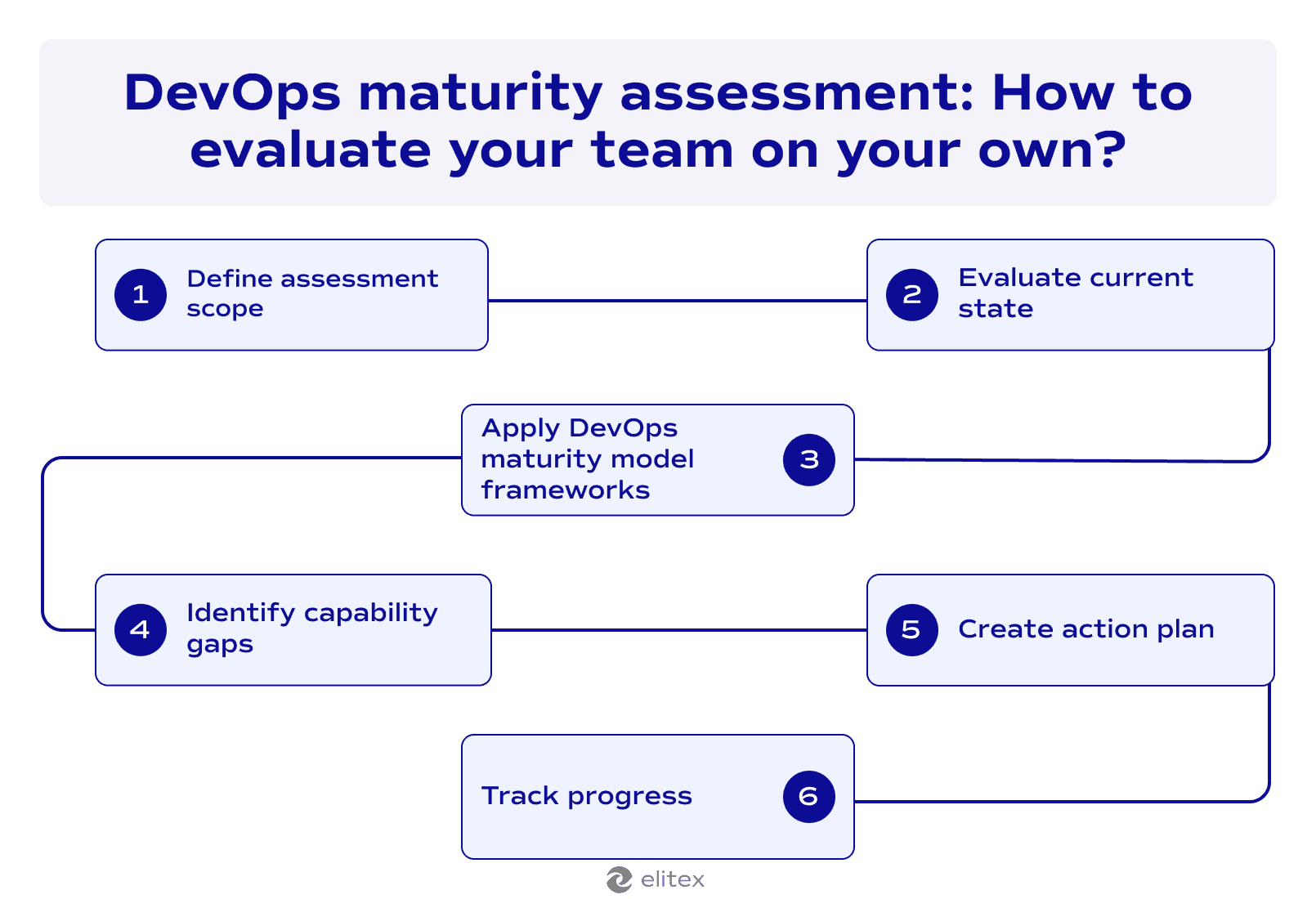
- Define assessment scope: Identify which teams, processes, and systems will be included in your DevOps maturity assessment. Establish clear boundaries and stakeholder involvement.
- Evaluate current state: Assess your organization across all four dimensions: people & culture, processes & practices, technology & automation, and governance & metrics (use our matrix from above).
- Apply the DevOps model framework: Map your current capabilities against the chosen DevOps model to determine your maturity level for each dimension.
- Identify capability gaps: Compare your current state with your target DevOps maturity level to pinpoint specific improvement areas and priorities
- Create an action plan: Develop a detailed roadmap with concrete steps, timelines, and resource requirements to advance your DevOps maturity (we will return to this in the next section)
- Track progress.
6 steps to improve your DevOps maturity level
After completing your assessment, the next phase focuses on systematic improvement. These 6 steps provide a versatile one-size-fits-all approach to advancing DevOps maturity from base or beginner level to intermediate level.
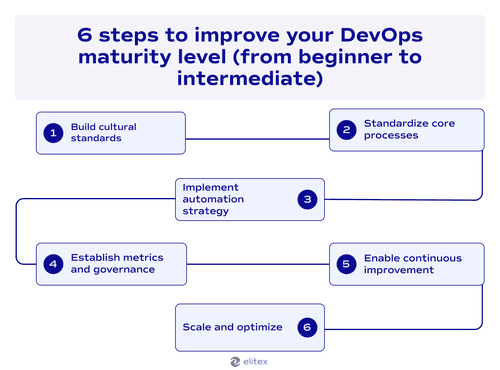
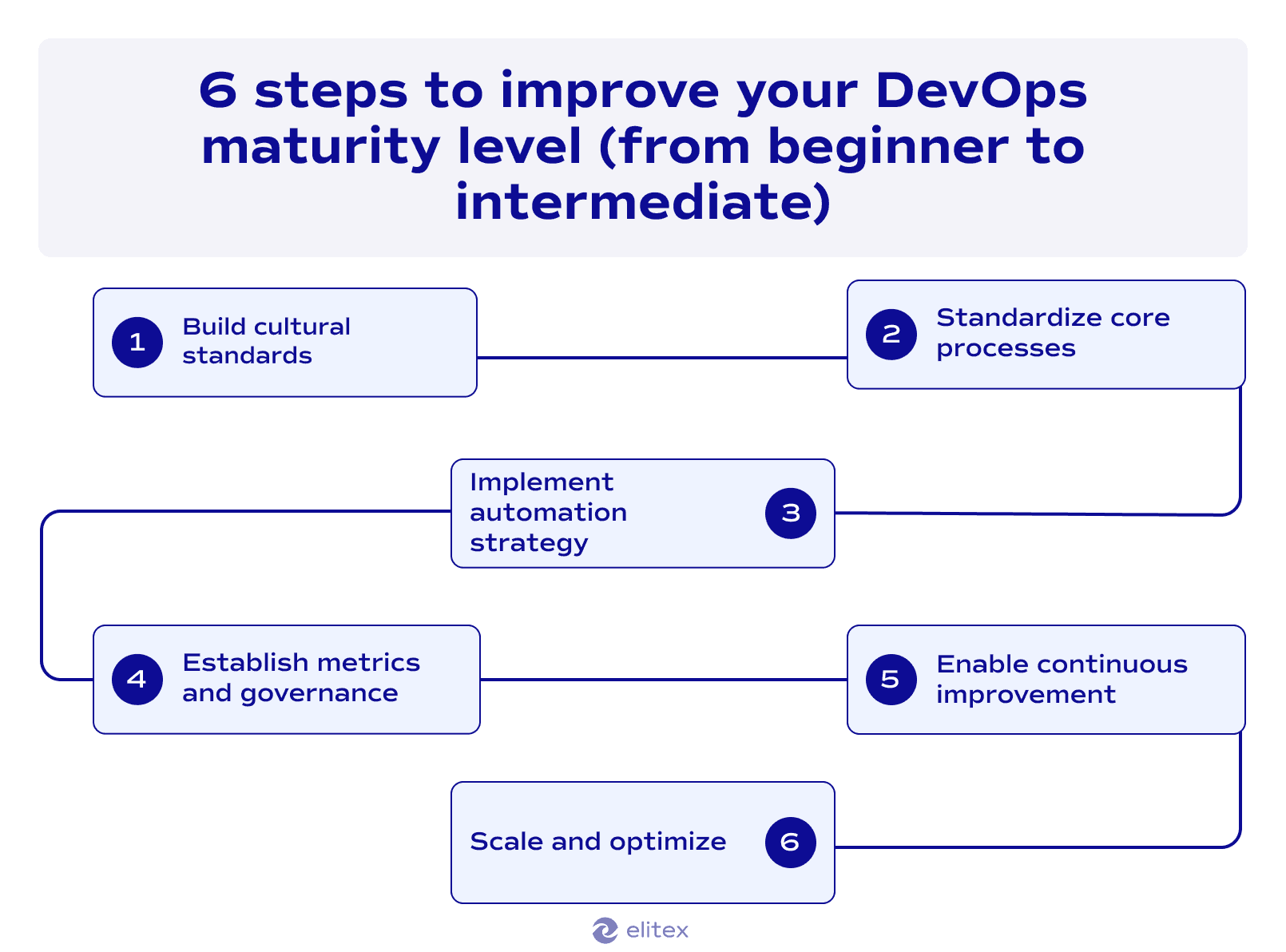
- Build cultural foundation: Start by fostering collaboration between development and operations teams. Establish shared goals, create cross-functional working groups, and implement regular communication practices. Focus on psychological safety, where team members can experiment and learn from failures without blame.
- Standardize core processes: Document and standardize your workflows for code reviews, testing, deployment, and incident response. Create repeatable procedures that reduce variability and increase predictability. Implement change management protocols that balance speed with stability.
- Implement automation strategy: Begin with basic CI/CD pipeline setup and gradually expand automation coverage. Focus on IaC implementation and infrastructure automation. Automate testing, deployment, and monitoring to reduce manual intervention and human error.
- Establish metrics and governance: Implement DORA metrics and other relevant KPIs to track progress objectively. Create dashboards for real-time visibility into deployment frequency, lead times, and failure rates. Balance oversight with team autonomy to maintain compliance without slowing delivery.
- Enable continuous improvement: Create feedback loops that turn incidents into learning opportunities. Conduct regular retrospectives and post-mortems to identify systemic issues. Establish improvement cycles where teams continuously optimize processes based on data insights.
- Scale and optimize: Expand successful practices across the organization while maintaining local autonomy. Implement advanced practices like chaos engineering and predictive analytics. Focus on business alignment to ensure DevOps improvements directly support strategic objectives.
How ELITEX help companies achieve a higher DevOps maturity level
This guide provides solid maturity model frameworks, but every organization still faces their own unique challenges. Generic maturity models can’t address your specific legacy systems, compliance requirements, or team dynamics. What works for an enterprise won’t necessarily work for a startup. Individual assessments are what actually reveal the real bottlenecks that standard frameworks miss.
Here you have ELITEX. ELITEX becomes your reliable technology partner when theory meets reality. ELITEX built DevOps from scratch for startups launching their first products. We’ve also transformed enterprise environments with decades of technical debt. Our DevOps automation services adapt to your specific situation, whether you’re implementing CI/CD pipelines or optimizing complex multi-cloud deployments. Whether you need a DevOps strategy consultation or practical help in DevOps implementation, ELITEX can help you skip the common pitfalls that derail most transformation efforts. Choosing ELITEX means choosing a tech partner beyond your initial expectations!
FAQs about the DevOps maturity model
What is a DevOps maturity level?
A DevOps maturity level represents your organization's current capability stage within a DevOps maturity model, ranging from Base (traditional practices) to Expert (industry-leading automation and culture).
How long does it take to advance through DevOps maturity levels?
From our practice, most organizations take 6-24 months to move from one DevOps maturity level to the next, depending on their starting point and resource commitment. We should note that cultural changes typically take longer than technical implementations.
What maturity level are most organizations currently at?
Based on our practice, approximately 60% of product teams operate at Base or Beginner levels. Only 15% have reached Advanced or Expert stages using our DevOps maturity matrix.
Can my team skip maturity levels and jump directly to Advanced?
No, each level builds foundational capabilities required for the next. Attempting to skip levels in your DevOps maturity model progression often leads to unstable implementations and higher failure rates.
How often should we reassess our DevOps maturity?
Conduct formal DevOps maturity model assessments every 6-12 months, with quarterly check-ins on key metrics. This ensures your improvement efforts stay aligned with business objectives and emerging best practices.
POSTED IN: