


- TL;DR: This article explains the concept of the DevOps ecosystem, covering the tools, culture, practice, and technologies that work together in modern DevOps-based development workflows.
- We examine what a working DevOps ecosystem consists of and how its components integrate.
- Additionally, we provide a step-by-step guide on building your own DevOps ecosystem for your specific needs, from assessing pain points to reaching a full-scale DevOps maturity.
- We also provide a few real-world examples from ELITEX projects that illustrate how these principles are applied differently across the healthcare and publishing industries.
- And, finally, we cover future trends shaping the evolution of DevOps ecosystems in the following years.
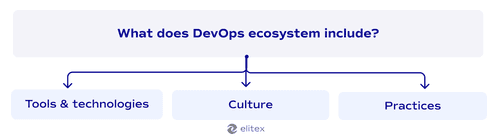
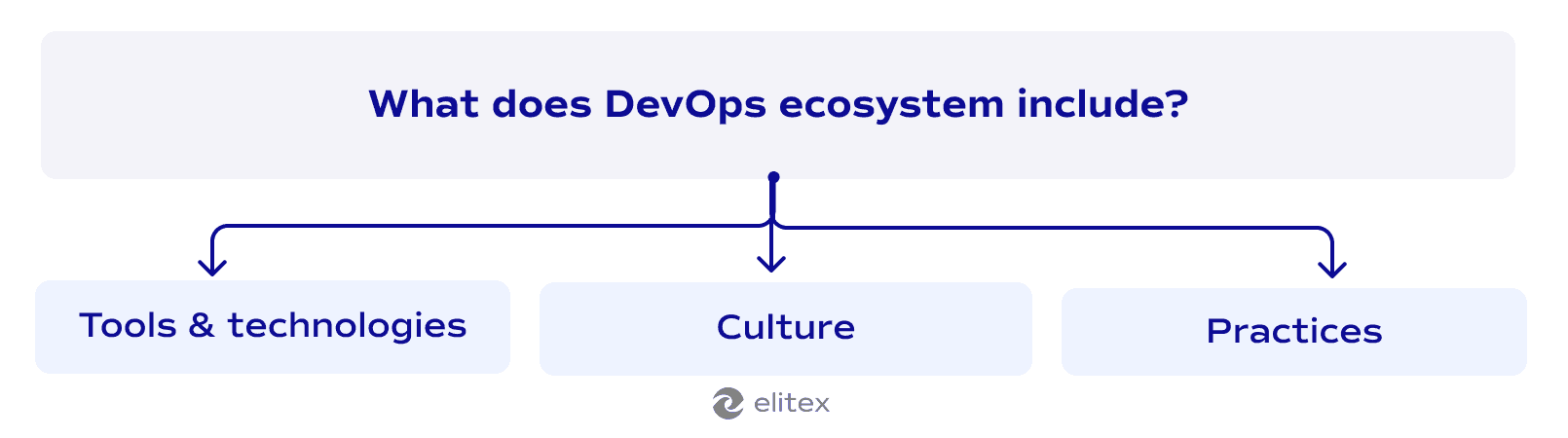
This article is part of our DevOps series, where we break down the basic concepts needed for working with modern development practices. You’ve probably heard about the DevOps lifecycle, CI/CD pipelines, infrastructure-as-code implementation, continuous monitoring, DevOps observability, and other aspects of DevOps. But there’s another term that often comes up in technical discussions: the DevOps ecosystem. It is colloquially used to describe the tools, culture, practices, and technologies that need to work together in your setup. These components don’t function in isolation. They form an interconnected environment where each piece depends on others to do its job.
Picking the right components from this ecosystem takes experience. As a professional DevOps automation services and solutions provider, ELITEX work with teams across various industries to map out their options and build toolchains, culture, and practices that match real business problems. In this guide, we’ll cover the major DevOps ecosystem components, how they connect, what matters when you’re choosing your tools, and how to build such an ecosystem in your organization. Without any further ado, let’s go!
What is the DevOps ecosystem?
The DevOps ecosystem is the collection of tools, practices, and technologies available for building and optimizing your development workflow. This ecosystem isn’t static. It combines multiple variations of solutions that exist for similar challenges teams face when shipping software. Each category of software development challenges has competing options to solve them with different approaches and trade-offs. The components connect through APIs, plugins, and integrations that determine how well they work together.
When one tool gets updated or a new competitor emerges, the relationships between the components of the DevOps ecosystem shift. Your setup today might need different pieces next year as your team scales or your requirements change. The ecosystem responds to real problems that engineering teams encounter in production environments. Tools that don’t solve actual issues fade away while solutions that address genuine pain points gain wider and wider adoption across the industry. Understanding this ecosystem means knowing not just what tools exist, but how they depend on each other and where integration points create either friction or efficiency in your workflow.
Core components of the DevOps ecosystem
Now, let’s take a closer look at the components, what they do, and how they fit together in working systems.
Culture & people
Culture and people form the foundation of any DevOps ecosystem. Without a collaborative culture, even the best tools create friction instead of value. DevOps requires the collaboration between development, IT operations, business, and security teams, who traditionally worked in silos. These groups need shared goals and mutual accountability for the entire software lifecycle context.
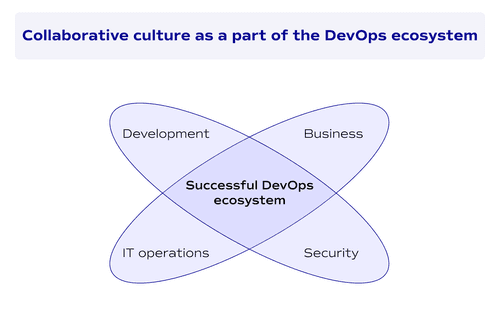
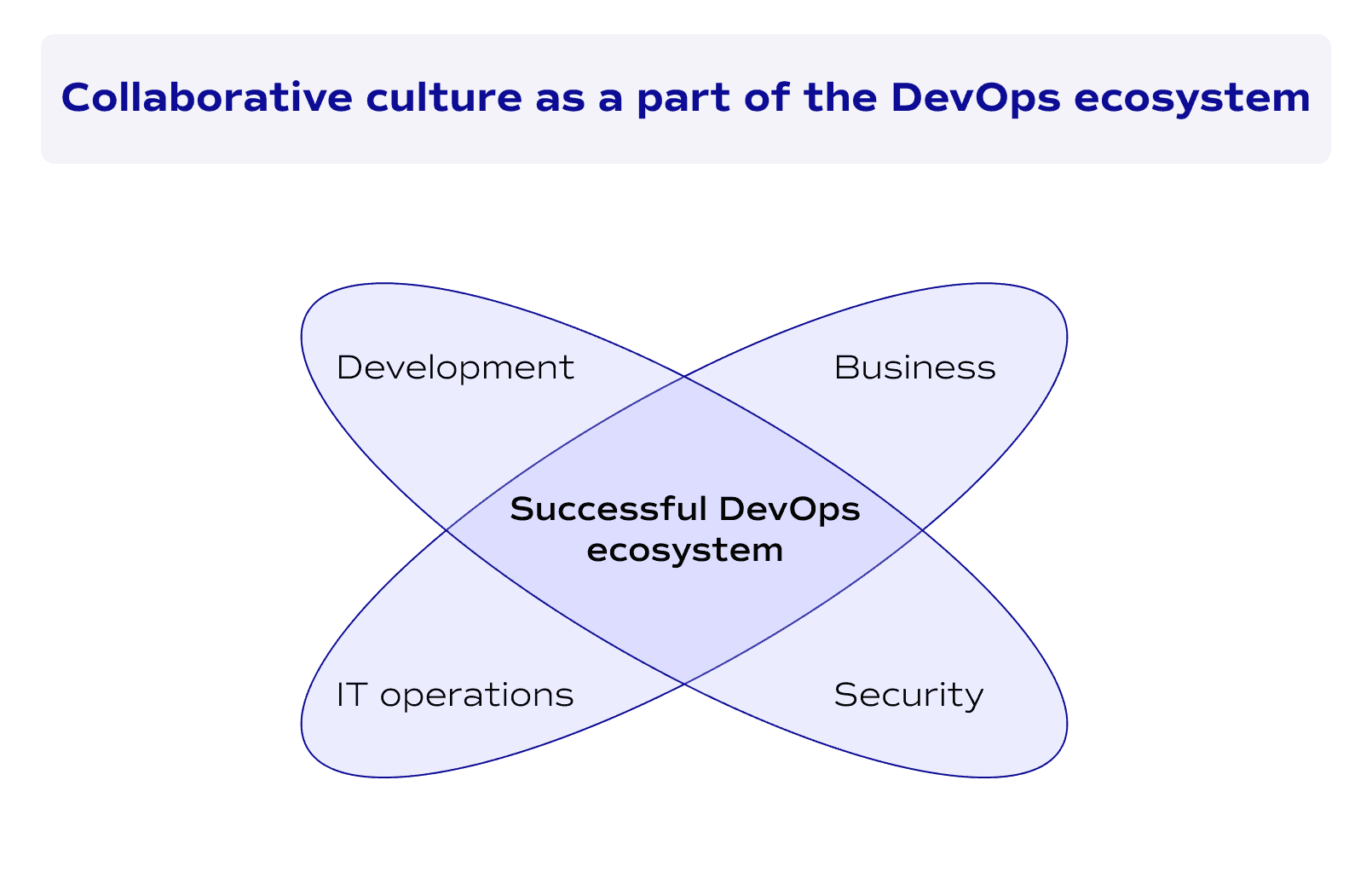
When developers understand operational constraints and ops teams grasp business priorities, decisions improve at every stage. A strong culture means teams use common templates and abstractions that everyone recognizes across the software development lifecycle. People who trust each other share knowledge faster, troubleshoot problems together, and build systems that actually work under pressure. The technical ecosystem just reflects the human one behind it.
DevOps Practices
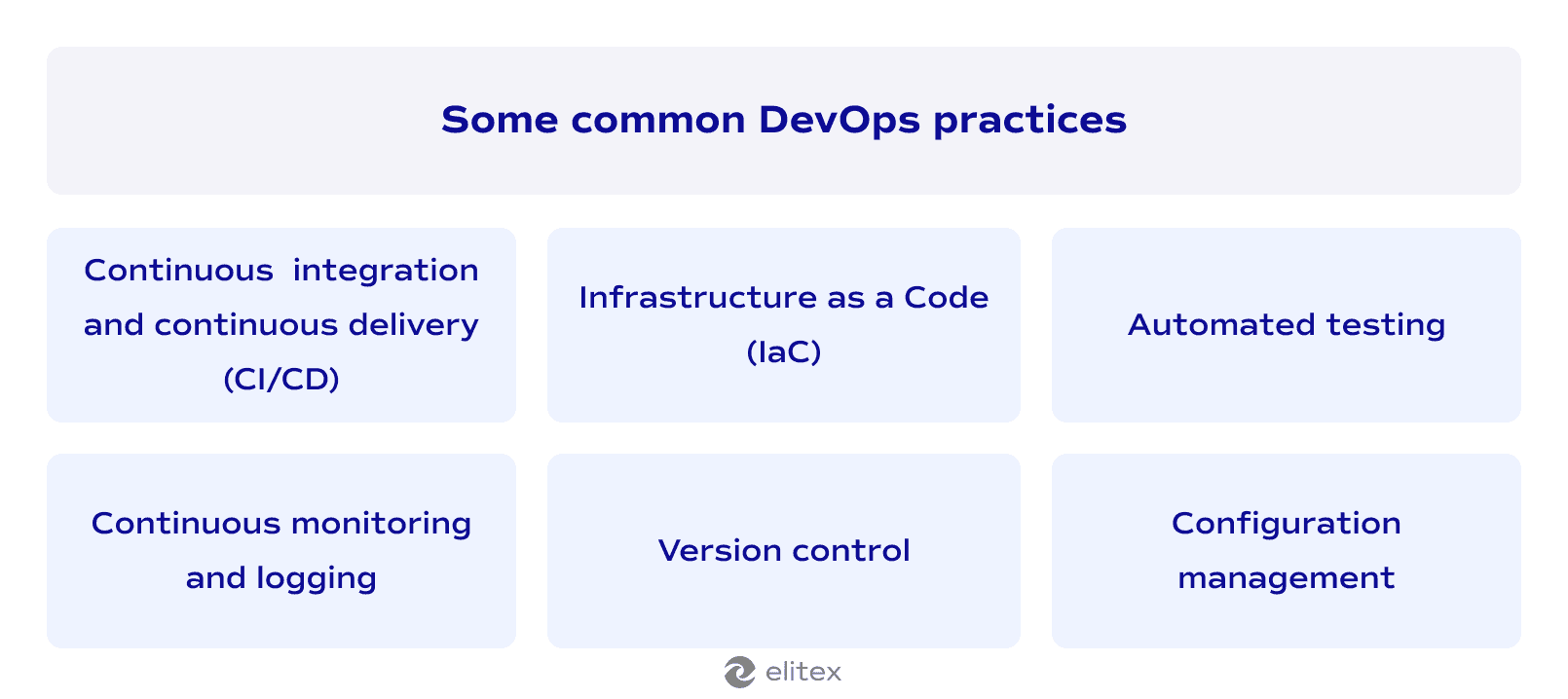
The collaborative culture described above manifests through specific practices that connect different components of the ecosystem. Here are several common practices that shape DevOps ecosystems in 2026:
Continuous integration and continuous delivery (CI/CD)
With CI/CD, code gets merged into the main branch multiple times per day. Each merge triggers automated builds and tests that catch problems before they reach production: CI/CD pipelines connect the version control system to the deployment infrastructure. They basically orchestrate the entire flow from developer commit to running containers in production, pulling together testing tools, artifact repositories, and deployment platforms into a single automated process.
Infrastructure as Code (IaC)
Infrastructure lives in version-controlled files. In such circumstances, manual dashboard configuration becomes obsolete. When environments need replication, scripts execute the work. Documentation stays in sync because it becomes executable code. This approach eliminates configuration drift and makes infrastructure changes reviewable through the same process as application code. IaC tools integrate with cloud providers, CI/CD pipelines, and configuration management systems. The version control connection means infrastructure changes trigger the same automated testing and approval workflows that application code goes through.
Automated testing
We should also add a brief thought about test automation itself. DevOps-based test automation executes at multiple pipelines without human intervention. The testing framework connects to CI/CD systems, triggering on every code change and blocking deployments when failures occur. Test results feed into monitoring systems to track quality trends. Modern test intelligence analyzes patterns in test failures and execution times to optimize which tests run when. This practice bridges development work with the operational concern of system reliability.
Continuous monitoring and logging
Production systems generate data about performance, errors, and software behavior in real time. Continuous monitoring means this data gets collected, analyzed, and turned into alerts when something breaks or degrades. Monitoring tools integrate with incident management platforms and send alerts to collaboration channels, where the cross-functional culture enables coordinated responses. The monitoring and feedback loop closes when data flows back into development through dashboards that show how code changes affect system behavior in production. Practices of logging, especially logging in microservices architecture, become particularly important as distributed systems make it harder to trace issues across multiple services.
Version control
Every codebase change gets tracked with information about who made it, when, and why. Work happens on different features simultaneously without conflicts. Version control sits at the center of this ecosystem, creating connections between code changes, infrastructure definitions, and business requirements. When commits happen, the version control systems trigger CI/CD pipelines and link to project management systems so technical work stays tied to business context.
Configuration management
With configuration management, settings and configurations stay consistent across environments. Tools like Ansible, Puppet, or Chef enforce desired states so servers don’t drift into unique configurations that break unexpectedly. Configuration management works alongside IaC to bridge the gap between provisioning new resources and maintaining them over time. The connection to monitoring systems verifies that configurations remain correct in production, while integration with CI/CD pipelines automates the deployment of configuration changes across infrastructure.
DevOps tools, technology, & automation
DevOps automation tools are another component needed to create a consistent DevOps ecosystem. These tools span multiple categories, each handling specific functions while integrating with other components. The tools trigger each other through APIs and plugins, creating automated workflows that run from code commit to production deployment. Choosing the right DevOps ecosystem tools depends on how well they integrate and whether they solve actual problems in the development workflow.
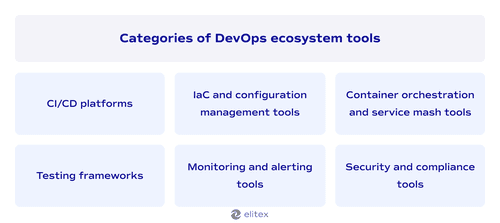
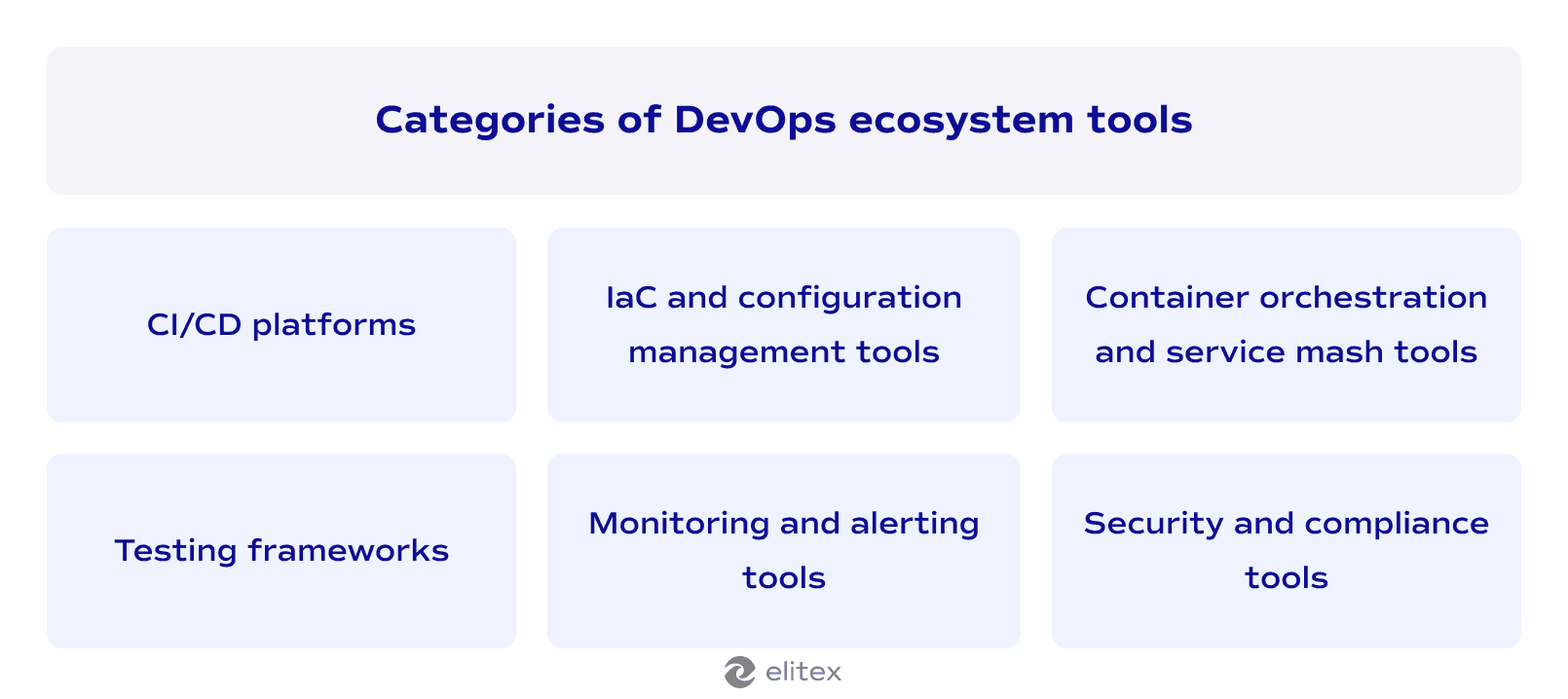
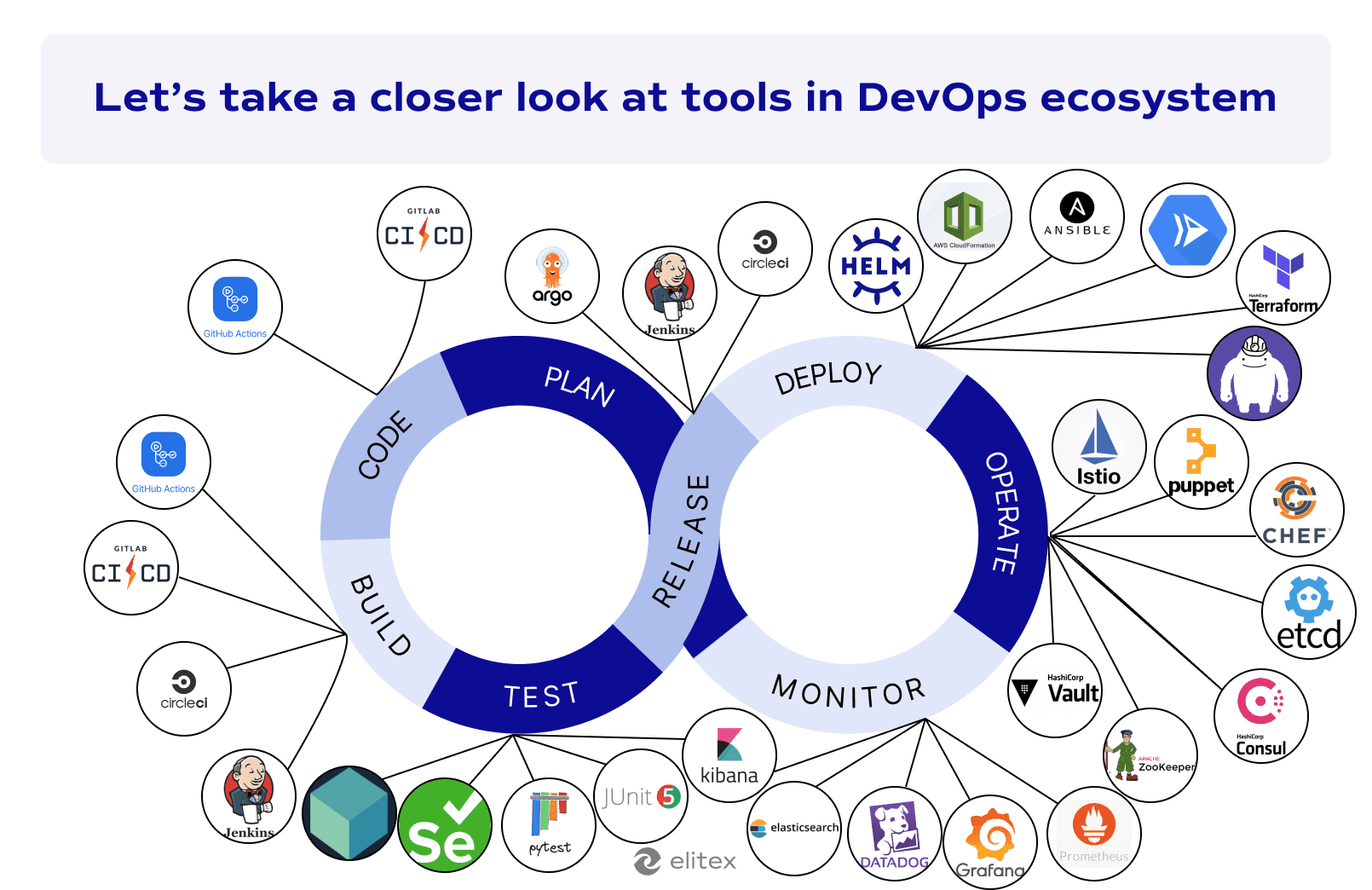
- CI/CD platforms: These tools orchestrate the development process flow from code commit to production deployment. GitLab CI/CD provides integrated security scanning within its native ecosystem. GitHub Actions offers extensive marketplace integrations for repository-hosted projects. Jenkins delivers maximum flexibility through its plugin architecture. CircleCI excels at containerized workflows with reusable Orbs. ArgoCD implements GitOps methodology for Kubernetes deployments.
- IaC and configuration management: These tools define infrastructure through code files and maintain consistent configuration across environments. They eliminate manual server setup and prevent configuration drift. Terraform and Terragrunt manage multi-cloud infrastructure through declarative code. AWS CloudFormation automates resource provisioning within the AWS ecosystem. Ansible handles agentless server configuration across platforms. Chef uses Ruby-based cookbooks for enterprise compliance. Consul provides dynamic service discovery for microservices. Etcd serves as distributed configuration storage for Kubernetes environments.
- Container orchestration and service mash: These platforms automate the deployment, scaling, and management of containerized applications. They handle load balancing, service discovery, and rolling updates across clusters. Kubernetes (through EKS and GKE) orchestrates containerized applications with auto-scaling and self-healing. AWS ECS and Fargate offer serverless container execution with deep AWS integration. Google Cloud Run provides scale-to-zero deployment for stateless services. Istio adds service mesh capabilities with traffic management and mTLS security. Helm packages Kubernetes applications for reusable deployments.
- Testing frameworks: Automated testing tools validate code quality at multiple pipeline stages. Test engineers configure these frameworks to catch bugs before production and block deployments when tests fail. Selenium automates cross-browser UI testing in real browsers. Postman specializes in API testing and validation. JUnit, PyTest, and Mocha handle unit testing across different programming languages. SonarQube analyzes code quality and security vulnerabilities. Testcontainers enables integration testing with real dependencies.
- Monitoring and alerting: These systems track infrastructure health and application performance in real time. They collect metrics, analyze logs, and send alerts when thresholds break. Prometheus, for instance, collects time-series metrics with powerful querying capabilities. Grafana visualizes data from multiple sources through unified dashboards. Datadog provides cloud-based observability across complex environments. PagerDuty orchestrates incident response with automated alerting. FluentBit handles log collection and forwarding. Elasticsearch and Kibana store and analyze log data. Sentry tracks application errors and performance issues.
- Version control and security: Version control tools track every code change and trigger automation workflows. Security tools scan for vulnerabilities and enforce policies throughout pipelines. Git forms the foundation, connecting commits to CI/CD triggers and infrastructure changes. Snyk scans for vulnerabilities in dependencies and container images. Dependabot automates dependency updates to patch security issues. AWS Security Hub centralizes security findings across AWS accounts and services.
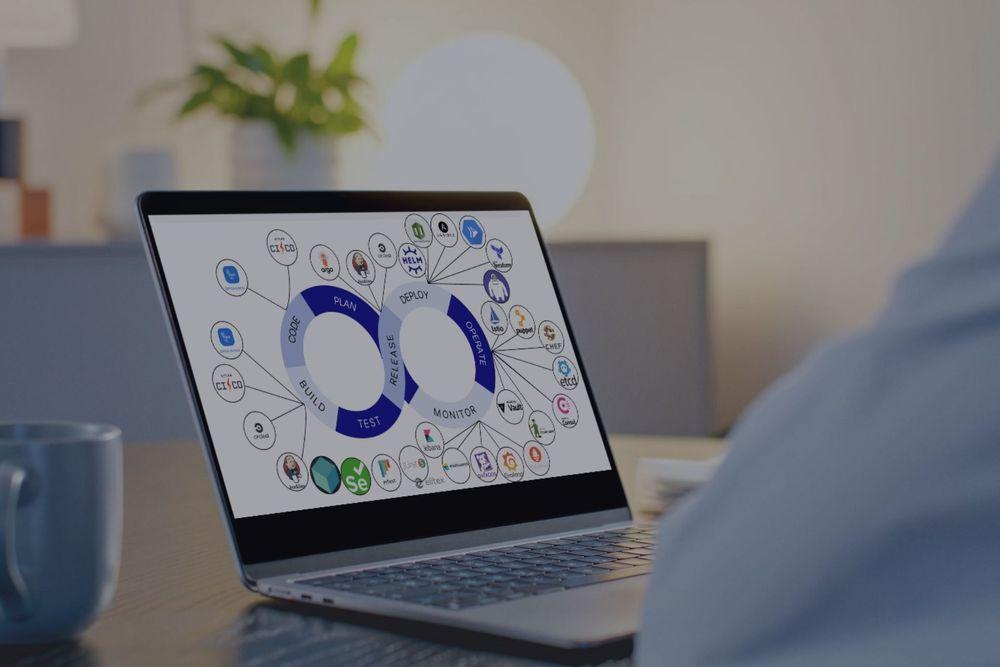
Here’s the simplified DevOps ecosystem diagram.
Key principles of the successful DevOps ecosystem
Now, when we have covered the culture, practices, and tools that form the DevOps ecosystem, we need to understand the principles that connect these components into working systems.
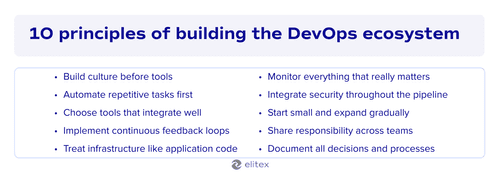
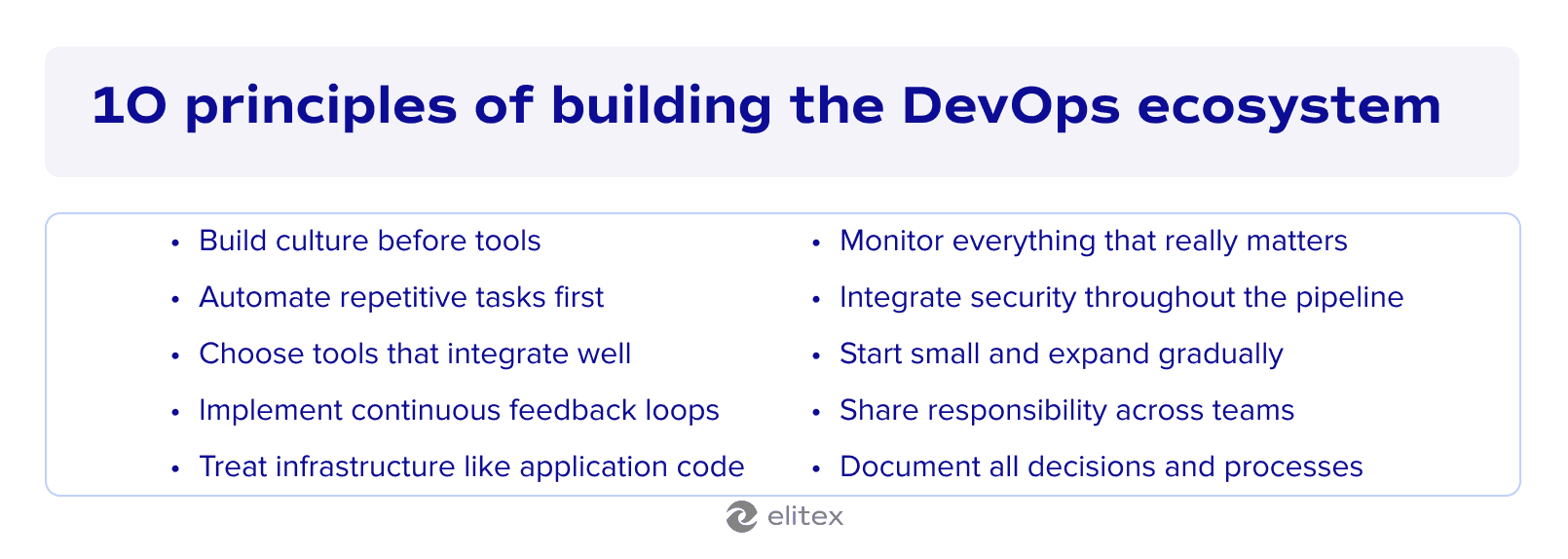
- Build culture before tools. Even the strongest technical setup fails without a collaborative culture. Tools just amplify existing team dynamics, not create them from scratch.
- Automate repetitive tasks first. Start with manual processes that waste the most time. Automate deployments, testing, and infrastructure provisioning before moving to sophisticated workflows. Focus on your daily tasks before trying to fix everything.
- Choose tools that integrate well. If you are building a DevOps ecosystem from scratch, consider that your CI/CD platform needs to talk to your monitoring system without custom scripts bridging the gap.
- Implement continuous feedback loops. Monitoring data should flow back to the development team through dashboards and an alerting system. Production issues need clear paths to code changes that caused them. Test results must block bad deployments before they reach users. Feedback should speed up problem resolutions and prevent repeat failures.
- Treat infrastructure like application code. Version-control your infrastructure definitions and review changes through the same process as code commits.
- Monitor everything that really matters. Application performance tells only part of the story. Infrastructure health, user behavior, and business metrics complete this picture. At the same time, alerts should wake people up only for real problems.
- Integrate security throughout the pipeline. Security should happen throughout the pipeline, not at the end. The earlier you begin, the better.
- Start small and expand gradually. Pick one pain point and solve it well before adding complexity. A working CI/CD pipeline beats a half-implemented container orchestration system. Teams learn tools better when adoption happens in stages. Success builds momentum for broader changes.
- Share responsibility across teams. Developers need access to production logs, and operations teams need input on architecture decisions. Shared responsibility is the alpha and omega of building a strong DevOps culture.
- Document decisions and processes. Configuration files should capture system state but not the reasoning behind choices. Runbooks should prevent knowledge silos when team members leave. The architecture decision should explain why certain tools were chosen over alternatives.
Benefits of building a strong DevOps ecosystem
Here’s what having a strong DevOps ecosystem means in practice:
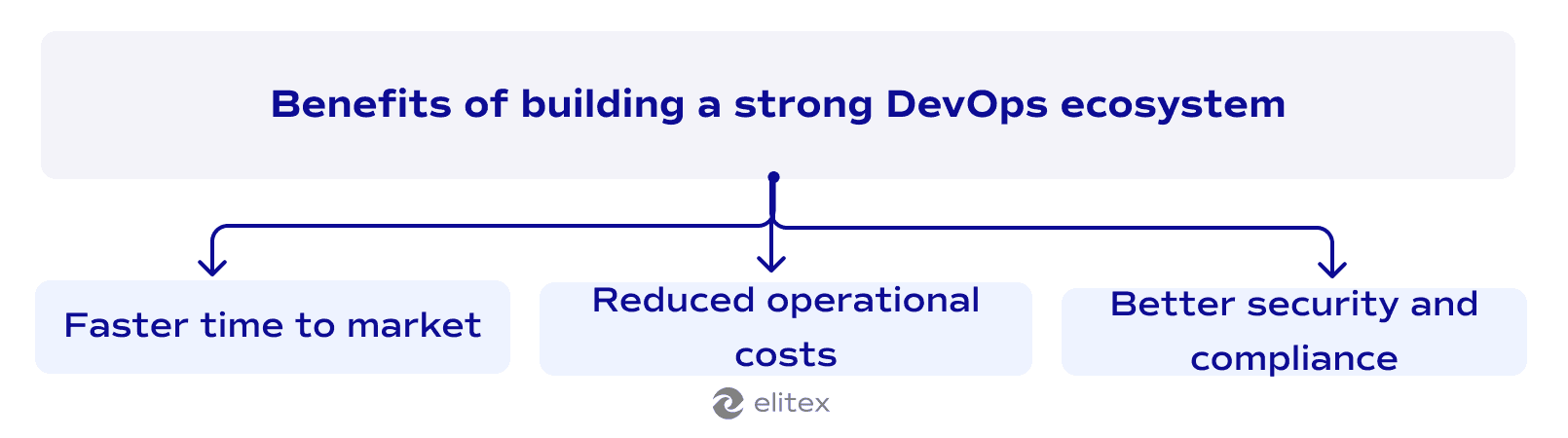
Faster time to market: Continuous integration, a part of any working DevOps ecosystem, catches bugs during development when they’re cheap to fix, and automated pipelines push code to production without waiting for approval chains or manual deployment windows. This directly translates to shipping features weekly instead of quarterly, saving you a lot of costs.
Reduced operational costs: Beyond speed, the benefits of the flawless DevOps ecosystem show up in operational efficiency. For instance, configuration drift causes expensive 3 AM incidents where nothing works and nobody knows why. However, if you properly use IaC tools and implement the 5th practice from the list above, you completely eliminate this problem. You define the desired state in version-control files that monitoring systems verify continuously, freeing engineers to build features instead of debugging why production differs from staging.
Better security and compliance: The cost savings extend to security as well. Security practices integrated directly into software development pipelines catch vulnerabilities before code reaches production, while version control automatically creates the audit trails compliance teams need during reviews. When accidents do occur, response times drop because the ecosystem already contains the tools needed for rapid remediation. Read more about the practical benefits of implementing a DevOps ecosystem in our healthcare compliance automation article.
Real-world examples of successful DevOps ecosystems
The principles and components described above come together differently in each project. Here are two examples from our practice:
When ELITEX built the STM Integrity Hub for academic publishers, we started with nearly no existing architecture. The platform needed to handle sensitive manuscript data from multiple publishers while maintaining strict privacy standards and legal compliance. Our team implemented an AWS-based DevOps ecosystem with Lambda functions, DynamoDB, and Fargate for serverless execution. Our DevOps engineers configured deployment pipelines that caught errors before production, while DataDog monitoring provided real-time visibility into system health and security issues. This setup eliminated deployment mistakes and cut downtime costs for a client operation in a highly regulated industry.
Standard Practice presents a different scenario. When this healthcare AI startup approached ELITEX, they had working technology but manual deployment processes that created bottlenecks. Our DevOps team replaced SSH-based manual deployments across development, staging, and production environments. The migration to AWS ECS with Docker containers enabled automated scaling that handled traffic spikes without manual intervention. HIPAA compliance requirements drove security enhancement throughout the pipeline, from automated vulnerability scanning to encrypted data handling. The transformation took several months, and the resulting ecosystem now processes thousands of insurance verification calls monthly while maintaining the strict security standards healthcare demands.
How to build a DevOps ecosystem in your organization?
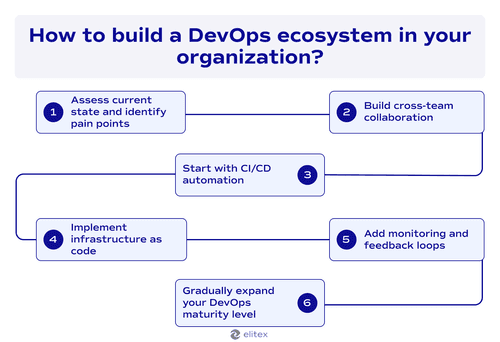
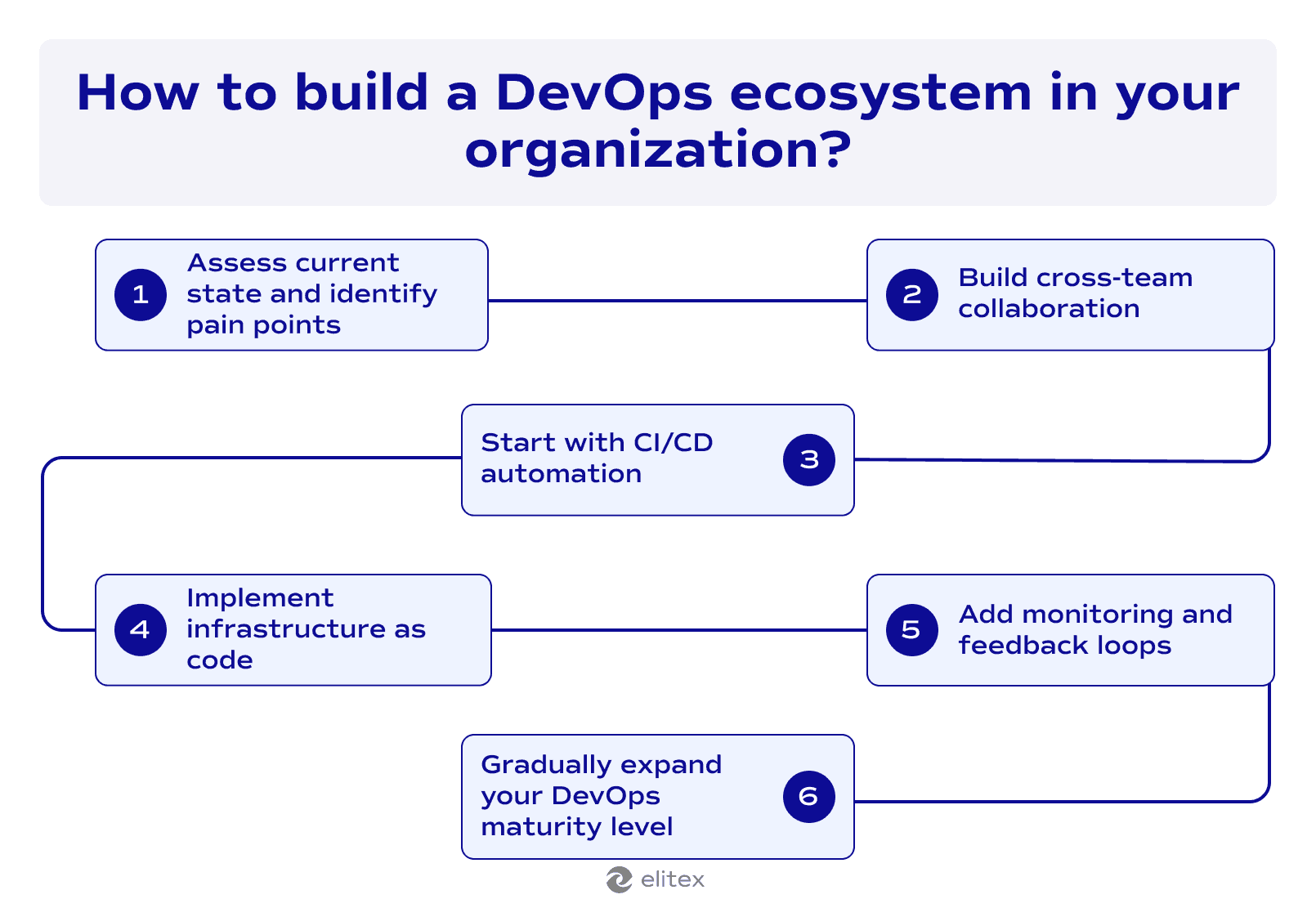
- Step 1: Assess current state and identify pain points. Map your existing development and deployment processes to find bottlenecks. Document where manual work wastes time and where teams wait for handoffs between development and operations.
- Step 2: Build cross-functional collaboration. Break down silos between development, operations, security, and business teams before choosing specific tools.
- Step 3: Start with CI/CD automation. Pick your CI/CD platform based on your existing stack and implement automated pipelines for one project. Start with a basic build and DevOps test automation, then add deployment stages as the team gains confidence. This foundation will connect well to every other component you’ll add later.
- Step 4: Implement infrastructure as code. Move infrastructure definitions into version-controlled files that trigger the same review process as application code. Start with one environment, prove it works, and then expand to others.
- Step 5: Add monitoring and feedback loops: Set up monitoring systems that collect metrics and send alerts to the teams who can fix problems. Connect monitoring data back to development through dashboards that show how code changes affect production behavior.
- Step 6: Expand gradually based on your DevOps maturity. Add container orchestration, advanced testing frameworks, or configuration management tools only after earlier components prove their value. Each addition should solve a specific problem your team faces, not just follow industry trends.
Future of the DevOps ecosystem
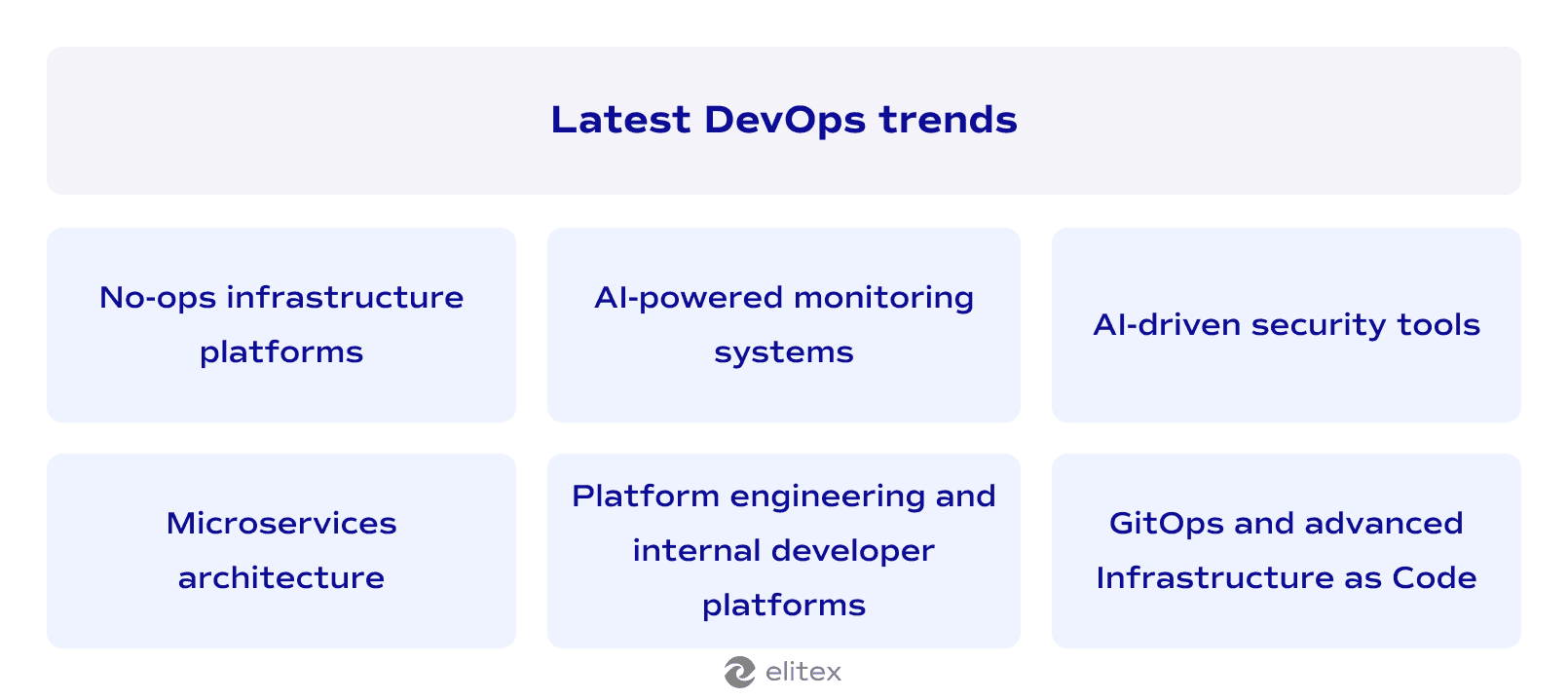
- AI in the DevOps ecosystem becomes standard: AI-powered monitoring predicts failures before they happen and self-corrects issues without waking engineers. Security tools patch vulnerabilities automatically while intelligent systems optimize resource allocation in real time.
- Platform engineering replaces traditional DevOps: Internal developer platforms give teams self-service access to deployment pipelines and infrastructure without deep technical knowledge.
- GitOps controls everything: Git repositories become the single source of truth for both code and infrastructure, with automated drift detection correcting discrepancies when production diverges from definitions.
- Microservices Architecture Dominates in DevOps: Applications split into independent services that deploy separately, enabling zero-downtime updates and faster feature releases across container orchestration platforms.
- No-Ops Platforms for Simple Products: Startups launch MVPs without infrastructure specialists as platforms handle deployment, scaling, and monitoring automatically, though complex applications still need dedicated expertise.
Also, read our article about the latest DevOps trends.
Building a DevOps ecosystem requires a hands-on understanding of how culture, practices, and tools connect to solve real business problems. If you have further questions about the DevOps ecosystem or need help choosing the right components for your project, ELITEX can guide you through the process. As a professional DevOps automation services and solutions provider, we bring a decade of experience building infrastructure across healthcare, publishing, fintech, e-commerce, and other industries.
ELITEX both created dozens of DevOps ecosystems from scratch for startups launching their first platforms and enhanced dozens of existing setups, managing complex multi-cloud environments for established companies. Our DevOps team knows which tools integrate well, where automation delivers the biggest impact, and how to implement changes without disrupting your current operations. Contact ELITEX to discuss your specific challenges and get a roadmap that matches your technical requirements and business goals.
FAQs
What is the DevOps ecosystem?
The DevOps ecosystem is the concept that combines DevOps tools, practices, culture, and technologies working together in the development workflow.
What does the DevOps ecosystem consist of?
The DevOps ecosystem consists of culture as the foundation, practices like CI/CD and IaC implementation, and the specific DevOps tools ecosystem spanning platforms for deployment, container orchestration, testing, monitoring, security, and other aspects of the development pipeline.
What are the main DevOps tools ecosystem components?
There are several categories of tools in the DevOps ecosystem. CI/CD platforms handle deployment, IaC tools manage infrastructure through code, container orchestration tools run applications, testing frameworks catch bugs, monitoring systems track performance, and security tools scan the software for vulnerabilities.
What are common challenges in the DevOps ecosystem?
Common challenges in the DevOps ecosystems include building collaborative culture across silos, choosing the tools that integrate well with each other, preventing configuration drift that causes production incidents, and meeting compliance requirements in regulated industries.
DevOps ecosystem vs DevOps lifecycle vs DevOps culture: what’s the difference?
These concepts share a lot in common, but let’s try to break them down like this: lifecycle describes process phases, culture means specific aspects like team collaboration, and is included in the ecosystem, while ecosystem covers available tools, integrations, technology, and culture. Your DevOps ecosystem is what you choose, the lifecycle is how you use it, and culture determines whether it works.
Should startups build a full DevOps ecosystem from day one?
No. Start with CI/CD and monitoring. No-ops platforms handle infrastructure automatically for simple products. Add complexity after validating your product and hitting real scaling problems.
POSTED IN: