

- TL;DR: This article examines six major DevOps trends reshaping how teams build and operate software in 2026, why they matter, and which ones will last.
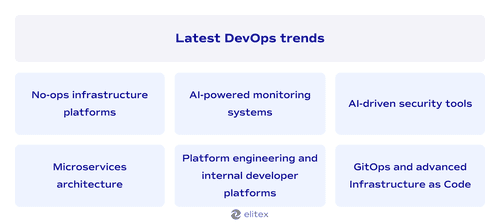
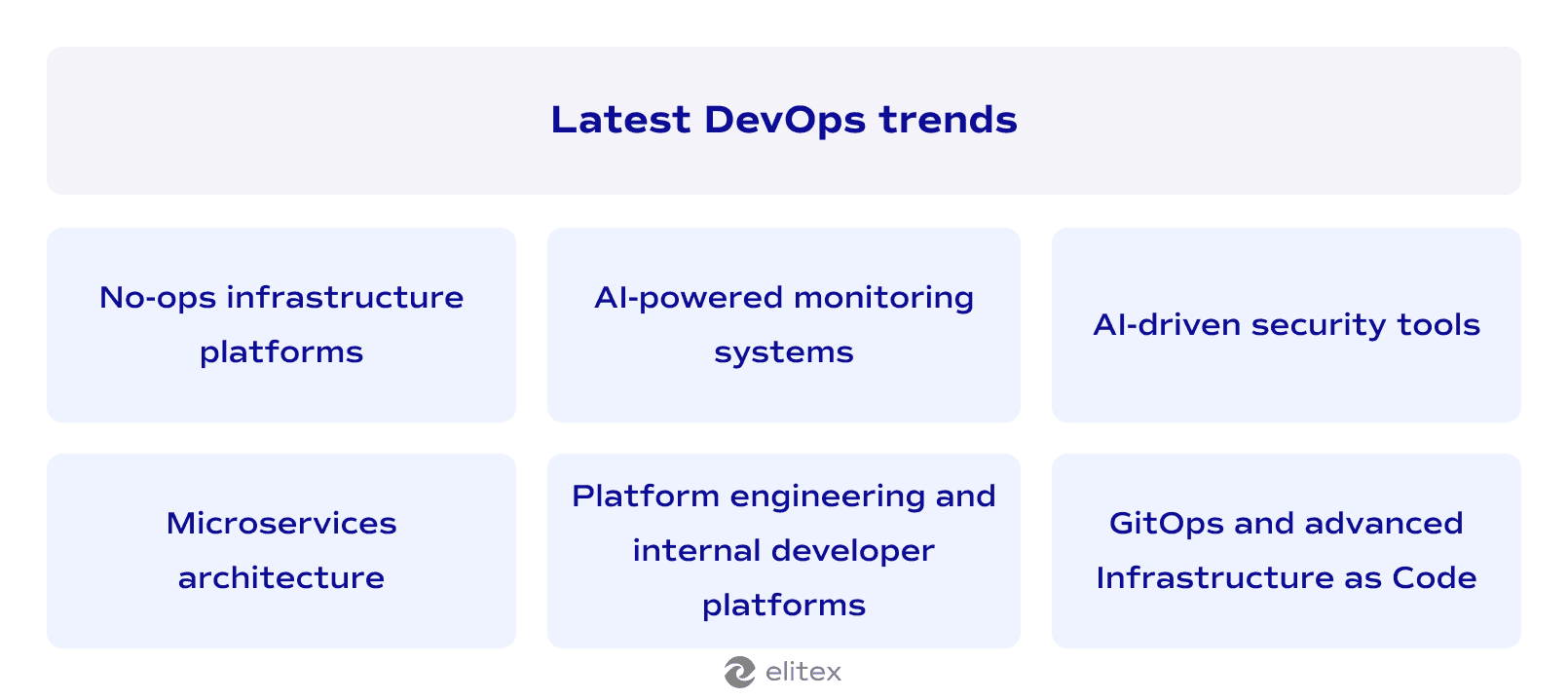
- We’ll take a closer look at no-ops platforms, AI-powered monitoring, AI-driven security, microservice architecture, platform engineering, and GitOps.
- No-ops platforms: Services like Vercel and Airtable handle infrastructure automatically, letting startups launch in weeks, but costs spike as applications grow.
- AI-powered monitoring: Tools self-diagnose issues and only alert teams when human intervention is actually needed.
- AI-driven security: Automated scanning finds vulnerabilities before hackers do and blocks attacks in real-time.
- Microservices architecture: Applications split into smaller services enable zero-downtime deployments multiple times daily.
- Platform engineering: Internal systems let developers deploy without infrastructure knowledge through self-service tools.
- GitOps: Git repositories become the single source of truth, with tools automatically correcting infrastructure drift.
- In our article, we’ll also explain why staying ahead matters, what drives these changes, and how DevOps teams are evolving.
Companies building digital products face an interesting infrastructure choice in 2026. They basically have two options: use no-ops platforms that handle infrastructure automatically, or build truly complex systems that require dedicated specialists to manually manage them.
The first option typically involves using platforms like Vercel and Airtable: not traditional no-code tools, but services that eliminate most of the infrastructure work. The first solution, Vercel, connects to GitHub and deploys your code automatically. The second, Airtable, provides databases with built-in APIs. When you use these two tools, you still write code, but servers, scaling, monitoring, and security happen behind the scenes. Such a minimalistic solution allows small startups to launch MVPs or even complete products without hiring infrastructure specialists. But in this scenario, costs typically spike as applications grow, and technology choices become limited.
The second option, building complex infrastructure from scratch in 2026, demands more DevOps expertise than ever. Development teams now split applications into microservices that run in containers and deploy multiple times daily. Doing this with zero downtime can be a challenging task without proper expertise. That’s why development teams deeply rely on DevOps automation services to monitor systems, scan for security threats, and manage infrastructure at scale. Modern DevOps automation tools allow software engineers to block attacks in real-time, detect outages before they occur, find vulnerabilities in code automatically, etc. However, the implementation of this complexity still requires DevOps specialists who understand container orchestration, zero-downtime deployments, automated monitoring, and alerting systems.
No-ops infrastructure represents just one of the several major DevOps trends reshaping how companies build software in 2026. The future of DevOps likely includes AI-based monitoring that predicts failures, security tools that patch vulnerabilities automatically, deployment systems that roll back problematic code within seconds, and other interesting developments that blur the line between human oversight and automated solutions. Our specialists examined these DevOps trends closely to understand what drives this industry shift and where technical teams should focus their attention. Here’s what we found:
6 DevOps trends 2026: What’s changing in Dev & Ops?
No-Ops infrastructure platforms: When DevOps becomes optional
As we already mentioned in the introduction, no-ops platforms eliminate most infrastructure work by handling deployment, scaling, and monitoring automatically. This trend represents part of a broader industry shift toward low-code and no-code solutions that reduce technical barriers across the software development lifecycle. Modern software development increasingly separates business logic from infrastructure concerns. Operations teams can focus entirely on writing application code while platforms manage servers, databases, and security behind the scenes.
From a business perspective, no-ops infrastructure dramatically improves time to market for new ventures. It’s especially suitable for startups seeking a quick MVP. With these no-ops platforms, startups can launch products within weeks rather than months, since they avoid hiring sophisticated DevOps teams or spending weeks on server configuration. Resource allocation becomes simpler when infrastructure costs are predictable and scaling happens automatically. However, this convenience creates significant limitations as companies grow. Costs can increase exponentially with traffic, and technology choices become restricted to what the platforms, like Vercel and Airtable, support. From our practice, companies resorting to no-ops infrastructure platforms often discover that their business ideas outgrow what simplified platforms can handle cost-effectively, forcing them to migrate to more complex infrastructure solutions that still require specialized expertise.
Also read our article about infrastructure cost optimization with DevOps.
AI-powered monitoring services: Intelligence that never sleeps
The recent evolution of DevOps brings monitoring services that actually think before bothering you. Tools like Uptime and Graylog watch servers, analyze logs, and track performance issues without a human from DevOps teams babysitting them. These AI-powered tools distinguish real outages from temporary hiccups, sparing teams from 3 AM false alarms. Artificial intelligence spots patterns in server behavior and pinpoints failure causes automatically. Instead of alert spam, you get detailed analytics about what broke, when, and why.
For developers, this means freedom from repetitive tasks that used to eat up entire days. Here, DevOps automation handles routine performance issues while you focus on building features. Modern tools allow you to get notifications wherever it’s suitable for you, be it Slack, phone, or PagerDuty. But it happens only when machines cannot solve problems alone. The new gen of DevOps observability and monitoring tools self-diagnose and often self-correct issues during off-hours, dramatically cutting emergency calls and weekend work. Still, even the most sophisticated AI-powered tools need some DevOps oversight for threshold configuration and complex failure interpretation, but far less than traditional monitoring required.
Learn more about how DevOps is being adapted for machine learning projects in our DevOps vs MLOps comparison.
AI-driven security monitoring
In 2026, DevOps practices automatically mean security becomes embedded in every deployment pipeline. These DevOps trends shift security from an afterthought to an automated process that runs continuously in the background (we wrote about this in our DevOps vs DevSecOps comarison). Tools like Snyk scan code for potential issues before hackers find them, providing specific recommendations to fix vulnerable libraries and dependencies. Security teams no longer wait for penetration testing: AI monitors production servers in real-time, detecting attack vectors and suspicious activity patterns. Security testing tools now integrate with CloudFlare and similar services to block DDoS attacks, flooding attempts, and malicious traffic automatically. This evolution means security practices happen without slowing development cycles, and just as in the case with any AI-driven monitoring, teams still need specialists who can understand threat modeling and can interpret complex vulnerability reports when AI systems escalate serious risks.
Also, read our article about DevOps observability, another microtrend in DevOps.
Microservices architecture
The future of DevOps increasingly centers on splitting large applications into dozens of smaller, independent services that run in Docker containers and orchestrate through Kubernetes. This shift responds to market demands for faster deployment cycles and overall better system reliability. Microservices architecture plays a crucial role in modern DevOps processes by enabling teams to deploy individual components multiple times daily without affecting the entire system. The tech industry embraces this approach because it allows zero downtime deployments: users never experience service interruptions during updates. And we, at ELITEX, bet that in the future we’ll only see more examples of microservices architecture adoption across companies of all sizes.
Also, read our dedicated article where we compare microservices architecture with monolithic architecture.
Platform engineering and internal developer platforms
The platform engineering approach focuses on the creation of internal systems that let cross-functional teams deploy applications without deep infrastructure knowledge. These platforms provide self-service environments where developers access databases, CI/CD pipelines, and monitoring tools through simple interfaces. This approach represents one of the key DevOps trends that balances automation with control: companies maintain enterprise-grade infrastructure while improving resource utilization by eliminating bottlenecks between development and operations teams.
GitOps and advanced Infrastructure as Code
For us, the DevOps future seems to increasingly treat Git repositories as a single source of truth for both application code and infrastructure configurations. GitOps workflows automatically deploy infrastructure changes when teams commit to specific branches, ensuring that production environments always match what’s stored in version control. This approach improves infrastructure management by making every server configuration auditable, rollback-ready, and repeatable. Advanced tools detect drift when live systems diverge from Git definitions and automatically correct discrepancies, eliminating the manual toil that plagued traditional DevOps workflows.
Also read our articles about DevOps maturity model and DevOps-as-a-Service model.
Why does staying ahead of DevOps trends matter?
We wrote this entire article with one simple belief. We, at ELITEX, think that understanding key trends in DevOps helps companies and organizations across various industries make better technology decisions and avoid costly migrations later. Here’s why it matters in practice:
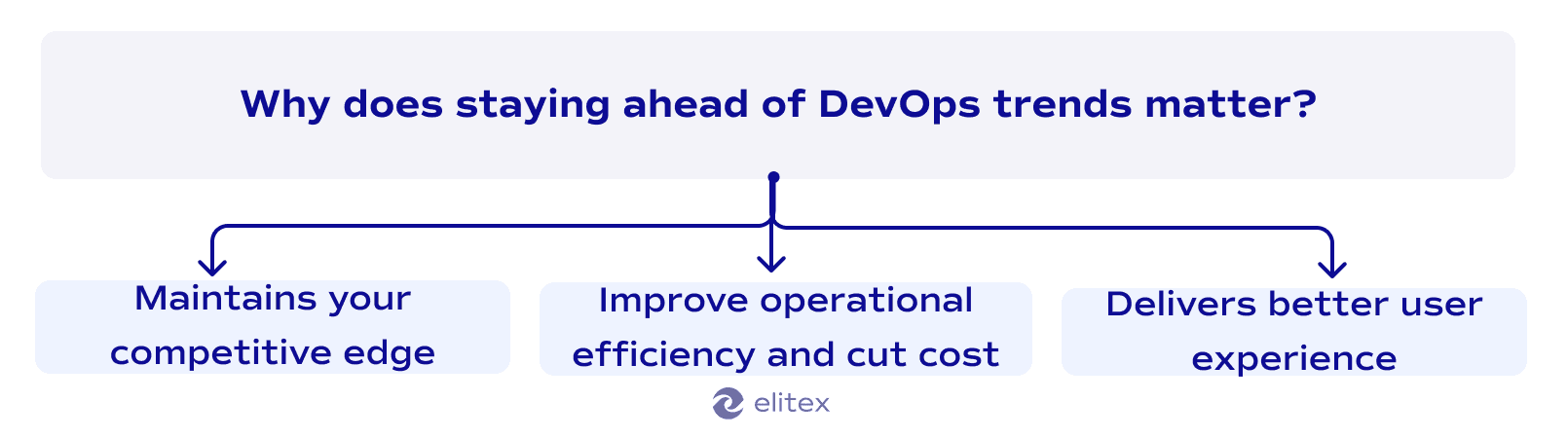
Maintain your competitive edge: Those who adopt efficient deployment practices ship features faster than competitors using outdated processes. Early adoption of automated tools creates market advantages that become harder to replicate over time.
Improve operational efficiency and reduce costs: DevOps' latest trends eliminate manual work that consumes expensive engineering hours. Automated real-time monitoring, security scanning, and deployment processes directly impact your bottom line by reducing staff overhead and preventing costly outages.
Deliver better user experiences: Advanced DevOps practices enable zero-downtime deployments and faster bug fixes, directly supporting business goals around customer experience. Users notice when applications work reliably and when new features appear quickly without service interruptions.
What drives these DevOps trends?
Three forces push companies toward these new DevOps workflows. Market pressure demands faster product releases, as customers expect new features weekly, not quarterly. Development complexity has outgrown human capacity to manage manually; modern applications span multiple cloud providers, dozens of services, and generate terabytes of microservices logs daily. Finally, AI capabilities now exist to automate tasks that previously required hours of work from specialized engineers, making sophisticated operations accessible to smaller teams.
These three drivers create a complex feedback loop: companies adopt automation to stay competitive, which raises customer expectations for faster updates, which forces competitors to automate even more processes. The result is an industry where manual DevOps becomes economically unsustainable for most organizations.
Also read our article about top DevOps-as-a-service providers in 2026.
Future of DevOps role: How DevOps trends are shaping the team structure?
Considering all mentioned above, we can easily conclude that DevOps teams evolve rather than disappear as these trends reshape application development. AI automation handles some routine and security tasks, but key roles shift towards platform design, infrastructure strategy, and complex system architecture. No-ops platforms eliminate basic DevOps work for simple projects, while sophisticated applications demand deeper expertise in container orchestration and microservices management, and here, the expertise of experienced DevOps specialists is needed even more than ever before.
All together, these changes improve collaboration between development and operations teams by removing repetitive manual work, allowing DevOps specialists to focus on building internal platforms, designing deployment strategies, and solving complex problems that AI cannot handle now.
DevOps trends vs. fads: What will actually stick?
At ELITEX, we are tech specialists, not fortune tellers who can predict the future with certainty. However, the trends in DevOps we’ve outlined, AI-powered monitoring, no-ops platforms, microservices architecture, and automation-first security, address real business problems and build on established technologies like containerization and cloud computing. These aren’t experimental concepts but practical solutions already deployed at scale by major companies.
However, what we, at ELITEX, can do is help you implement these trends through our high-quality DevOps services and solutions tailored to your specific business goals. Looking for new approaches? Want to implement all these buzzwords into your actual development process? Or just want to modernize your infrastructure? Contact ELITEX experts today to discuss what exact trends make sense for your business and what implementation roadmap will deliver the fastest ROI for your development team.


FAQs
What’s driving growth in the DevOps market, and which DevOps trends will dominate 2025?
The DevOps market grows due to demand for faster deployment cycles and AI automation. Key DevOps trends include broader implementation of no-ops platforms, especially amidst small businesses and startups; AI-powered monitoring (especially in the security area), microservices architecture everywhere—all focused on reducing manual work while maintaining system reliability.
How has DevOps evolution changed team responsibilities in recent years?
DevOps evolution shifts teams from manual infrastructure management to platform engineering and AI-assisted automation, requiring fewer routine tasks but deeper expertise in complex systems.
Which DevOps trends in 2025 offer the biggest impact for small companies?
No-ops platforms and AI-powered monitoring provide the biggest impact, allowing small teams to deploy and manage applications without dedicated DevOps specialists.
What separates lasting DevOps industry trends in 2025 from temporary fads?
Lasting DevOps market trends solve real business problems like deployment speed and system reliability. Also, lasting trends are typically based on proven technologies rather than experimental concepts (for instance, usage of AI automation in monitoring is already a fact, and nothing can change it).
How do the latest DevOps trends improve continuous delivery pipelines?
Latest DevOps trends like AI-powered monitoring and GitOps automate deployment validation and rollback decisions, enabling continuous delivery with minimal human oversight and faster recovery from issues.
Which DevOps automation trends are replacing traditional continuous integration practices?
AI-driven security scanning, automated testing, and container-based builds replace manual code reviews and server management in continuous integration workflows.
What cutting-edge technology will define DevOps in the next few years?
Probably, you can expect to see AI-powered infrastructure management, predictive analytics for failure detection, and self-healing systems will further automate the DevOps routine.
POSTED IN: