



Infrastructure costs drain budgets faster than most companies realize. Cloud bills spiral while manual cloud processes consume hours that engineering teams could spend on innovation. DevOps offers a proven path to cut these expenses by making infrastructure operations more efficient. From our practice, companies that adopt DevOps principles typically see infrastructure costs drop by 20-40% within 2-4 months.
How does it work? Well, basically, DevOps helps you eliminate waste by matching your infrastructure resources to actual demand. It happens through automated scaling combined with continuous monitoring, revealing inefficiencies before they compound. As a DevOps automation service provider with a decade of hands-on experience, we at ELITEX have helped numerous clients reduce infrastructure costs while maintaining overall system reliability. Based on our vast experience, we can confidently say that the key to efficient infrastructure use lies not in downsizing resources but in rightsizing them continuously. But what does this smart resource utilization mean? Let's figure it out together!
Why are infrastructure costs rising for most companies?
In simple terms, in most cases, infrastructure costs rise because companies provision resources for worst-case scenarios and then leave them running regardless of actual demands. This creates massive waste that compounds over time.
Here are the six main culprits:
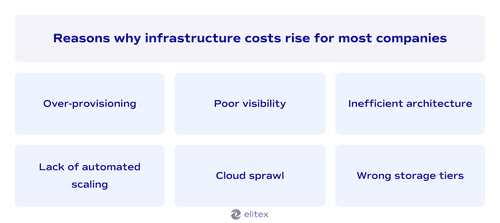
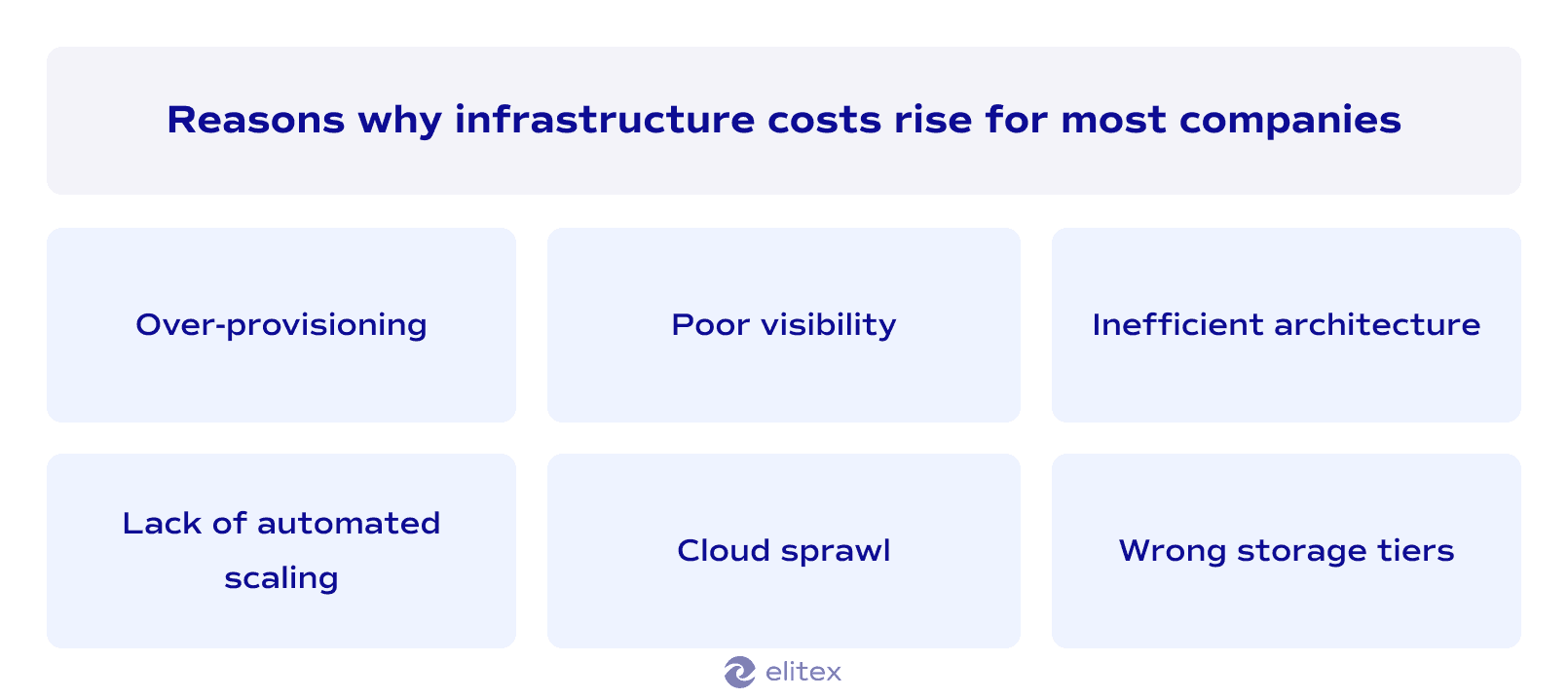
- Over-provisioning happens when you buy capacity for peak loads that occur only a few times per year, leaving resources idle most of the time.
- Lack of automated scaling means your servers run at full capacity even during low-demand periods because no one manually adjusts them.
- Poor visibility prevents your teams from tracking which services actually consume resources or identifying where waste occurs.
- Cloud sprawl accumulates when developers spin up test instances or experiments and forget to shut them down.
- Inefficient architecture forces you to scale entire monolithic applications when only one component needs more capacity.
- Wrong storage tiers drain budgets by keeping rarely-accessed data on expensive high-performance storage instead of cheaper archive options.
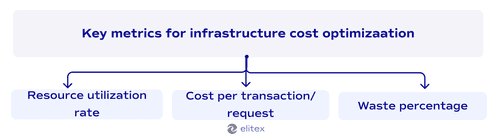
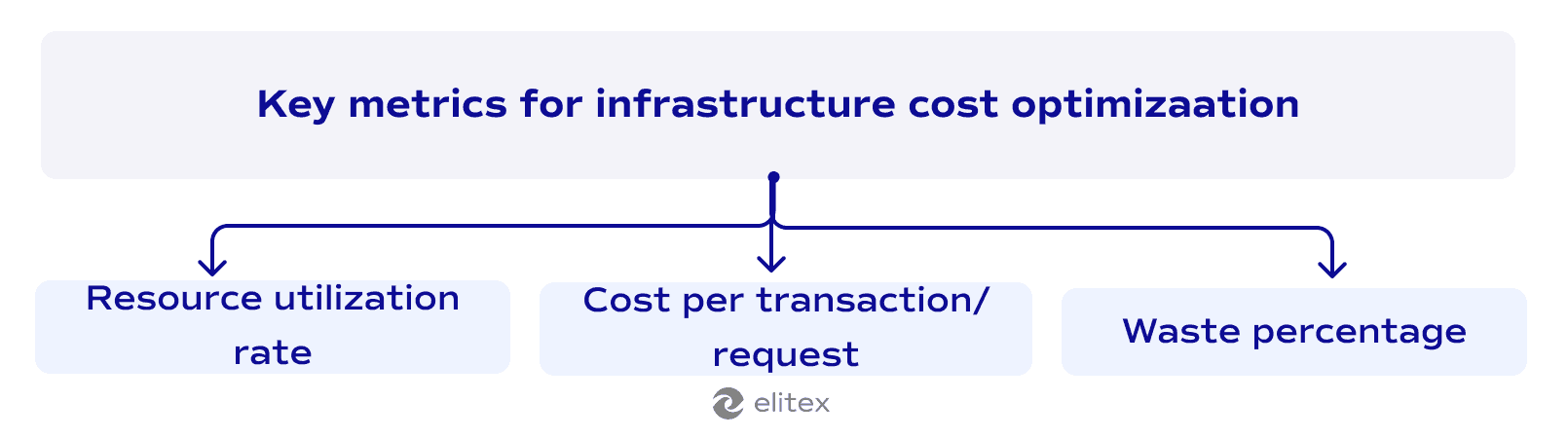
Key metrics for infrastructure cost optimization
Now, let’s see how you can measure the effectiveness of the usage of cloud infrastructure. Here are 3 key metrics used for this purpose:
Resource utilization rate
Resource utilization rate measures how much of your provisioned capacity actually gets used. It tracks CPU, memory, network, and cloud storage consumption as percentages, revealing the gap between what you pay for and what you need. Our rule for this metric is: “When utilization sits below 40-50%, you’re spending on capacity that delivers no value.”
This metric is essential for spotting oversized instances, unused cloud storage volumes, and idle resources that can be downsized or eliminated. Companies that track utilization patterns consistently uncover waste that was invisible before measurement began. Such an approach creates clear paths to reduce infrastructure costs while maintaining performance.
Cost per transaction/request
The cost per transaction metric divides total cloud costs by the number of transactions/requests your infrastructure processes, creating a unit economics view of IT operations efficiency. This metric reveals whether rising bills stem from genuine growth or from infrastructure inefficiency. Track it by measuring monthly infrastructure spend against transaction volume, then watch how the ratio changes over time. How does it work? When cost per transaction climbs while volume stays flat, you’ve found inefficiency.
This metric uncovers problems that aggregate spending hides: a microservice consuming excessive resources per API call, a database query pattern that scales poorly, or background jobs that burn compute without delivering proportional value. You can use this data to prioritize optimization work, focusing engineering effort where cost reduction delivers the biggest impact per transaction served.
Waste percentage
Waste percentage measures idle or underutilized resources as a share of total cloud costs. Calculate it by dividing wasted spend (idle instances, orphaned storage, forgotten test environments) by total infrastructure expenditure. Industry data, such as The Flexera 2025 State of the Cloud Report, shows waste typically hits 27% of cloud spending, meaning on average over a quarter of budgets fund unused capacity. Track this metric monthly to measure cloud cost optimization progress. Declining waste percentage confirms your rightsizing efforts and automated policies are improving cloud usage efficiency.
Other useful metrics that give you insight regarding the progress of your infrastructure cost optimization:
- Reserved vs on-demand ratio - Balance between commitment discounts and flexibility
- Cost allocation - Spending breakdown by service, team, or environment
- Rightsizing opportunities - Number/value of oversized resources
- Storage cost by tier - Hot vs cold storage distribution
- Data transfer costs - Cross-region/AZ bandwidth expenses
- Spot instance adoption rate - Use of discounted compute
- Cost per customer/user - Business metric for scaling economics
How can DevOps help reduce infrastructure costs?
Now, when we’re done with key metrics, let’s explore how DevOps practices actually reduce IT infrastructure spending. DevOps focuses on automating tasks that previously required hours of manual work across various stages of the development pipeline. Here are 6 DevOps practices that help reduce infrastructure cost:
Infrastructure as Code (IaC)
Manual infrastructure setup creates inconsistencies because each engineer configures things differently, which often leads to over-provisioning as a safety buffer. Implementation of IaC turns your cloud infrastructure into code files instead of manual configuration through dashboards. Now, developers write infrastructure definitions using specific DevOps automation tools like Terraform or AWS CloudFormation. These tools read your code and provision exactly what they specified. The result is a consistent environment every time your team deploys the software, which eliminates the confusion that creates unnecessary resources.
Automated scaling and rightsizing
Traffic patterns typically shift throughout the day, but static provisioning treats them as constant. DevOps-based automated scaling addresses this by adding capacity during spikes and removing it when demand drops. This works through autoscaling rules based on CPU, memory, or custom metrics relevant to your application. System performance monitoring data then helps to rightsize instance types based on actual needs.
Remember the resource utilization metric? It reveals not just whether you have too many instances, but whether you have the wrong type of it. A database with high memory usage but low CPU utilization running on a compute-optimized instance costs more while performing worse. Practices and tools from the DevOps ecosystem can analyze these patterns and recommend or automatically switch to appropriate instance families that match your actual workload characteristics.
Containerization and serverless computing
Containers pack multiple applications onto single servers with better density than virtual machines. This density practically means you need fewer instances to run the same workloads. DevOps practices make containerization practical through specific orchestration tools, like Kubernetes, that handle deployment and scaling automatically. Docker containers work well for consistent loads, while serverless functions make sense for intermittent tasks that only charge for execution time. Fault-tolerant batch jobs particularly benefit from spot instances, where costs can drop by up to 90% compared to standard pricing.
Continuous monitoring with anomaly detection
Costs spiral when problems go unnoticed until the bill arrives. DevOps observability and continuous monitoring practices catch issues as they develop through monitoring tools that track resource consumption and spending patterns in real time. Anomaly detection alerts when spending deviates from normal patterns. A misconfigured autoscaling group can consume a significant budget over a weekend, so early detection makes a real difference.
Strategic cloud resource management
Your baseline workloads run around the clock, making on-demand rates more expensive than necessary. DevOps approaches to cloud resource management combine reserved instances for predictable capacity with spot instances for fault-tolerant workloads. Reserved instances reduce spending through longer-term commitments that discount your most consistent usage. Beyond pricing models, some workloads cost less when hosted on-premises rather than in the cloud, which is where hybrid cloud architecture becomes relevant. The goal of DevOps here is to align your cloud infrastructure with actual usage patterns rather than provisioning for theoretical peaks.
Automated lifecycle management
Development environments left running overnight consume budget during idle hours when nobody uses them. DevOps automation tools address this through lifecycle policies that shut down non-production resources during off-hours without requiring manual intervention. Schedules that stop dev and test environments at 7 PM and restart them at 8 AM reduce waste from idle time. Storage lifecycle rules then move old data to cheaper archive tiers automatically, while monthly scans identify unattached volumes and obsolete snapshots that add up over time.
Case study: Real-world example of the DevOps practices that cut infrastructure costs
One of our recent clients demonstrates what cloud cost reduction with DevOps looks like in practice. This leading Swiss bank (we continue working with them under NDA) ran their financial services platform on legacy Azure infrastructure with 23 interconnected microservices scattered across separate repositories. Monthly cloud bills kept climbing while deployments consumed hours of manual work. Our DevOps team started by implementing Infrastructure as Code and automated deployment pipelines to replace manual processes. We then consolidated the scattered applications into a single monorepo and implemented an ISTIO service mesh for security and SOC 2 compliance.
The final step applied strategic cloud resource management: migrating the entire cluster from Azure to AWS while selecting services that matched actual workload needs rather than default setups. The result? Infrastructure costs dropped by 90%. This happened through deliberate application of DevOps practices we described earlier: replacing expensive components with cost-effective alternatives, rightsizing infrastructure, and building systems that aligned with real usage patterns instead of over-provisioned safety buffers.
Which Cloud Optimization Techniques Deliver the Biggest ROI?
Now, let’s talk about ROI. It’s quite an interesting question, as the biggest ROI will primarily depend on where your infrastructure stands today. A company that’s never optimized gets different returns than one with mature DevOps practices already in place. Here are 3 common scenarios:
Scenario # 1. Starting from scratch: Eliminate waste first
If you’ve never systematically optimized your cloud infrastructure, start by addressing waste. Remember the waste percentage metric we discussed earlier? When the number sits around 27%, as it was in Flexera’s report, you’re funding unused capacity with over a quarter of your budget. Hunt down idle instances, orphaned storage volumes, and forgotten test environments. Implement automated lifecycle management to shut down non-production resources during off-hours. These changes require minimal technical complexity but deliver immediate 15-25% cost reduction. Such a good ROI is reached easily because in this scenario, you’re stopping payments for resources that do nothing.
Scenario # 2. Basic optimization in place: Focus on rightsizing and automation
Now, let’s look at the scenario where your infrastructure already has some cost controls, but the resource utilization metric shows you’re still running below 50% on many instances. This signals the next ROI opportunity: automated scaling and rightsizing. Replace static provisioning with autoscaling rules that match capacity to actual demand. Analyze which instance types fit your workloads better. A database running on the wrong instance family wastes money while performing worse. DevOps automation tools can handle this analysis and make recommendations. At this stage, you can see 20-40% of additional savings through rightsizing as systems start adapting to real usage patterns instead of guesses.
Scenario # 3. Mature infrastructure: Strategic transformation pays off
Your basics are solid, waste is low, and utilization looks healthy. Now the highest ROI comes from strategic changes that require more effort but unlock compounding benefits. This is where our client from the case study above found their 90% cost reduction. The transformation involved DevOps-based infrastructure automation implementation to eliminate configuration inconsistencies, strategic cloud resource management to optimize provider and pricing model choices, and architectural consolidation to reduce operational overhead. These projects take months rather than days, but the returns justify the investment when your foundation is already optimized.
What are the common mistakes that increase infrastructure costs?
Now, to finalize the big picture, let’s examine the most common mistakes that drive infrastructure costs up and how DevOps practices help you avoid them.
| Mistake | Why it costs money | DevOps solution |
| Treating all environments the same | Running both dev and test environments 24/7 like production wastes money on unused capacity | Automated DevOps lifecycle management shuts down non-production environments outside business hours, cutting costs by 60-70% |
| Skipping resource tagging | Without tags, you can’t trace spending to teams or projects, making optimization impossible | Enforce tagging standards through IaC where tags become mandatory in deployment templates |
| Provisioning manually without standards | Each engineer configures differently, leading to over-provisioning as safety buffers | Infrastructure as Code codifies exact specifications so everyone deploys identical configurations |
| Ignoring cost metrics in CI/CD pipelines | Teams deploy without understanding the cost impact until the bill arrives | Build cost estimation into DevOps automation tools that flag expensive changes during code review |
| Missing monitoring and alerting | Misconfigured rules or forgotten instances run for weeks unnoticed | DevOps observability with continuous monitoring and anomaly detection catches issues as they develop |
| Using default instance types | General-purpose instances cost more than specialized types optimized for specific workloads | Regular rightsizing reviews identify mismatches between workload needs and instance families |
| Keeping everything on-demand | Predictable baseline workloads running 24/7 on on-demand pricing waste money | Strategic cloud resource management matches pricing models to usage patterns through reserved instances |
| Forgetting data transfer costs | Moving data between regions or availability zones generates charges that accumulate over time | Design architecture with data locality in mind, keeping services in the same zone when possible |
How to start reducing infrastructure costs with DevOps today?
Here’s how you can start to reduce infrastructure costs with DevOps on your own, step-by-step.
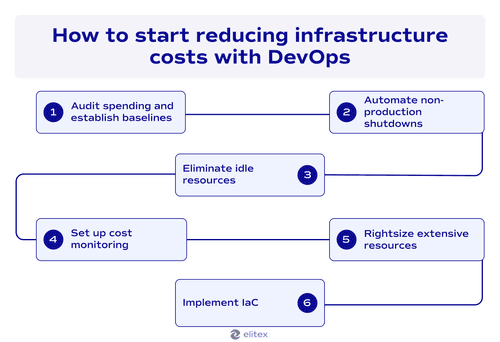
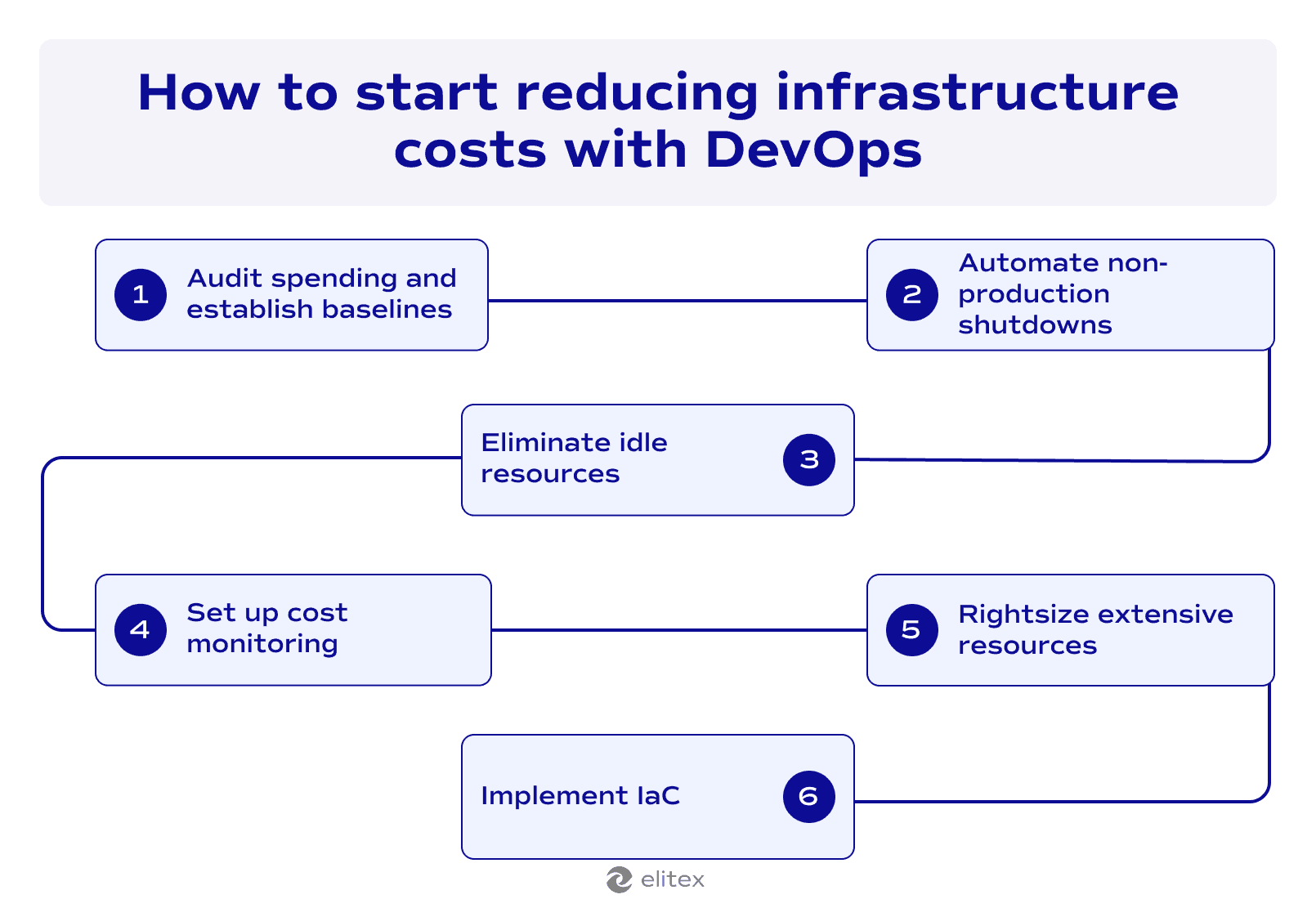
Step 1: Audit spending and establish baselines
Pull your last three months of cloud bills and calculate your waste percentage, resource utilization rates, and cost per transaction. This baseline shows where you stand at the moment and helps you measure progress as you gradually implement changes.
Step 2: Automate non-production shutdowns
Start with the easiest win: schedule your dev and test environments to stop at 7 PM and restart at 8 AM on weekdays, plus a full shutdown on weekends.
Step 3: Eliminate idle resources
Then, scan for unattached volumes, forgotten snapshots, stopped instances that nobody needs, and old AMIs consuming storage. Delete what you find and set up automated cleanup policies to prevent recurrence.
Step 4: Set up cost monitoring
Next, deploy monitoring tools that track both resource consumption and spending patterns in real time. Configure alerts for when spending deviates from your baseline by more than 20%, so you catch problems within hours.
Step 5: Rightsize extensive resources
Identify your top 10 highest-cost resources and analyze their actual utilization over the past 30 days. Downsize instances running consistently below 40% CPU and memory, or switch instance families to match workload characteristics better.
Step 6: Implement IaC
Finally, begin converting your manual infrastructure setup into IaC templates using Terraform or CloudFormation. Start with new deployments and gradually migrate existing resources. This prevents configuration drift and ensures every deployment follows cost-optimized standards right from day one.
How can ELITEX help with infrastructure cost optimization?
Every infrastructure presents unique challenges that require careful investigation before building any optimization plan. Not all optimization opportunities fit into standard templates either, because your architecture, workload patterns, team structure, and business constraints differ from everyone else’s.
ELITEX bring a decade of cross-industry DevOps experience to this challenge. Our portfolio includes dozens of successful infrastructure cost optimization projects across fintech, healthcare, e-commerce, scientific, publishing, and SaaS platforms. We start by analyzing your specific environment through the metrics we discussed earlier, identify which DevOps practices will deliver the highest ROI for your situation, implement them alongside your team, and then ensure complete knowledge transfer so your engineers can maintain and improve the optimizations independently going forward. Whether you’re dealing with cloud sprawl from rapid growth, legacy architecture that resists optimization, compliance requirements that complicate cost reduction, simply looking for DevOps consulting services, or need assistance in DevOps strategy development, don’t hesitate to contact ELITEX. Our engineers have solved dozens of similar problems before and know which approaches actually work in infrastructure optimization.
Our clients typically discover that the actual savings exceed their initial projections. The Swiss bank, which we mentioned earlier today, expected a 30-40% reduction but achieved 90%. This happens because thorough analysis reveals optimization opportunities that surface-level audits miss.
Ready to see what’s possible with your infrastructure? Contact ELITEX for a cost optimization assessment that goes far beyond the obvious.


FAQs
What is infrastructure cost optimization and why does it matter?
Infrastructure cost optimization is the process of aligning cloud resources with actual usage to reduce infrastructure costs without sacrificing performance. According to the Flexera 2025 Status of Cloud Report, companies typically waste 27% of cloud spending on idle or underutilized resources. Optimization recovers this waste while freeing engineering time for innovation instead of manual infrastructure management.
‘How to reduce infrastructure costs with DevOps without disrupting operations?
Start with non-production environments where disruption risk is minimal. Implement automated shutdowns during off-hours and eliminate idle resources first. Then, move to monitoring and alerting that catches issues before they impact users. Finally, use Infrastructure as Code to standardize configurations gradually. This phased approach lets you reduce infrastructure costs while maintaining system reliability throughout the transition.
How quickly can DevOps reduce infrastructure costs?
From our practice, companies adopting DevOps principles see infrastructure costs drop by 20-40% within 2-4 months. Quick wins like automated shutdowns for non-production environments could already deliver 15-25% savings, requiring minimal effort. Deeper optimizations through rightsizing and IaC implementation compound over time, with some organizations achieving 90% reductions through comprehensive transformation.
What infrastructure automation cost savings can I expect?
Infrastructure automation cost savings vary by starting point. Automated lifecycle management can save up to 60-70% on non-prod environments. Rightsizing through automated analysis typically reduces compute costs by 20-40%. Spot instances can cut batch processing costs by up to 90%, so everything depends on your circumstances. On average, according to the Flexera 2025 Status of Cloud Report, organizations waste 27% of their cloud budget, so the lion’s share of it can be recovered
POSTED IN: