



Disclaimer: What is DevOps automation and why should you care? Simple. It turns your manual deployment chaos into smooth, automated workflows. Teams waste weeks on repetitive tasks that scripts can handle in minutes. This guide cuts through the complexity and shows you exactly how automation works. We'll answer what is DevOps automation from a business perspective. You'll see real examples from the best DevOps automation companies that slashed deployment times by 30% and handled 5x more traffic without breaking their budget. No technical jargon, just practical steps that deliver results fast.
According to Atlassian's DevOps Trends Survey, a striking 99% of organizations report positive impacts from DevOps implementation, which, we should say, is also confirmed by our own experience. From our practice, with professional DevOps services, almost any company can achieve significant improvements in virtually any aspect of their development cycles.
This improvement primarily happens because DevOps breaks down barriers between the development and operations teams, replacing isolated work patterns with a more efficient DevOps-based workflow. From an operational perspective, DevOps is an environment for building active collaboration that speeds delivery while maintaining high quality of your code.
The path to DevOps success isn’t complex, but it does require changing established practices. And, of course, such a path more than pays for itself through faster delivery and higher quality products. And many businesses actually understand it, knowing they need specialized expertise, but worrying about additional hiring costs. What they often miss is understanding how exactly DevOps specialists quickly deliver value by slashing development cycles from months to days. The secret? Well, let’s begin with the most basic aspect of it: automation. DevOps automation service, to be more precise.
Automation, a particular branch of DevOps we want to spotlight today, is one of the most effective ways for DevOps specialists to deliver immediate value for virtually any business. This critical component sits at the very heart of successful DevOps implementation, driving efficiency at every stage of development. In the following sections, we’ll break down the core elements of DevOps automation services that allow specialists to deliver measurable results and show you how to implement DevOps-driven automation into your workflow. So, without any further ado, let’s go!
What is DevOps automation?
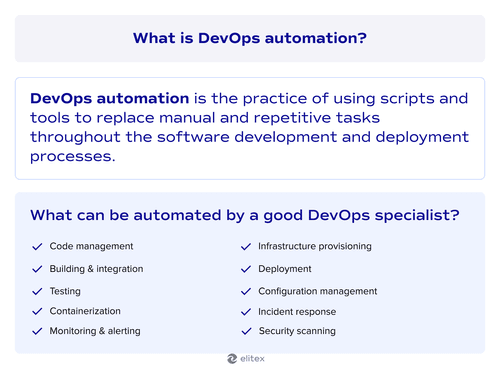
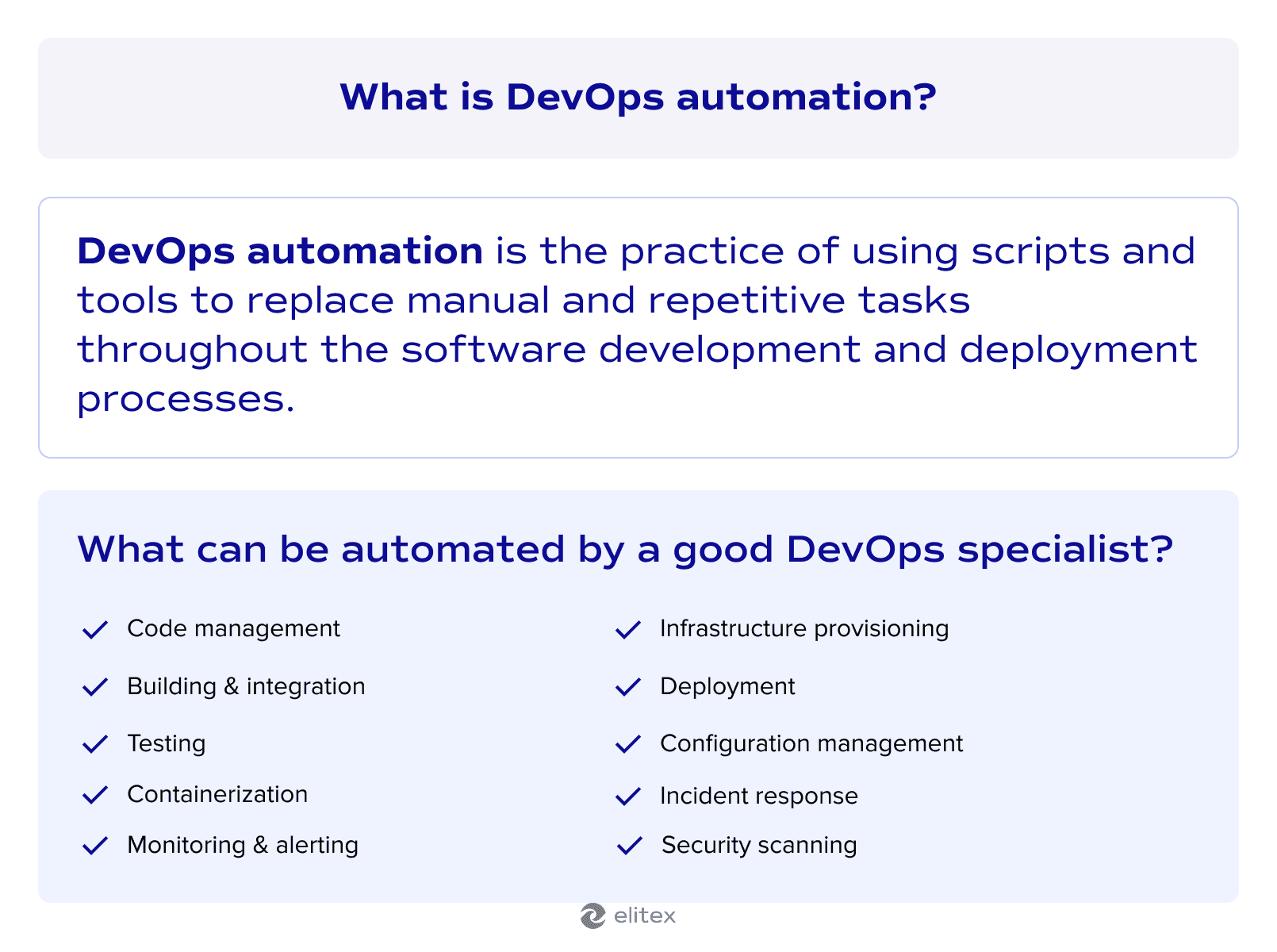
DevOps automation is the practice of using scripts and tools to replace manual repetitive tasks throughout the software development and deployment process. It includes automating code builds, testing, infrastructure provisioning, deployments, and monitoring. DevOps automation creates standardized workflows that ensure consistency, reduce human error, and enable teams to deploy code more frequently with higher quality.
At its core, DevOps automation relies on specialized tools that form a continuous pipeline. Version control systems track code changes. Build servers automatically compile code whenever changes occur. Automated testing tools verify functionality without human intervention. Configuration management platforms deploy identical environments across development, testing, and production. Containerization technology packages applications with all dependencies for consistent operation anywhere. Monitoring systems continuously check system health and alert teams to potential issues. Together, these tools form an integrated automation chain that executes in seconds what would take humans hours or even days to perform manually.
What does DevOps automation practically mean for your business?
DevOps automation transforms your software delivery from a manual, error-prone process into a streamlined and predictable operation. It removes human bottlenecks and standardizes workflows across your development and operational teams. With DevOps automation, your company gains three critical measurable business advantages:
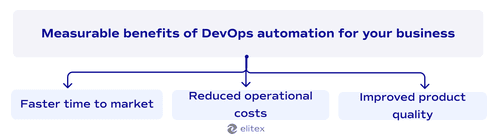
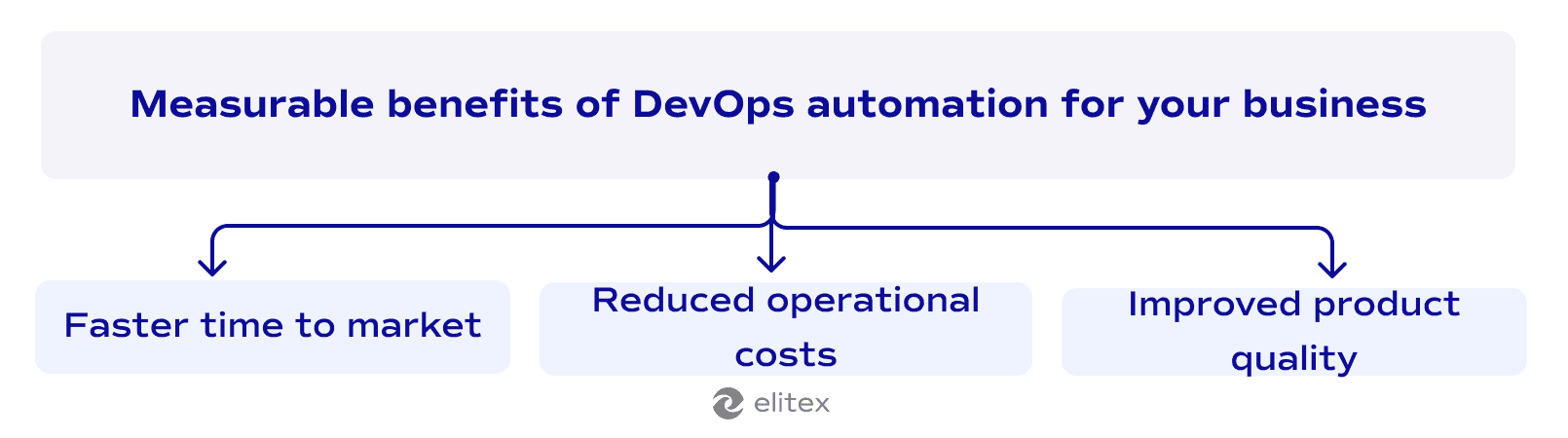
Faster time to market
DevOps automation shortens development cycles from months to weeks. Changes move through testing and deployment in hours instead of weeks. Features reach customers faster, giving your business a competitive edge. Market opportunities no longer pass while waiting for software updates.
Reduced operational costs
Automation eliminates expensive manual work across your IT operations. Engineers spend less time on repetitive tasks and more time on innovation. System failures decrease due to consistent deployment processes. Support costs drop as fewer bugs reach production. Your IT budget shifts from maintenance to growth initiatives.
Another aspect is how DevOps can help to optimize infrastructure cost. Read more in our article.
Improved product quality
DevOps test automation catches issues before they reach customers. Consistent deployment environments eliminate “works on my machine” problems. System monitoring identifies potential failures before users actually experience them. Your product reliability increases, building customer trust and reducing churn rates.
Four key DevOps automation areas
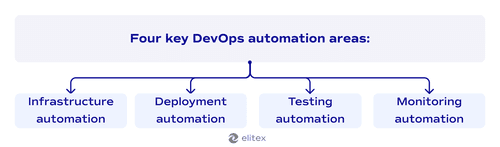
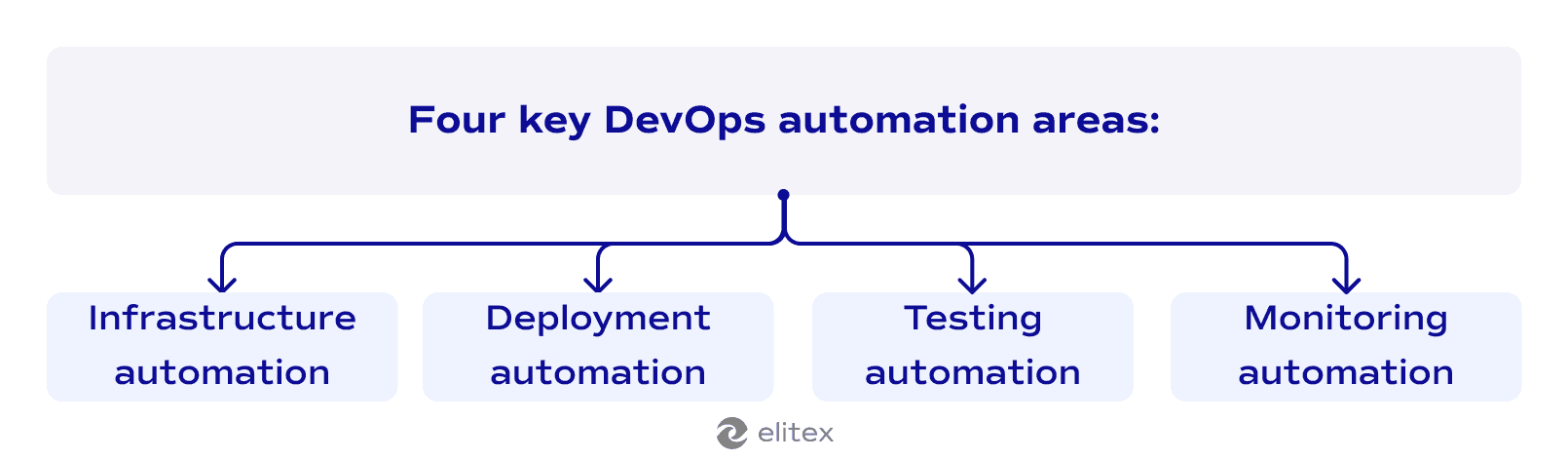
Infrastructure automation
Infrastructure automation services transform physical hardware management into code-driven operations. With professional DevOps expertise, companies cut infrastructure costs up to 10 times through efficient resource utilization. Server provisioning shifts from weeks of manual configuration to minutes of script execution. This approach eliminates environment inconsistencies that cause production failures and costly troubleshooting cycles.
Deployment automation
Deployment automation creates reliable pathways from code creation to production release. Release processes become standardized, eliminating the “works on my machine” syndrome that plagues traditional deployments. Feature delivery accelerates from quarterly releases to daily updates. The business gains the ability to respond to market changes or security threats within hours rather than months.
Testing automation
The automation of testing builds quality assurance into every development step. Manual verification bottlenecks disappear as automated test suites execute thousands of scenarios in minutes. Developer productivity increases as immediate feedback prevents defects from progressing further in the pipeline. Products reach customers with fewer bugs, resulting in higher satisfaction and lower support burdens.
Monitoring automation
Monitoring automation converts invisible system behaviors into actionable intelligence. Unlike manual checks that may miss critical trends, automated monitoring captures performance patterns 24/7 across your entire infrastructure. This constant vigilance identifies potential failures days before they manifest as customer-facing issues. When incidents do occur, root cause analysis that once took hours happens in minutes, slashing mean time to recovery by up to 70%. The business benefit extends beyond traditional metrics to tangible customer retention and brand protection.
Common DevOps automation tools and practices
- Continuous Integration (CI): Automatically builds and tests code with each commit, catching integration issues immediately and reducing debugging time by up to 80%.
- Continuous Delivery (CD): Extends CI by automatically deploying code to testing environments, ensuring code is always in a deployable state.
- Infrastructure as Code (IaC): Manages infrastructure through configuration files rather than manual processes, treating servers and networks as versioned software components.
- Configuration management: Automates system setup and maintenance across all environments, eliminating configuration drift and human error.
- Containerization: Packages applications with dependencies into standardized units, eliminating environment inconsistencies and enabling consistent deployment anywhere.
- Microservices architecture: Breaks applications into small, independent services that teams can develop, deploy, and scale separately for faster delivery cycles. Here, we have a dedicated article about microservices logging, and about the role of microservices in DevOps in which we have written more about microservices architecture.
- Test-Driven Development (TDD): Creates tests before writing functional code, ensuring every feature meets requirements and improving code quality from the start rather than fixing issues later.
- Version control: Tracks changes to code and configuration files, enabling collaboration, rollback capabilities, and complete modification history.
- Monitoring and DevOps observability: Collects and analyzes metrics, logs, and traces across systems, providing real-time visibility for proactive issue resolution.
-
Chaos engineering: Deliberately introduces system failures to test resilience, identifying weaknesses before they affect users.
Here's a separate article dedicated to the best DevOps automation tools and another one about the latest DevOps trends.
The DevOps automation ecosystem
These tools and practices form an integrated DevOps ecosystem that amplifies the DevOps benefits outlined earlier. When implemented with professional guidance, they create a continuous feedback loop that transforms software delivery from a periodic, high-risk event into a routine business process. Organizations that adopt these practices not only slash development cycles and operational costs but fundamentally change how technology supports their business objectives. Rather than being limited by technical constraints, companies gain the ability to quickly adapt to market changes, security threats, and customer needs, creating a sustainable competitive advantage in an increasingly digital marketplace.
Let’s take a closer look at practical examples
Now, let’s check 3 practical examples:
DevOps automation for the e-commerce business
At Smartrr, DevOps solutions & automation services from ELITEX completely changed their e-commerce platform’s performance. The ELITEX team created automated scaling solutions (for the infrastructure) that split the crash-prone monolithic backend into Cloud Run services that expand on demand. ELITEX built a dedicated webhook processor that automatically handles thousands of Shopify notifications without any manual intervention. These automation improvements significantly cut overall deployment time by up to 30%, eliminated manual scaling headaches, and allowed the system to handle 5x more traffic without adding costs, enabling Smartrr to grow fivefold in less than a year while maintaining rock-solid reliability.
DevOps automation for the AI startup
In case of another AI startup development we were involved in, the infrastructure was a disaster waiting to happen. Developers manually SSH'd into exposed servers, pulling code from repositories and restarting services by hand, like it was two decades ago. Some of their databases were exposed to the internet. ELITEX's DevOps engineers stepped in and rebuilt everything in just 30 days. They created bulletproof pipelines that automatically deploy code through dev, staging, and production; no human hands required.
The secret? AWS ECS containers that spin up when traffic spikes, then vanish when idle. Infrastructure costs plummeted while performance soared. Security hardening now protects patient data with HIPAA-grade compliance. The old system crashed under load; the new one treats traffic surges like a gentle breeze. Best part? Developers can finally sleep at night instead of babysitting broken servers.
Here we have a dedicated article about healthcare compliance automation with DevOps.
DevOps automation for the scientific publishing platform
For STM, a scientific publishing giant, ELITEX built automated DevOps pipelines that handle security checks, integration testing, and deployments across STM's entire AWS infrastructure. Our team integrated Datadog to create real-time dashboards showing downtimes, application health, and security alerts. These automated systems caught critical issues before production, virtually eliminating human error during deployments. The monitoring framework operates hands-free, requiring no manual data handling. Result? Faster incident response, minimal production downtime, and complete platform visibility through shared dashboards that keep STM's team informed 24/7.
You can find more real-world DevOps automation examples in a dedicated article.
Getting started with DevOps automation
Getting started with DevOps solutions and automation services requires more than just tools and practices—it demands profound expertise. The smartest approach in case you want to begin your automation journey is to partner with experienced DevOps specialists who’ve already solved the challenges you’re facing.
ELITEX bring decades of collective experience from dozens of successful automation projects across industries. Our specialists don’t just implement tools; they design custom automation strategies that fit your specific needs. Whether you’re dealing with legacy systems or building pipelines from scratch, we’ve been there. We turn painful manual processes into smooth, automated workflows that let your team focus on innovation instead of infrastructure fires. So, are you ready to escape deployment nightmares and embrace automation that actually works?


POSTED IN: