



Code changes create ripple effects that can surface days or even weeks after successful deployments. That’s why, in 2026, smart and effective development teams rely on proactive testing strategies as their primary defence mechanism. One of the most effective mitigation approaches in case of proactive testing involves DevOps test automation that allows product teams to catch issues well before they affect end users. Under this scenario, automated testing runs comprehensive checks before problematic code creates real problems. This approach shifts quality control left in the development cycle.
But well-tuned testing is more than just mere QA. Automated testing forms a critical piece of the broader DevOps & automation services puzzle, as it integrates well with deployment pipelines, monitoring systems, configuration management solutions, infrastructure orchestration software, and other aspects of the DevOps lifecycle and DevOps paradigm. Also, we should add that automated testing is a critical part of continuous delivery workflows. In fact, in properly calibrated environments, tests even act as the primary gatekeepers for product releases. That’s where DevOps automation testing appears.
What do properly calibrated environments and truly automated testing mean? Basically, it means that your team executes thousands of individual tests with each code commit. These validation checks run across multiple environments to catch issues at different stages. What does it mean? Those teams that implement comprehensive test automation can easily deploy code multiple times daily without breaking user experiences. The result is faster delivery cycles with reduced risk of production incidents. But let’s take everything step by step.
What is DevOps test automation?
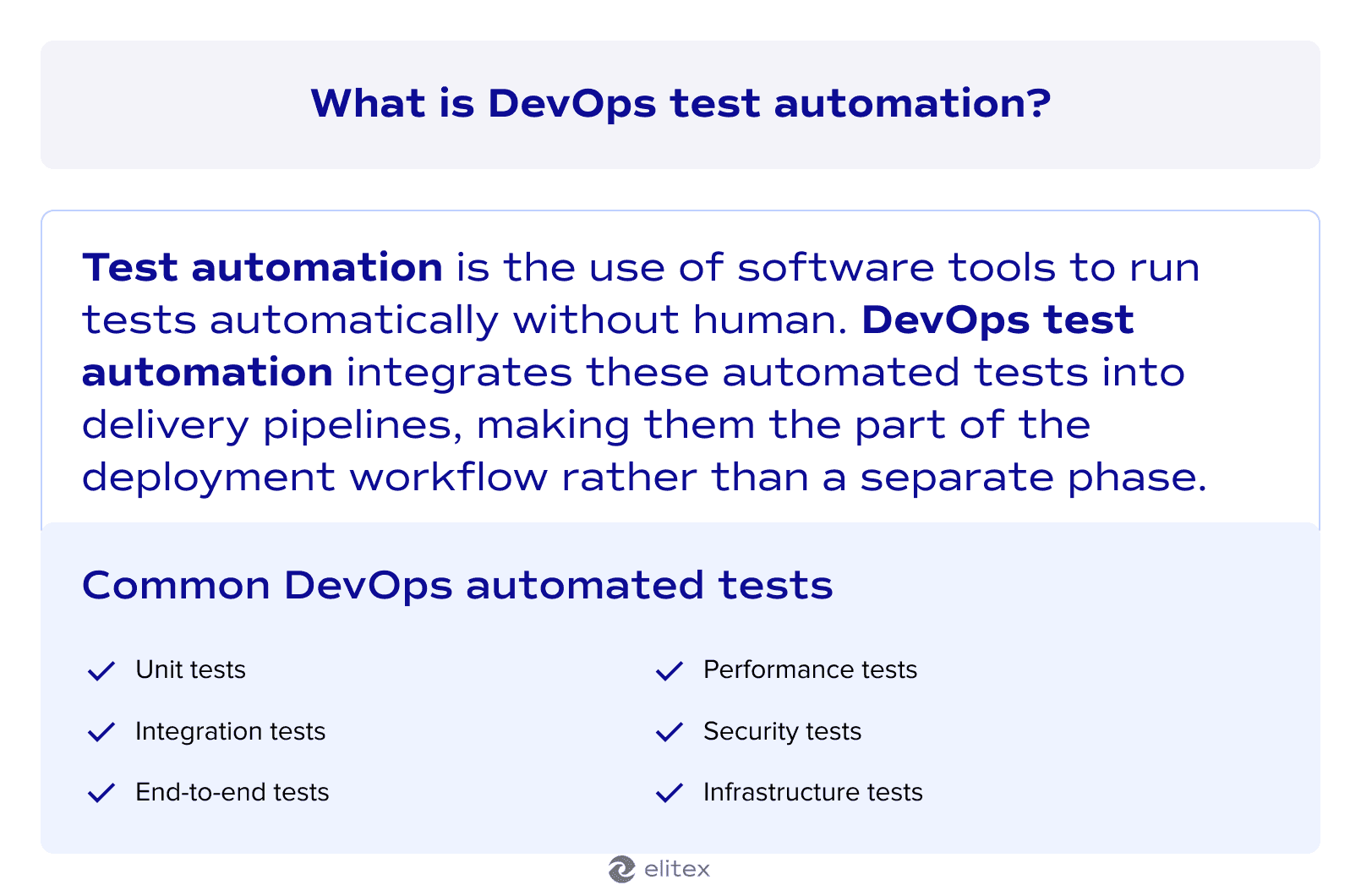
Let’s demystify it step by step. Test automation is the practice of using software tools and scripts to execute tests automatically, eliminating human intervention from the testing process and removing dedicated testing phases from development workflows.
DevOps integrates this automated testing directly into continuous delivery pipelines, making quality checks an automatic part of every code deployment. This integration shifts testing from a separate gate-keeping phase to a continuous validation process that runs alongside development.
DevOps test automation connects development velocity with quality assurance: automated tests provide immediate feedback on code changes while enabling rapid deployment cycles.
Test automation is an essential part of any DevOps maturity model.
Examples of commonly automated types of tests under the DevOps paradigm:
- Unit tests catch bugs at the source by testing individual functions and methods. Developers run these lightning-fast checks thousands of times daily during coding sessions.
- Integration tests expose the chaos that happens when separate code modules try to work together. These tests reveal miscommunication between APIs, databases, and third-party services.
- End-to-end tests act like digital quality agents, clicking through entire user workflows to spot interface bugs and broken user journeys.
- Performance tests stress-test applications under heavy load conditions. For instance, they simulate Black Friday-like traffic spikes to identify which components will crash first (if they will).
- Security tests look for code vulnerabilities that may be exploited, scanning dependencies for known threats and checking authentication mechanisms.
- Infrastructure tests verify that servers, networks, and cloud configuration match deployment requirements, preventing environment-related deployment failures.
Also, read our article where we juxtapose manual testing with automation testing.
Why DevOps test automation matters for modern teams
Here are several simple arguments why almost any digital business should consider DevOps test automation.

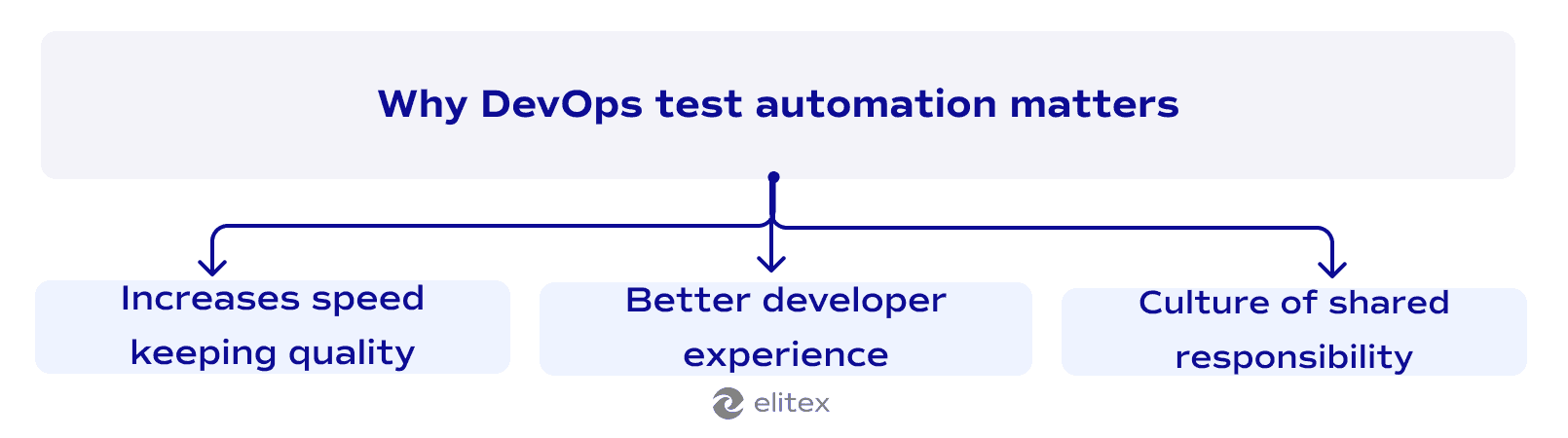
Speed without sacrificing quality
Automated tests catch bugs before they reach production, preventing costly rollbacks and emergency fixes. Teams deploy code multiple times per day because tests validate each change instantly. Manual testing bottlenecks disappear when DevOps ecosystem and test automation work together.
Better developer experience means better code
Developers receive immediate feedback on code quality instead of waiting for manual testing cycles. They fix issues while code context remains fresh, reducing debugging time significantly. Confidence grows when comprehensive automated checks validate every commit.
Shared responsibility across teams
One of the main DevOps benefits is a culture of shared responsibility. Similarly, testing becomes everyone’s responsibility rather than the QA department’s headache. The entire team contributes to test creation and maintenance, spreading quality ownership throughout the organization. Operations teams deploy with confidence because automated tests verify system stability before release.
Key components of DevOps test automation
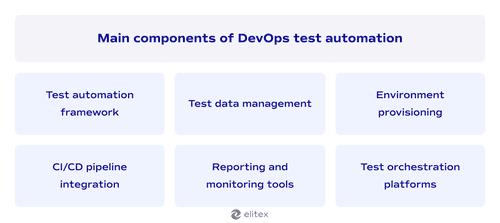
DevOps test automation has distinct technical components that teams need to implement, like CI/CD integration, test frameworks, environment management, and monitoring tools. These components work together to create an automated testing system within DevOps workflows. Here are some of these components:
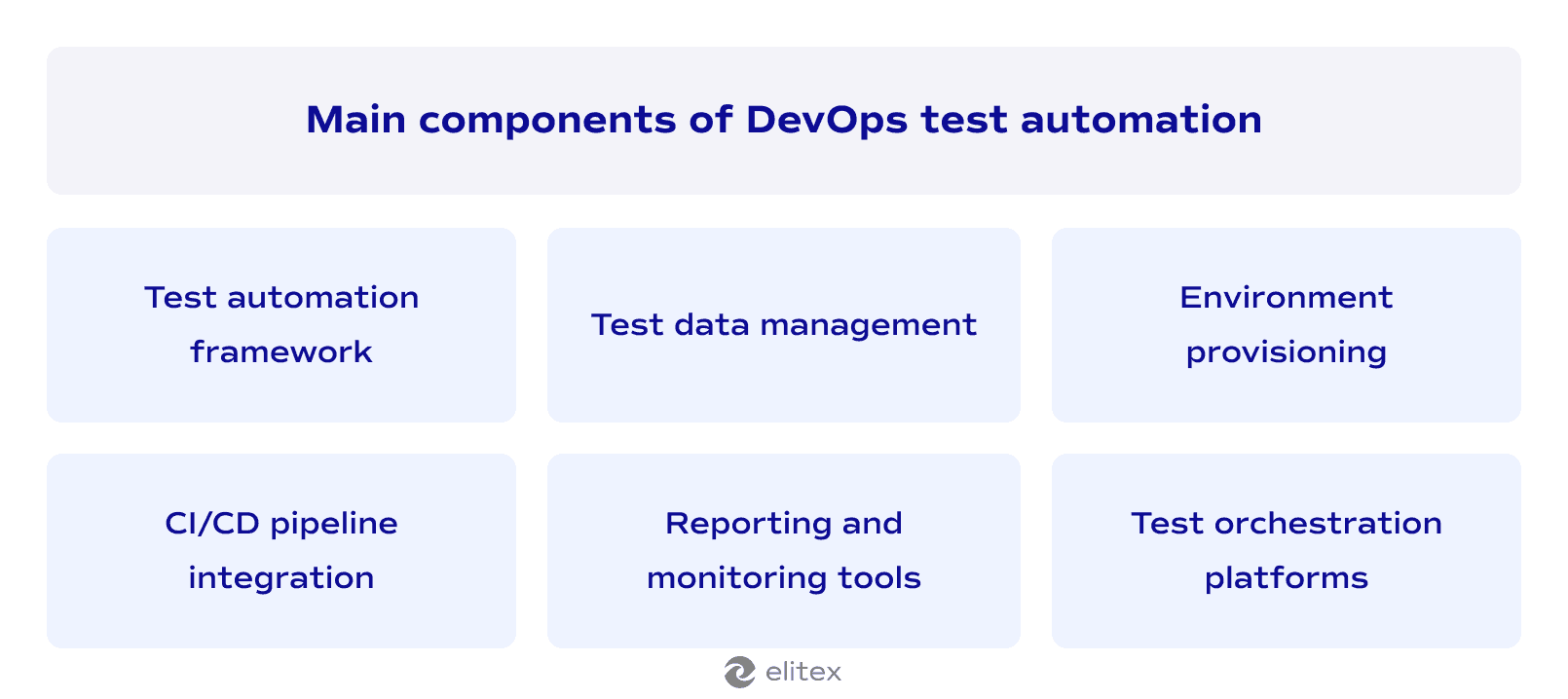
Test automation frameworks
The frameworks provide the foundation for writing and executing tests across different environments. Selenium, Cypress, Jest, or other frameworks define how tests are structured, run, and reported.
CI/CD pipeline integration
Automated tests trigger when developers commit code, blocking deployments if quality checks fail. This integration provides the bridge between DevOps workflows and automated testing, ensuring quality validation happens automatically at every stage of the software lifecycle. However, configuring these pipelines properly requires specialized knowledge, which is why many teams rely on CI/CD implementation services to set up special tools and processes correctly.
Test data management
Automated testing systems create, maintain, and refresh test data across various environments without manual intervention. This includes generating synthetic data that mimics production patterns, creating database snapshots for consistent baseline testing, and masking sensitive information to protect privacy. Clean, well-managed test data prevents false positives and ensures consistent test results across different environments.
Reporting and monitoring tools
These tools track rest results, identify unstable tests, and provide software quality metrics to development teams. Dashboards show test coverage, execution trends, and failure patterns over time. Flaky tests detection helps teams focus maintenance efforts on unreliable tests that create noise in the feedback loop.
Environment provisioning
Automated infrastructure creation ensures tests run in consistent, isolated environments. On-demand environment spinning eliminates configuration drift between testing stages. Environment consistency eliminates the “work on my machine” problem that plagues manual testers.
Test orchestration platforms
These platforms coordinate different test types, manage parallel execution, and optimize test run times across available resources, making the overall process more precise and well-coordinated.
Common challenges and best practices to overcome them when implementing DevOps test automation
The following section will be useful for specialists with a technical background who need implementation details and architectural considerations for automating tests. For practical implementation examples without tech jargon, dive into the section “Real-world examples & case studies of DevOps test automation.”
| Challenge | Practice to mitigate/overcome the challenge |
| Slow test execution blocks deployment | Implement parallel test execution and smart test selection algorithms. Prioritize fast unit tests in early pipeline stages. Use test result caching to avoid re-running unchanged components. |
| Flaky tests create false failures | Establish strict testing practices that include test isolations, proper setup and teardown procedures, and deterministic test data creation. Implement automatic retry mechanisms for known environment issues while tracking retry patterns to identify underlying problems. |
| Low test coverage creates production bugs | Set minimum unit test coverage thresholds that block deployments below acceptable levels. Create coverage reports that highlight untested code paths and integrate them into code review processes. Encourage developers to write tests before implementing features. |
| Tests break frequently with code changes | Design maintainable test suites using page object models, shared test utilities, and abstraction layers. Implement flexible project management approaches that allocate dedicated time for test maintenance alongside feature development. |
| Team lacks testing expertise | Provide comprehensive training programs that bring the entire team up to speed on testing methodologies and tools. Establish mentorship programs where experienced testers guide developers in writing effective tests. Create internal documentation and testing standards. |
| Environment inconsistencies cause test failures | Implement infrastructure as code that creates identical testing environments across all stages. Use containerization to ensure consistent runtime environments and automated provisioning scripts that eliminate manual configuration drift. |
| Test data management becomes complex | Create automated test data generation pipelines that produce realistic datasets without exposing sensitive production information. Implement database seeding scripts and data cleanup procedures that maintain consistent test states. |
Choosing the right tools for DevOps test automation
Another aspect of successful implementation of test automation in DevOps involves selecting tools that match your team’s capabilities and infrastructure. Previously, we have written a comprehensive guide on DevOps automation tools, where we described all kinds of useful DevOps tools. Besides CI/CD, monitoring, infrastructure management, and containerization tools, there, we have a separate section dedicated to the best testing tools that covers the most popular options available today.

Real-world examples & case studies of DevOps test automation
Now, let’s look at two real-world examples demonstrating how organizations successfully integrated test automation and DevOps to achieve measurable business outcomes:
Example of test automation in DevOps in an e-commerce project
Smartrr partnered with ELITEX to build automated testing processes from scratch. The combined team implemented comprehensive test automation using TypeScript and the Playwright framework, which dramatically reduced regression testing time and freed resources for feature development. Integration of DevOps and automation testing enabled biweekly releases with minimal unknown bugs reaching production. This approach helped Smartrr scale their platform architecture, improve system stability, and achieve fivefold company growth within one year.
Example of integration test automation and DevOps in a publishing project
STM partnered with ELITEX to build a secure cloud platform for validating research papers across multiple publishers. The team of ELITEX specialists implemented robust DevOps deployment pipelines with DataDog monitoring that caught errors before production and provided real-time security dashboards. Using test automation in the DevOps paradigm eliminated deployment mistakes and reduced downtime costs through automated vulnerability detection. This approach enabled STM to process sensitive manuscript data securely while maintaining strict privacy standards and achieving seamless integration with publisher systems across the academic publishing industry.
Also, read our article about DevOps examples.
How to get started with DevOps test automation
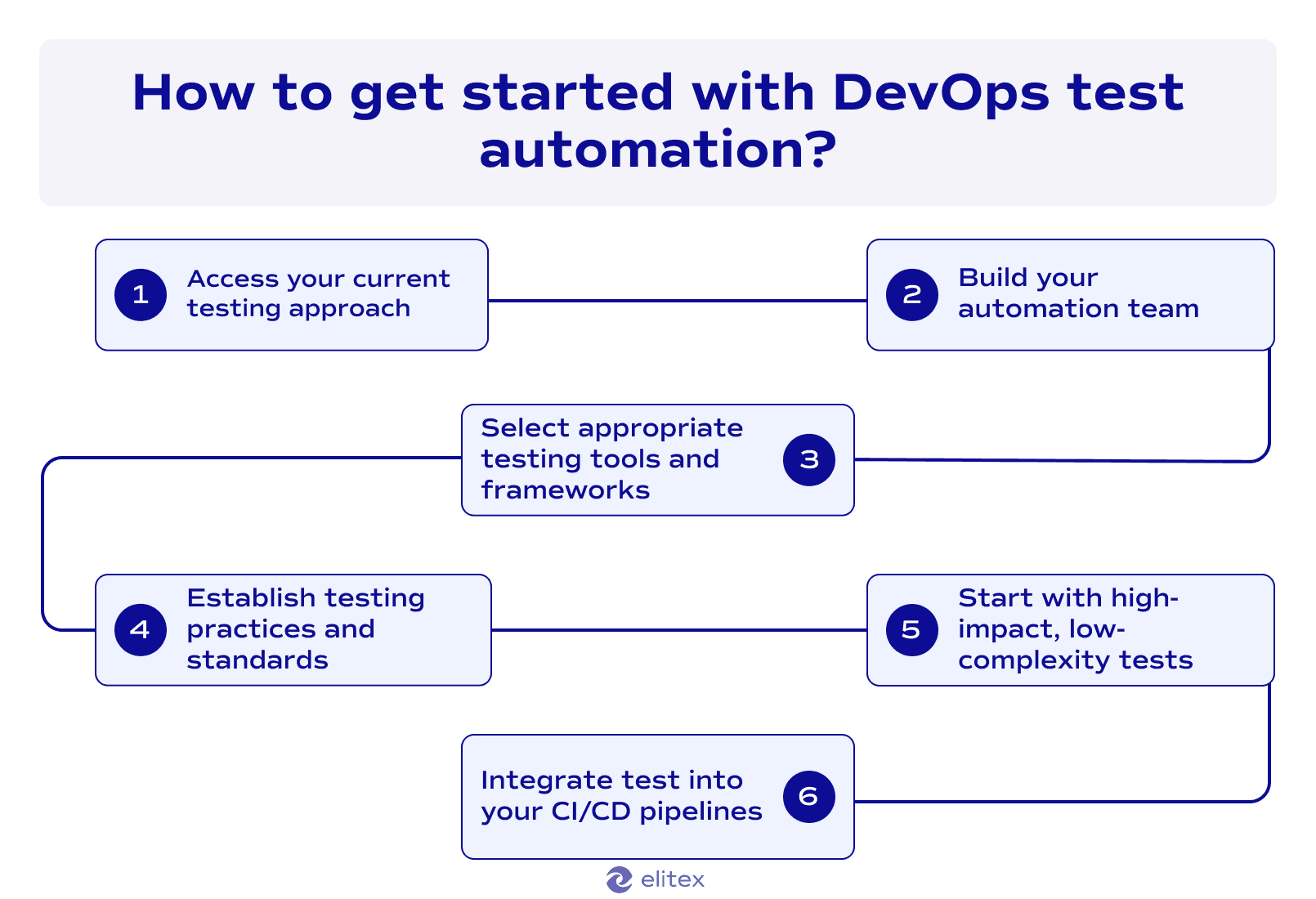
- Access your current testing approach. Evaluate existing manual testing processes and identify which tests consume the most time. Document current workflows, testing tools, and team skills to understand automation readiness.
- Build your automation team. Hire or train automation engineers who understand both development and testing principles. Include DevOps specialists who can configure CI/CD integrations and manage testing infrastructure. These roles bridge development, testing, and operations.
- Select appropriate testing tools and frameworks. Choose testing tools that integrate with your existing development stack and CI/CD pipelines. Consider factors like team expertise, maintenance requirements, and long-term scalability when evaluating options. Popular frameworks include Selenium for web testing, Jest for JavaScript, and Pytest for Python applications.
- Establish testing practices and standards. Define coding standards for test scripts, naming conventions, and test data management approaches.
- Start with high-impact, low-complexity tests. Begin automation with unit tests and simple integration tests that provide immediate value. Focus on stable, frequently executed test cases that currently require significant manual effort. Avoid complex end-to-end scenarios initially.
- Integrate tests into CI/CD pipelines. Configure automated tests to run at appropriate pipeline stages, with fast tests blocking commits and comprehensive tests running before deployments.
Trends in DevOps test automation for 2026-2027
We’ve previously covered broader DevOps trends in our comprehensive article. However, here are the three automation testing focuses for the coming years:
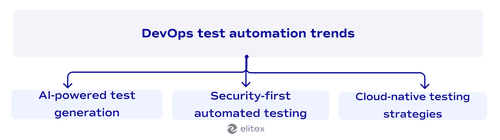
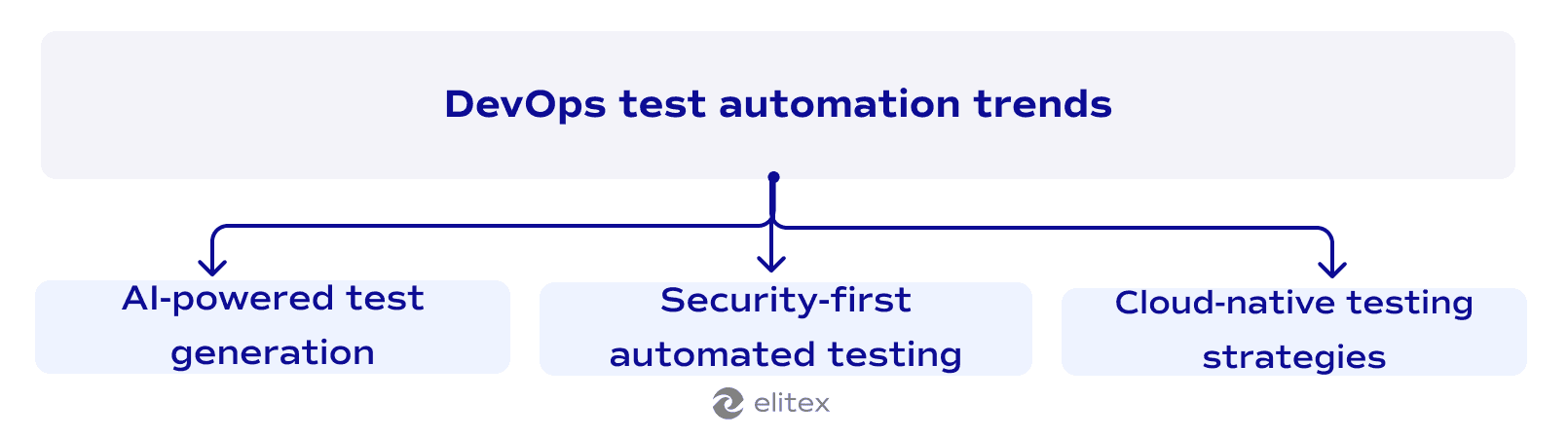
AI-powered test generation and maintenance
In capable hands, machine learning algorithms can now generate test cases automatically from user behavior data and code changes. These systems identify testing gaps and update test scripts when applications evolve, reducing manual maintenance overhead. In the coming years, AI-driven testing will likely become essential for maintaining test coverage. Read more about the role of machine learning in DevOps in our MLOps vs DevOps comparison.
Security-first automated testing
DevSecOps integration makes security testing mandatory at every DevOps pipeline stage. In 2026, automated vulnerability scanning, dependency checks, and compliance validation should run continuously rather than as separate security audits. Security testing shifts left to catch vulnerabilities during development rather than post-development. In the coming years, security automation will likely become the primary defense against increasingly sophisticated cyber threats. Read more about it in our DevSecOps vs DevOps article and healthcare compliance automation with DevOps.
Cloud-native testing strategies
Container-based testing environments and serverless test execution become standard practices. Teams test microservices independently while validating entire system behavior through automated service mesh testing. Kubernetes-native testing tools enable testing at scale across distributed architectures. Cloud-native testing delivers faster feedback loops and reduced infrastructure costs, so in the coming years, we will likely see more of it.
Also read our article about DevOps-as-a-Service
Final thoughts: To wrap things up
Often, test automation starts not with an estimate but with finding a reliable tech partner who understands both your technical requirements and business goals. ELITEX specializes in helping organizations implement robust test automation within their DevOps workflows. Our team combines deep technical expertise with proven experience across industries like e-commerce, publishing, healthcare, fintech, real estate, hospitality, and many others. We provide comprehensive DevOps services and automation solutions that transform manual testing processes into efficient, automated quality gates.
Implementation success depends on having the right expertise at every stage, from initial strategy through ongoing maintenance. ELITEX’s QA automation services include everything from framework selection and test development to CI/CD integration and team training. We work as an extension of your team, ensuring automated testing becomes a competitive advantage rather than a technical burden. ELITEX provide results beyond your initial expectations!


FAQs
What is DevOps test automation?
DevOps test automation is the practice of integrating automated testing directly into continuous delivery pipelines, making quality checks part of every deployment rather than a separate phase in the development process.
How does DevOps automation testing differ from traditional testing?
DevOps automation testing runs continuously throughout the development cycle, providing immediate feedback and blocking deployments when tests fail.
Which tests should I automate first in DevOps automation testing?
Start with unit tests and simple integration tests and simple integration tests that run frequently and provide quick feedback to developers. These tests offer immediate value while being easier to maintain than complex end-to-end scenarios.
How long does the implementation of test automation in DevOps take?
From our practice, this implementation typically takes from 3 to 6 months, depending on your existing infrastructure, team size, and automation scope. Simple setups can be operational within weeks, while comprehensive automation requires longer planning and execution.
What tools are essential for test automation in DevOps workflows?
Essential tools include testing frameworks like Selenium or Jest, CI/CD platforms such as Jenkins or GitLab, environment provisioning tools, and monitoring systems that integrate seamlessly with your existing development stack.
Can small teams benefit from DevOps testing automation?
Yes, small teams often gain the most value from automated testing by eliminating manual testing bottlenecks and enabling faster release cycles. Automation helps small teams achieve enterprise-level deployment frequency without additional resources.
How does automation testing in DevOps improve deployment frequency?
Automated tests validate code changes instantly, eliminating manual testing delays that traditionally slow deployments. Teams can deploy multiple times daily because tests provide immediate confidence in code quality without human intervention.
What’s the ROI of implementing DevOps test automation?
From our practice, companies see a 50-70% reduction in testing time and significantly fewer production bugs within the first year. The investment pays for itself through reduced debugging costs and faster feature delivery.
POSTED IN: