



- TL;DR: DevOps as a Service is an operational model where external providers assume complete responsibility for your entire DevOps operations (you typically don’t have any in-house team with this model).
- Under this model, external server providers usually handle CI/CD pipelines, infrastructure management, monitoring, and deployment processes.
- Unlike traditional DevOps outsourcing, where consultants deliver projects and leave, DevOps as a Service provides ongoing operational management continuously.
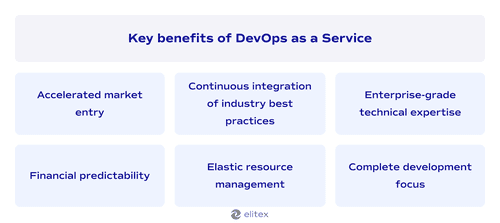
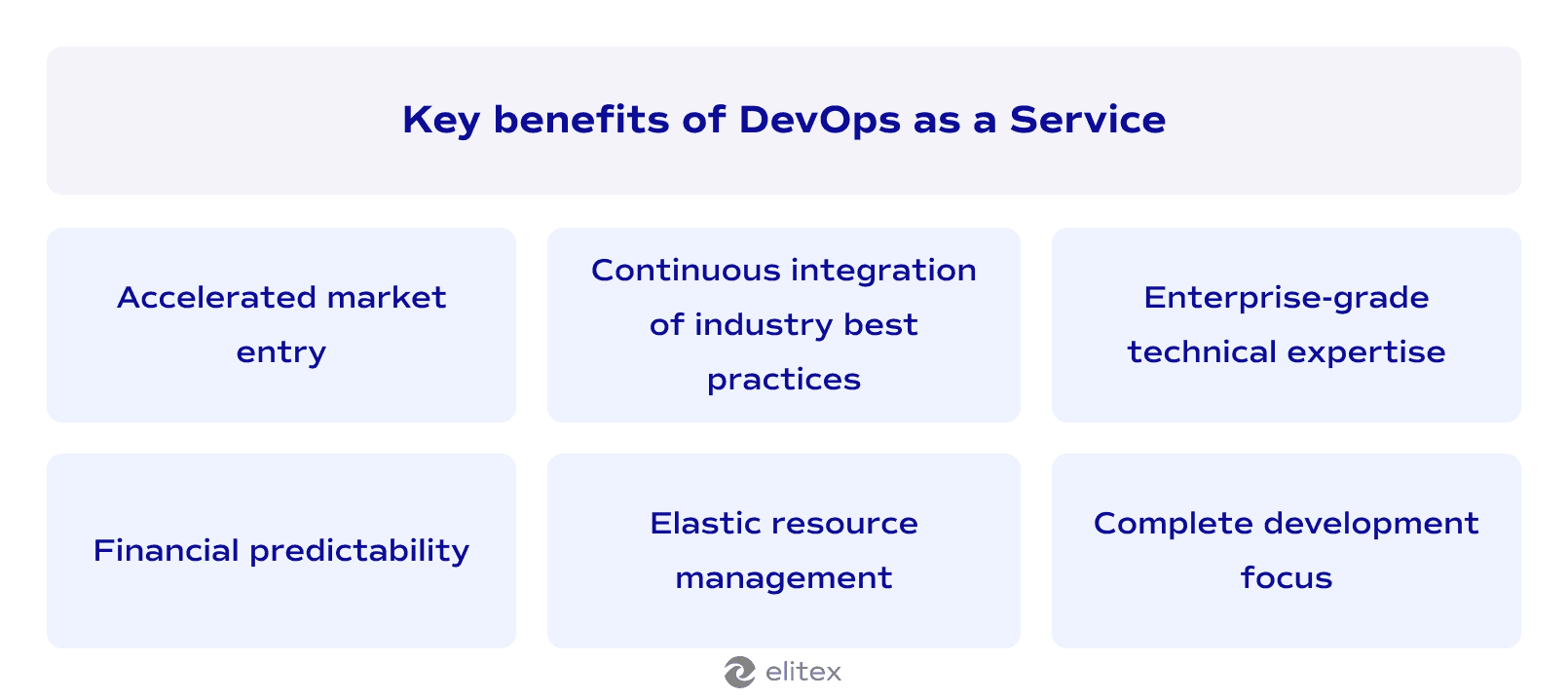
- Key benefits of this model include accelerated market entry, enterprise-grade expertise access, financial predictability, and complete development focus.
- In this guide, we prepared a detailed market analysis for 2026 and beyond.
- Also, we provided two Fortune 500 case studies for enterprises that adopted DevOps-as-a-Service and identified the top 4 service providers available today.
- Additionally, we wrote a step-by-step implementation guide for this model.
DevOps' importance in 2026 requires no explanation anymore. At least we hope so. However, from our practice, most companies seeking external DevOps expertise approach this challenge with familiar assumptions about software development outsourcing. When resorting to DevOps outsourcing, companies just expect to hire specialists who charge hourly rates for specific tasks.
But the reality is that the industry has developed fundamentally different models. One of them is called DevOps as a Service (DaaS). This approach operates on entirely different principles from traditional DevOps outsourcing.
ELITEX have spent more than a decade delivering various DevOps and automation services to companies across multiple industries. Through our extensive experience, we’ve witnessed the evolution of the DevOps market from traditional consulting approaches to comprehensive DaaS and DevOps managed service models. That’s precisely why we want to explore this alternative approach and help you understand how DevOps as a service might transform your operational strategy. So, let’s go!
What is DevOps as a Service?
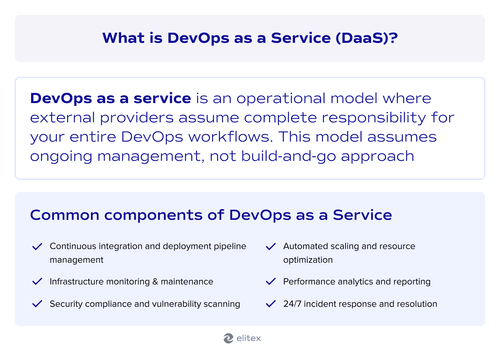
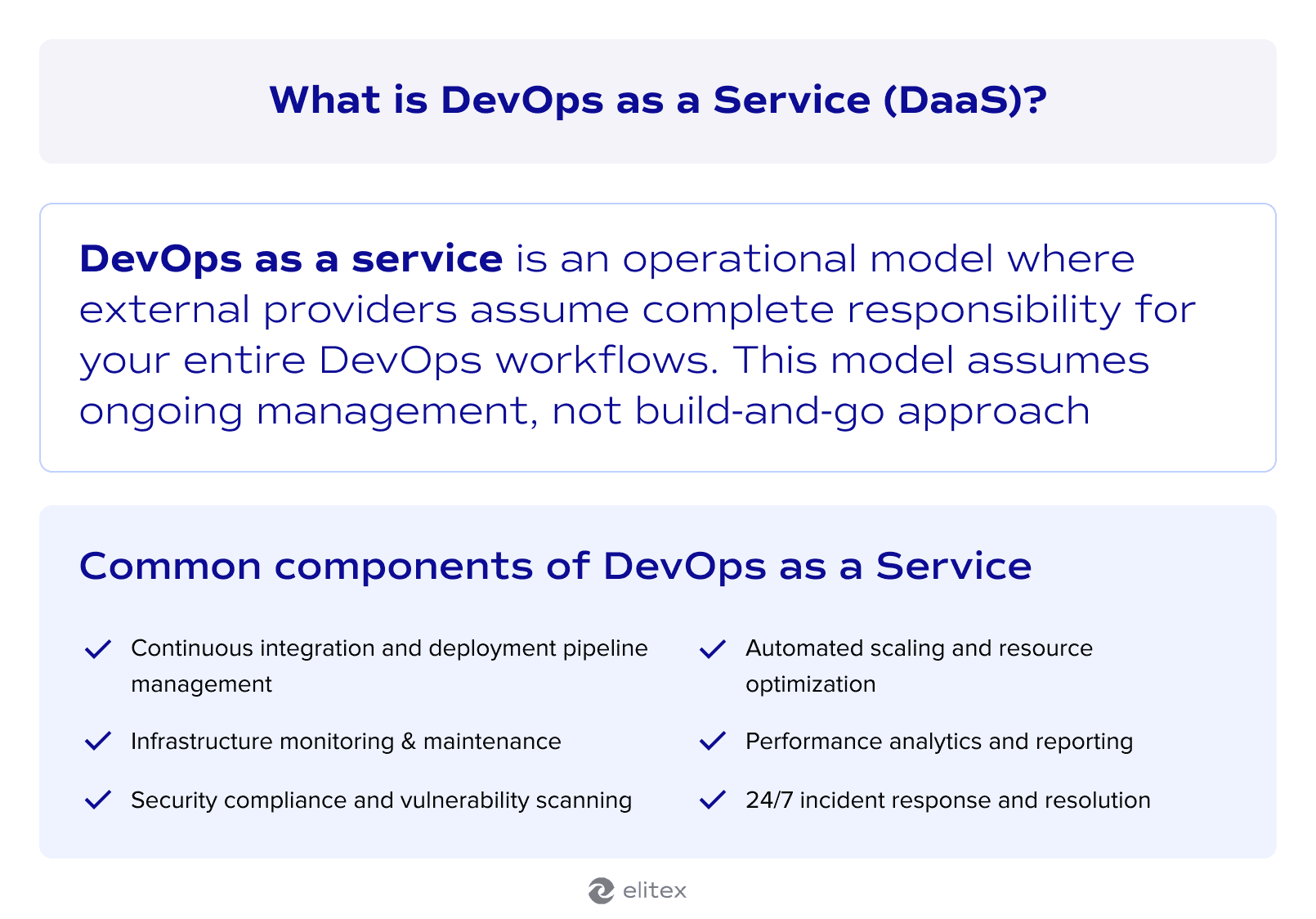
DevOps as a Service is an operational model where external providers assume complete responsibility for your entire DevOps operations, not for its specific parts or areas. With DevOps as a service model, you typically do not care about in-house DevOps at all, leaving it for the DaaS provider.
Unlike traditional DevOps consulting services, where specialists deliver specific projects/deliverables and then leave, this approach provides ongoing management of your development processes, infrastructure, deployment workflows, and security operations through dedicated teams who handle everything from automated DevOps pipelines to incident response.
Common components of DevOps as a Service:
- Continuous integration and deployment pipeline management;
- Infrastructure monitoring and maintenance;
- Security compliance and vulnerability scanning;
- Automated scaling and resource optimization;
- Performance analytics and reporting;
- 24/7 incident response and resolution.
DevOps as a Service vs traditional DevOps outsourcing
Now, let’s compare it with traditional DevOps outsourcing:
| Aspect | DevOps as a Service | Traditional DevOps services |
| Service model | Ongoing operational responsibility | Project-based, goal-oriented consulting |
| Ownership | Provider owns the entire DevOps operations | Client retains entire ownership after delivery |
| Duration | Continuous long-term partnerships | Typically fixed-term contracts |
| Pricing | Monthly subscription fees | Hourly rates or project costs, depending on the software pricing model |
| Team structure | Dedicated remote teams | Temporary consultant assignments |
| DevOps practices | Provider implements and maintains DevOps ecosystem | Consultants establish DevOps culture, transfer knowledge, and then leave |
| Knowledge transfer | Minimal knowledge transfer | Extensive knowledge transfer |
| Scope of DevOps services | Comprehensive ongoing DevOps support | Depends on the specific contract, delivery of pre-defined services |
| Risk management | DaaS provider assumes operational and performance risks | During the contract, it depends; after project completion, the client bears all risks |
| Cost-efficiency for short-term needs | Higher costs for short-term or one-time projects | More cost-effective for specific projects and limited engagements |
| Vendor independence | Long-term dependency on a single service provider | Freedom to work with different specialists for various projects |
| Performance accountability | Provider accountable for system uptime and performance metrics | Consultant accountability ends with project delivery |
Key benefits of DevOps as a Service
Accelerated market entry
DevOps as a service model eliminates setup delays that plague traditional consulting engagements. With DaaS, your software development process starts immediately with pre-configured pipelines and established workflows. In most cases, choosing DevOps as a Service is the fastest solution.
Continuous integration of industry best practices
In a word, your operations benefit from collective operational intelligence across multiple production environments. How does it work? Let’s see.
The distinction between traditional DevOps consultants and DaaS providers lies in operational accountability. While both work across multiple clients, top DevOps-as-a-service providers live with all the consequences of their decisions every day. When they discover that a monitoring configuration prevents downtime across several environments, they immediately implement that improvement for their entire client base.
Traditional consultants also might recognize the same patterns, but they lack ongoing operational relationships to implement improvements after project completion. Because DaaS providers face direct accountability for uptime and performance metrics, they must continuously refine their approaches based on real-world results, creating powerful incentives for operational learning that project-based consultants don’t experience.
Enterprise-grade technical expertise
Finding DevOps engineers who understand the full technology stack still remains incredibly difficult. The big advantage of DaaS providers is that, due to narrow specialization, they are likely already employing specialists for most commercial technologies and tools. These specialists have already solved the configuration challenges and compatibility issues that typically consume weeks of troubleshooting time. This means that with DaaS, you access deep technical expertise immediately without the lengthy hiring processes, competitive salary battles, or knowledge gaps that plague internal DevOps teams.
Financial predictability that actually works
Monthly subscription models transform DevOps from a cost center with unpredictable spikes into a predictable operational expense. This consistency enables accurate budget forecasting and eliminates the unpleasant surprises with hourly consulting rates during crisis periods.
Elastic resource management
In cases where your business demands constant fluctuations, DevOps as a Service is a go-to choice that gives you the required flexibility. In their very nature, DaaS teams adjust their focus and resource allocation based on your current requirements without lengthy contract negotiations, recruitment delays, and other hiring/firing.
Complete development focus
Perhaps the most valuable benefit for many teams involves what actually doesn’t happen. Your developers stop spending time on infrastructure management and pipeline maintenance. They focus entirely on building features that drive straightforward business value. Although not for every team, this separation can easily create productivity gains that often justify the entire DaaS investment.
Industries benefiting from DevOps as a Service
What does DevOps as a Service mean for different industries, and why do they prefer it over other engagement models? Let’s see!
- Healthcare: Reliability and compliance are non-negotiable. Patient data systems need 99.9% uptime while maintaining complex HIPAA standards that most internal teams can’t handle properly. Read more about healthcare compliance automation and role of DevOps in healthcare.
- eCommerce: Traffic spikes during Black Friday or flash sales can make or break quarterly revenue. DaaS providers automatically handle these sudden load increases without the panic of emergency infrastructure scaling. Your checkout systems stay online when it matters most.
- Fintech: Security regulations in financial services are brutal. Between PCI compliance, fraud detection, and disaster recovery requirements, specialized providers simply know these systems better than internal teams who are learning as they go.
- SaaS companies: Feature deployment speed directly impacts customer churn and competitive positioning.
- Gaming: Player experience depends entirely on performance. DaaS teams manage complex server scaling across multiple regions while maintaining low-latency connections that keep gamers happy. When your game lags during peak hours, players find alternatives quickly.
- Media and entertainment: Streaming services live or die by uptime during peak viewing periods.
- Logistics and supply chain: Real-time tracking systems connect warehouses, transportation networks, and customer interfaces that all need to communicate flawlessly. The integration complexity alone justifies specialized expertise.
Use cases of DevOps as a Service
First, let’s look at a typical DevOps as a Service pipeline:
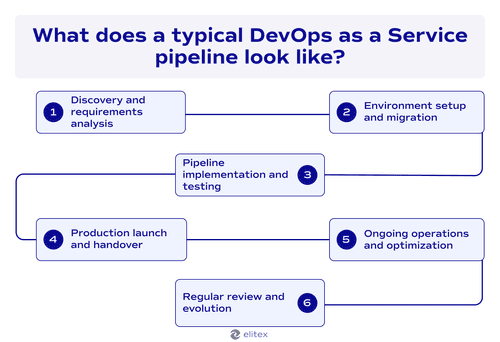
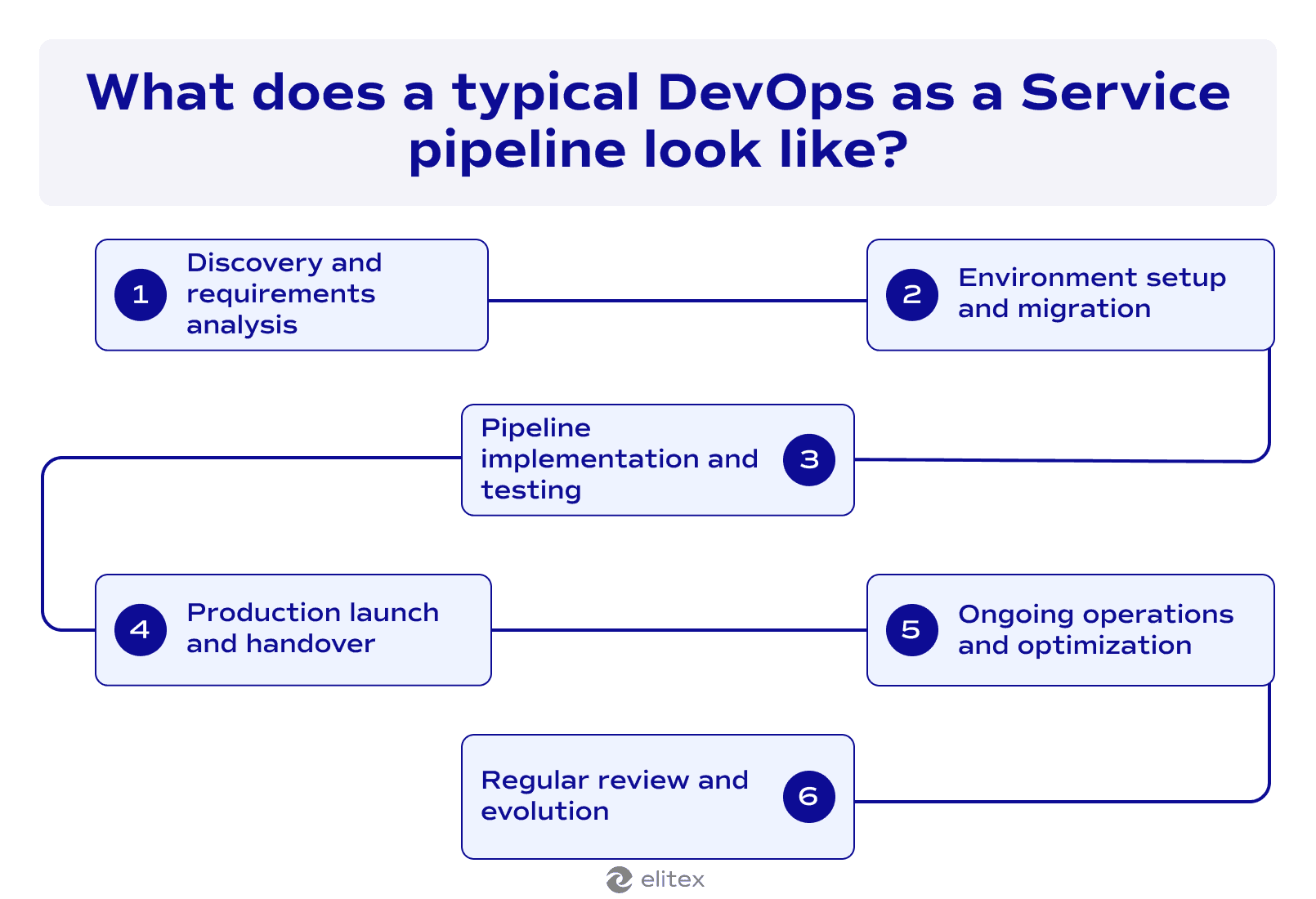
Step 1: Discovery and requirement analysis: Any involvement of external DevOps expertise starts with an initial consultation to assess current infrastructure, identify pain points, define success metrics, and establish service scope and SLA requirements.
Step 2: Environment setup and migration: Then, service providers typically start to provision scalable cloud infrastructure using infrastructure as code principles to ensure continuous deployment. This process begins with automated provisioning templates that create standardized environments across development, staging, and production. Secure networking protocols are established to protect data transmission and access points. Existing applications migrate to the new environments with carefully planned procedures that minimize business disruption. Comprehensive monitoring systems provide visibility into all infrastructure components while security controls maintain compliance with industry standards.
Step 3: Pipeline implementation and testing: When infrastructure is ready, teams build CI/D pipelines that integrate directly into the software development lifecycle. Automated build processes trigger with each code commit, followed by end-to-end testing frameworks that validate quality and security. The continuous delivery pipeline then automates deployment procedures across environments, ensuring smooth releases from development to production. Controlled testing validates each component before full activation.
Step 4: Production launch and handover: Once pipelines pass validation, the actual production launch begins with systematic deployment of live systems. At this stage, operational control transfers to the dedicated DaaS teams who configure essential DevOps tools for real-time system management. Communication channels get established between your team and theirs to ensure seamless collaboration.
Step 5: Ongoing operations and optimization: Daily operations now focus on maintaining system performance through continuous monitoring and proactive improvements. This includes managing container orchestration for scalable application deployment while implementing robust security measures that protect against emerging threats. Performance optimization happens based on actual usage patterns and system behavior. Also, at this stage, DaaS teams try to gain complete DevOps observability.
Step 6: Regular review and evolution: Scheduled assessments evaluate overall system performance and identify opportunities for strategic improvements. These reviews encompass infrastructure evolution planning, disaster recovery testing, and alignment with changing business requirements. Continuous service enhancement ensures your DevOps maturity adapts to technological advances and organizational growth.
Actual companies that preferred DevOps as a Service over alternatives
Two major Fortune 500 companies are well-known examples of choosing DevOps as a Service over traditional internal teams or consulting models.
Capital One
Capital One, the Fortune 500 financial services giant, completed an extraordinary 8-year transformation (2012-2020) that made it the first US bank to exit all data centers and go “all in” on AWS. This comprehensive DevOps transformation involved deep collaboration with AWS Professional Services and resulted in a 99% reduction in infrastructure provisioning time, which positioned Capital One as a “technology company that does banking”.
Why did Capital One choose DaaS over internal development? The decision centered on speed and regulatory expertise that internal teams couldn’t develop quickly enough to compete with digital-native financial services. Development environment build times averaging 3 months created massive bottlenecks, while manual infrastructure provisioning and quarterly releases made innovation impossible at the pace required by modern banking customers.
The results proved transformational: Capital One achieved multiple deployments per day instead of quarterly releases, reduced transaction errors by 50%, and built 80% of their nearly 2,000 cloud applications from scratch. They successfully closed all 8 on-premises data centers while scaling their technology team to 11,000 members and maintaining over 500,000 automation pipelines daily.
Southwest Airlines
Southwest Airlines, the Fortune 500 airline serving 120+ destinations with 4,000+ daily flights, underwent an accelerated DevOps transformation with GitLab Professional Services following their December 2022 operational crisis. The holiday meltdown resulted in 16,700+ flight cancellations and $800+ million in losses, exposing critical weaknesses in their 20-year-old crew scheduling systems that couldn’t handle disruption recovery. This crisis catalyzed a comprehensive modernization effort that transformed Southwest from having the worst cancellation performance among major U.S. airlines to achieving industry-leading reliability metrics within two years.
Why did Southwest choose GitLab Professional Services over building internal capabilities? The airline needed rapid transformation capabilities that internal teams couldn't deliver quickly enough following the operational failure. Their technical debt included obsolete crew scheduling software from the Xbox 360 era, fragmented development processes across teams, and a 27% decline in full-time tech workers from 2018-2021 that had created dangerous capability gaps. GitLab's integrated DevSecOps platform offered the unified approach Southwest needed to standardize processes across all development teams while handling their enterprise scale of 72,000+ employees.
The transformation delivered remarkable results: Southwest achieved the lowest flight cancellation rate among U.S. airlines in 2024, deployed 12x faster data processing capabilities, and saved over 5 months of manual work through network automation alone. The airline invested $1.7 billion in technology transformation during 2024, building the operational resilience needed to prevent future crisis scenarios while enhancing customer experience through comprehensive digital capabilities.
DevOps as a Service market in 2026
Recently, the DevOps as a Service market was estimated to $2.8 billion and is expected to reach $15.7 billion by 2030. This surge reflects companies abandoning complex internal DevOps builds for comprehensive service partnerships that deliver immediate expertise and eliminate toolchain bottlenecks. Market leaders like AWS Professional Services, Microsoft Azure DevOps, and Google Cloud dominate by bundling infrastructure with specialized consulting, while the persistent skills shortage (affecting 37% of IT leaders) drives organizations toward external providers who guarantee results rather than promising eventual capability.
Enterprise demand centers on speed and accountability rather than ownership. Companies choose DaaS because providers deliver continuous operational responsibility, automated infrastructure management, and instant scaling without hiring delays. North America leads with 38.5% market share, but Asia-Pacific shows fastest growth as businesses prioritize rapid market entry over internal development. AI-powered automation, integrated DevSecOps, and serverless architectures have become standard DaaS features, enabling providers to achieve dramatic outcomes like 99% faster infrastructure provisioning and multiple daily deployments that internal teams rarely match within reasonable timeframes.
Top 4 DevOps as a Service providers in 2026
Here is the list of 4 trusted DevOps as a Service companies.
AWS Professional Services
The undisputed market leader with 33% global cloud market share, AWS delivers comprehensive DevOps transformation through CodePipeline, CloudFormation, and 200+ integrated services. Their enterprise consulting organization serves Fortune 500 clients (like Capital One and Southwest Airlines mentioned before), providing unmatched breadth, global infrastructure across 30+ regions, and pay-as-you-go pricing with up to 75% Reserved Instance discounts.
Microsoft Azure DevOps Services
Enterprise integration champion excelling in Microsoft-centric environments through seamless Office 365, Active Directory, and hybrid cloud capabilities. Azure’s complete platform includes Pipelines, Repos, and GitHub Copilot AI integration, serving major clients like Novo Nordisk and Vodafone with transparent pricing from 6$/user/month and industry-leading hybrid cloud solutions.
Accenture
Accenture continues our rating as the premier global DevOps transformation leader for large-scale enterprises. With extensive Fortune 500 relationships and multi-industry expertise, Accenture delivers billion-dollar digital transformation programs through comprehensive consulting, strategic planning, and outcome-based service models across financial services, healthcare, manufacturing, and other sectors.
ELITEX
Boutique specialist provider of DevOps services, delivering focused technical excellence for multiple industries. ELITEX offer exceptional cost efficiency, zero bureaucracy, complete transparency, and technical prowess. ELITEX serve both Fortune 500/Fortune Global 500 giants and early-stage startups, delivering comprehensive consulting, automation, and managed solutions. An ideal choice for smaller teams needing enterprise-grade expertise without corporate overhead.
Step-by-step guide on how to implement DevOps as a Service for your company
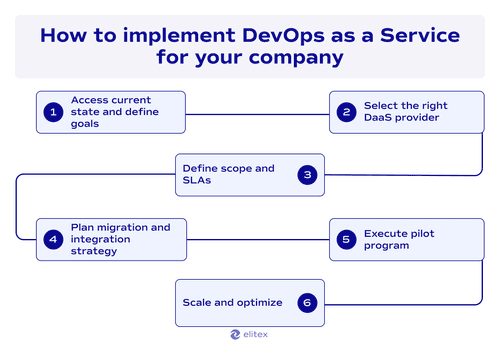
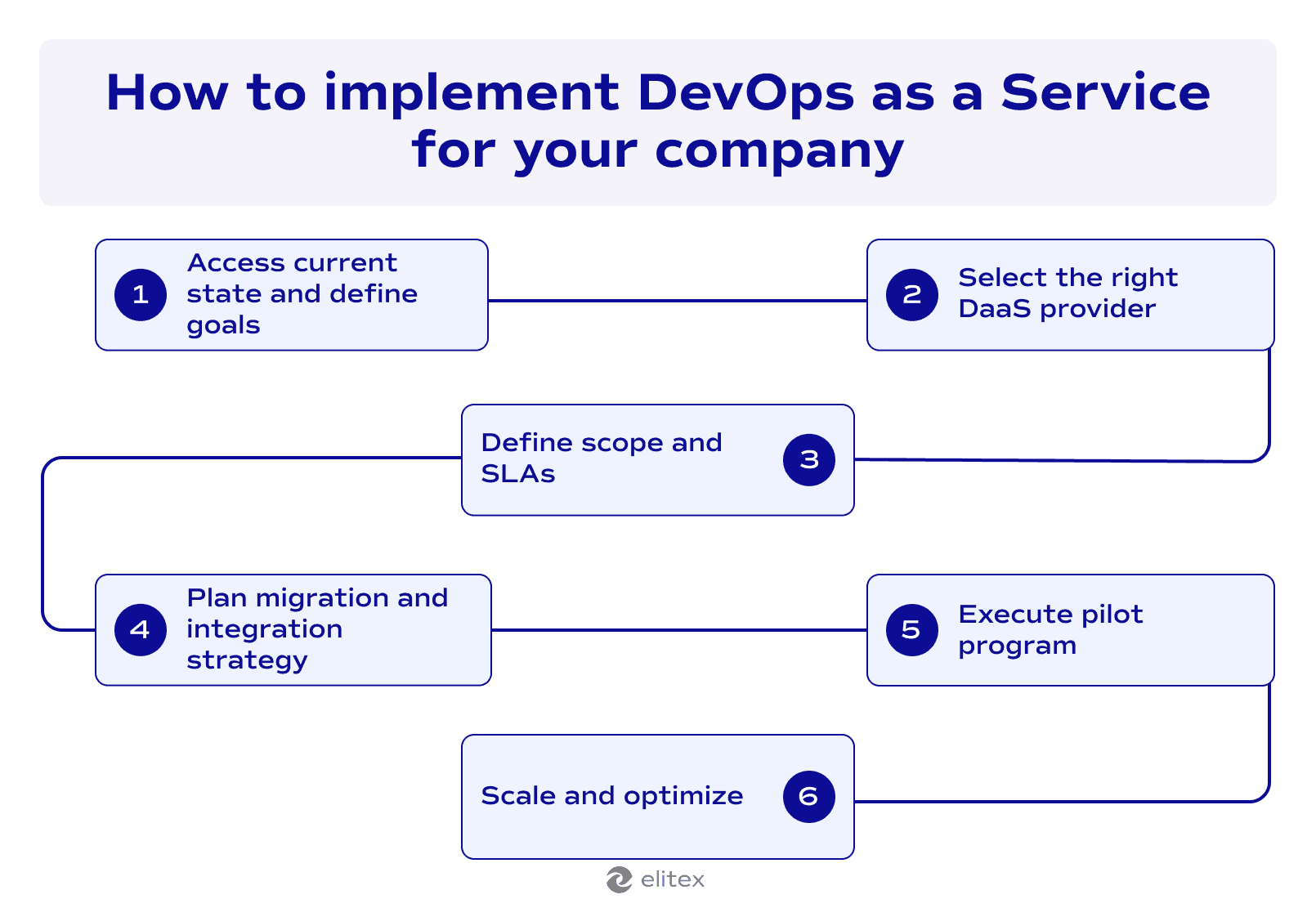
Step 1. Assess current state and define goals: Evaluate existing processes and define specific objectives for DevOps as a Service implementation.
Step 2. Select the right DevOps as a service provider: Research providers based on company size, budget, technical requirements, and cultural fit. Consider industry expertise, service breadth, and pricing models when making your decision.
Step 3. Define scope and SLAs: Establish clear boundaries and document specific performance metrics.
Step 4. Plan migration and integration strategy: Develop a phased transition approach with integration plans for existing DevOps tools, data migration timelines, and communication protocols. Create detailed schedules that minimize business disruptions while ensuring smooth handover of operations.
Step 5. Execute pilot program: Start with a non-critical system to test the arrangement.
Step 6. Scale and optimize: Expand coverage based on pilot results and continuously review performance metrics to maximize ROI.

FAQs
What is DevOps as a Service?
DevOps as a service is an operational model where external providers manage your entire DevOps operations, including CI/CD, infrastructure, monitoring, testing, deployment, etc.
How does DevOps as a managed service differ from traditional consulting?
DevOps as a managed service provides ongoing operational responsibility, while traditional consulting delivers pre-defined projects/deliverables and leaves. Managed services offer continuous support and accountability.
Is DevOps as a Service from AWS suitable for small companies?
Yes, AWS Professional Services offers scalable DevOps solutions with pay-as-you-go pricing, making it accessible for companies of all sizes. Also, pay attention to ELITEX, a boutique end-to-end DevOps service provider that specializes in working with small and mid-sized companies and offers cost-efficiency and vast experience.
What future trends will shape DevOps as a Service in 2026-2030?
The biggest DevOps trends will be AI-powered automation, serverless computing integration, enhanced security-first approaches, and platform consolidation. Together, these trends will shape the market.
What’s the biggest implementation challenge for DevOps-as-a-Service?
Cultural resistance and loss of control concerns are primary challenges, followed by integration complexity with existing systems.
POSTED IN: