



- TL;DR: In this article, we talk about what DevOps in healthcare means in practice and why clinical environments demand a different approach than other industries.
- We cover compliance in depth because HIPAA and GDPR requirements shape every pipeline decision in the healthcare industry from the start.
- We also walk through the key requirements for implementation and a step-by-step adoption guide built around real healthcare constraints.
- We share our own case study from working with Standard Practice, a US healthcare AI startup, so you can see what an actual engagement produces.
- Finally, we cover the most common challenges teams run into during adoption and how to address them.
Healthcare software fails differently than other software. When a patient management system goes down, clinical staff lose access to the information that shapes care decisions. That kind of failure has consequences that stretch well beyond SLAs or revenue metrics, which is precisely what makes DevOps in healthcare its own discipline rather than a variation of what works in fintech or ecommerce. Since the pandemic accelerated digital adoption in clinical settings, healthcare providers have faced a specific tension: patients and administrators expect faster digital services, while regulators enforce compliance standards that weren't designed with rapid deployment cycles in mind. So, digital transformation in this industry is no longer a strategic option, and DevOps has become a core part of how organizations pursue it without putting critical systems at risk.
Most organizations that attempt this transition run into the same wall: their internal teams know their systems, but lack the depth in modern DevOps practice to bridge both worlds. At ELITEX, we've worked as a DevOps automation services and solutions provider across healthcare and several other regulated industries, and that experience shapes everything in this article. What follows is a practical breakdown of what DevOps adoption in a healthcare environment actually involves, from compliance requirements to real implementation decisions. So, let’s go!
What is DevOps in healthcare?
DevOps in healthcare is the application of modern software delivery practices to clinical and administrative systems where the cost of failure shows up in patient outcomes before it shows up in engineering metrics. At its core, it integrates development and operations into a shared workflow, but in a healthcare context, that means working within regulatory compliance requirements and around legacy EHR infrastructure that wasn't built with rapid deployment cycles in mind. The result is a delivery model that is both faster and more controlled than traditional medical IT approaches. Regulatory compliance is built into the pipeline from the start. DevOps-based automated testing validates every change before it reaches a live environment. Monitoring runs continuously against systems that clinicians depend on for patient care. Getting there requires mastering a specific set of practices, and the six below define what a healthcare DevOps setup actually covers.
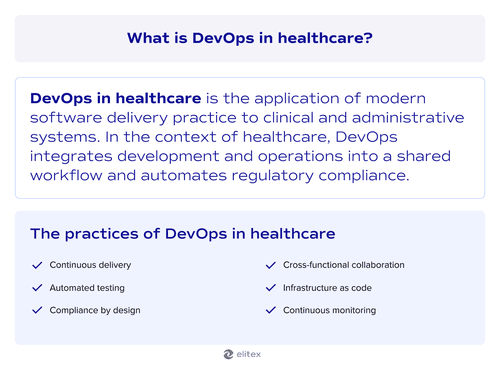
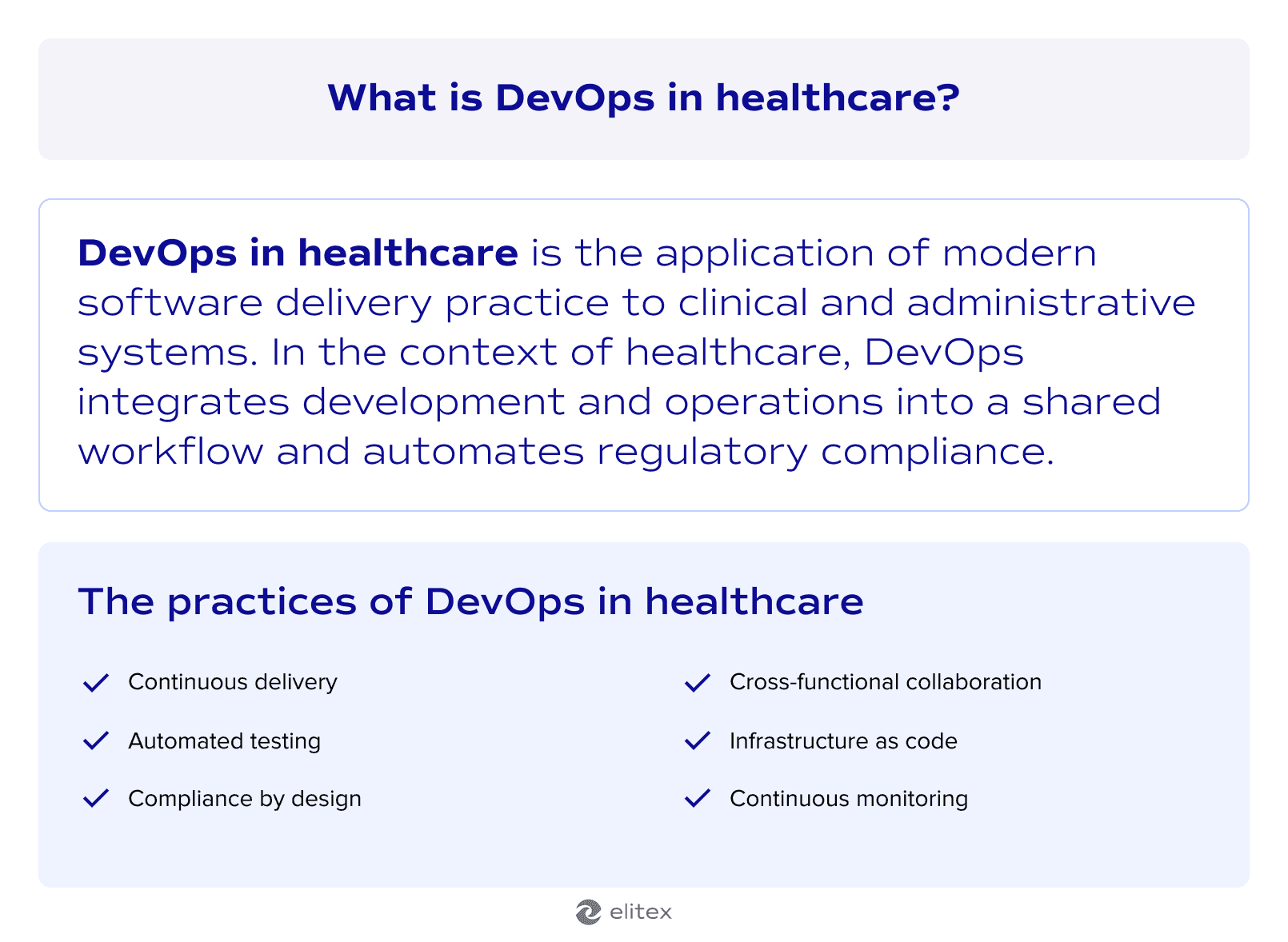
- Continuous delivery: A CI/CD pipeline automates the path from code commit to production, reducing manual handoffs in clinical software releases.
- Automated testing: Every code change is validated against predefined standards before it reaches a live environment, catching issues that manual review would miss during high-volume development cycles.
- Compliance by design: Regulatory compliance requirements are built directly into the pipeline so that each release is audited automatically as part of the standard delivery process, not reviewed manually after deployment. We will talk about compliance and DevOps in the following sections.
- Cross-functional collaboration: Development, operations, and clinical teams share workflows and visibility, which shortens the feedback loop between the people who build systems and the people who rely on them for patient care.
- Infrastructure as code: Environment setup is managed through version-controlled scripts, making deployments consistent and repeatable.
- Continuous monitoring: Production systems are observed in real time so that performance issues and security anomalies are caught before they escalate into clinical disruptions.
Why the healthcare industry needs DevOps now
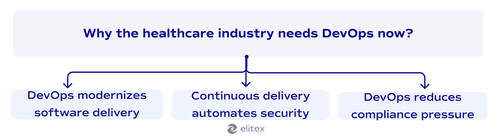
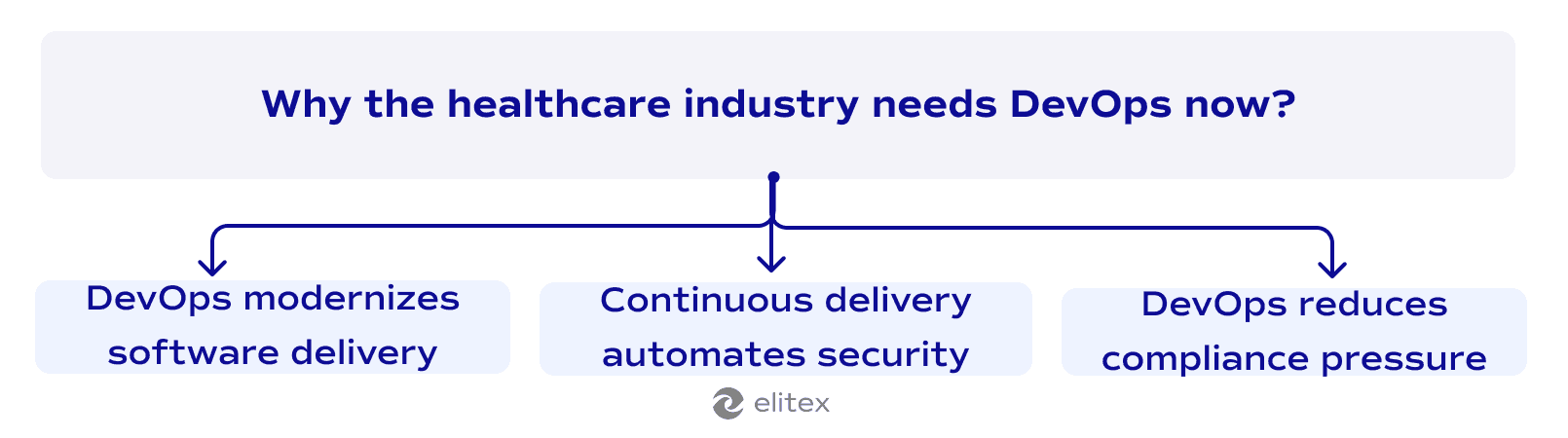
Let’s take a closer look at why DevOps matters for the healthcare industry:
Legacy infrastructure is reaching its limits
The healthcare industry built its digital backbone on systems that were never designed for frequent updates or modern continuous integration patterns. DevOps for healthcare gives organizations a structured path to modernize delivery without replacing core systems overnight, which is the only realistic option most clinical IT teams actually have.
Patient data is under sustained attack
Healthcare remains the most targeted sector for cybersecurity breaches, and traditional release cycles move security patches slowly through manual approval processes. The benefits of DevOps show up here immediately: continuous delivery pipelines make security updates a routine deployment event rather than an emergency procedure.
Compliance pressure is intensifying
HIPAA, GDPR, and a growing number of country-level health data regulations are tightening requirements around audit trails and incident response timelines. Manual compliance processes struggle to keep pace with both regulatory change and modern software delivery speeds, which is what makes DevOps transformation a compliance argument for the healthcare industry as much as an engineering one. But let’s take a closer look at this matter.
DevOps and compliance in healthcare
Compliance in DevOps for healthcare is where most implementation efforts either hold together or fall apart. Healthcare organizations operate under HIPAA, GDPR, and a range of sector-specific regulations that govern how protected health information is stored, accessed, and transmitted. The common mistake is treating compliance as a review stage at the end of the delivery cycle. By that point, fixing violations is expensive and slow.
The more effective approach is building compliance requirements directly into the pipeline so that every deployment is audited automatically as part of standard delivery. Access controls, encryption standards, and audit logging become engineering defaults rather than manual checklists. We've covered this in more depth in a separate article on how to automate healthcare compliance with DevOps, which is worth reading alongside this one if your organization is in the early stages of planning.
Benefits of implementing DevOps in healthcare
Beyond what was written above, DevOps itself brings a set of advantages specific to clinical environments. Here's what healthcare organizations consistently report after a successful adoption.
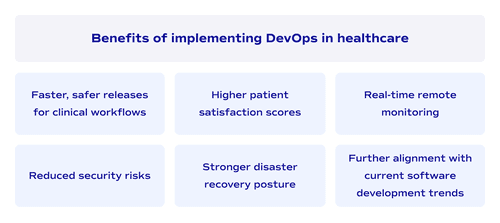
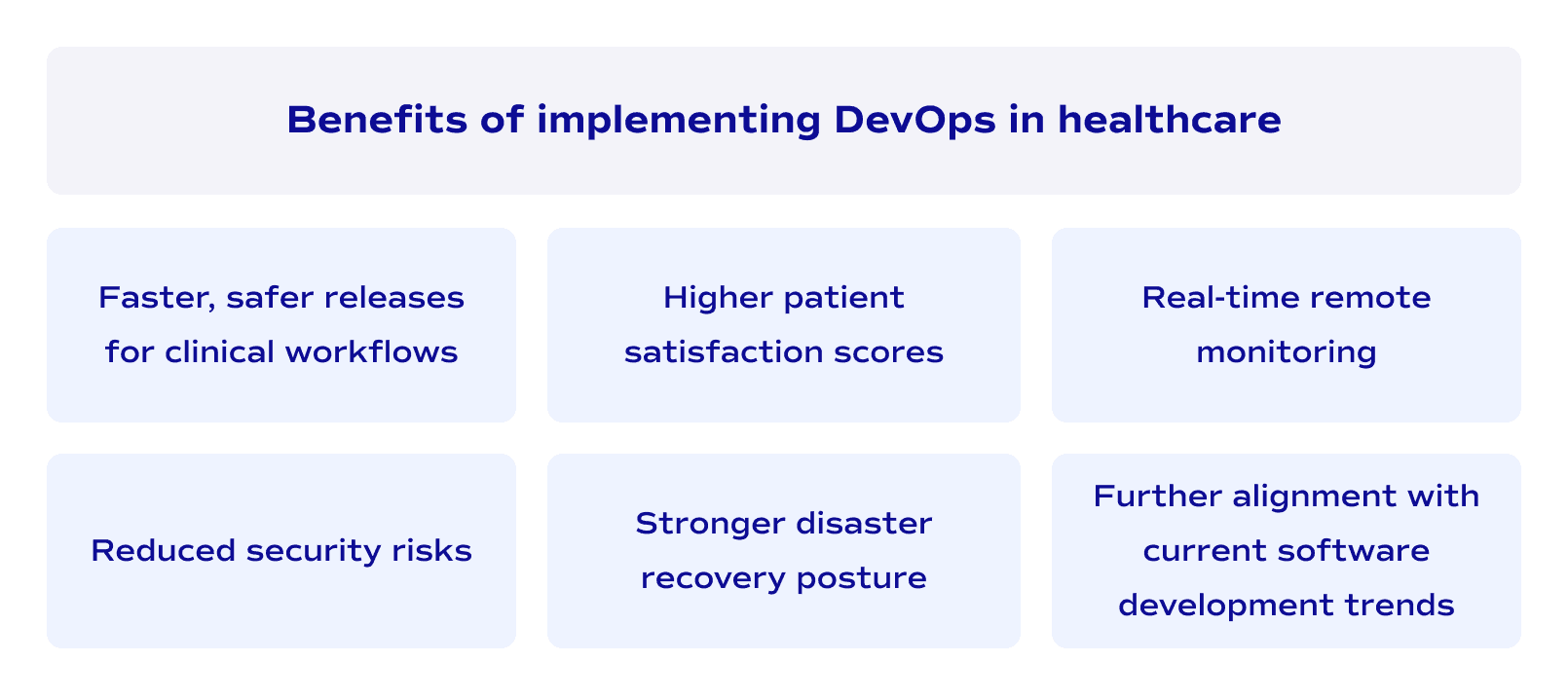
- Faster, safer releases for clinical workflows: CI/CD pipelines shorten the time between a code change and its deployment to production, which matters when clinical workflows depend on software that is updated frequently. What changes is the risk profile: automated gates replace manual review steps, so speed and safety move in the same direction.
- Reduced security risks: DevOps shifts security left, meaning vulnerabilities are identified during development rather than after deployment. For healthcare, where a single exposed database can result in regulatory penalties and loss of patient trust, catching security risks early in the pipeline is a structural advantage.
- Stronger disaster recovery posture: Infrastructure as code and automated deployment mean that environments can be rebuilt from scratch in a fraction of the time traditional recovery procedures require. A system that took days to restore manually can be back online in hours.
- Higher patient satisfaction scores: Software stability has a direct line to patient experience. Booking systems, patient portals, and telehealth platforms that release updates without downtime contribute to satisfaction metrics in ways that clinical IT teams don't always get credit for.
- Real-time remote monitoring through DevOps observability: Real-time remote monitoring paired with DevOps observability practices gives operations teams a live view of system health across distributed environments. Issues surface before patients or clinicians notice them, which changes the nature of incident response entirely.
- Alignment with current software development trends: The shift toward AI-assisted deployment, automated compliance checks, and cloud-native infrastructure are all DevOps trends that are arriving in healthcare now. Organizations that have already adopted DevOps in healthcare are positioned to absorb these advances without rebuilding their delivery model from scratch.
Measuring DevOps success in healthcare
Knowing that DevOps practices in healthcare IT projects are working requires more than a gut feeling about deployment speed. DevOps automation for healthcare changes enough variables at once that without defined metrics, teams often can't tell whether improvements are coming from the tooling, the process changes, or both. Healthcare software development has its own performance benchmarks, and the four DORA metrics provide a solid starting point, but they need to be read alongside healthcare-specific indicators to mean anything useful.
- Deployment frequency: It’s all about how often code reaches production without incident, measured against the baseline from before DevOps adoption.
- Change failure rate: The percentage of deployments that require a hotfix or rollback, which in clinical environments carries compliance implications beyond the technical ones.
- Mean time to recovery: This one is about how long it takes to restore a system after a failure, particularly relevant for patient-facing platforms where downtime has measurable operational consequences.
- Automated test coverage: The proportion of the codebase covered by automated tests, which tracks how much of the delivery pipeline has been de-risked from manual error.
- Security vulnerability resolution time: How quickly identified vulnerabilities move from detection to patched deployment, a metric that sits at the intersection of engineering performance and regulatory obligation.
- Audit trail completeness: Whether every deployment generates the documentation required for compliance review, which determines how much manual work remains in the compliance process after automation is in place.
6 key requirements for implementing DevOps in healthcare
Now, let’s move to the practical part. Here are 6 key requirements needed to start DevOps implementation in your healthcare organization:
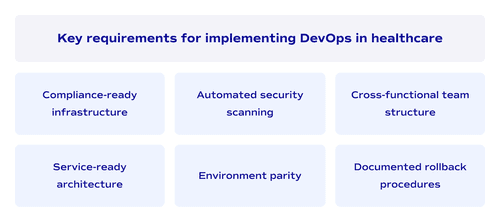
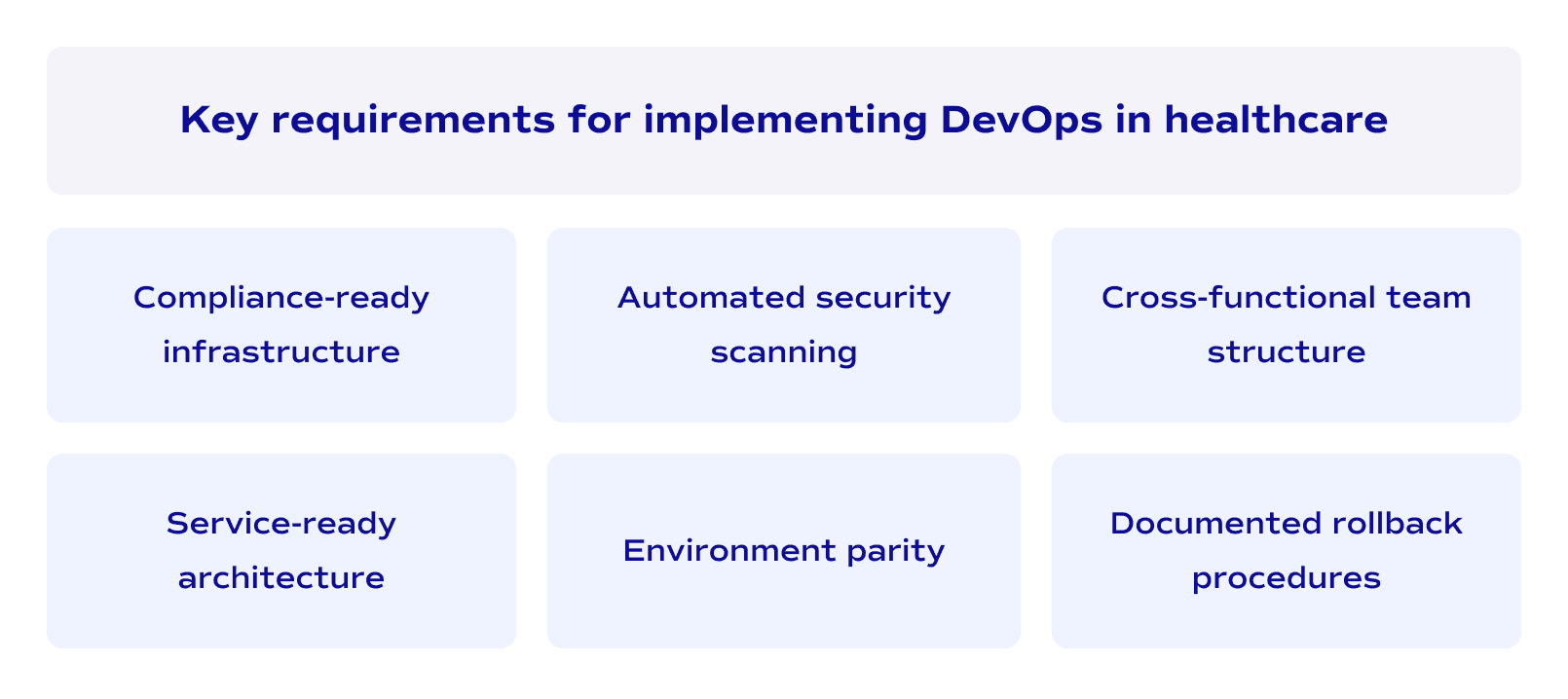
- Compliance-ready infrastructure: Every environment, from virtual machines to containerized services, needs audit logging and access controls built in by default. Retrofitting compliance after deployment costs significantly more than designing for it from the start, a lesson most healthcare companies learn the hard way.
- Service-oriented architecture: A service-oriented architecture makes it possible to update individual components of a clinical system without taking the entire platform offline, which is a hard requirement where patient care continuity is non-negotiable.
- Automated security scanning: Security check automation should run at every stage of the pipeline so vulnerabilities are flagged before code reaches production.
- Environment parity: In medical software development, environment inconsistency is one of the most common sources of release failures. Development, staging, and production environments need to mirror each other closely enough that a deployment behaving correctly in staging doesn't fail in production.
- Cross-functional team structure: DevOps automation for healthcare works best when clinical stakeholders are part of the delivery process. Healthcare companies that keep development teams siloed from clinical operations consistently see longer feedback cycles and higher rework rates.
- Documented rollback procedures: Every deployment needs a tested rollback path. When a release affects systems that clinicians rely on for patient care, the ability to revert quickly is a clinical requirement as much as a technical one.
How healthcare organizations adopt DevOps in practice
Implementing DevOps in healthcare follows a different sequence than in other industries. The steps below reflect how organizations move from a standing start to a functioning delivery model without disrupting live clinical operations:
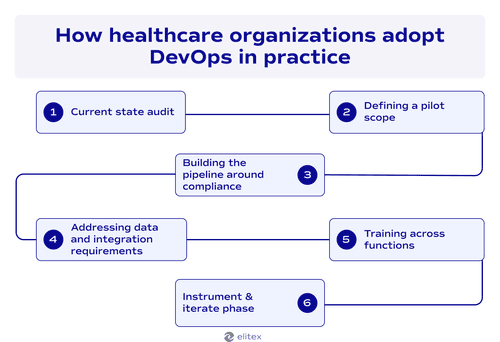
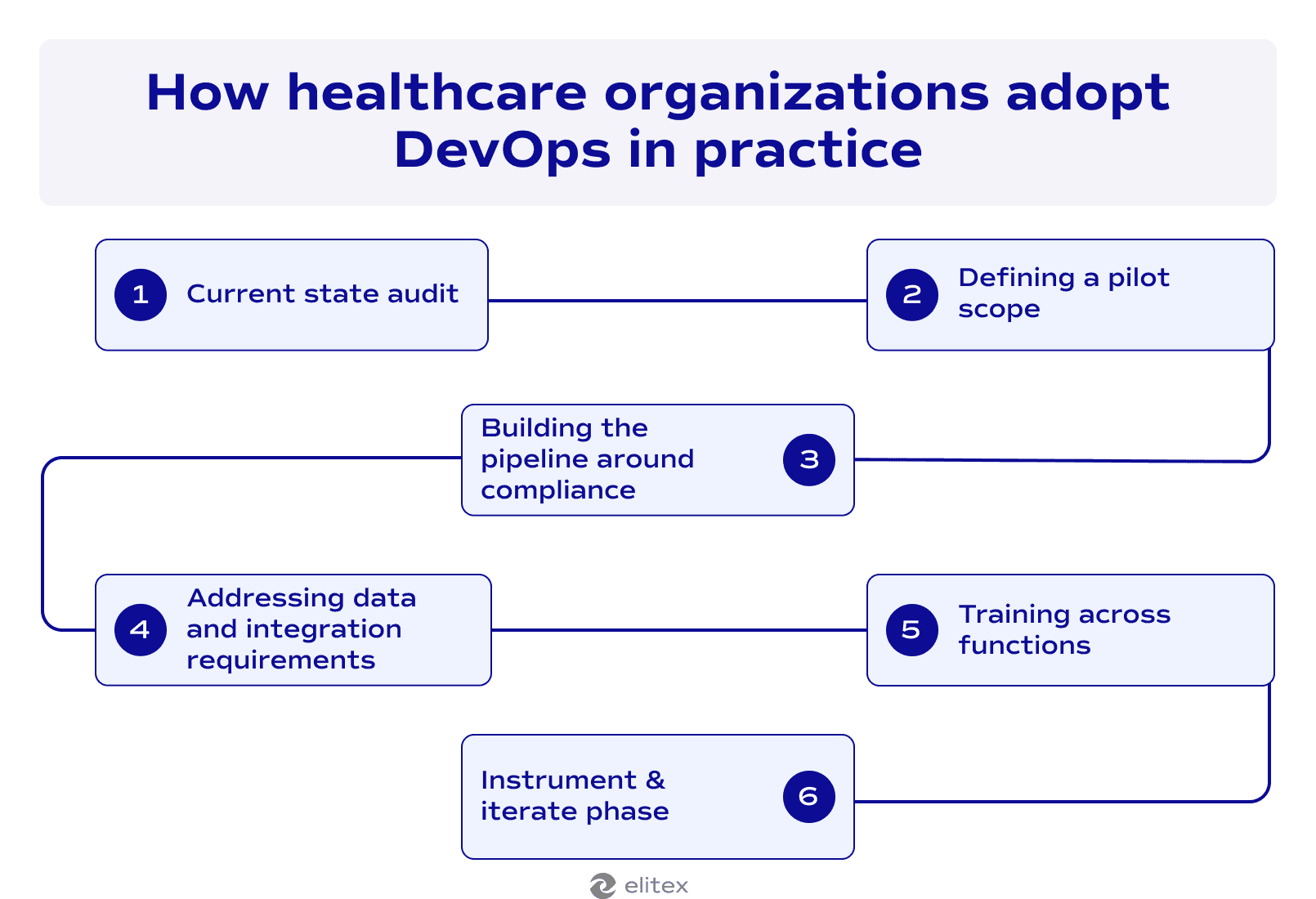
- Step 1: Audit the current state: Before any tooling decisions are made, map what exists. Which systems are business-critical? Where do deployments currently fail? What compliance obligations apply to each environment? This baseline shapes every subsequent decision in the adoption process.
- Step 2: Define a pilot scope: DevOps in healthcare should start small. Identify one system or workflow where the risk of experimentation is low and the feedback loop is short. A successful pilot builds internal confidence and surfaces environment-specific issues before they affect critical infrastructure.
- Step 3: Build the pipeline around compliance: When implementing DevOps in healthcare, compliance controls go into the pipeline architecture from day one. Audit logging, access management, and automated policy checks are configured before the first production deployment runs through the new system.
- Step 4: Address data sharing and integration requirements: Clinical environments involve data moving between EHR platforms, billing systems, and third-party services. Data sharing protocols and medical device integration requirements need to be mapped and tested within the pipeline before continuous delivery goes live, because integration failures in healthcare carry regulatory consequences.
- Step 5: Train across functions: Adoption of DevOps automation tools without cultural change produces limited results. Clinical stakeholders, compliance officers, and operations teams all need enough familiarity with the new delivery model to participate in it meaningfully.
- Step 6: Instrument and iterate: Once the pipeline is running, connect it to the success metrics defined earlier. Deployment frequency, change failure rate, and recovery time give teams the data needed to improve the process systematically rather than reactively.
Real-world case study: How DevOps automates compliance for the US healthcare startup
Now let’s see how it works with real healthcare companies.
Standard Practice is a New York-based AI company that automates insurance verification calls for medical clinics across the US. When they came to ELITEX, they had proven AI technology but infrastructure that relied on manual deployments through SSH connections, with services restarted by hand after every update. There was no automated scaling, and the security posture didn't meet HIPAA requirements.
Within one month, ELITEX’s DevOps team replaced that setup with automated DevOps pipelines across development, staging, and production environments, migrated services to AWS ECS with Docker containers, and introduced automated scaling alongside HIPAA-compliant DevOps security best practices. The platform now processes thousands of insurance verification calls monthly, freeing clinic staff to focus on patient care rather than hours of manual phone work with insurance providers.
DevOps in healthcare: Common challenges and how to address them
Adopting DevOps in healthcare comes with obstacles that don't appear in most other industries. Here's how they typically surface and what actually helps
| Challenge | Why it happens | How to address it |
| Legacy system dependencies | Core clinical platforms weren't built for continuous delivery and resist modern pipeline integration | Wrap legacy systems in APIs and modernize incrementally rather than replacing them outright |
| HIPAA and GDPR compliance overhead | Compliance requirements add review layers that slow traditional delivery cycles | Build compliance checks directly into the pipeline as automated gates |
| Resistance from clinical staff | Clinicians prioritize system stability and distrust frequent updates to tools they depend on | Involve clinical stakeholders early and run pilots on non-critical systems first |
| Security vulnerabilities in fast release cycles | Speed increases the attack surface if security reviews remain manual | Shift security left with automated scanning at every pipeline stage |
| Vendor lock-in | Healthcare infrastructure often depends on proprietary EHR and billing platforms with limited integration flexibility | Prioritize open standards and service-oriented architecture from the start |
| Skill gaps in DevOps for healthcare | DevOps engineers with healthcare compliance experience are scarce | Combine internal upskilling with external partners who have regulated industry experience |
Working with a DevOps partner in healthcare
That last point in the table reflects a pattern we've seen consistently across healthcare engagements. Building internal DevOps capability takes time that most clinical IT teams don't have, and the compliance dimension makes the learning curve steeper than in other industries. The market for DevOps consulting in healthcare has grown accordingly, and there are now many providers offering everything from tooling implementation to full DevOps-as-a-service implementations. The quality varies considerably, and the right fit depends heavily on whether a provider has actual experience working within regulated environments rather than just adapting general DevOps practice on the fly.
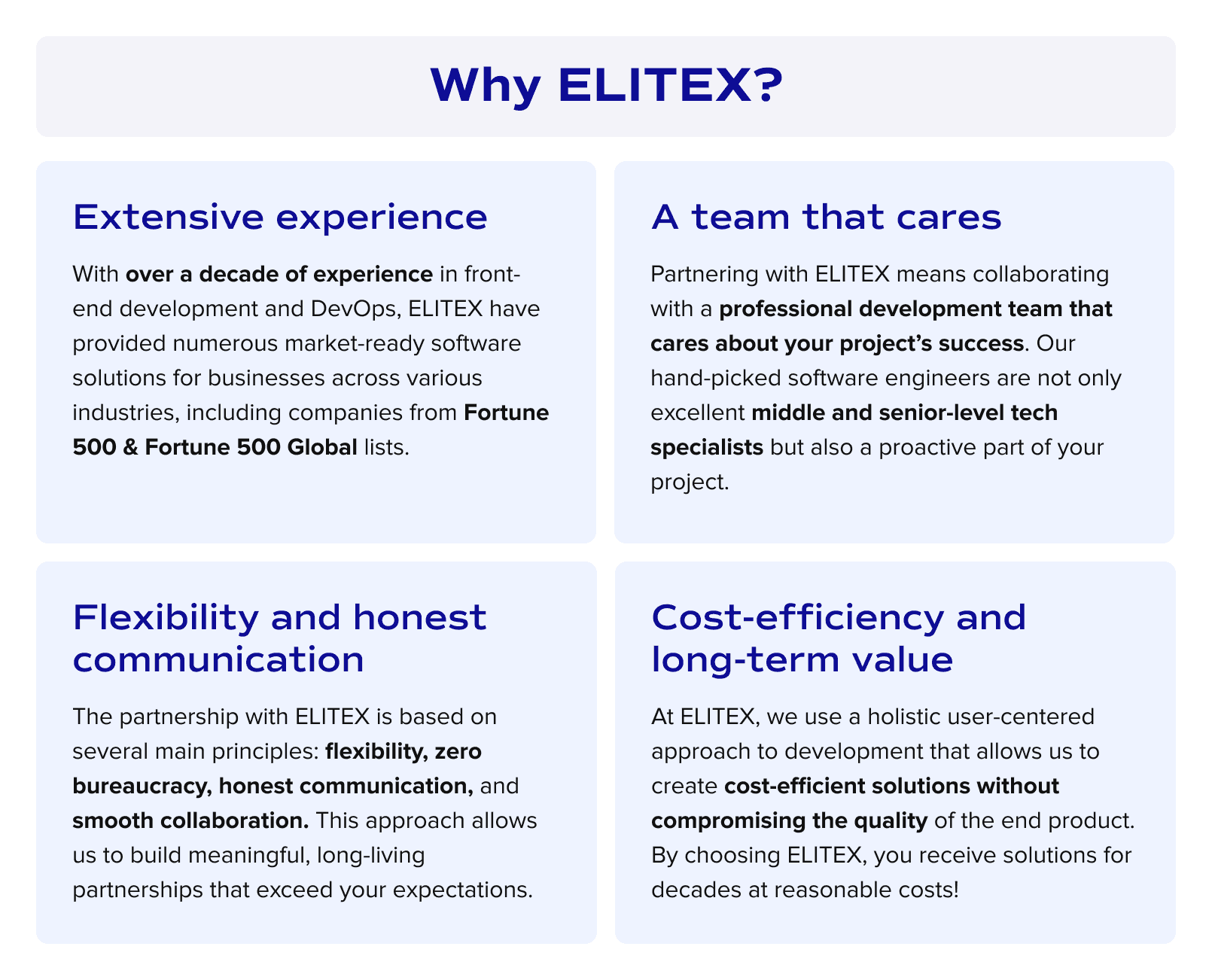
ELITEX has worked across healthcare and other compliance-heavy industries since 2015, and our team is 90% middle and senior level engineers. We offer DevOps infrastructure automation services, DevOps managed services, and DevOps consulting services that are built around the specific constraints healthcare organizations operate under, including HIPAA compliance, legacy system integration, and security-first pipeline design. If you're evaluating partners, the Standard Practice engagement covered earlier in this article is a fair representation of how we work and what that produces in practice.
DevOps in healthcare FAQs
What is DevOps in healthcare, and how does it differ from standard DevOps practice?
DevOps in healthcare applies the same continuous delivery and automation principles as general DevOps, but within a compliance framework that governs how patient data is handled, stored, and transmitted. HIPAA and GDPR requirements mean that every pipeline decision carries regulatory weight that most other industries don't face.
What are the most widely used DevOps tools in healthcare?
DevOps tools in healthcare tend to follow the same core stack as other industries: Jenkins, GitLab CI, and GitHub Actions for pipeline automation, Terraform for infrastructure as code, and Kubernetes for container orchestration. What changes is the configuration around them, with compliance logging, access controls, and security scanning built into every stage.
How does DevOps in healthcare handle HIPAA compliance?
DevOps in healthcare addresses HIPAA by treating compliance as an engineering problem. Audit logging, encryption standards, and access control policies are automated into the pipeline rather than reviewed manually after deployment.
Are there DevOps jobs in healthcare specifically, or is it general DevOps experience that matters?
DevOps jobs in healthcare increasingly specify regulated-industry experience, particularly around HIPAA compliance and EHR integration. General DevOps skills transfer well, but engineers who understand healthcare data governance requirements and security-first pipeline design are significantly harder to find and more valuable to clinical organizations.
POSTED IN: