



DevOps is on everyone’s lips these days. Companies rush to adopt this approach, but here’s the catch: many struggle with actual implementation. This happens because, just as with any digital transformation, the transition to DevOps demands more than good intentions. It requires a concrete cultural shift, changes in how teams work together. From our experience, as a DevOps automation service provider with a decade in the field, we see the same pattern repeat. Businesses invest in DevOps tools but skip the human element; they focus on technology while ignoring team dynamics. This approach fails every time.
As practice shows, successful DevOps transformation always starts with people, not tools. We’ve watched companies spend millions on automation platforms only to see minimal results. Why does this happen? Because businesses treat DevOps like a software purchase instead of a cultural evolution. At the same time, the teams that succeed understand one key principle: collaboration beats automation every time. Companies with successful cases of DevOps transformation build trust between developers and operations first. Then they add the technical pieces. In fact, this sequence matters way more than most businesses realize. When you get it right, everything else falls into place faster than expected. But let’s proceed in order!
What is DevOps transformation?
Let’s demystify the DevOps transformation itself first.
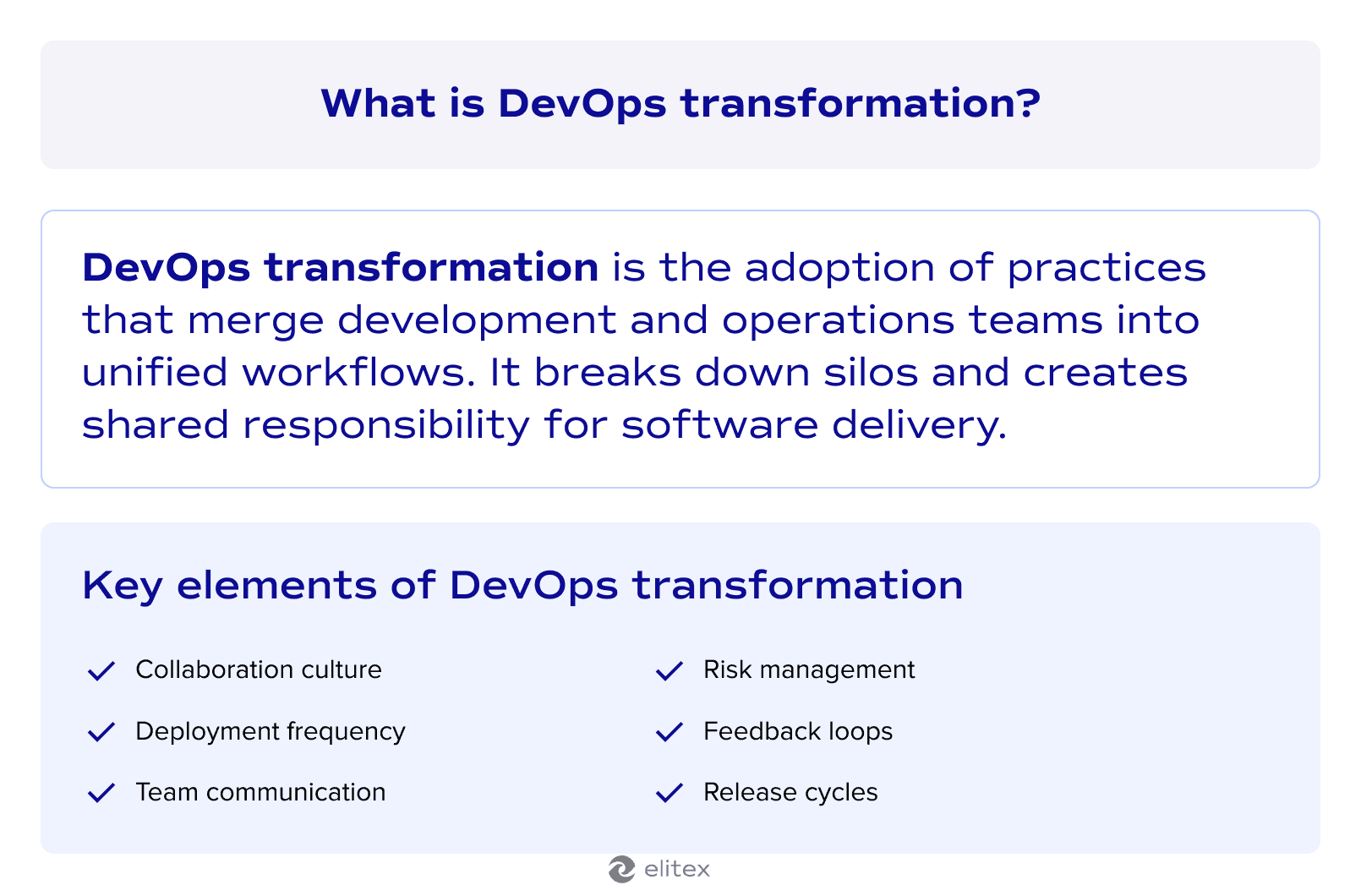
DevOps transformation is the process of adoption of DevOps culture that merges development and operations into a unified workflow. Adoption of DevOps culture means that teams stop working in separate departments and start collaborating throughout the entire software development cycle. Instead of developers building features while operations handles deployment separately, under the DevOps paradigm, both groups share common goals from the start. In this scenario, the focus shifts to creating a culture of collaboration where everyone takes responsibility for the final software product.
Such an adoption also fundamentally changes how teams communicate and make decisions. It means teams that once blamed each other for failures now work together to prevent further issues. They share the same tools, use the same metrics, follow the same processes, and celebrate the same successes.
Another aspect of the software development process impacted by DevOps transformation is releasing new features. When development and operations align their efforts, deployment becomes routine rather than risky. Companies see fewer outages, faster recovery times, and teams that trust each other to deliver quality results.
And of course, adopting DevOps means implementing the right technology stack after all. Modern DevOps automation tools can help your team handle repetitive tasks like testing, building, monitoring, optimizing, and deploying code with minimal human intervention involved. These DevOps tools create consistent processes that reduce errors and free up team members to focus on strategic work. However, smart organizations introduce these tools at later stages of DevOps transformation, after the culture of collaboration has been established.
Why DevOps transformation matters in 2026?
We have a separate article regarding DevOps benefits. Don’t hesitate to check it to get a detailed explanation of the advantages of DevOps and why it still matters in 2026.
A brief conclusion: Companies that delay their DevOps transformation journey face mounting pressure from competitors who ship features weekly instead of quarterly. The gap between traditional software development approaches and modern DevOps practices widens every month, making 2026 a perfect time for organizational change (the earlier the better)
Here are 3 clear and measurable metrics that indicate a successful DevOps business transformation:
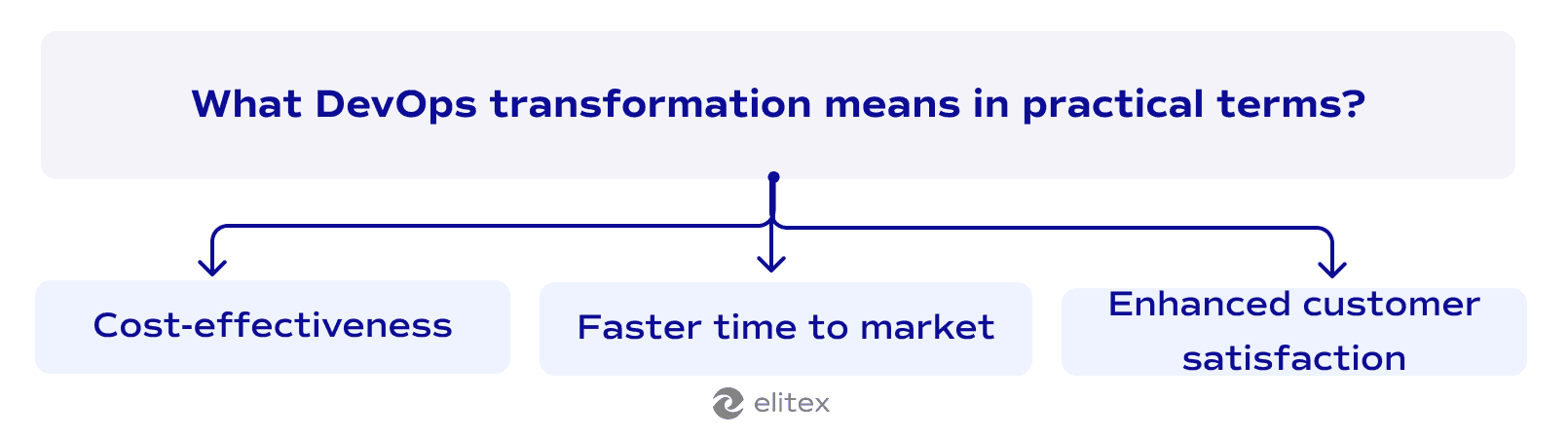
Cost-effectiveness: DevOps practices significantly reduce operational costs by eliminating manual processes and preventing costly production failures. Teams spend less time fixing issues and more time building features that actually generate revenue. The ROI of DevOps digital transformation typically becomes visible within the first six months of implementation. Additionally, DevOps typically helps you to reduce infrastructure costs.
Faster time to market: With DevOps, businesses achieve faster deployment through automated DevOps pipelines and streamlined workflows. Features that once took months to release now reach customers in weeks or days. This speed advantage translates directly into competitive positioning and revenue growth.
Enhanced customer satisfaction: Continuous improvement cycles, as a final goal of any DevOps transformation, mean teams respond to customer feedback quickly and effectively. Fewer bugs reach production, and when issues occur, teams resolve them faster. Overall, DevOps makes your customers more satisfied with your product.
If you prefer real-world scenarios over theory, check our DevOps transformation case study:
DevOps transformation roadmap: Key phases
A successful DevOps transformation strategy requires careful planning and phased implementation. Your specific roadmap depends largely on your current company culture and broader business goals. Some organizations need major cultural shifts before technical changes work. Others already have strong collaboration and can jump straight to automation tools.
Companies with siloed teams face a longer journey. They must break down barriers between development and operations first. Meanwhile, businesses with collaborative cultures can focus on technical improvements immediately. Here, the key is matching your approach to your starting point. Your transformation path becomes clear once you understand where you stand today and where your business needs to go.
Here’s an average DevOps transformation roadmap. This roadmap is based on the decade of our practical experience and applies to companies that have never adopted DevOps before.
Access the current state
Start your DevOps journey by mapping existing development workflows and identifying silos between development and operations teams. Document current delivery processes and measure key performance indicators to be improved. This assessment reveals the gaps that need attention and forms a basis for your DevOps transformation strategy.
Identify your biggest pain points
Once everyone understands the goal, focus on the most critical bottlenecks in your software development lifecycle. Be precise and target the specific pains of your company. For instance, if you need to improve the software delivery process, focus on factors that slow down delivery; if you need to cut costs, look for automation opportunities, etc. Build metrics that will directly derive from your exact pain points.
When you’re dealing with DevOps transformation strategy in a broader sense, map your entire flow from development to production to spot recurring issues. Document where teams waste time, where quality drops, and where customer complaints originate. These pain points reveal what matters most to your market demands and help convince key stakeholders that change is necessary.
Build leadership support
Secure executive commitment for the cultural shift ahead. Leaders at all levels must understand that DevOps culture requires investment in people, not just tools. Without top-level support, teams resist changes and DevOps transformation stalls. We've seen this pattern repeat across organizations in the real world.
What can you do from your side? Present clear business cases that link DevOps adoption to competitive advantage for your specific situation. Show how the DevOps transformation will impact the entire organization beyond just IT departments. Present metrics for measuring DevOps performance and explain how these numbers connect to revenue growth, customer satisfaction, and operational efficiency that executives care about. Build a strong understanding of why your company really needs DevOps.
Foster cross-team collaboration
Break down organizational barriers that prevent effective communication between teams. In case your ultimate goal is faster delivery, focus on eliminating handoff delays between departments. If quality issues affect business outcomes, create shared responsibility for testing and deployment.
Next, create a shared space where developers and operations staff work together daily. Establish common goals that both groups can achieve only through cooperation (e.g., reducing deployment time, achieving 99.9% uptime, etc). This collaboration between development and operations teams forms the foundation of a sustainable DevOps culture.
Now, teams that once blamed each other for problems, solve issues together. Regular cross-functional meetings ensure everyone understands project priorities and timelines. Shared responsibilities for business outcomes replace the finger-pointing that plagues traditional approaches. This step is the very essence of any DevOps transformation roadmap.
Implement automation tools
When you have already built collaboration between your team parts properly and have general idea about your future DevOps lifecycle, gradually introduce DevOps automation. Start with the most painful manual processes: begin with repetitive tasks that consume team time and cause human errors. Choose automation tools that match your specific workflow needs, cloud provider, and technical stack. Use tools like Ansible, Terraform, Jenkins, Istio, Chef, Etcd, Consul, Grafana, etc (see a full list in our DevOps automation tools article). Start small with one or two tools rather than implementing everything at once. Measure the impact on delivery speed and error rates immediately.
Establish continuous improvement cycles
Create feedback loops that capture insights from every stage of the delivery process. Remember that under the DevOps paradigm, teams need regular performance reviews to spot optimization opportunities. These ongoing refinements ensure your DevOps practices evolve together with changing business objectives.
Set up monthly retrospectives where teams discuss what worked and what needs adjustment. Use these sessions to refine processes and address emerging challenges. Track long-term trends in key metrics to measure the progress of your DevOps transformation journey over time.
Also, remember that continuous improvement goes beyond internal processes. Your newly built DevOps team should listen to customer feedback and market response. This customer-focused approach drives innovation and keeps products competitive.
And the last thing to say in this roadmap: the most successful organizations treat DevOps transformation as an ongoing journey rather than a destination. They constantly find new ways to deliver value faster while maintaining quality standards that satisfy demanding customers. This is what we, at ELITEX, call a successful DevOps transformation.
Also, if you are curious regarding in which stage of transformation your team currently is, read our article about DevOps maturity model.
Best practices to ensure DevOps transformation success
Apart from the roadmap mentioned above, a successful DevOps transformation process requires following several key practices and proven methodologies:
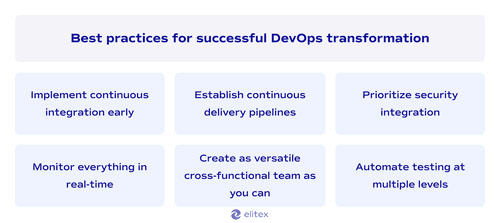
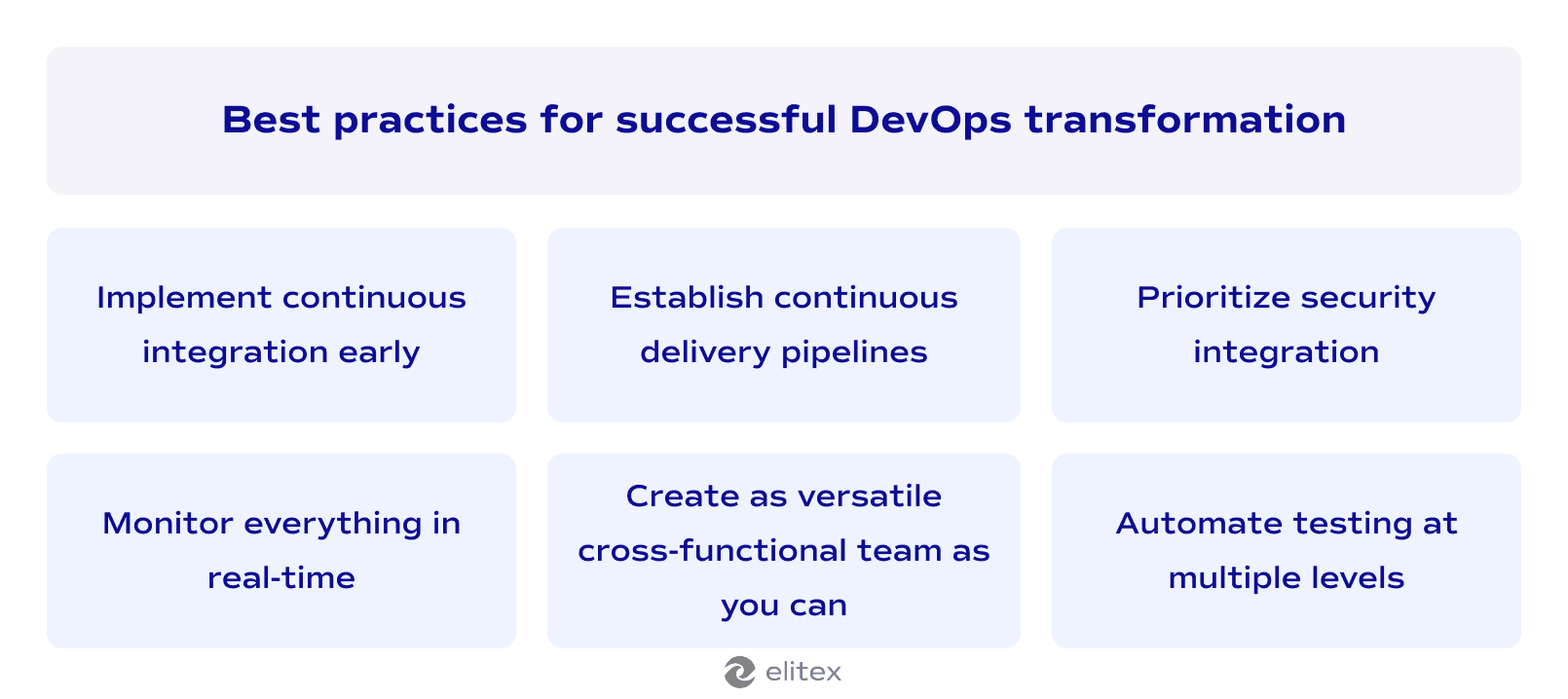
- Implement continuous integration early: Merge code changes frequently and build DevOps test automation to catch issues before they compound. With continuous integration, your teams will detect problems within minutes instead of days.
- Establish continuous delivery pipelines: Automate deployment processes to eliminate manual bottlenecks and human errors.
- Prioritize security integration: Build security checks into every development stage rather than adding them later. Integrate DevSecOps if needed (here, in this article, we have compared DevOps vs DevSecOps). Early detection prevents costly vulnerabilities and compliance issues later.
- Monitor everything in real-time: Track application performance, infrastructure health, user behavior, and deployment metrics continuously. Data-driven insights enable quick responses to emerging problems.
- Create as versatile cross-functional teams as you can: Combine developers, operations staff, security experts, and quality engineers in unified groups. Shared ownership accelerates decision-making and reduces handoff delays.
- Automate testing at multiple levels: Run unit tests, integration tests, performance tests, and security scans automatically. Automate as many tests as you can. Comprehensive testing coverage ensures quality without slowing release cycles.
Real-world examples of DevOps transformation
Here are 2 real-world businesses showing how DevOps adoption transforms the entire operational flow. If you want to check more real-world examples of DevOps automation, don't hesitate to check a dedicated article!
Small-sized E-commerce platform
DevOps transformation was implemented during Smartrr’s growth phase, after establishing QA processes, when infrastructure bottlenecks became critical. ELITEX DevOps engineers began by building a unified workflow. Then, they broke the monolithic architecture into two parts, strengthened security, implemented auto-scaling solutions, and optimized data processing workflows. This transformation took several months, but as a result, it eliminated system crashes under load and supported Smartrr’s fivefold growth in less than a year.
An example from an enterprise world
Another good example is IBM. IBM began their enterprise DevOps transformation in 2012 to streamline software development across the organization. The company adopted agile practices, implemented CI/CD pipelines, restructured teams into cross-functional squads, and automated delivery processes using tools like Jenkins and GitHub. This transformation reduced software delivery cycle time by 75% and significantly improved code quality.
Challenges in DevOps transformation
However, sometimes, companies transitioning to DevOps may face some challenges like cultural resistance or tool integration complexities. At the same time, when organizations follow core DevOps principles mentioned earlier and implement automation properly, nothing serious can disrupt the process. In such a case, the key to success is to work with experienced professionals who understand both technical and cultural aspects of DevOps transformation.
Thinking about implementing DevOps into your business?
As we mentioned at the beginning of the article, successful DevOps transformation always starts with people, not tools. Cultural shifts require careful navigation, and technical implementation demands deep expertise. If you’ve never implemented DevOps principles before, working with experienced professionals can save months of trial and error while preventing costly mistakes.
Here, ELITEX and our automation strategy consulting services come. At ELITEX, we bring a decade of DevOps expertise to organizations ready for transformation. We focus on cost-efficient solutions that deliver measurable results without unnecessary bureaucratic delays. Our approach combines honest, direct communication with technical expertise gained across multiple industries and economic domains. Whether you’re dealing with legacy systems or modern architectures, ELITEX specialists ensure your DevOps transition runs smoothly from day one.
FAQs
What is DevOps transformation?
DevOps transformation is the adoption of practices that merge development and operations teams into a unified workflow. It breaks down organizational silos and creates shared responsibility for software delivery through cultural change and automation.
What are the main benefits of DevOps transformation?
The key benefits of DevOps transformation include faster time to market, improved collaboration between teams, reduced operational costs, enhanced software quality, and better customer satisfaction through more reliable deployments and quicker issue resolution.
Is agile methodology compatible with DevOps transformation?
Yes, absolutely. Agile methodology and DevOps transformation are highly compatible. Both emphasize collaboration, iterative improvement, and rapid feedback cycles. Agile practices like sprint planning and daily standups complement DevOps automation and continuous delivery workflows.
How do I create a DevOps transformation plan for my team?
Start by assessing your current workflows, identifying pain points, and securing leadership support. Build your plan around specific business objectives, focusing on cultural change before technical implementation. Set clear metrics and a timeline for each transformation phase. In case you have difficulties in creating your transit-to-DevOps plan, contact ELITEX!
What should be included in a DevOps transformation roadmap?
A comprehensive DevOps transformation roadmap includes current state assessment, pain point identification, team collaboration setup, automation tool implementation, and continuous improvement cycles. ELITEX can help you design and execute a customized roadmap that matches your organization’s specific needs and technical requirements.
POSTED IN: