



Unfortunately, in 2026, the fact remains that product teams across industries and economic domains still spend countless hours on manual tasks that machines could handle more efficiently. Engineers still manually deploy code, then monitor dashboards, hoping nothing breaks. Operations teams still check server health by logging into each machine individually. Database administrators still run backup scripts manually every night, praying nothing corrupts. When services crash at midnight, someone still gets paged to restart them manually.
From our practice, we see that these scenarios repeat daily across dozens of companies, but they don’t have to! For more than 15 years, DevOps automation services have offered a solution that eliminates this waste, allowing teams to focus on building better software instead of babysitting infrastructure and dashboards.
We can write a lot about the transforming power of DevOps automation, revolution, and business process optimization. But let’s be honest. DevOps isn’t a particularly new thing. DevOps workflows have been around since at least 2009. The idea of automating repetitive tasks isn’t groundbreaking anymore at all. However, as a company with a decade of experience in DevOps workflow automation, we observe something curious: in 2026, automation has become even more relevant than ever. We see dozens of companies that still struggle with the same manual processes that DevOps and automation solved a decade ago. This persistent gap between available solutions and actual implementation creates scepticism about automation’s real-world effectiveness. But it’s absolutely in vain. And we’ll prove it.
If you still have doubts about the effectiveness of automation, this article presents concrete DevOps automation examples with measurable results. These solutions are around us, they are in a production environment right now, they work. So, let’s take a closer look at them!
What is DevOps automation?
We have a separate article that explains DevOps automation in detail. However, before diving straight into examples, we still need a brief definition on which to base our article.
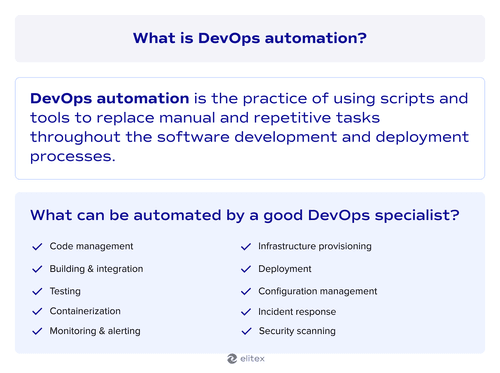
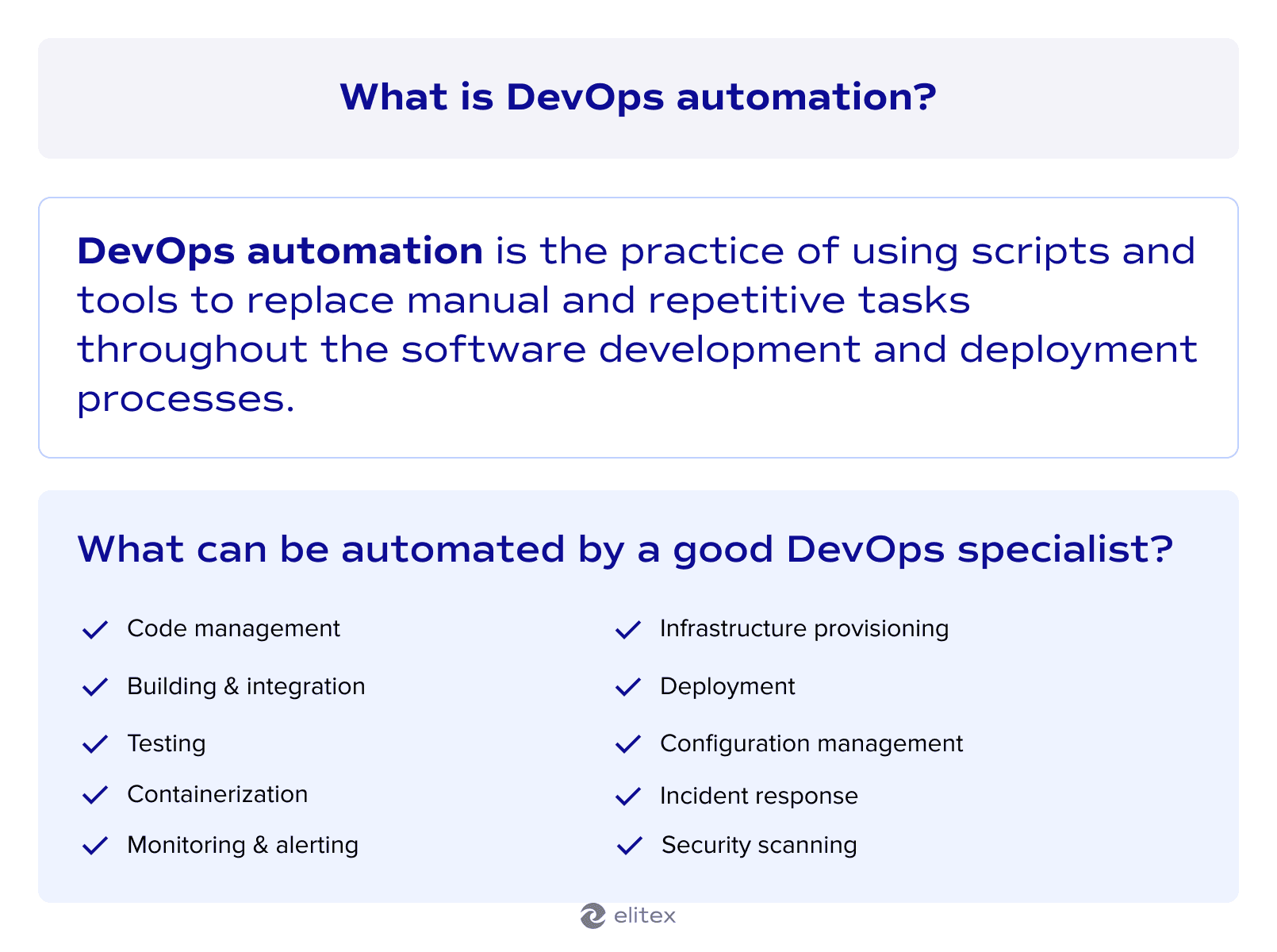
DevOps automation is the practice of using special tools and scripts to perform repetitive tasks without human intervention throughout the software development lifecycle. It eliminates manual effort in deployments, testing, monitoring, and infrastructure management. The final goal of DevOps automation is to boost software quality while allowing teams to focus on innovation instead of routine operations.
What are the main benefits of DevOps automation?
Let’s see what the benefits of DevOps automation practically mean for businesses:
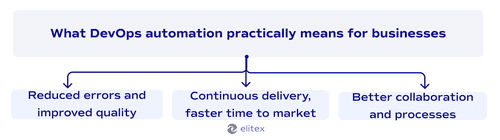
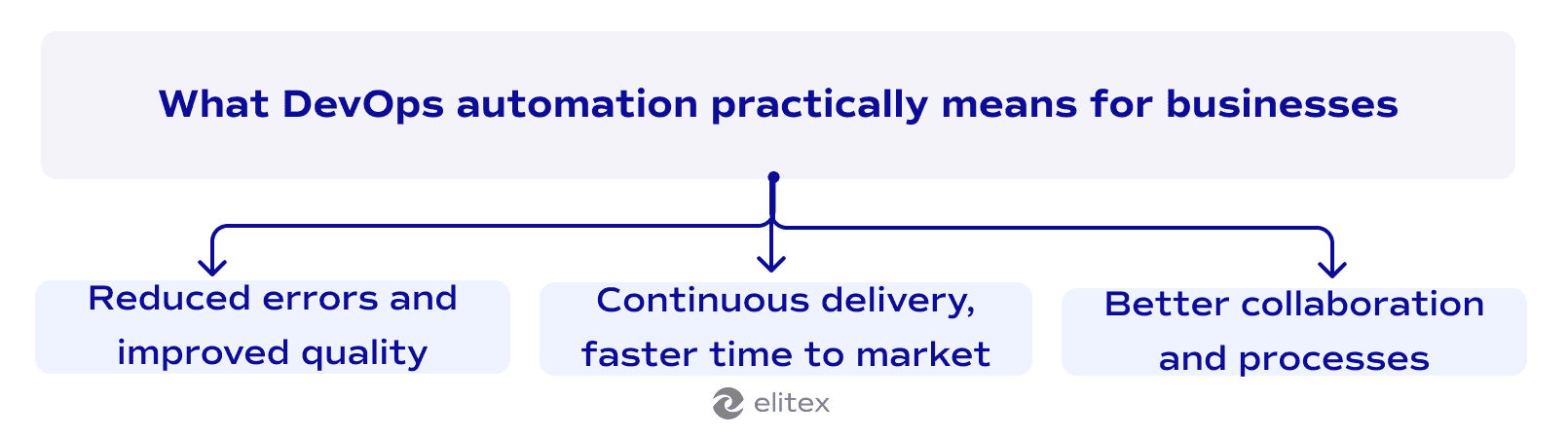
Reduced errors and improved quality
DevOps automation examples consistently show dramatic reductions in human error across the entire software development process. According to the 2024 Google DORA report, elite DevOps teams maintain a 5% change failure rate or lower, compared to significantly higher rates of teams that still rely on manual processes. This error reduction applies across multiple areas. DevOps-based automated testing catches bugs before they reach production. Standardized deployment procedures eliminate configuration mistakes. Key metrics like MTTR and defect escape rate improve substantially. These combined improvements eventually result in high-quality software that customers trust.
Continuous delivery and faster time-to-market
The concept of continuous delivery is an important chunk of DevOps culture. Teams that integrated DevOps automation deploy code far more frequently than is physically possible with a manual approach. Automated CI/CD pipelines reduce deployment time from hours to minutes, while infrastructure as code allows environment provisioning in seconds instead of days.
For businesses, this means faster time-to-market and eventually higher customer satisfaction scores. With CI/CD, companies can respond to customer feedback quickly and release new features when demand peaks. Continuous delivery pipelines increase overall development speed without sacrificing software stability, which is a benefit that is hard to overestimate.
Enhanced team collaboration and process efficiency
DevOps creates a culture of collaboration by removing friction between development and IT operations teams. Shared responsibility, transparency, and faster feedback become the foundation of high-performing teams. Collaboration and problem-solving rank as the most important elements of a successful DevOps culture.
Teams working in silos create bottlenecks and develop a “not our problem” mentality. You can read about it in earlier DORA reports (for instance, in the DORA report from 2020). DevOps automation eliminates these issues through shared workflows and transparent monitoring systems. When problems arise, teams focus on solving them together rather than pointing fingers. Automating processes provides clear visibility into system health across all stakeholders. This cultural shift allows engineers and QA teams to spend more time on innovation and less time on manual coordination.
Top DevOps automation examples
Now, when we’re done with the theoretical part, let’s jump into practice. In this section, let’s start with prominent DevOps automation examples in real life from industry leaders like Capital One and Netflix.
If you want to see examples from our practice, as a DevOps services company, proceed to the following section, “Real-Life Use Cases of DevOps Automation.”
Case # 1: Capital One
Capital One is one of the largest banks in the US, with a 35-year-long history. It offers credit cards, checking and savings accounts, auto loans, and other miscellaneous financial services. Known for its digital innovations, the company has positioned itself as a technology-driven financial institution rather than a traditional bank, and for a good reason.
Challenge: In 2010, Capital One began recognizing the need for digital transformation and started its DevOps journey (major implementation occurring from 2012 to 2020). Back at those days, the company faced significant technical challenges, such as slow release cycles that took months to deliver new features, manual infrastructure management that was error-prone and inefficient, scalability issues with their growing customer base, and a traditional structure of the overall IT infrastructure that couldn’t support the fast-paced demands of digital banking.
Solution: Capital One implemented comprehensive cloud DevOps automation practices to address these challenges. The company adopted Infrastructure as Code through AWS CloudFormation and Terraform. They build DevOps pipelines with Jenkins and AWS CodePipeline for continuous integration and deployment. Additionally, Capital One used automated testing, covering unit tests, integration tests, and security scans. The bank alsom moved to microservices architecture with containerization using Docker and Kubernetes, embracing DevSecOps practices (you can read more about it in our DevOps vs DevSecOps comparison).
The results speak for themselves: Capital One cut infrastructure setup time from weeks to minutes. Release cycles became 50% faster, letting them push software updates to customers much quicker. Developer productivity jumped while cloud-based pricing reduced costs.
The company strengthened security without slowing development speed. They also created their "16 Gates" design principles to maintain quality control across all development work. This modern tech environment now attracts top talent who want to work with advanced systems.
Case # 2: Netflix
You’ve probably heard about Netflix. Netflix is the world’s leading video streaming platform that serves over 214 million subscribers across 190+ countries.
The challenge: Netflix faced major scalability challenges as its user base exploded globally. Traditional software delivery methods created bottlenecks that threatened service quality. The company needed to automate DevOps processes to handle massive traffic spikes while maintaining zero downtime. Manual deployment processes took weeks and couldn’t support the rapid deployments needed in modern software development.
The solution: Netflix built one of the most advanced DevOps automation examples in the industry. They implemented continuous monitoring through custom automation tools that provided valuable insights into system performance. The company created Chaos Monkey, a monitoring tool that deliberately breaks services to test resilience. They established CI/CD pipelines using Spinnaker for rapid deployments.
The result: Netflix achieved near-perfect uptime for their streaming services, which you can experience by yourself. Their approach became a gold standard for DevOps examples across the tech industry. The automation enabled Netflix to deliver high-quality software at unprecedented speed, supporting their growth from 8.4 million to over 214 million subscribers.
Real-life use cases of DevOps automation
ELITEX have automated DevOps processes for clients across multiple industries. Here are DevOps automation examples in real life that delivered concrete business results:
Case # 3: Science publishing platform
STM operates as an association of publishers with 145 members across 17 countries, developing the STM Integrity Hub to screen manuscripts for research integrity violations.
The challenge: STM needed to prevent deployment errors across multi-cloud infrastructure serving sensitive academic data. Traditional deployment methods created a significant risk of errors and required too much human involvement. The platform needed continuous monitoring to detect security threats while handling manuscripts from multiple publishers.
The solution: ELITEX DevOps teams implemented three core automation components:
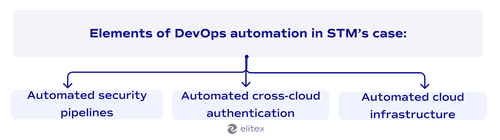
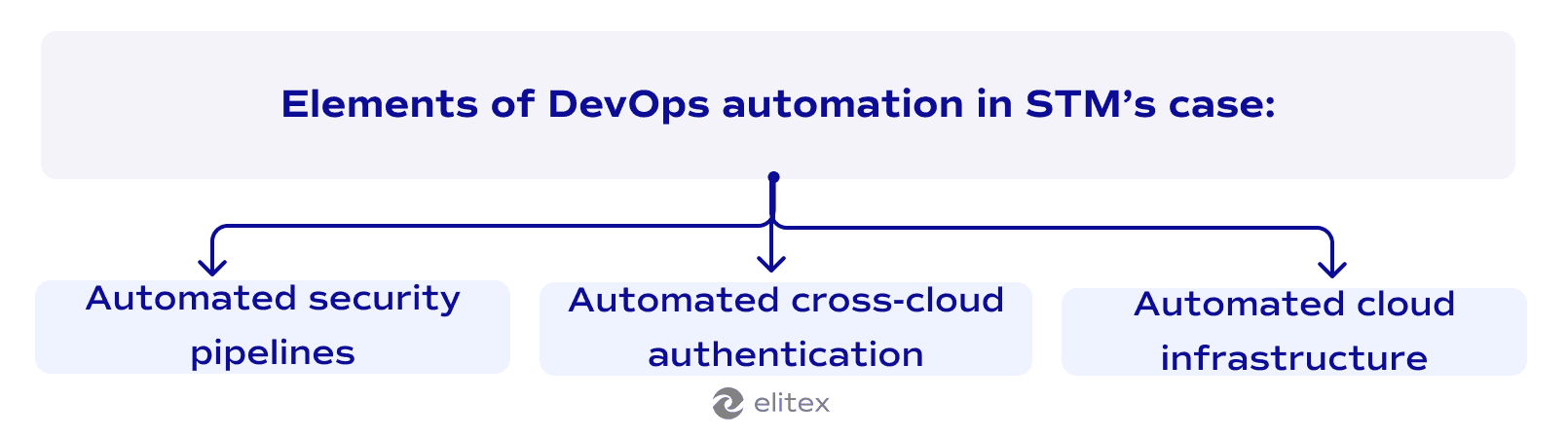
- Automated security pipelines: We implemented Datadog-based monitoring dashboards that eliminate manual deployment risks and detect security threats before escalation.
- Automated cloud resources: ELITEX built an infrastructure on AWS services (integrating Lambda, DynamoDB, and OpenSearch), combined with automated deployment pipelines for scalable manuscript processing;
- Automated cross-cloud authentication: We designed automated security integration between Azure users and AWS services, removing human involvement in error-prone processes
The result: STM achieved zero production errors since ELITEX began to automate DevOps on the project. The platform reduced downtime costs through instant alert systems and eliminated deployment mistakes across both cloud environments.
Case # 4: DevOps automation for an AI startup
Here, the client's name was hidden due to confidentiality
The young startup develops AI-powered software that automates insurance verification calls for medical clinics, eliminating manual processes where staff spend hours on phone calls with insurance providers.
The challenge: The platform faced serious security threats with publicly accessible databases and manual SSH deployments. Infrastructure required excessive human involvement for code updates and service restarts, creating a significant risk of errors. The system lacked scaling capabilities under increased load and couldn’t meet HIPAA compliance requirements essential for modern software development in healthcare.
The solution: ELITEX DevOps teams implemented automated CI/CD pipelines that eliminated manual deployments across dev, staging, and production environments, removing manual intervention from error-prone processes. Our team migrated the platform to AWS ECS with Docker containers, load balancers (ALB/NLB), and auto-scaling based on actual demands. Security hardening measures applied HIPAA compliance protocols with continuous performance monitoring and automated security testing systems to protect against security issues.
The result: Startup achieved significantly faster deployment speed and enhanced customer trust through security improvements. The platform now delivers high-quality software with improved availability through on-demand scaling and reduced infrastructure costs via resource-based pricing.
Best Practices for DevOps Automation
Smart automation in the DevOps transformation journey helps companies deploy software faster and with fewer errors. The best DevOps examples show that teams using the following versatile automation strategies demonstrate better results in their DevOps automation journey. Here are several proven practices that help anyone build reliable systems responding quickly to business needs:
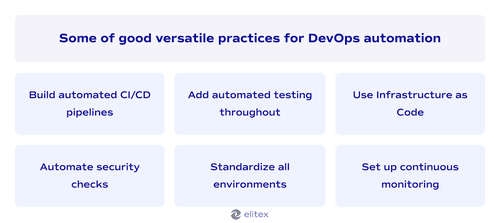
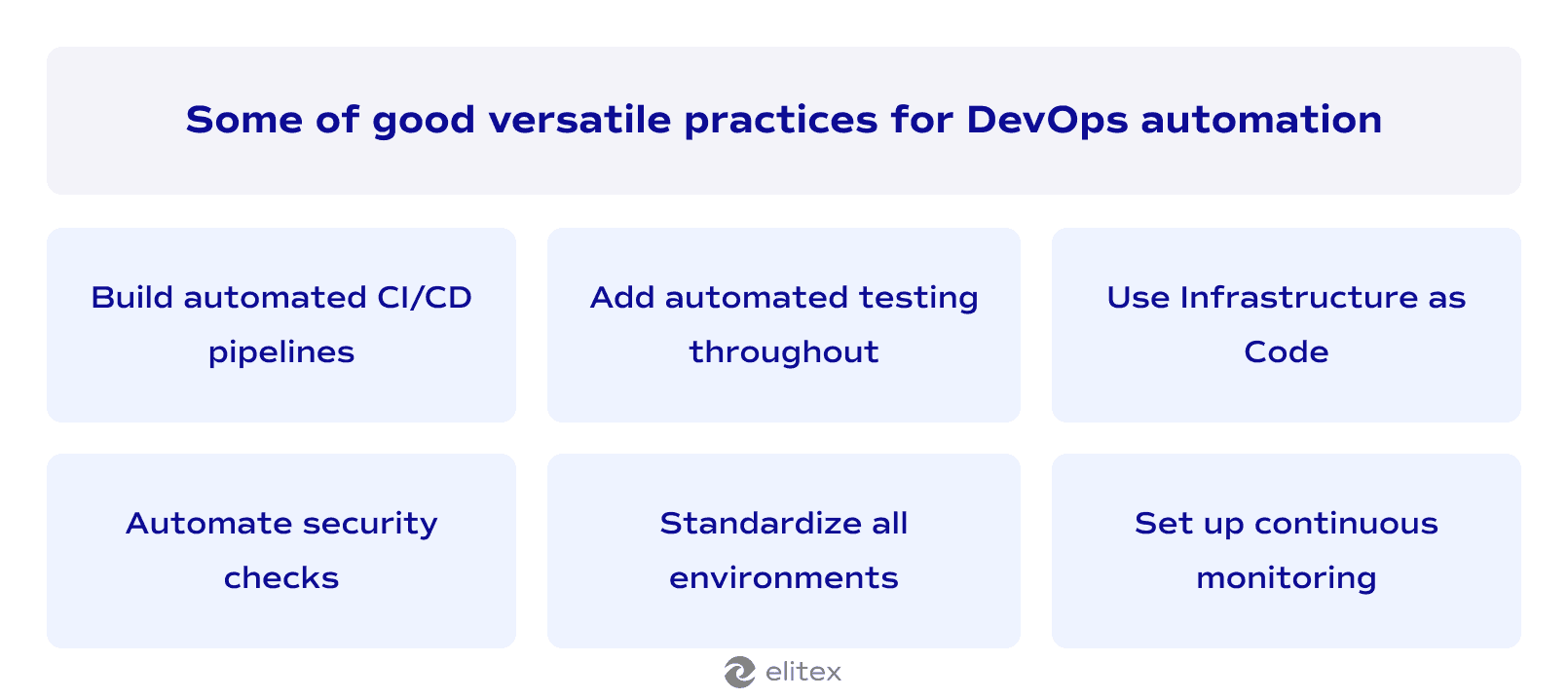
- Build automated CI/CD pipelines: Create pipelines that automatically handle code integration, testing, and deployment, using reliable DevOps automation tools.
- Add DevOps automated testing throughout: Set up automatic tests at every stage of the software lifecycle to catch problems before they reach your customers.
- Use Infrastructure as Code: Write your infrastructure setup as code so teams can test and deploy environments automatically.
- Set up continuous monitoring: Install DevOps tools that track system performance and alert you instantly when something goes wrong.
- Automate security checks: Build security scans directly into your deployment process to stop vulnerabilities as early as possible.
- Standardize all environments: Use containers to keep development and production environments identical, preventing deployment surprises.
Also, read our top 10 best DevOps automation companies in the USA in 2026
Future of DevOps automation
The future looks exceptionally bright for DevOps automation across all industries. Intelligent DevOps automation tools will probably handle increasingly complex routine tasks that currently consume valuable engineering time. Meanwhile, no-code and low-code solutions will democratize automation, making these powerful capabilities accessible to teams without a deep technical background
Current DevOps trends point toward remarkable technological changes that will reshape how we build software. AI-driven systems will automatically optimize infrastructure performance without requiring human input or oversight. These smart platforms will analyze patterns to predict failures before they occur, preventing costly downtime. Additionally, they will self-heal applications in real-time, resolving issues faster than any human operator could manage.
We will see more tools that seamlessly integrate machine learning directly into the DevOps process, creating smarter workflows. As a result, development teams can focus their energy on strategic initiatives rather than repetitive manual operations. Furthermore, emerging DevOps automation examples already demonstrate how modern platforms automatically provision resources, execute security scans, and deploy updates across global infrastructure within minutes rather than hours
Transforming your automation workflow with tailored DevOps automation solutions
However, predicting the future is always a kind of magic. We, at ELITEX, aren’t fortune seekers and can’t do prediction magic. But what we know for sure is that these technological advances won't eliminate the need for skilled DevOps professionals. Instead, they will elevate their role toward higher-level architectural design and strategic platform development. This shift means organizations will need expert guidance even more than ever in order to harness these new capabilities effectively.
At ELITEX, we help organizations implement advanced DevOps solutions that align with their specific business objectives. Our exclusive style is based on a decade of technical experience combined with transparency and honesty in communication, as well as a zero-bureaucracy approach. Together with deep multi-industry knowledge, it ensures that our specialists know how to enhance any automation system to deliver maximum value.
Choosing ELITEX means choosing a partner that understands both technology and business results. We don’t just implement tools—we build automation strategies that solve real problems. Our team directly works with your engineers, eliminating unnecessary management layers that slow down decision-making. This direct collaboration ensures your automation projects stay on track and deliver measurable improvements.
Furthermore, we prioritize knowledge transfer to ensure your team can maintain and evolve the automation systems independently. Our specialists document processes thoroughly, and as soon as you are ready, train your engineers, making your organization truly self-sufficient. This approach builds long-term capability within your team while reducing dependence on external support to maximize your long-term profit.
Ready to automate your software approach? Contact ELITEX today to get started with your DevOps automation journey!


FAQs about DevOps automation examples
What is automation in DevOps?
Automation in DevOps means using tools and scripts to handle repetitive tasks like code deployment, testing, monitoring, alerting, and infrastructure management without manual intervention. This approach eliminates human errors, speeds up software delivery, and allows development teams to focus on building features instead of managing operations.
What are some DevOps automation examples in real life that show measurable results?
As we wrote in our article, Capital One reduced infrastructure provisioning from weeks to minutes and achieved 50% faster release cycles through automated Continuous integration/conitinuos delivery pipelines. Netflix built Chaos Monkey and automated monitoring systems to maintain near-perfect uptime while serving 214+ million subscribers. Other DevOps automation examples include Amazon, Google, Microsoft, Spotify, and Uber.
Can you share some DevOps automatization examples that focus on DevOps automated deployment?
Major DevOps automation examples include Netflix using Spinnaker for automated deployments that happen thousands of times daily, and Capital One implementing DevOps automated deployment pipelines that reduced release cycles by 50%. Amazon also uses automated deployment systems that push code changes across their massive infrastructure without human intervention, while Google employs automated rollback mechanisms as part of their deployment automation strategy.
How does DevOps automation help reduce business costs?
DevOps automation cuts costs through comprehensive release management and overall fewer errors. Each automation component delivers savings in different ways. DevOps automation of testing reduces the holding costs by finding bugs early instead of fixing them after launch. Early detection costs pennies compared to post-release patches. Infrastructure automation eliminates manual server setup, freeing teams for strategic work. DevOps automation examples in real life, like Capital One saving weeks of manual work or Netflix processing thousands of daily deployments, prove these practices deliver measurable savings across industries.
POSTED IN: