



- TL;DR: Selecting the right DevOps automation partner represents a critical business decision. In today’s article, we outlined the best approach to his selection process.
- We covered evaluation criteria (also covered selection criteria for our own top).
- We offered our own top 10 DevOps automation companies in the USA.
- Additionally, we wrote a detailed breakdown of which industries benefit most from DevOps automation and added several words about future trends in DevOps.
What drives successful software delivery in 2026? The golden standard here is DevOps culture. DevOps stops the endless cycle of broken releases and weekend emergency fixes. Yet implementing DevOps properly requires specialized knowledge that most teams lack. So, basically, when seeking DevOps transformation, most companies face two distinct paths: building extensive and reliable in-house teams for years or partnering with DevOps automation companies for faster market entry. And it's absolutely clear why many businesses resort to outsourcing when hiring an in-house DevOps engineer may easily cost $150,000+ annually, while outsourcing delivers immediate expertise at a fraction of that cost.
In this case, choosing the right tech partner is absolutely crucial. Companies collaborating with professional DevOps automation services providers deploy code up to 200 times more frequently than their competitors without implementing DevOps. Consequently, development teams stop spending weekends fixing broken deployments and start shipping features that really matter. This advantage allows companies to adapt to customer demands in days, not quarters. Therefore, for today’s article, we’ve analyzed the leading DevOps automation companies to help anyone interested in finding partners that deliver measurable results, not just impressive demos.
Why do businesses need DevOps automation today?
We have previously written a dedicated article about the benefits of DevOps automation. Here is a brief overview of it written in clear language without unnecessary tech jargon:
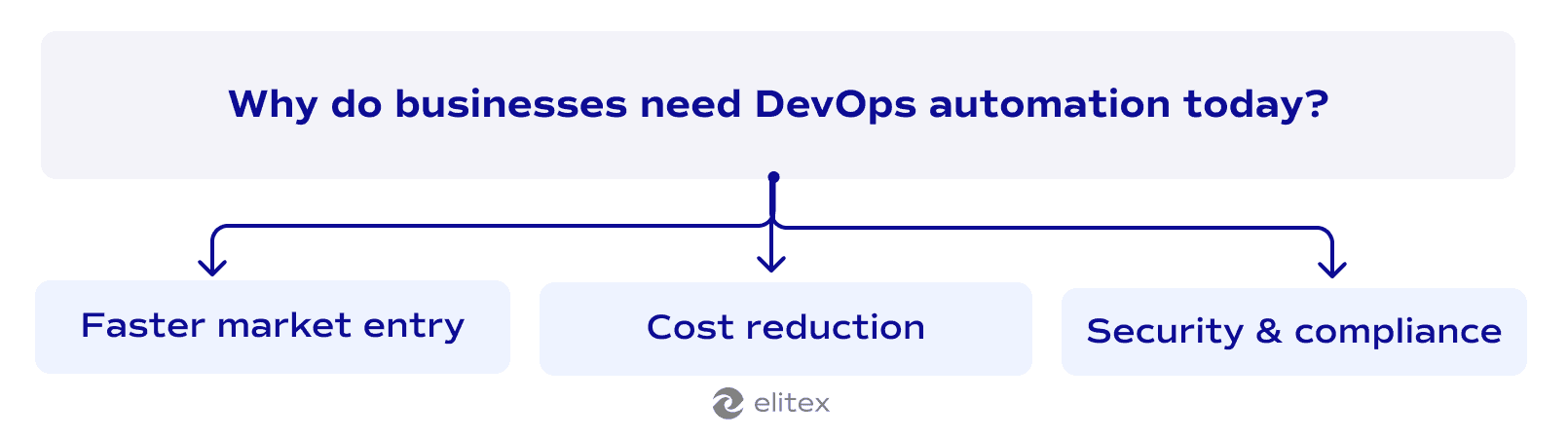
Faster market entry
Modern markets punish slow movers. As mentioned earlier, DevOps services enable continuous integration that turns week-long release cycles into daily deployments. Therefore, your team ships features while competitors are still just planning theirs.
Cost reduction
Manual processes drain budgets through constant firefighting and after-hours support incidents. Yet DevOps services eliminate costly interruptions by standardizing deployment and monitoring processes and approaches. This operational efficiency typically significantly reduces deployment incidents within the first year. Beyond this, DevOps culture automates infrastructure management, preventing expensive server crashes and resource waste that traditionally required dedicated operations teams.
Security and compliance
Compliance failures cost companies millions in fines and lost reputation. However, DevOps automation builds security checks directly into your development pipeline. With DevOps in place, every code change gets automatically tested for potential vulnerabilities and regulatory compliance violations. Because of this proactive approach, your app delivery meets industry standards without slowing down development velocity. With DevOps, manual compliance reviews that once took weeks now happen in minutes.
Key features to look at when choosing DevOps companies
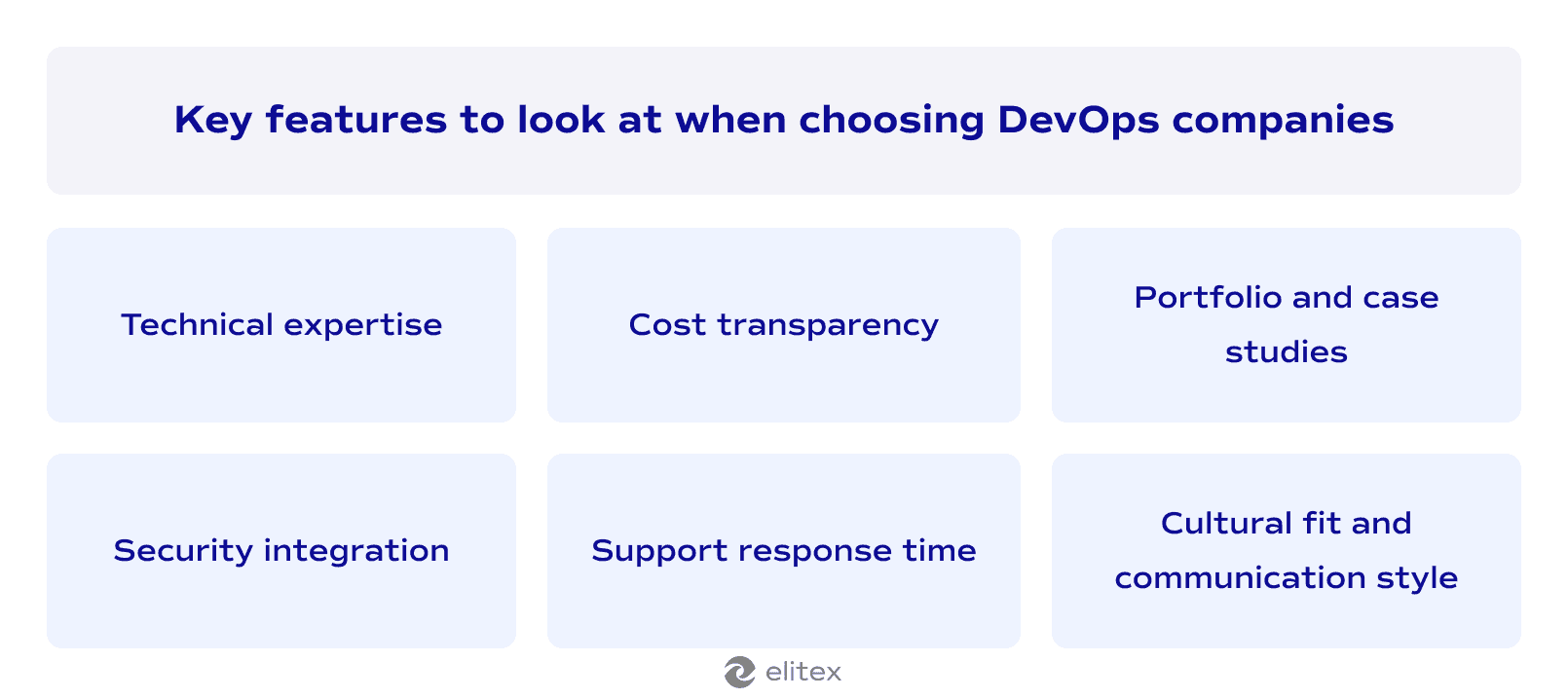
Technical expertise: First of all, assess the candidates’ proficiency with modern DevOps automation tools like Kubernetes, Docker, Jenkins, and Terraform, plus cloud platforms. Then, review their certifications and case studies to verify hands-on experience with your technology stack and their overall DevOps experience.
Security integration: In 2026, security cannot be an afterthought in automated DevOps pipelines. Evaluate how providers implement automated security scanning, vulnerability assessments, and compliance monitoring throughout the entire development lifecycle.
Cost transparency: Hidden fees destroy project budgets. Demand clear pricing models that account for infrastructure costs, automation tool licensing, ongoing support, and scalability adjustments. Transparent pricing prevents surprises, so choose providers who offer detailed cost breakdowns upfront.
Support response time: Production issues demand immediate attention, especially when customers are affected. But the truth is that support quality varies dramatically between providers, so a thorough evaluation becomes essential. When looking for DevOps automation companies, examine their SLA commitments, escalation procedures, availability during critical incidents, and dedicated account management. Fast response times during emergencies can mean the difference between minor hiccups and major revenue losses.
Portfolio and case studies: Examine their track record more deeply. Look for companies similar to yours in size and industry. Request specific examples of DevOps transformations they’ve completed, including before-and-after metrics like deployment frequency, failure rates, and recovery times. Real case studies reveal their problem-solving approach and results delivery capability better than generic marketing materials.
Cultural fit and communication: DevOps success depends heavily on collaboration between teams. Evaluate how potential providers communicate during the sales process, their willingness to understand your business goals, and their approach to knowledge transfer. Strong cultural alignment ensures smoother project execution and long-term partnership success beyond just technical implementation.
How did we choose DevOps automation companies for our list?
Finding the right providers among countless options requires focused criteria. So, let’s clarify our approach. First of all, we targeted mid-sized DevOps automation companies that either operate from the USA or actively serve American businesses. Why mid-sized? Quite easily! These firms balance technical capability with personalized attention through dedicated account management, which makes them quite a natural choice as the best DevOps automation providers.
We excluded product vendors and focused exclusively on custom implementation specialists. Our research drew from GoodFirms, Clutch, The Manifest, and TechReviewer to identify providers with proven track records and verified client results.
Now, when all that was required is done, let’s finally examine the companies that made our final list.
Top DevOps automation companies in the USA in 2026
| Company | Experience | Client satisfaction | Areas of expertise | Key differentiators |
| ELITEX | 10+ years | 4.9/5 | End-to-end DevOps solutions, infrastructure automations, security automation, monitoring solutions | Fortune 500 experience, 50%+ senior engineers |
| Cinnova Technologies | 15+ years | 5/5 | Microsoft Azure, AWS, DevSecOps, ISO 27001 | $15M revenue, Inc. 5000 list |
| Ancient Tech | 12 years | 4.9/5 | CI/CD pipelines, Infrastructure automation, Security integration | Huge experience in the FinTech industry |
| NaNLabs | 12 years | 4.9/5 | GitHub Actions, Terraform, Docker, Kubernetes, AWS | AWS partner, strong multi-area portfolio |
| OpsWorks Co. | 8 years | 4.9/5 | EKS, Kubernetes, CI/CD, Zero-downtime deployment | AWS Advanced partner, ISO 27001 certified |
| Dedicatted | 12 years | 5/5 | Multi-cloud, Agentic AI, DevSecOps consulting services, FinOps | Top 2% AWS partner |
| binbash | 8 years | 4.9/5 | AWS, Terraform, OpenTofu, Kubernetes | Multiple reports on 10x faster deployment as a result of collaboration |
| Flyaps | 12 years | 4.8/5 | Kubernetes, Docker, CI/CD, Cloud migration for small companies | 90% master's degrees |
| IT Outposts | undisclosed | 5/5 | Ansible, Puppet, Chef, Multi-cloud management | 24/7 support |
| AFI OPS Technologies | 12 years | 5/5 | Apache Spark, Hadoop, ETL, Multi-cloud automation | Big data specialization |
1 . ELITEX
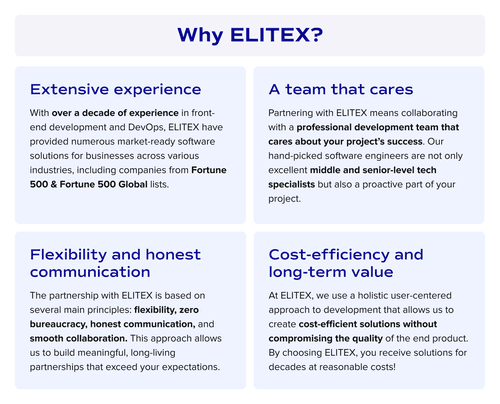
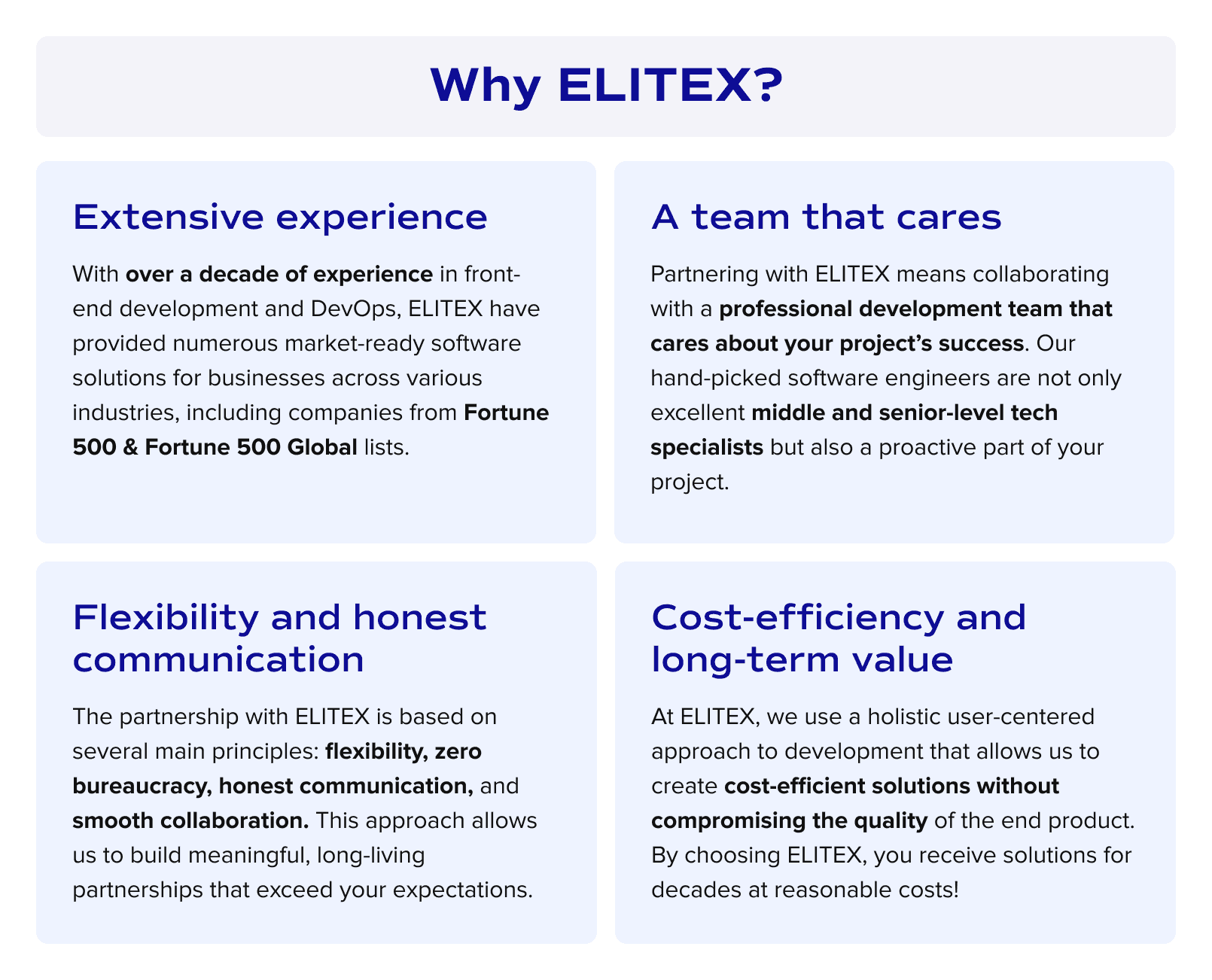
ELITEX leads our list with over a decade of DevOps experience across banking, publishing, eCommerce, healthcare, manufacturing, and other industries. Their track record speaks volumes: their clients report 99.9% uptime and up to 90% infrastructure cost reduction after implementation. This cross-industry experience allows ELITEX to adapt automation strategies to specific regulatory requirements and business challenges. The company works with both Fortune 500 enterprises and early-stage startups alike.
What distinguishes ELITEX is their transparent approach to pricing and communication. They provide detailed project breakdowns upfront, eliminating surprise costs that plague many DevOps projects. When choosing ELITEX, you always communicate directly with their DevOps consultants without unnecessary intermediaries slowing down decisions.
ELITEX specialize in building scalable CI/CD pipelines, monitoring and alerting systems, infrastructure automation services, and security solutions. They focus on sustainable transformations rather than quick patches. This methodology proves especially valuable for companies planning comprehensive digital overhauls that need to deliver long-term value.
2 . IT Outposts
IT Outposts specializes in DevOps automation services that deliver measurable results. They've helped clients optimize infrastructure budgets by up to 40%. Their DevOps consulting transforms manual workflows into automated systems. The company excels at infrastructure as code implementations that eliminate deployment errors. They also provide container orchestration using Docker and Kubernetes for consistent application performance. IT Outposts stands out through transparent pricing and dedicated support teams. This makes them a reliable choice for organizations planning DevOps transformation projects.
3 . binbash
binbash stands out among DevOps consulting companies as an AWS Advanced Tier Services Partner with over 15 years of expertise in cloud infrastructure automation. They specialize in implementing advanced security measures through comprehensive frameworks that meet ISO 27001 and HIPAA compliance standards. The company excels in infrastructure as code implementations using Terraform and OpenTofu, combined with Kubernetes container orchestration for scalable deployments. binbash serves healthcare, fintech, and risk management industries with their remote-first team of AWS-certified professionals. Their proven track record includes delivering well-architected cloud solutions that prioritize security by design while enabling rapid development cycles.
4 . NaNLabs
NaNLabs stands among DevOps automation companies with over a decade of experience in automating software deliveries and infrastructure management. They specialize in comprehensive CI/CD pipeline development using GitHub Actions, Terraform for Infrastructure as Code, and containerization with Docker and Kubernetes. The company maintains extensive open-source DevOps resources, including automation frameworks, AWS service integrations, and security management tools. Their expertise spans cloud-native solutions across AWS and GCP platforms, serving cybersecurity, fintech, and mobility sectors. NaNLabs combines Agile methodologies with DevOps practices to deliver automated testing, deployment, and monitoring solutions that enhance development velocity while maintaining high security standards.
5 . Ancient
Ancient ranks among specialized DevOps automation companies focused on transforming IT operations through advanced automation strategies. They excel at implementing CI/CD pipelines that accelerate development lifecycles and reduce deployment complexity. Ancient provides real-time monitoring solutions and automated infrastructure management to simplify scalability challenges. Their security-first approach integrates protection measures at every DevOps stage. The company helps organizations enhance productivity while adapting to market demands through cloud automation technologies. Ancient combines development and operations expertise to deliver streamlined software delivery processes.
6 . Flyaps
Flyaps delivers comprehensive DevOps automation services with over 10 years of experience in cloud transformations. Their team specializes in CI/CD pipeline automation using Jenkins, GitHub Actions, and GitLab CI/CD. They provide infrastructure automation through Terraform, AWS CloudFormation, and Azure Resource Manager across multi-cloud environments. Flyaps excels in container orchestration with Kubernetes and Docker Swarm for scalable deployments.
The company offers end-to-end cloud migration services, transitioning legacy systems to modern cloud-native environments. Their expertise spans DevSecOps (read our DevOps vs DevSecOps article), MLOps(read our MLOps vs DevOps article), and SRE practices with seamless AWS, GCP, and Oracle cloud integrations. Flyaps maintains a highly qualified team where 90% hold master's degrees in mathematics or computer science. They deliver remote DevOps engineers within 24 hours and provide ongoing managed services for sustained performance optimization.
7 . Cinnova Technologies
Cinnova Technologies delivers comprehensive DevOps automation services with over 15 years of modernization expertise across multi-cloud environments. Their DevOps consulting approach includes strategy assessment, CI/CD pipeline automation, and cloud-native infrastructure management using AWS, Azure, and Google Cloud platforms. As an ISO 27001-certified organization with Microsoft and AWS partnerships, they specialize in DevSecOps implementation that embeds security testing and vulnerability scanning throughout development cycles. Cinnova ensures regulatory compliance with HIPAA, SOC 2, and GDPR standards while providing automated monitoring through Prometheus, Grafana, and ELK Stack. Their three-phase service model covers initial assessment, implementation with security integrations, and ongoing support for sustained performance optimization.
8 . Dedicatted
Dedicatted ranks among specialized DevOps companies providing comprehensive automation services across AWS, Azure, GCP, and hybrid cloud platforms. They offer DevOps-as-a-Service with CI/CD pipeline automation, Infrastructure as Code implementation, cloud-native engineering, and FinOps solutions. The company holds SOC 2 Type 2 and ISO 27001 certifications while maintaining AWS Advanced Tier Partnership status. Dedicatted integrates agentic AI for automated incident response and operational workflows within existing toolchains. Their managed services include 24/7 monitoring, rapid incident resolution, and developer mentoring to ensure long-term adoption success.
9 . OpsWorks Co.
OpsWorks Co. stands among the leading DevOps consulting companies serving enterprises in Tech, E-commerce, Finance, and Healthcare sectors. As an AWS Advanced Tier Partner with 50+ certifications, they are one of the top DevOps-as-a-Service companies with solutions including EKS infrastructure, CI/CD automation, and zero-downtime deployments. The ISO 27001-certified company has completed 100+ projects, achieving up to 80% cloud cost reduction and 99.9% uptime for clients like Syndigo and Vodafone. Their expertise spans Infrastructure as Code, microservices migration, and container orchestration across the US and European markets.
10 . AFI OPS TECHNOLOGIES
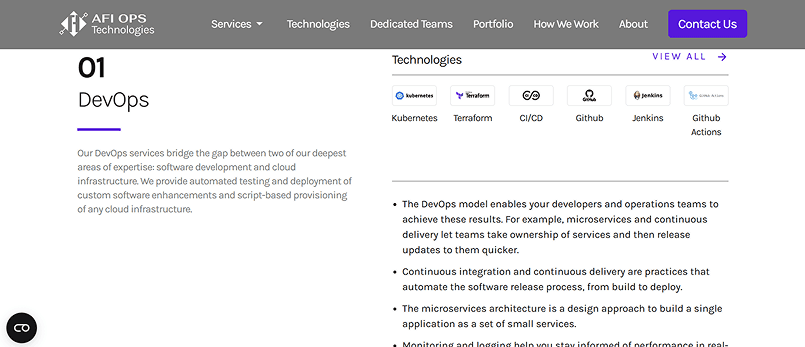
AFI OPS TECHNOLOGIES ranks among specialized DevOps automation companies providing multi-cloud infrastructure services across AWS, Azure, and Google Cloud platforms. They deliver CI/CD pipeline automation, automated deployments, and cloud infrastructure management with proven results, including a 70% reduction in Apache Spark job processing times. The company specializes in big data projects and ETL process optimization for enterprise clients.
Their cloud migration services enable seamless transitions from on-premise to cloud environments while maintaining cost efficiency. AFI OPS TECHNOLOGIES combines DevOps automation with microservices architecture development, scaling client infrastructure to hundreds of nodes. Founded in 2013, they focus on delivering high-quality software solutions through streamlined deployment processes and comprehensive cloud automation strategies.
Industries that benefit most from DevOps automation
| Industry | Why does DevOps automation benefit this industry? |
| Financial services | Financial services face strict regulations. DevOps automation helps meet most compliance requirements through automated security patches. |
| Healthcare | Healthcare organizations struggle with HIPAA compliance while maintaining patient safety. DevOps automation protects sensitive data through encrypted pipelines while ensuring life-critical applications achieve 99.99% availability across distributed hospital networks. |
| eCommerce | eCommerce platforms experience unpredictable traffic spikes. Automated scaling allows these platforms to handle peak seasons more effectively. |
| SaaS/Software | SaaS companies need rapid feature delivery to stay competitive. However, maintaining quality across multi-tenant architectures proves challenging. DevOps automation enables continuous integration while reducing risks through automated testing. |
| Telecommunications | Telecommunications infrastructure requires absolute reliability. DevOps automation maintains 99.99% uptime standards. |
| Gaming | Gaming platforms face real-time performance demands with dramatically fluctuating player bases during events. DevOps automation enables instant patch deployment while dynamically scaling server capacity to match player traffic without service interruption. |
| Media & Entertainment | Content platforms must handle viral traffic surges instantly. DevOps automation optimizes global content delivery networks. |
| Government | Government agencies manage complex legacy architecture while serving millions of citizens. Security compliance requirements continue expanding. DevOps automation modernizes outdated systems while maintaining strict regulatory standards through transparent deployment processes. |
Which type of DevOps automation services should you choose?
The right solution for selecting the right DevOps automation approach depends heavily on your organization’s technical complexity, team capabilities, and growth trajectory. DevOps automation solutions companies typically offer a range of services, including managed services, DaaS models, consulting, or even some hybrid models that combine different approaches.
Here’s a short description of some of these services and a hint on how to choose the right one for your situation:
- DevOps consulting services: Assessment of current infrastructure through comprehensive audits, roadmap development with implementation timelines, strategic guidance for technology adoption, and best practices training. A good choice for organizations with technical teams needing expert guidance on DevOps transformation.
- DevOps-as-a-Service: Complete infrastructure management with automated deployments, CI/CD pipeline automation across multiple environments, 24/7 monitoring with incident response, and ongoing system maintenance. Best for companies lacking internal DevOps expertise or wanting to focus solely on development in-house.
- Staff augmentation model: Temporary DevOps engineers integrate with existing teams for specific projects. Ideal for organizations with some level of adoption of DevOps culture needing additional expertise in the short term.
- Migration services: Cloud adoption with platform assessment, legacy system modernization through containerization, data migration with zero-downtime strategies, and post-migration optimization. Choose when moving from no-premise to cloud or between cloud providers.
- Security integration services: DevSecOps implementation with security check automation. Essential for regulated industries or companies handling sensitive data.
- Monitoring services: Performance tracking with real-time dashboards, alerting systems with escalation protocols, incident response automation, and capacity planning analytics. Suitable for companies needing visibility into system health and performance.
- Optimization services: Cost reduction through resource rightsizing. Best for organizations with established DevOps ecosystem seeking efficiency improvements.
- DevOps observability services: Comprehensive logging across distributed systems, metrics collection with custom dashboards, distributed tracing for microservices architecture (check our article about the role of microservices in DevOps), and application performance monitoring. Choose for complex architectures requiring deep system insights.
Future trends in DevOps automation
DevOps trends in 2026 are split into two approaches. Small teams choose no-ops platforms like Vercel that handle infrastructure automatically. Large companies build complex microservices requiring specialized DevOps expertise. AI now monitors systems and predicts failures without human oversight. With AI, security scanning happens automatically in every deployment. DevOps automation companies focus on creating self-service platforms for developers. Additionally, GitOps treats code repositories as the single source of infrastructure truth.
Key future trends in DevOps:
- No-ops platforms: Automated deployment and scaling for rapid MVP launches
- AI-powered monitoring: Predictive failure detection and self-healing systems
- Embedded security: Real-time vulnerability scanning and automated threat response
- Platform engineering: Self-service developer environments with simplified infrastructure access
- GitOps workflows: Git-based infrastructure management with automatic deployment
- Microservices architecture: Container-based services enabling frequent, zero-downtime deployments
Brief conclusion: To wrap things up
DevOps evolution in 2026 creates two distinct paths for companies. Small teams gravitate toward automated platforms that eliminate infrastructure complexity. Meanwhile, enterprises require sophisticated systems with specialized oversight. DevOps automation companies bridge this gap by providing expertise that most internal teams lack. However, choosing the wrong approach leads to costly migrations and delayed product launches. Therefore, success hinges on partnering with providers who understand both current technical needs and future business requirements.

Partner with ELITEX for your DevOps journey
ELITEX addresses every stage of your DevOps transformation through proven expertise and tailored solutions. Whether you need strategic consulting to evaluate existing systems, managed services for complete automation, or staff augmentation for specialized projects, we deliver results that accelerate development cycles. Furthermore, our team combines modern automation techniques with deep industry knowledge, taking into account not only technical performance but also measurable business outcomes that really matter. Partnering with ELITEX means always receiving results that exceed your initial expectations.
Looking for a development process transformation? Contact ELITEX today!
FAQs
What are the best automation providers in 2026?
Our list of best DevOps automation providers includes ELITEX (Fortune 500 experience, 99.9% uptime), Cinnova Technologies (ISO 27001 certified, $15M revenue), Ancient Tech (FinTech specialization), NanLabs (AWS partner, open-source expertise), OpsWorks Co. (AWS Advanced Partner, 100+ projects), Dedicatted (Top 2% AWS partner, agentic AI), binbash (HIPAA compliance, 10x deployment speed), Flyaps (90% master's degrees, 24-hour deployment), IT Outposts (40% cost savings, 24/7 support), and AFI OPS Technologies (big data specialization, 70% performance improvement).
How do DevOps automation services companies structure their offerings?
DevOps automation companies offer consulting for strategic guidance, DevOps-as-a-Service for complete management, staff augmentation for temporary expertise, migration services for cloud adoption, security integration for compliance, monitoring services for system visibility, optimization for cost reduction, and observability for complex architectures. Choose based on your team's existing capabilities and specific needs.
Which industries benefit most from working with DevOps automation companies?
Financial services, healthcare, eCommerce, SaaS/Software, telecommunications, gaming, media & entertainment, and government sectors gain the most value. DevOps automation companies help these industries meet compliance requirements, handle traffic spikes, maintain 99.99% uptime, and modernize legacy systems while ensuring regulatory standards.
How do DevOps automation solutions companies reduce operational costs?
DevOps automation solutions companies eliminate manual firefighting, automate infrastructure management, prevent expensive server crashes, and standardize deployment processes. They typically reduce deployment incidents significantly within the first year while automating compliance reviews that previously took weeks.
What should you expect when partnering with DevOps automation services companies?
DevOps automation services companies provide detailed project breakdowns, direct communication with consultants, measurable results like improved deployment frequency, and transparent pricing models. Expect faster market entry, reduced weekend emergency fixes, and the ability to adapt to customer demands in days rather than quarters.
When should companies choose staff augmentation from DevOps automation companies?
DevOps automation companies recommend staff augmentation for organizations with existing DevOps knowledge needing temporary expertise for specific projects. This model works best when you have some internal capabilities but require additional specialists on a short-term basis without long-term hiring commitments.
How do you evaluate the track record of DevOps automation companies?
Examine case studies with before-and-after metrics like deployment frequency, failure rates, and recovery times. DevOps automation companies should provide specific examples from similar industries, client testimonials with measurable outcomes, and proven experience with your technology stack and compliance requirements
What’s the difference between DevOps tool provider companies and DevOps automation companies?
DevOps tool providers sell platforms and software that DevOps teams use to build their own automation workflows, while DevOps automation companies implement and manage those tools for you. As a few examples of DevOps tool providers, we can mention the following companies: GitLab offers an integrated platform for version control, CI/CD pipelines, and security scanning, GitHub provides repository hosting with Actions for workflow automation and collaboration features, Docker delivers containerization technology that packages applications with their dependencies for consistent deployment, Ansible automates configuration management and application deployment through simple YAML scripts, DataDog monitors infrastructure and applications with real-time analytics and alerting, Terraform enables infrastructure as code across multiple cloud providers, Jenkins provides open-source automation for building, testing, and deploying applications. We cover DevOps automation tools in depth in our separate dedicated article.
POSTED IN: