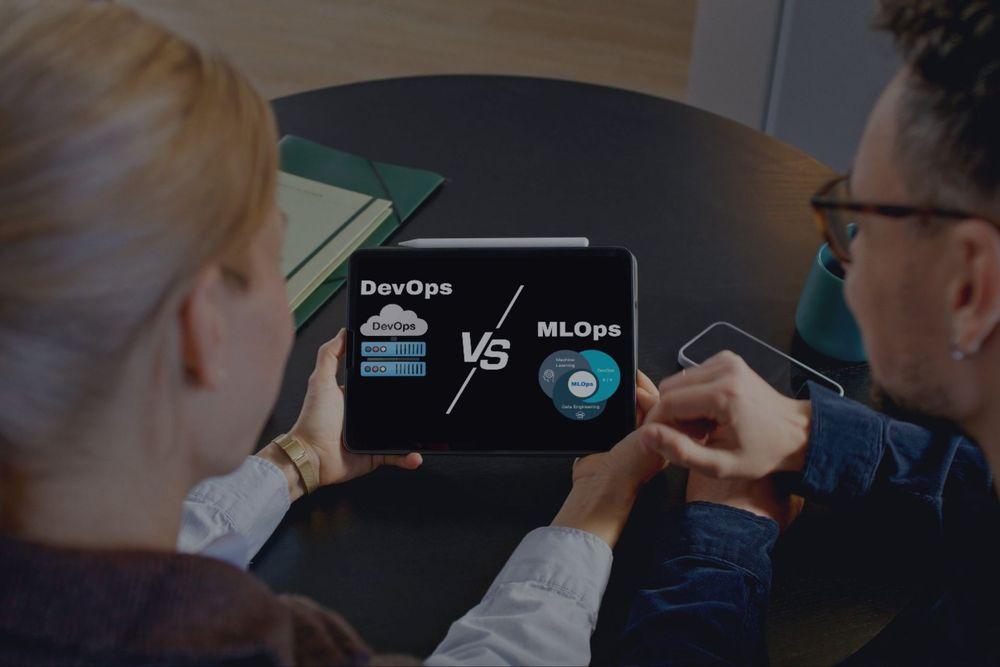


In 2026, machine learning powers virtually everything from your morning coffee app to global financial systems. You can see it with an unaided eye: recommendations shape your social feeds, chatbots handle customer service, predictive algorithms manage supply chains in the supermarket you visited in the morning, and computer vision systems secure physical locations. Of course, this technological boom creates trillion-dollar opportunities for companies bold enough to integrate AI into their core operations. That’s why software engineers face growing pressure to adopt machine learning capabilities in as many situations as possible. The rise of AI-driven applications represents one of the most significant DevOps trends reshaping how teams approach deployment and monitoring.
However, the other side of this growth coin reveals an unexpected factor that catches development teams off guard: the software development lifecycle for projects with ML is way more sophisticated than for traditional projects. From our practice, we have seen the situation where organizations are rushing to adopt machine learning without a proper operational framework (traditional automation pipelines often struggle with AI model requirements), many times. Standard DevOps automation services excel at deploying web applications and databases, but machine learning models demand different monitoring, versioning, rollback strategies, data pipeline management, and model performance tracking.
But there is an answer. Enter MLOps: a specialized approach designed for deployments of projects with integrated machine learning. It creates entirely new operational demands that coexist alongside traditional DevOps practices.
Today, in our article, we’ll break down both approaches, compare their core functions, examine their practical applications, and provide a clear framework for choosing the right strategy in various situations. You’ll learn when traditional DevOps automation works best, where MLOps becomes a good choice, and how to implement either strategy effectively. This DevOps vs MLOps analysis will reveal which operational model best fits your team’s current needs and future goals. So, without any unnecessary ado, let’s dive in!
What is DevOps?
Let’s start by clearly defining both concepts.
DevOps is a methodology/approach/culture/paradigm designed to automate software delivery from code to production. It connects development with IT operations teams through shared tools and workflow processes. Adopting DevOps culture allows companies to eliminate manual handoffs that slow down releases and create errors. Also, DevOps uses several practices, such as continuous integration, automated testing, deployment pipelines, and infrastructure monitoring, to ship software faster and more efficiently (you can read more about it in our dedicated article about DevOps benefits). With DevOps, teams can release updates daily or even hourly instead of waiting weeks or months.
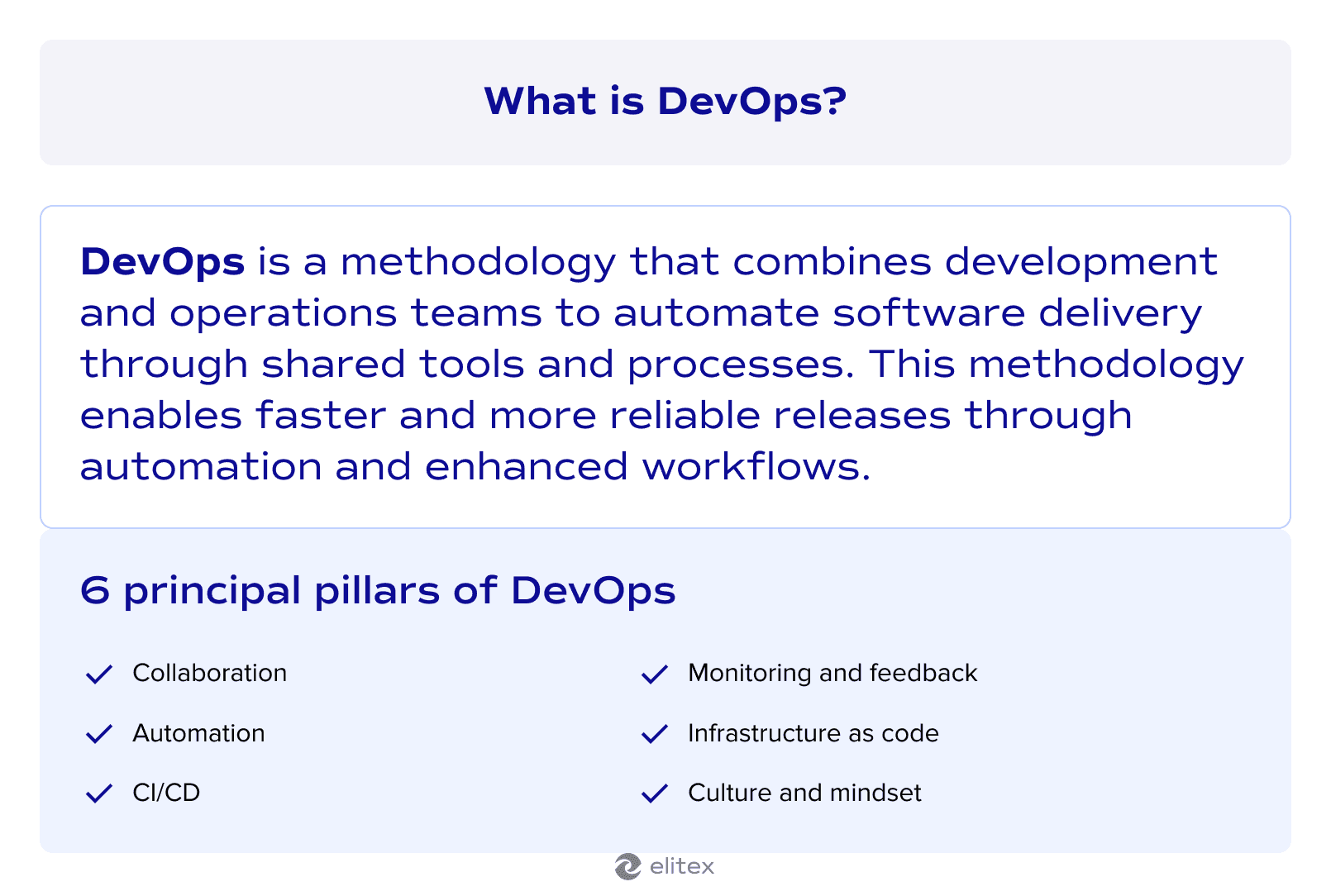
DevOps has become the modern standard in the software development industry, and now it boosts productivity across companies and economic domains worldwide. You can read more about real-world use cases of DevOps in our article about DevOps examples. Additionally, we should add that DevOps operates on several core principles that guide the successful implementation of this culture. They are typically called DevOps pillars. Here are six main of them:
- Collaboration: Under the DevOps paradigm, development and operation teams work together (the very word DevOps is created by combining DEVelopment and OPerationS), sharing responsibilities and breaking down traditional silos.
- Automation: With DevOps, manual processes get replaced with automated workflows wherever it’s possible (e.g., in testing, deployment, configuration management, infrastructure provisioning, etc).
- Continuous Integration/Continuous Deployment: CI/CD practically means that code changes integrate frequently with automated testing, enabling rapid and reliable software releases. A well-tuned CI/CD pipeline equals bugs that get caught early in development rather than during production deployments.
- Monitoring and feedback: Monitoring culture is all about real-time system monitoring, providing instant visibility and DevOps observability into application performance, user behavior, infrastructure health, security, and other key metrics.
- Infrastriucture as Code implementation: With DevOps, infrastructure management happens through version-controlled code, making environments reproducible and consistent across development stages.
- Culture and mindset: DevOps is not only about practices but about culture as well. Adoption of this culture allows teams to improve both workflow and quality of the end product.
What is MLOps?
Now, let’s take a look at our second concept.
MLOps is a specialized methodology/approach/culture/paradigm that manages machine learning model lifecycles from development to deployment in prod. This concept emerged around 2015 as organizations gradually discovered that traditional software development approaches weren’t designed to handle the complexities of AI models. We should emphasize that MLOps builds upon DevOps foundations to address machine learning-specific challenges. Such challenges include model versioning, feature engineering, automated retraining, handling data pipelines, data drift detection, experimental tracking, regulatory compliance, and other issues rarely encountered in traditional software development.
Once again, MLOps is built on DevOps foundations, extending DevOps principles to handle machine learning-specific challenges. It uses the same CI/CD frameworks, DevOps automation tools, infrastructure-as-code practices, monitoring systems, and collaborative workflows that DevOps established, but adds ML-specific components on top.
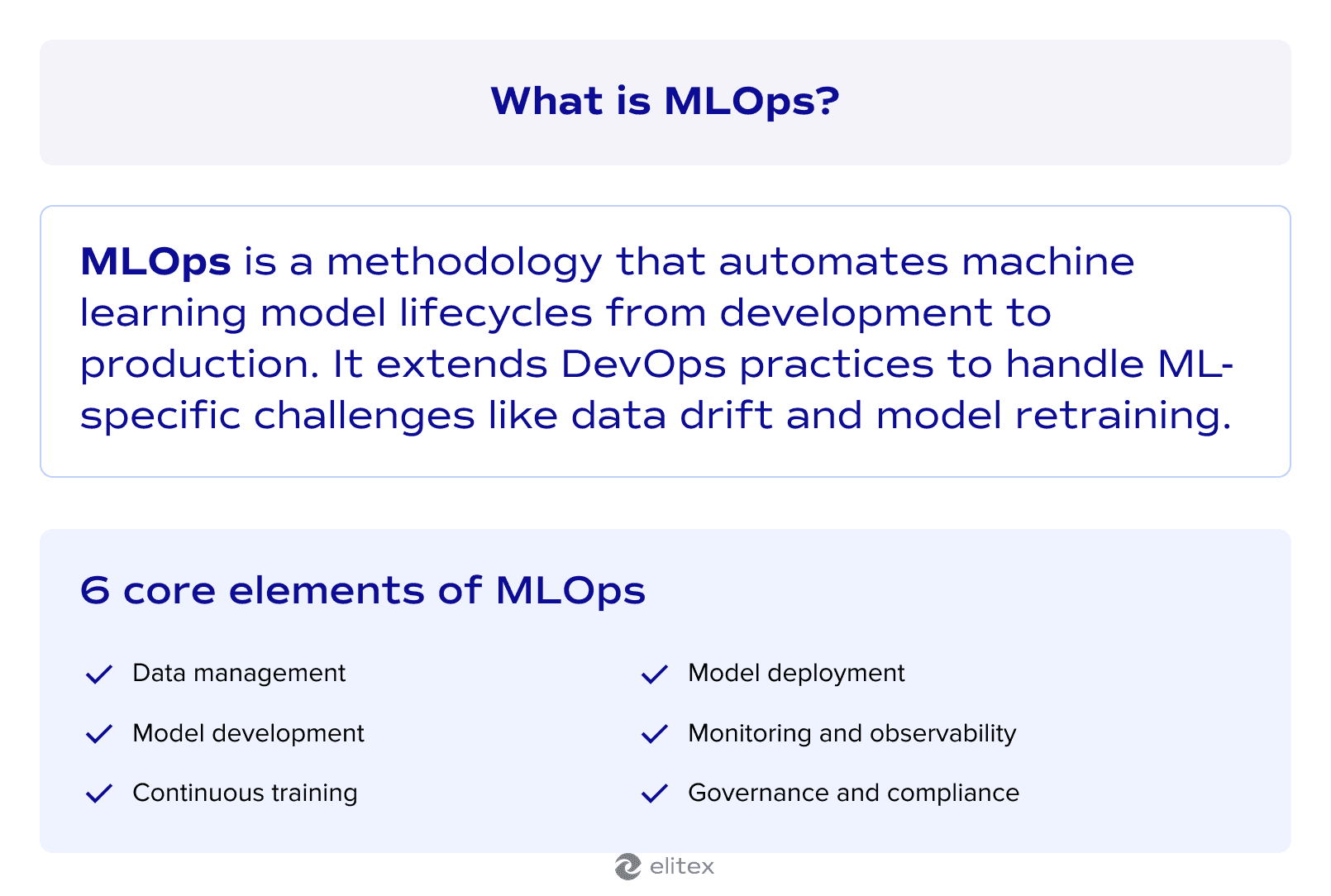
Six core elements of MLOps:
- Data management: MLOps is about accuracy when working with data. This approach involves tracking every version of your training data and maintaining detailed lineage records showing where datasets originate from.
- Model development: Data scientists use special MLOps platforms to log experiments, track hyperparameters, store successful models in registries, and collaborate without conflicts. These platforms integrate with version control systems that handle code changes and maintain reproducible results across different environments. Such a setup allows data science teams to compare different approaches and revert to previous versions when experiments don’t work as expected.
- Continuous training: MLOps as an approach endorses continuous retraining of models. It typically happens in pre-defined scenarios: for instance, when data drift occurs or accuracy drops below pre-defined thresholds.
- Model deployment: MLOps handles containerization, load balancing, traffic routing, and A/B testing frameworks for production environments. Rolling deployments minimize downtime while canary releases catch issues early. The system manages multiple model versions and scales based on actual demand.
- Monitoring and observability: Just like in DevOps, MLOps requires clear monitoring and observability. However, the metrics are completely different. Under MLOps, production systems often track model accuracy, data quality, prediction latency, and certain other business metrics in real-time.
- Governance and compliance: MLOps paradigm maintains audit trails for model decisions, implements bias detection algorithms, and ensures regulatory compliance. Here, the documentation standards help models pass legal reviews while risk assessment protocols identify potential failures before they impact operations.
Similarities between MLOps and DevOps
Despite different focus areas, MLOps and DevOps share fundamental operational principles. Both methodologies emphasize automation, collaboration, and several other aspects of a systematic approach to software delivery. Here’s what both approaches have in common:
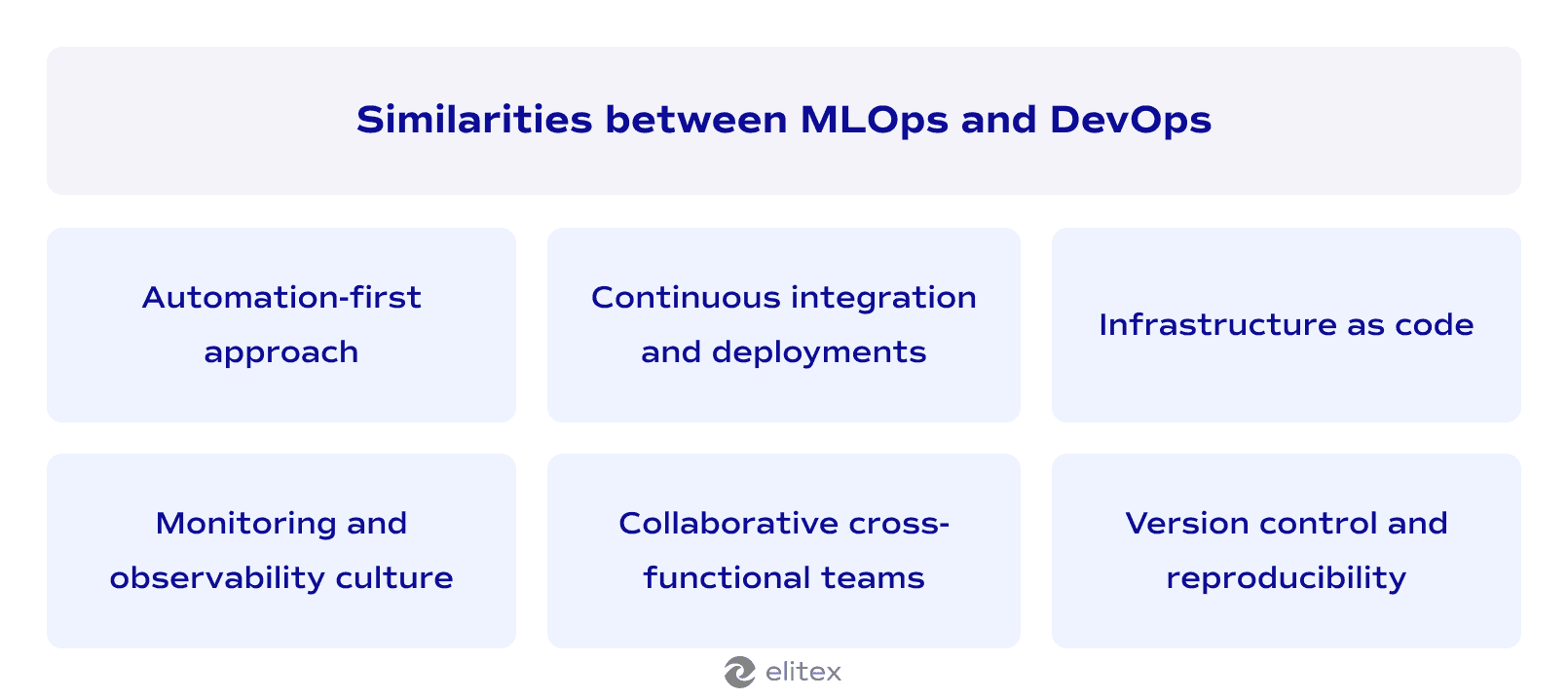
Automation-first approach
Both methodologies prioritize automating manual processes as much as possible in order to reduce human errors and increase overall efficiency. In both cases, teams eliminate repetitive tasks through scripted workflows. This fundamental principle drives faster delivery cycles and more reliable operations.
Continuous integration and deployments
Both DevOps and machine learning operations rely on CI/CD pipelines to streamline code integration and deployment processes. Both methodologies use automated testing alongside version control systems. The core difference lies in what gets deployed: traditional applications versus trained models.
Infrastructure as code
Both methodologies prefer to manage infrastructure through version-controlled code rather than manual configuration.
Monitoring and observability culture
Comprehensive monitoring forms the backbone of both DevOps and MLOps, though the metrics differ significantly. DevOps teams track application performance while MLOps extends this to include model accuracy and data quality. Both approaches use dashboards and automated incident response to maintain system reliability. Real-time visibility helps teams catch problems before they impact actual users or business operations.
Collaborative cross-functional teams
Both methodologies break down traditional silos between different technical roles. Teams work together on shared goals using common tools. Both methodologies endorse the collaboration model, where most team members share collective responsibility for outcomes.
Version control and reproducibility
Both DevOps and MLOps workflows depend heavily on version control systems to track changes and enable collaboration. Git repositories store code alongside infrastructure definitions across both disciplines. The main distinction appears in MLOps, where teams must also version datasets and model artifacts. This shared foundation ensures teams can recreate any previous state of their systems when problems arise. Reproducible environments become critical when debugging issues or rolling back problematic deployments.
MLOps vs DevOps: A side-by-side comparison
| Aspect | DevOps | MLOps |
| Scope | Manages the entire lifecycle of software applications from code to production | Does the same (manages the entire lifecycle) but specifically for machine learning models, including training, validation, and inference |
| Primary focus | Getting code deployed fast and keeping applications running smoothly | Managing data pipelines, training models, and serving predictions reliably |
| Roles involved | Developers write code, ops engineers manage infrastructure, QA testers catch bugs, DevOps specialists handle infrastructure, and DevOps/security specialists handle compliance | Data scientists build models, ML engineers productionize them, DevOps engineers handle infrastructure, data engineers manage pipelines |
| Version control | Git tracks every code change with clear history | Specialized tools track code, training data versions, model artifacts, and hyperparameters simultaneously |
| Validation type | Unit tests catch code bugs, integration tests verify components work together | Model accuracy tests, data quality validation, A/B testing that compares model performance in production |
| Infrastructure management | Both use containers, Kubernetes, and cloud orchestration tools | Both use containers, Kubernetes, and cloud orchestration tools |
| Monitoring | Tracking application uptime, response times, error rates, and server resources | Monitors model accuracy degradation, data drift, prediction latency, and other metrics specific to ML models |
| Deployment strategies | Blue-green deployments, canary releases, rolling updates minimize downtime | Similar deployment patterns plus sophisticated A/B testing for comparing model performance |
| Rollback complexity | Simple—you just need to revert to the previous working code version | Complex—rolling back involves model weights, training data versions, and feature pipeline dependencies |
MLOps vs DevOps: Key differences
Now, let’s take a closer look at some principal differences between DevOps and MLOps
MLOps vs DevOps: Data dependency complexity
DevOps handles relatively stable data requirements. Configuration files, environment variables, and user-generated content change predictably. DevOps teams version these files alongside code, creating straightforward dependency management.
MLOps faces exponentially more complex data challenges. Machine learning models depend on massive training datasets that continuously evolve through the MLOps lifecycle. Data scientists must track dataset versions alongside feature transformation and data quality metrics across multiple sources.
A single model might require hundreds of gigabytes of training data with specific preprocessing steps. When data changes, it can break model performance in subtle ways that only appear weeks later in production.
MLOps vs DevOps: Model drift management
DevOps deals with software that typically performs consistently over time. Once code works correctly, it typically continues functioning the same way unless explicitly changed. Applications don’t spontaneously degrade or lose functionality without external modifications.
MLOps must constantly combat model drift as real-world data patterns shift. Machine learning models lose accuracy gradually when training data no longer matches production inputs. Customer behavior changes, market conditions evolve, and seasonal patterns emerge that weren’t present during initial training. MLOps teams implement automated monitoring to detect when model drift occurs and trigger retraining workflows. Without active management, even the best models become unreliable within months of deployment.
MLOps vs DevOps: Experimentation tracking
DevOps focuses on deploying stable code versions. Development teams track what works and ship it to production. The final goal of the process is to move proven functionality from development to the live system as efficiently as possible.
MLOps, in turn, requires managing thousands of experimental iterations. Data scientists test different algorithms, hyperparameters, and feature combinations to find optimal models. Each experiment generates metrics, logs, and artifacts that must be preserved for comparison. Under the MLOps paradigm, teams need detailed records of what was tried, what failed, and why certain approaches worked better than others.
MLOps and DevOps: Testing approaches
DevOps uses deterministic testing methods. Unit tests verify code logic, integration tests check component interactions, performance tests measure system behavior under load, and security tests identify vulnerabilities. All these tests produce consistent pass/fail results.
MLOps requires statistical validation instead of binary outcomes. Model accuracy tests measure performance against holdout datasets, A/B testing compares different models in production, data quality validation ensures input integrity, and bias detection tests check for unfair algorithmic behavior. Results involve confidence intervals and statistical significance rather than simple pass/fail verdicts.
MLOps and DevOps: Resource consumption patterns
DevOps typically manages predictable resource usage. Web applications consume steady CPU, memory, and storage based on user traffic patterns. Infrastructure scaling follows established metrics with clear thresholds for adding or removing capacity.
MLOps handles volatile resource demands. Training ML models requires massive computational bursts that can consume entire server clusters for hours or days. Inference serving for ML models uses different resources than training, creating unpredictable scaling patterns based on model complexity and request volume.
DevOps vs MLOps: Failure modes
DevOps handles clear failure scenarios. Applications crash, servers go down, or databases become unreachable. Software projects fail in obvious ways that trigger immediate alerts and require direct fixes.
MLOps deals with gradual performance degradation. ML models slowly lose accuracy without obvious symptoms, making problems harder to detect. Models might work technically, but produce increasingly wrong predictions over months.
DevOps vs MLOps: Differences in business impact measurement
DevOps measures traditional software metrics through uptime monitoring and user satisfaction tracking. These metrics directly correlate with system performance and revenue impact from outages.
MLOps requires measuring model effectiveness on business outcomes through prediction accuracy monitoring and customer conversion analysis. Success depends on whether ML models actually improve business results rather than just technical performance. Data science teams must connect algorithmic decisions to measurable revenue changes.
How MLOps complements DevOps: Not just a replacement
So, to wrap it up: MLOps works alongside DevOps rather than replacing it. Your web servers still need DevOps, while your recommendation engine needs MLOps.
In 2026, we see a lot of teams using both methodologies on the same project: DevOps handles the app infrastructure, while MLOps manages the AI features. This complementary relationship allows teams to leverage existing DevOps investments while adding ML capabilities. Most successful AI companies nowadays run hybrid operations where DevOps engineers collaborate with data scientists, sharing tools and best practices across both domains.
When to choose MLOps vs DevOps?
Choose DevOps when: Your project involves traditional software applications without machine learning components. Web applications, mobile apps, databases, and API services work perfectly with standard DevOps services and solutions. Teams building real estate applications, developing trading platforms, content management systems, business applications, or basic automations should stick with DevOps.
Choose MLOps when: Your application depends on trained models for core functionality. Recommendation engines, fraud detection systems, computer vision applications, and natural language processing tools require MLOps. Any project where algorithms learn from data and make predictions needs a specialized approach, so, yes, choose MLOps.
Choose both when: Your system combines traditional software with machine learning features. Many modern applications use DevOps for their core infrastructure while implementing MLOps for specific artificial intelligence-based features. The frontend, backend, and databases follow DevOps practices while model training and inference pipelines use MLOps approaches.
Start with DevOps if: You’re unsure about your ML requirements. Most teams begin with traditional DevOps and add MLOps components when they introduce machine learning features. This approach reduces complexity during initial development phases.
Looking for an experienced tech partner that can help you adopt MLOps or DevOps?
ELITEX is a DevOps and AI development company that specializes in modern operational practices. Our team delivers comprehensive CI/CD implementation services alongside advanced MLOps workflows. Whether you need traditional DevOps automation or cutting-edge machine learning deployments, we provide end-to-end solutions precisely tailored to your unique business requirements.
From custom software development to complete AI development services, ELITEX handles projects of any complexity and size. We build intelligent applications from scratch while streamlining your existing deployment processes. Our expertise spans the full spectrum of modern software operations, ensuring your team gets the right technical approach for sustainable growth and competitive advantage.
FAQs
What are DevOps and MLOps?
DevOps is a methodology that automates software delivery from development to production through CI/CD pipelines and infrastructure management. MLOps, in turn, extends DevOps principles specifically for machine learning applications, adding model training, data pipeline management, and AI-specific monitoring capabilities. Both methodologies emphasize automation and collaboration, but serve different technical requirements.
What is the difference between DevOps and MLOps?
DevOps focuses on traditional software deployment, while MLOps handles machine learning model lifecycles. DevOps manages code changes and application infrastructure. MLOps adds data versioning, model drift detection, experiment tracking, and automated retraining workflows. DevOps for machine learning works for basic AI features, but complex AI systems require MLOps-specific tools. The key distinction lies in handling data complexity and model performance monitoring that DevOps and machine learning integration cannot fully address alone.
Can I integrate machine learning in DevOps workflows?
Yes, but with certain limitations. Traditional DevOps can handle basic ML model deployment, but lacks specialized tools for data versioning, model drift detection, and experiment tracking. For simple ML features, machine learning in DevOps works adequately. However, production-grade AI applications require MLOps-specific capabilities like automated retraining and statistical validation.
What’s the main difference between machine learning operations and DevOps for data handling?
In our MLOps vs DevOps comparison, data complexity represents the biggest distinction between these two methodologies. DevOps manages static configuration files and predictable user data. MLOps handles massive, evolving training datasets with complex lineage tracking, feature engineering, and quality validation requirements that traditional DevOps tools cannot address directly.
Do I need separate teams for MLOps and DevOps?
Not necessarily. Many organizations use hybrid teams where DevOps engineers collaborate with data scientists. Traditional DevOps handles infrastructure, databases, and application deployment, while MLOps specialists manage model training, data pipelines, and AI-specific monitoring. This approach leverages existing DevOps expertise while adding machine learning capabilities.
POSTED IN: