

Behind every successful real estate app lies a story of choices that shaped its path forward. These choices begin long before the first line of code is written. In practice, the real estate app development process goes far beyond creating listing displays and photo galleries we see on modern websites. This journey is a long process requiring clear decisions that turn concepts into tools people trust and use daily. While parts of this process seem simple, building successful software often confuses, especially those new to it. That’s why we created our today’s guide.
However, let’s introduce ourselves first. We at ELITEX, a real estate software development company bring nearly a decade of experience to these projects. We’ve helped numerous founders go through similar challenges. Each project taught us new lessons about what makes property apps succeed or fail.
To show you what real estate app development looks like: we’ll explore two common scenarios: a property management platform and a mobile marketplace app. We’ll examine each development phase - from planning to launch - and reveal what makes apps successful at every step. You’ll learn which preparations matter, what key decisions to make, and how to avoid common mistakes. This guide will give you a clear path to building your own real estate app.
Real estate app development process: A versatile approach
First, we should notice that software development follows several common patterns, regardless of the software type - whether you build a social network, delivery service, or real estate platform. At its core, each app needs user research, feature planning, and technical choices that match your business goals. While each industry adds its own rules, the fundamental steps stay the same. So, for this purpose, we’ll describe a general development approach first, and then discuss the specificity of software development for the real estate industry.
Step 0: Before the development process: What do you need to know before starting the development
Successful real estate app development starts with thoughtful groundwork - decisions that shape your entire development journey. This initial phase sets the tone for success or failure, much like choosing the foundation for a house. While many founders rush to start coding, any experienced development teams know the value of proper preparation.
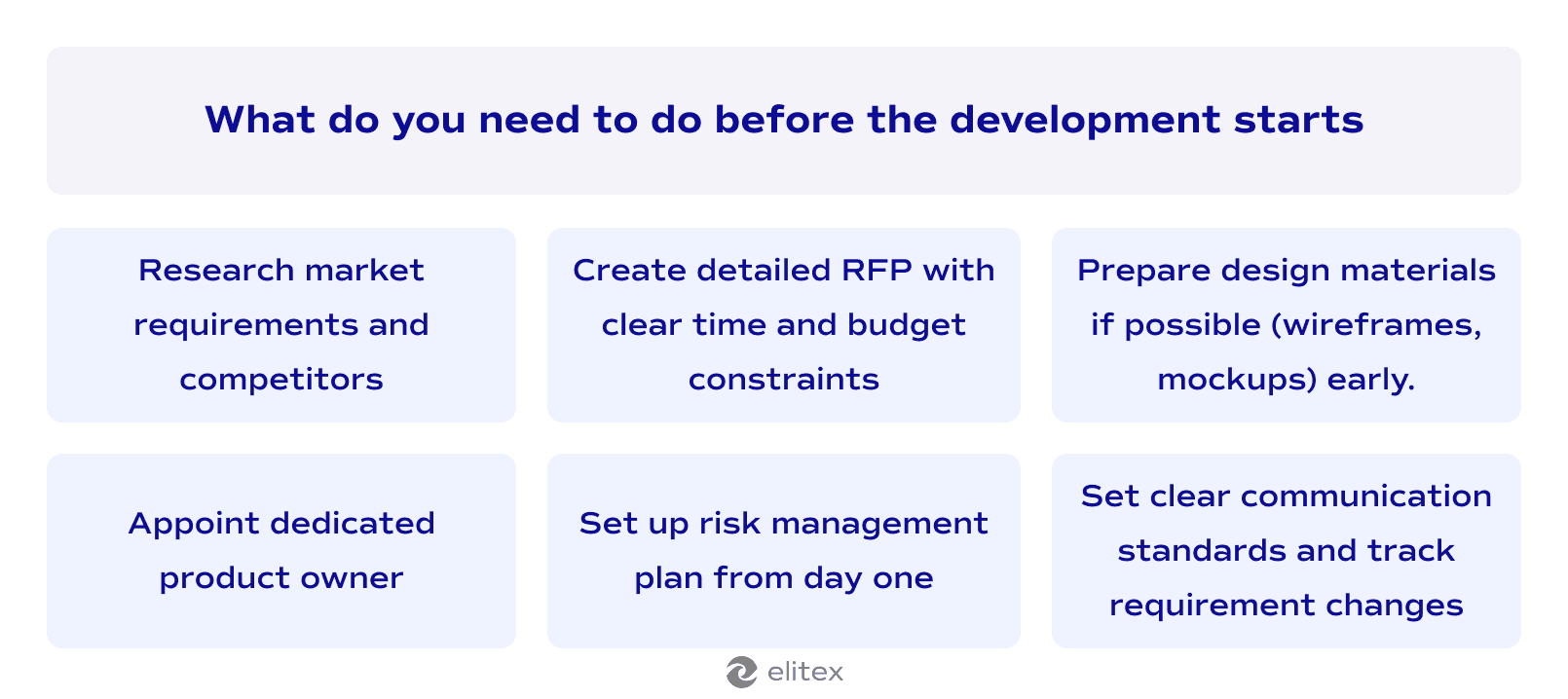
Before diving into development, start with thorough market research to understand what features your users need most. Study your potential competitors and validate your idea through user interviews or surveys to confirm market demand. This knowledge will help you write a detailed Request for Proposal (RFP) that outlines your project’s scope, goals, and constraints. Having wireframes or design concepts ready at this stage proves invaluable - they transform abstract ideas into concept plans vendors can evaluate (we will return to development costs a bit later).
Next, appoint one person to guide your project’s direction. In software development, this person is often referred to as a product owner. A dedicated product owner becomes your project’s compass, making daily decisions that keep development on course. This role requires someone who not only understands your business vision but can translate it into technical requirements. If you decide to be the product owner yourself, prepare for intense involvement. The early weeks demand constant attention to detail - from feature priorities to user flows - every day. Each decision shapes your product, and delays in communication can stall entire development teams.
With these foundations in place, establish your project’s framework. Create a risk management plan to identify potential issues early. Set clear communication standards - choose your preferred project management methodology, plan meeting schedules, and create a process for documenting changes in the project outline and new requirements. These steps prevent most of the costly mistakes later.
Remember: most critical errors happen in early project stages when changes cost the least to fix.
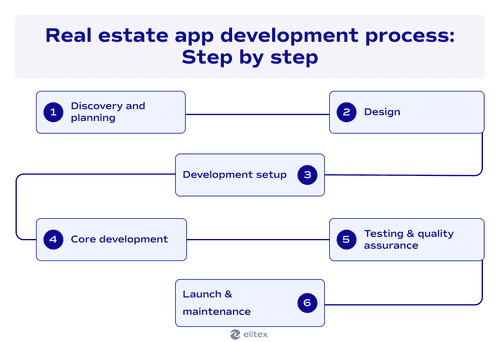
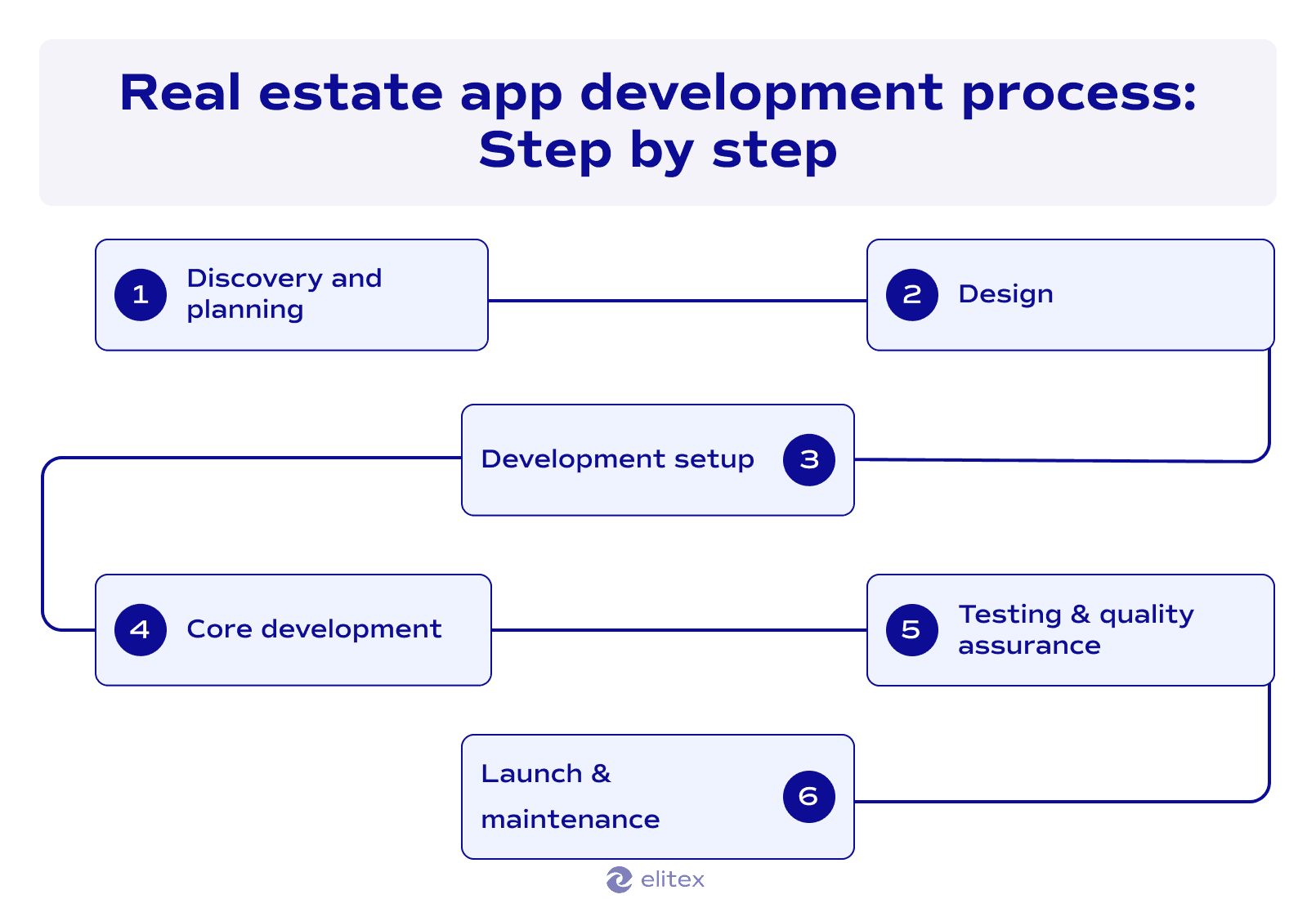
Step 1: Discovery and planning
After setting the foundations, the discovery phase begins. At this point, development teams analyze your requirements to create a detailed technical roadmap. They examine integration points, outline potential architecture solutions, and estimate timelines for each project stage.
This phase often reveals hidden complexities - something like third-party integration limits or specific market regulations. Also, at this stage, teams define development priorities, break features into deliverable chunks, and create sprint plans, all in intense collaboration with the product owner. Technical leads assess the technology stack and tools that best fit your project needs.
The discovery phase is typically quite a short phase and it ends with a clear development plan and refined estimates, clear for all parties of the process. At the end of this stage, the product owner will receive documentation covering technical architecture, development stages, and key milestones. This becomes a reference point throughout development. The final step of the discovery phase establishes transparent communication protocols - from daily standups to sprint reviews, ensuring all team members understand their roles and responsibilities in the upcoming development process.
Step 2: Design
Professional design transforms early mockups into a polished user experience. Design can come from your side or from the development team - both approaches work when there’s clear communication. The key is involving developers early in design discussions to ensure technical feasibility. Although this stage is marked as the second step, design often runs parallel to other development stages. Developers definitely need some foundation to work with, but it doesn’t mean that they need all screens done to start working.
When it comes to creating a UI/UX design from scratch, here’s what it looks like. The process typically starts with mapping core user flows and turning them into wireframes. These wireframes evolve into UI designs, with each screen going through review cycles. Regular check-ins between designers and developers ensure the designs match technical capabilities.
Both teams also focus on creating a consistent design system - from color schemes to component libraries. This system serves as a foundation for future updates and helps maintain visual consistency across the app. Special attention goes to responsive design, ensuring the app works well on all devices.
Step 3: Development setup
While designers build the visual foundation, developers prepare the technical groundwork. This stage focuses on configuring development environments, setting up basic architecture (practical implementation), and establishing coding standards guiding the coding process.
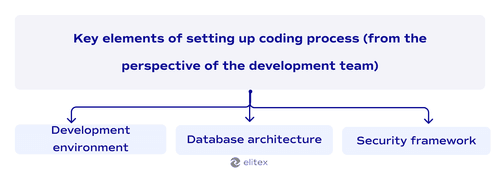
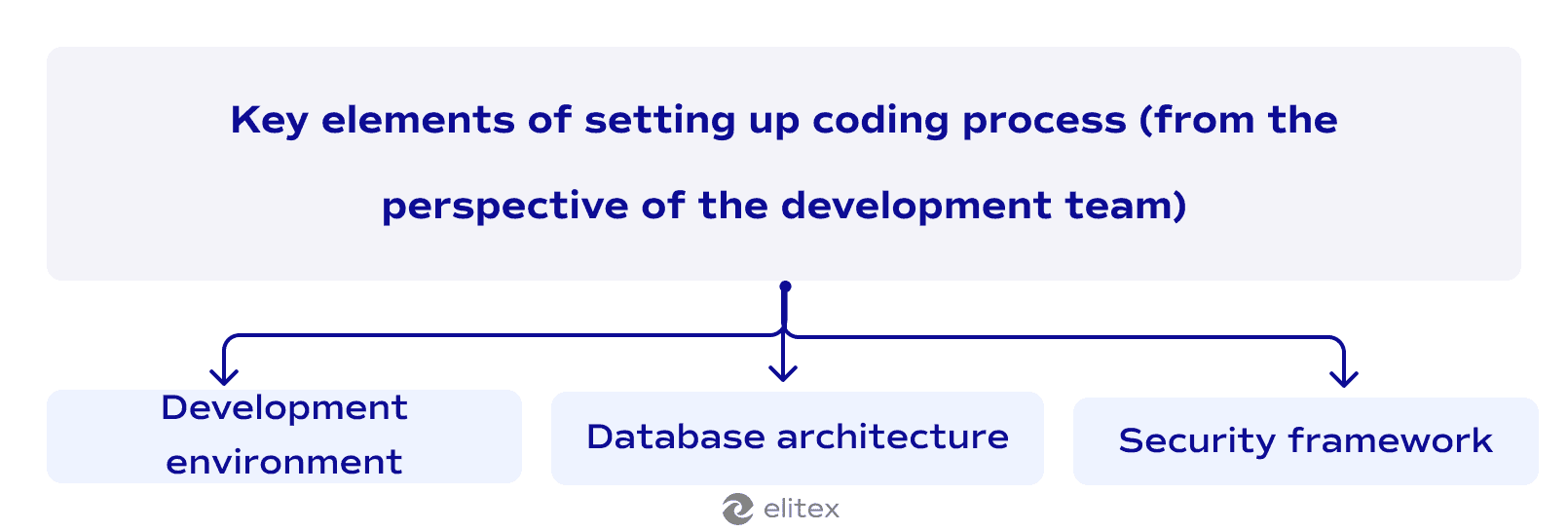
Step 4: Core development
In most modern development projects, the coding process follows established cycles called sprints - each aimed at building specific features from your product backlog. A typical sprint spans two weeks, starting with planning and ending with a demo of new functions. Development teams write code, review each other’s work, and integrate new features with existing ones.
Product owners play a key role during this phase by providing quick feedback and clarifying requirements. Daily standups help spot potential blockers, while sprint reviews demonstrate progress and gather insights for the next cycle. This stage demands the most time but brings your app closer to launch with each completed sprint.
Step 5: Testing & quality assurance
Testing starts as soon as the first features are ready, running parallel to the coding itself. QA engineers verify each function, test user flows, and check how features work together. On smaller projects, QA teams often help analyze business requirements, bringing valuable insights to the feature planning process. Here, we have a text dedicated to the importance of quality assurance for businesses.
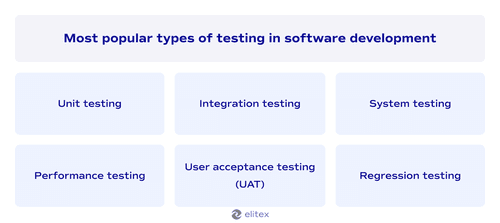
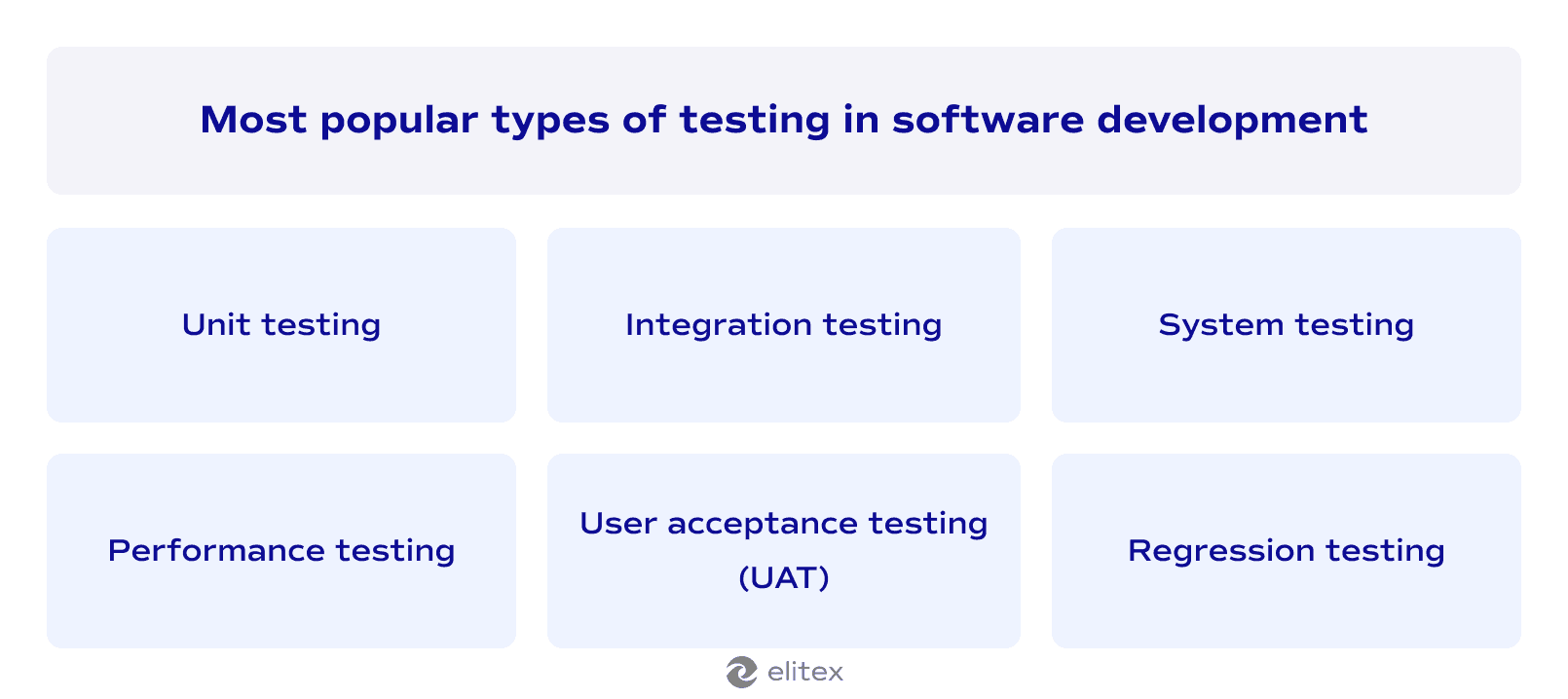
The testing workload peaks near project completion when all features need final verification. QA teams run stress tests to check app performance under heavy loads, verify security measures, and ensure smooth operation across different devices. User acceptance testing begins once core features are delivered, gathering feedback from real users or stakeholders.
Step 6: Launch & maintenance
Launch day is a very important date but it doesn’t mark the end of the development. It just marks a new phase in your app’s journey. After final testing and deployment preparations, your software goes live with monitoring systems in place to track performance and user behavior. The maintenance phase brings regular updates based on user feedback, security patches, and performance improvements. A good development team stays ready to address issues and implement new features as your business grows.
So, that’s how the development process looks like in general. Now, let’s move to our two specific cases.
Case # 1: Mobile app development for real estate
Let’s start with our real estate mobile app development case. What makes mobile apps different from regular ones?
What is a real estate mobile app?
Mobile apps have become the primary tool for property searches among regular users. While real estate agents rely on complex desktop and web software, most buyers prefer searching through mobile-optimized web platforms or dedicated mobile apps. Why do we think so? Most users reach the Internet through mobile phones, as of 2026.
In our case, a real estate mobile app is a specialized software solution that helps users search, view, and interact with property listings through their smartphones, offering features like map-based search, photo galleries, and direct communications with agents (we will return to the features a bit later).
Mobile development, in such a case, demands its own approach. The six-step process we described above stays largely the same, but each step gains mobile-specific requirements. Discovery focuses more on user behavior patterns and device capabilities. Design must consider touch interfaces and screen variations. Development setup includes mobile-specific environments and testing tools. Core development adds features like push notifications and offline modes. Testing expands to cover different devices and conditions. The launch requires app store compliance and regular updates that match new OS versions.
Real estate mobile application development: The essential features
However, what really sets real estate mobile applications apart lies in their features. While basic functions help users find and view properties, advanced capabilities transform simple listing browsers into powerful tools for property search and management. Let’s examine both sets of features that shape the mobile user experience.
| Basic features | Description |
| Advanced search filters | With search mechanisms, users set price, location, and property type filters, making finding relevant listings quick. |
| Real estate listings feed | Clean display of properties with key details and high quality images. |
| Property details pages | Full property information with specifications and features. It may include floor plans, location details, and other relevant specifications. |
| Interactive maps | Map-based property search with location markers. Shows nearby amenities and transport options. |
| Save favorites | Users bookmark properties and searches. Get notifications about saved property updates. |
| Agent contact | Direct messaging forms with auto-fill from user profiles. |
| Push notifications | Alert about new listings and price changes. Keep users engaged with relevant updates regarding literally everything. |
| Mortgage calculator | Users estimate monthly payments based on price and terms right inside of your app. |
| Share listings | Quick sharing to social media and messaging apps, helps close deals faster and promote your app. |
| Image galleries | Optimized photo browsing for mobile screens. It should support high quality images with fast loading. |
| User profiles | Simple registration and preference settings. It should store search history and favorites. |
While the previous table was more about must-have features, the following one will provide you with some additional features that can give your platform a serious competitive edge if you implement them really well. Each of these capabilities solves specific challenges of your potential user and opens new market opportunities for you:
| Advanced features | Description |
| AR visualization | Place virtual furniture in empty rooms and test layouts. Gives buyers a much better understanding of space and delivers a competitive edge in luxury markets where visualization matters most. |
| Virtual tours | Complete digital property walkthrough, reducing unnecessary visits for potential buyers. Essential for remote buyers and international markets - can triple viewing requests from qualified leads. |
| Integration of video tours | Professional video tours with agent commentary are a perfect way to present the property object. Increases property appeal - key for high-end properties and international sales. |
| Smart recommendation system | Suggestions based on user behavior and driven by artificial intelligence. Increases engagement and helps close deals faster by showing relevant properties. |
| Real-time chat | Developed a system of instant messaging with real estate agents, including file sharing. Crucial for fast-moving markets where quick response determines sales success. |
| Market analytics | Price trends and investment insights with predictive modeling. Attracts serious investors and helps position properties at optimal prices. |
| Document scanning | Digital document management with OCR technology. Speeds up transactions and appeals to tech-savvy clients who value paperless processes. |
| Offline access | Core features work without the Internet. Would be great for areas with poor Internet coverage and international users with data restrictions. |
| Scheduling system | Automated viewing bookings with agent calendar sync. Reduces scheduling conflicts and speeds up the viewing process. |
| Area insights | Detailed neighborhood data and market trends. Critical for relocation clients and investors who need deep market understanding. |
The right feature set shapes how users interact with your app. While basic features ensure core functionality, advanced capabilities can triple user engagement and speed up property deals. From our practice, success comes from balancing must-have features with strategic advanced features that match the specific needs of the market and the expectations of your potential audience.
Case # 2: Property management platform development
Let’s examine our second case: property management platforms. What makes these solutions different from consumer-facing apps like in the previous case?
What is a property management platform?
First, we should mention that property management platforms serve a specific audience - real estate professionals, landlords, and property managers. Unlike consumer apps focused on property search, these platforms are designed to automate complex business operations and streamline routine property management processes.
As of 2026, most property management systems run as web applications, letting teams access data from any device and integrate with other inner business tools. While desktop software once dominated, web platforms now lead the industry for their flexibility and real-time updates.
Development here also follows our six-step framework - in fact, the framework was created with web apps in mind. At the same time, the entire development largely focuses on business process optimization, so the discovery & planning phase digs into workflow analysis and system integration even deeper. The design prioritizes function over form while maintaining user experience. Coding itself centers on data security and system stability, with testing focused on business scenarios and data accuracy.
Property management platform: The essential features
Here, the exact list of features largely depends on your business model and target users. Small landlords need basic tools for rent collection and maintenance tracking. Large property managers require complex systems with detailed reporting and integrations. Let’s explore core features that serve both scenarios:
| Feature | Description |
| Property database | Comprehensive property records with detailed specifications and history. Critical for portfolio management. |
| Tenant management | Track tenant information, lease agreements, and payment history. Includes application processing and screening. |
| Financial tools | Rent collection, expense tracking, and financial reporting. Integrates with accounting software. |
| Maintenance management | Work order system, for repair requests and preventive maintenance. Tracks contractor assignments and costs. |
| Document management | Digital storage for leases, contracts, and other property documents. Ideally, if we talk about a paperless framework, it should include e-signature capabilities. |
| Communication system | Automated notifications for tenants and owners. Includes mass messaging and templated responses. |
| Reporting dashboard | Custom reports for occupancy, finance, and maintenance. Essential for business intelligence. |
| Owner portal | Separate access for property owners to view performance metrics and documents. |
| Calendar management | Schedule viewing, maintenance, and lease renewals. Syncs with team calendars. |
| Integration APIs | Connect with payment processors, accounting software, and marketing platforms. |
Here, similarly to real estate mobile app development, the right mix of features shapes platform success. However, in this case, features should be focused more specifically. Each feature must directly improve business operations and integrate seamlessly with existing workflows to deliver real value.
Cost considerations for real estate app development
For detailed pricing information, check our dedicated article about real estate app development costs. Here, we’ll briefly outline the costs of our two main scenarios.
Mobile app development for real estate typically starts around $50,000 for solutions with basic features. This price covers a 4-5 month development cycle with two full-time real estate app developers, part-time QA (10 hours per week), and project management. We should mention that from our practice, mobile development typically costs less due to available pre-built components, established development patterns, and fewer expenses for responsive design. Depending on the number of features required, costs may vary up to millions.
Property management platforms usually start from $70,000 for basic solutions. The higher cost compared to real estate mobile app development comes from more hours spent on the development process, basically. Web platforms need responsive design for both desktop and mobile views, custom backend development for complex business operations, and extensive database architecture. These systems also require more testing across different browsers and devices, plus integration with multiple third-party services that businesses already use. A typical 4-5 month development cycle for a platform with basic features will require two full-stack developers, and an additional back-end developer (for advanced databases and third-party integrations). The project also needs more active involvement of QA (20 hours per week instead of 10) and project management to ensure smooth delivery.
In-house developers vs. outsourcing: Making the right choice for real estate application development
One of the hardest decisions when starting real estate application development is choosing between building an in-house development process and outsourcing. This choice affects development speed, costs, and final product quality. Let’s take a brief look at both approaches.
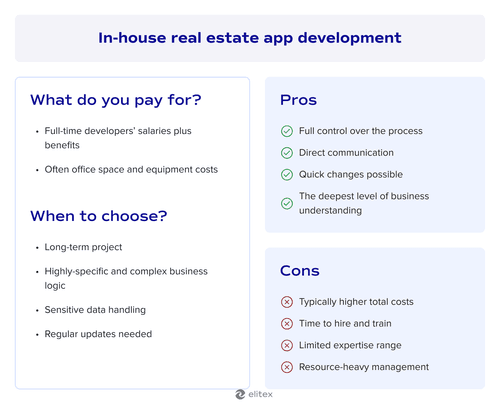
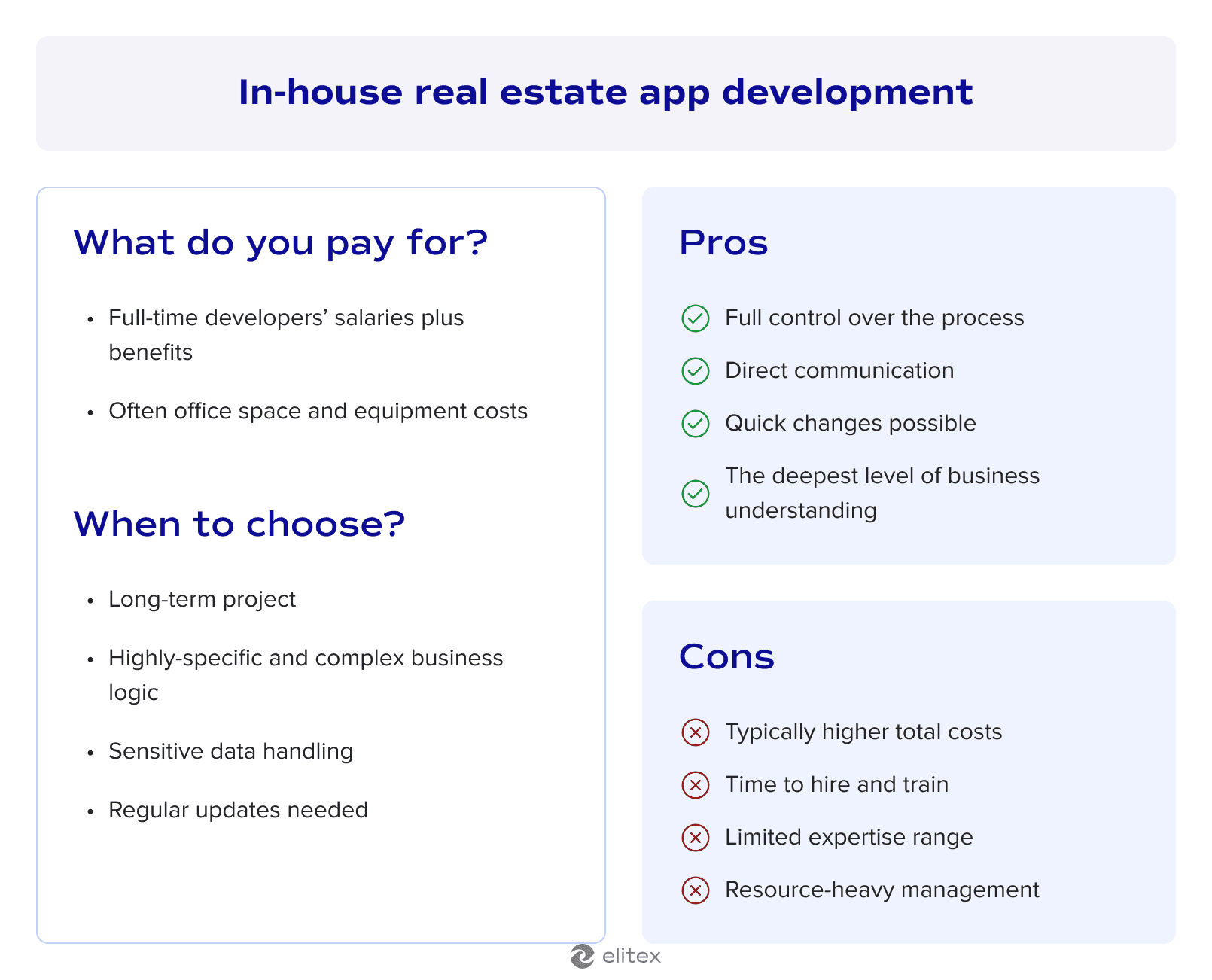
In-house development gives you full control over the app’s creation. Your team lives with the product daily, understands your business deeply, and can adapt quickly to changing needs. This approach works best for companies with long-term development plans and resources to maintain a tech team and a wide range of administrative staff. In-house developers build core features while keeping all sensitive data within company walls.
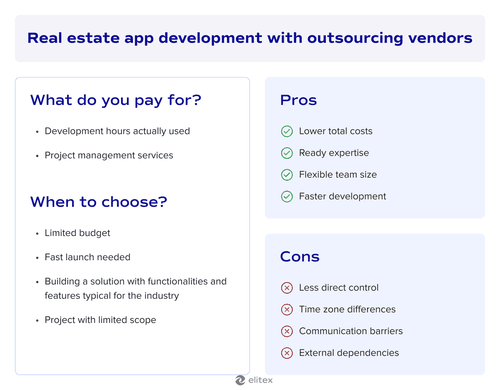
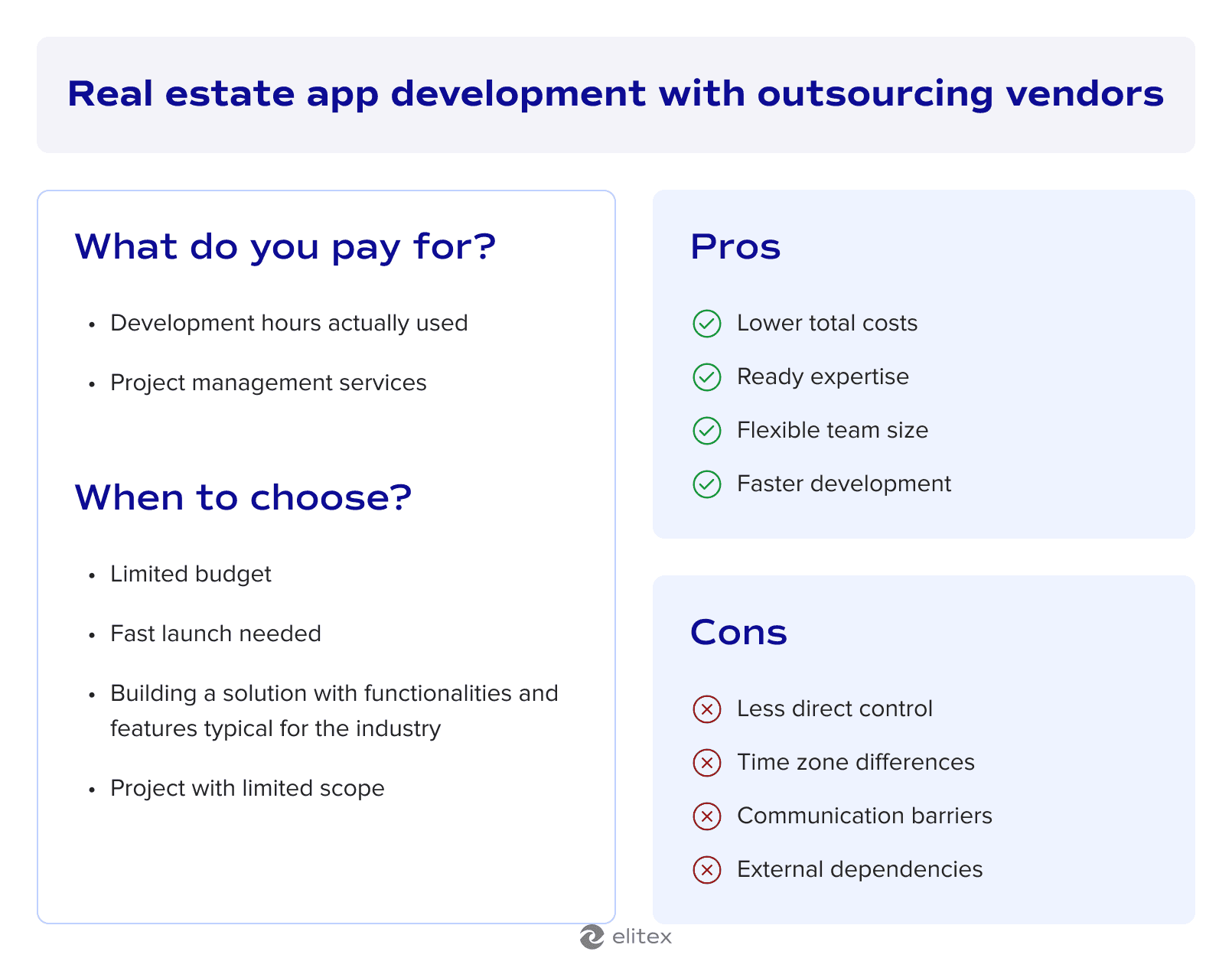
Another way is outsourcing. Outsourcing to real estate app development tech companies often proves more cost-effective than hiring local talent, especially with balanced models like nearshore software development. These companies bring specialized expertise and ready-to-use solutions that cut development time. Specialized real estate software development companies, such as ELITEX, maintain dedicated teams with varied skills - from UI designers to security experts and DevOps. This reduces risks and speeds up development time, letting you launch faster.
Mistakes to avoid during the real estate app development process
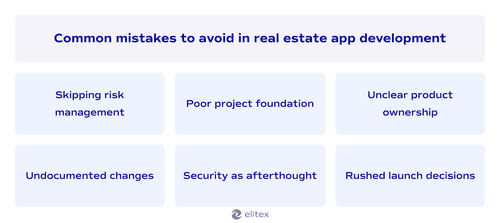
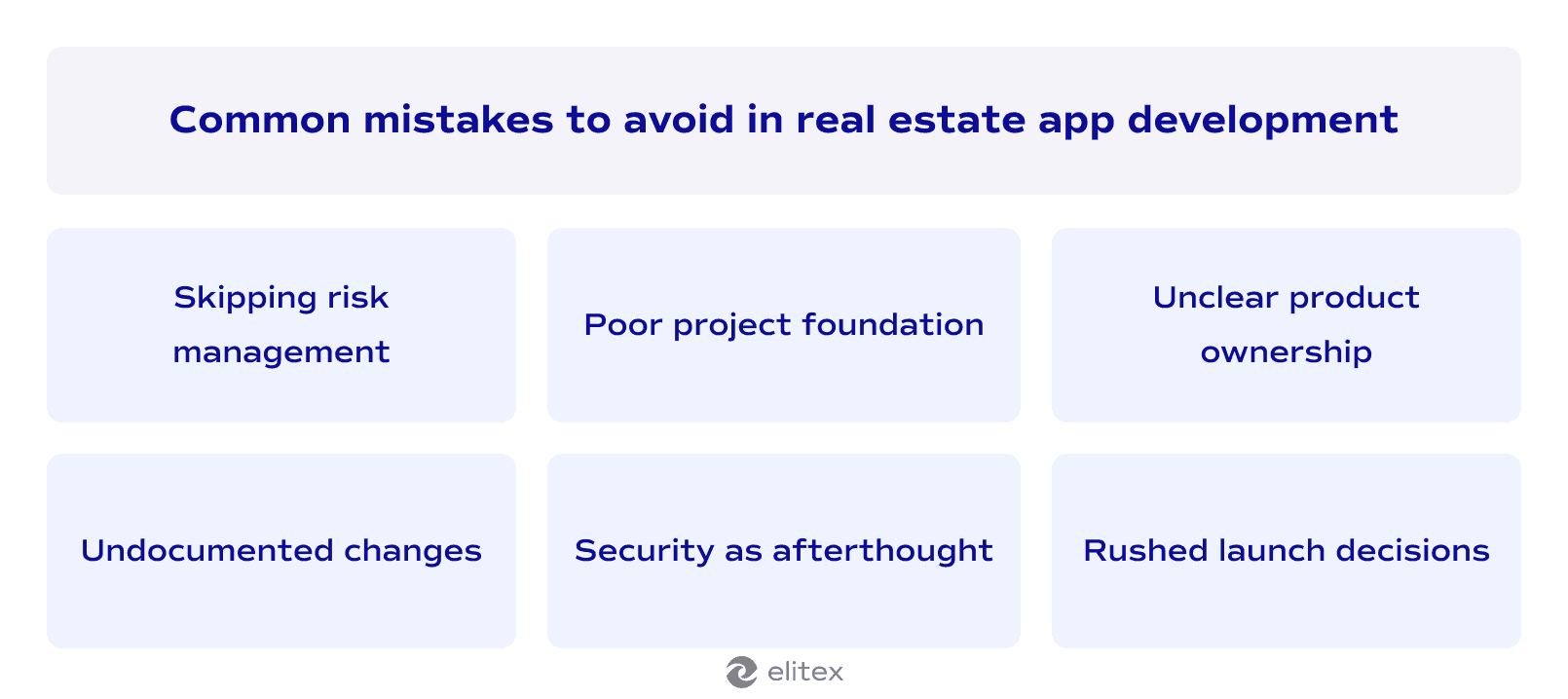
The last thing that shapes the success of real estate app & software development comes from avoiding common pitfalls. Here are six critical mistakes we’ve seen across projects and brief thoughts on how to prevent them:
Skipping risk management
Create a risk assessment plan covering technical, market, and resource risks before the start of the development. Update this plan regularly as new challenges emerge. Track potential integration issues, security concerns, and scalability problems. Regular risk reviews help your team prepare contingency plans and allocate resources better, preventing small issues from becoming major roadblocks.
Poor project foundation
As told before, most critical errors happen in the early stages, that’s why Step 0 is the most lengthy section of our article. Take time to define clear requirements, user stories, and success metrics. Document your target audience, core features, and technical constraints. Set realistic timelines and budgets based on market research. Consider future scaling needs and integration points early - changes cost less during planning than development.
Unclear product ownership
Projects stumble when product owners lack authority or understanding. Your product owner needs deep knowledge of both business goals and technical constraints. They must make quick decisions on key features, prioritize tasks, and communicate clearly with developers. Define their role and responsibilities clearly before development starts.
Undocumented changes
Feature additions and changes need proper documentation. Create a formal change request process that tracks scope changes, budget impacts, and timeline shifts. Without clear documentation, scope creep threatens project timelines and budgets. Keep a log of all changes for future reference and project clarity.
Security as afterthought
Security breaches can destroy user trust. Plan data protection, user authentication, and privacy features right from day one. Follow security best practices and industry regulations. Additionally, regular security audits help identify vulnerabilities before they become problems.
Rushed launch decisions
A poor launch can damage your app’s reputation permanently. Take time to properly test, optimize performance, and prepare support systems. Create a detailed launch plan covering marketing, user support, and technical monitoring. Have rollback plans ready for potential issues.
Real estate app development - our experience
Let us share our experience in developing real estate software. Here’s one particular example of success that matches perfectly with today’s scenario - ELITEX helped to build a custom property management system.
We built a comprehensive hotel management SaaS platform that streamlined property operations across multiple locations. Besides property management, the platform also offers booking engines and channel management, all in one place. Working alongside a core in-house team, we started by refining the UI and finished with full-stack development, handling everything from secure payment processing to custom reporting tools. To avoid common outsourcing issues and build seamless collaboration, our team adapted to US time zones. Partnership with ELITEX, a trusted software development vendor, accelerated our client’s app development, driving faster market entry, enhanced code quality, and robust QA processes that directly supported business growth.
Looking to build a real estate app? Whether you need full-scale real estate app development services or want to explore your existing software, ELITEX brings the right expertise to help. Our team can guide you through planning, technical decisions, and, of course, development. By choosing ELITEX, you choose a partnership beyond your expectations.
Let’s discuss your project - contact us for a free consultation today
FAQs
What are the first steps when learning how to build a real estate app?
To create a real estate app that succeeds, start with market research, risk management strategies, and clear planning. Research your target users’ needs, study competitors, and define core features before the start of the development. This preparation helps avoid costly changes late and shapes your app’s success way more than technical choices.
What’s the approximate cost range for real estate application development?
Costs typically range from $50,000 for basic mobile apps and $70,000 for property management platforms and up to millions for complex software solutions with advanced functionality. Basic prices we provide cover 4-5 months of development with a full team including developers, QA, and project management. Final costs always depend on features, with real estate mobile application development being generally less expensive.
What are the essential features in real estate mobile app development?
Successful apps combine core features like advanced search, high-quality photo galleries, and interactive maps with practical tools like push notifications and offline access. The key is building features that work seamlessly on phones while solving real users' problems.
What’s the difference between basic and advanced features in real estate portal development?
Basic features like search filters and listing galleries form the foundation, while advanced features create unique value. Portal development for the real estate industry succeeds when it balances essential tools with strategic additions like virtual tours, market analytics, and AI-powered recommendations that match specific user needs.
How can businesses learn how to build a real estate app that stands out?
Start with thorough market research to understand the actual needs of your potential users. Define core and advanced features that solve real problems. Follow a structured development process focusing on user experience, required functionality, and strategic tools like virtual tours or AI recommendations.
POSTED IN: