

- TL;DR: In this article, we explore what shift left means in DevOps and how it transforms the software development process.
- Shift left in DevOps is a practice that brings testing, security, and monitoring into the development phase, where problems are cheapest to fix.
- This approach extends beyond basic testing and security alone to six comprehensive dimensions: testing, security, quality checks, monitoring, team collaboration, and infrastructure validation.
- Shift-left has become an important strategy because production fixes drain budgets, while early detection reduces costs and accelerates releases.
- We demonstrate how to implement this strategy for your case through a detailed 6-step how-to guide and actionable practical tips.
- This article also explains shift-right as a complementary approach that works well when combined with shift-left.
- In order to check how it works in practice, we additionally examine real-world examples of companies that show how shift-left delivers measurable results in security and compliance.
Software bugs cost more to fix in production than during development. That’s just an obvious fact. But what can you do to reduce the number of bugs in production? The solution is to move quality checks earlier in the pipeline, a concept known as shifting left. This concept also matches perfectly with DevOps culture, creating another concept: shift left in DevOps, which has become a core practice for product teams that want to build better software, cheaper and faster. The idea is quite simple: move testing and security earlier in your CI/CD pipeline. Because again, catching problems before they reach production saves tons of time and money.
As a DevOps automation services and solutions company, we at ELITEX see how this approach changes daily workflows. After the shift left, developers find issues while the code is fresh in their minds, so fixes happen faster. Security teams spot vulnerabilities before they become threats. Operations teams spend less time firefighting because fewer problems make it to production. Ultimately, the result is a development process that works better for everyone involved. But what does shift left mean in DevOps beyond the basic definition, and how can your team actually implement it? Let’s explore the practical steps that make this strategy work together with ELITEX, DevOps professionals with over a decade of multi-industry experience.
What is the shift‑left in the context of DevOps?
Shift-left in DevOps is a practice that moves testing, security checks, and quality controls earlier in the software development lifecycle. The name “shift-left” comes from moving these activities to the left on a timeline that typically shows development stages from left to right.
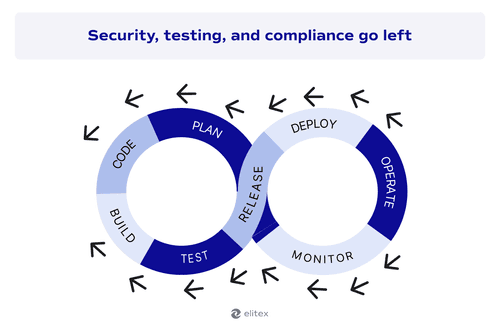
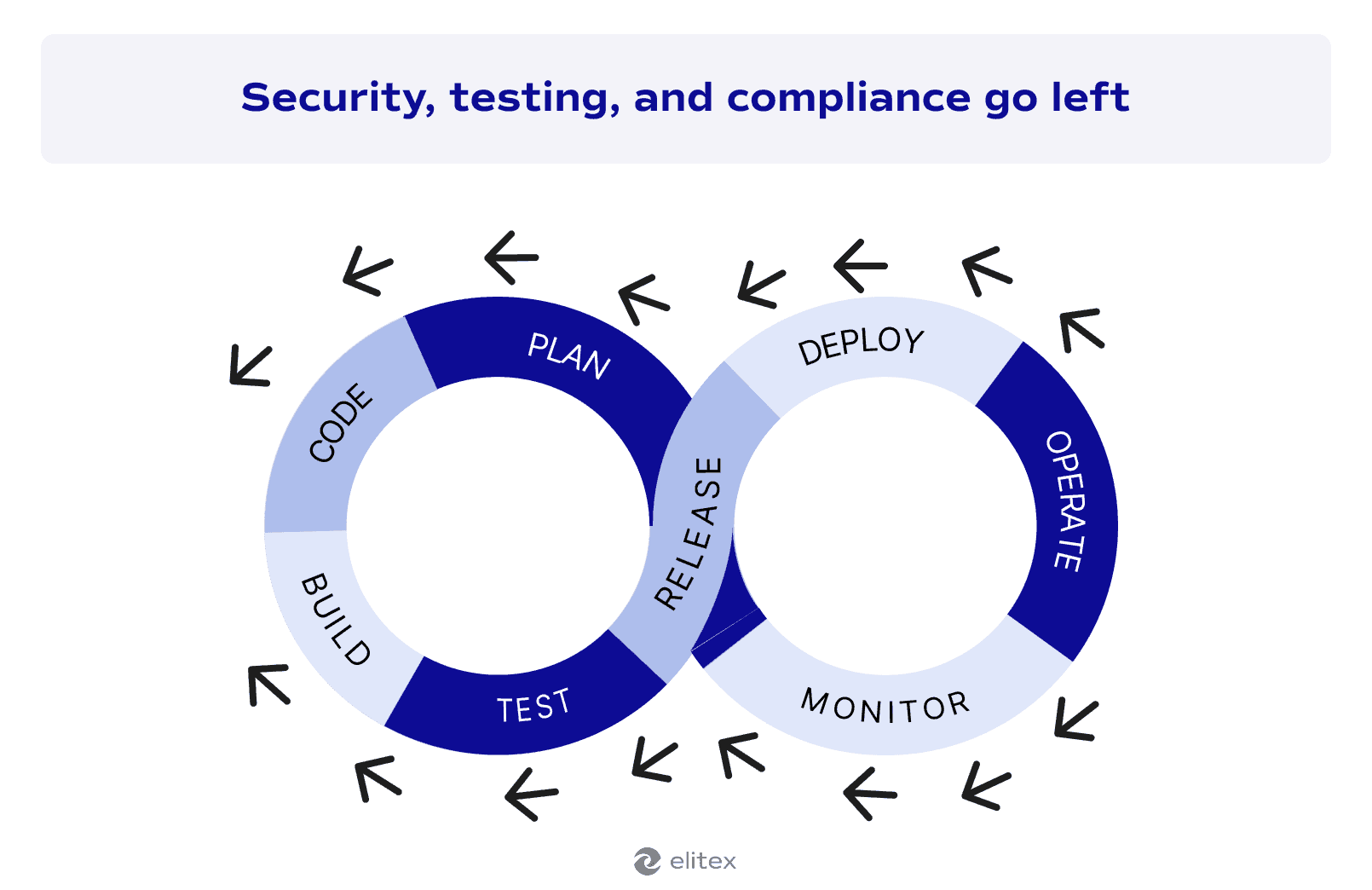
Shift-left in DevOps implies catching problems when they’re cheapest and fastest to fix, before they reach production. The basic explanation of shift-left is that developers build testing and security into their daily work from the start. However, in practice, it’s more complicated than just moving tests earlier. There are several key areas of the development process, often called the dimensions impacted by the DevOps shift left. Let’s take a closer look at them:
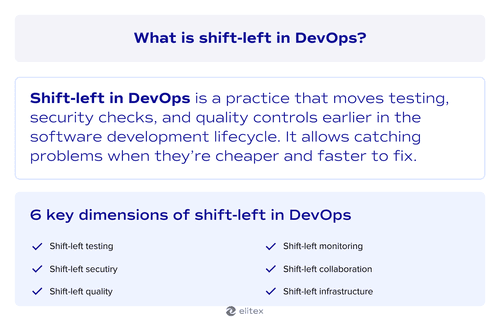
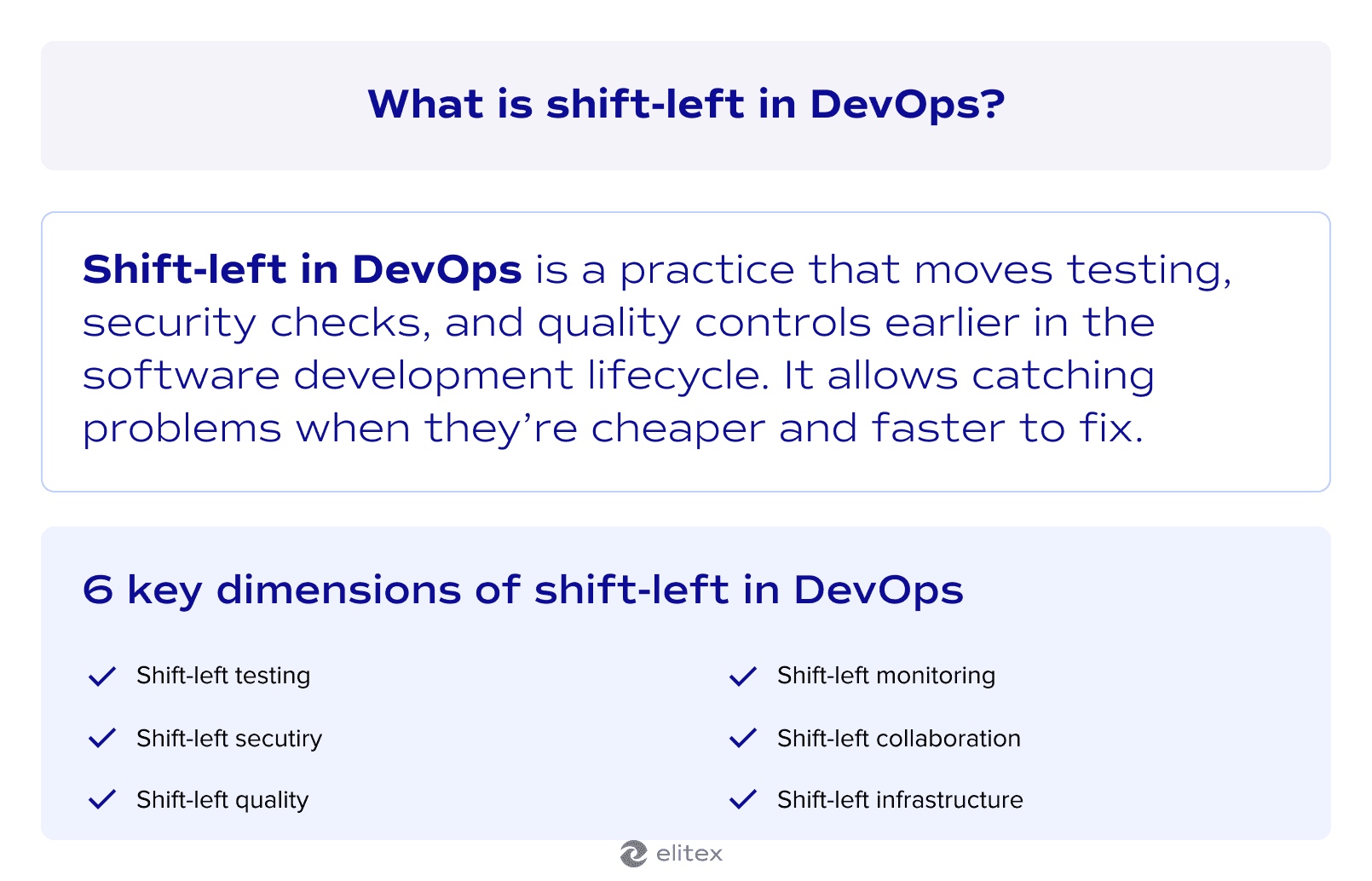
6 key dimensions of shift‑left in DevOps
Shift-left testing
This is where shift-left began, and it remains the foundation of the entire approach. Developers typically shift left several test types: unit testing, integration testing, performance testing, and regression testing.
Each test type serves a different purpose in catching issues early. Unit tests verify individual functions work correctly, while integration testing ensures different components work together. Performance testing identifies bottlenecks before they affect users. Regression testing confirms that new changes don’t break existing functionalities. The common thread is timing: all these tests run during development, giving developers immediate feedback on their code. This immediate feedback loop means problems get caught while developers still have full context about what they just built.
Shift-left security
Security used to be a final checkpoint before deployment. However, that model creates bottlenecks because security teams find critical issues when code is already considered “done.” The shift-left approach brings security back into the development workflow. What typically changes in practice is that static code analysis runs on every commit, scanning vulnerabilities as developers write code, not a day before the release. This automated scanning catches common security flaws like SQL injection or cross-site scripting before any code review starts.
We should also mention that shifting security left may involve a wide range of strategies and practices. For instance, engineers may also examine container configuration during development, which helps prevent misconfigurations that expose systems to attacks. Additionally, the good idea is to move security modeling to the design phase, so developers and security specialists consider potential threats when making architectural decisions. We have previously written our DevOps vs DevSecOps comparison, where we made a deeper dive into this topic. This early involvement transforms security from a gate into a collaborative process.
Shift-left quality
With shift-left, code quality checks run through automated linting before any kind of code review. In such a scenario, defect management begins during the coding phase, which means developers address issues while the code structure is still clear in their minds. This timing accelerates the entire development process because fixes require less investigation and rework.
Shift-left monitoring
This dimension often gets overlooked, yet it proves critical for production success. Shift-left in DevOps for monitoring means developers add logging during the development phase, not after operations. Developers also build in tracing and metrics from the start, which gives the entire team visibility into how their code behaves under real conditions. Beyond logging and metrics, engineers test alerting rules in staging environments, where they can fine-tune thresholds before production deployment. This proactive approach ensures DevOps observability exists when code goes live. As a result, teams avoid the scramble to add instrumentation after problems appear in production.
Shift-left collaboration
With the shift-left principle in DevOps, operations and security teams join architectural discussions from the very beginning of each project. This early involvement helps developers understand infrastructure constraints before they commit to specific technical approaches. Because of this timing, teams encounter fewer surprises during deployment. Additionally, under the shift-left model, developers, operations engineers, and security specialists communicate across the entire software development lifecycle. This ongoing communication breaks down the traditional silos between the roles.
Shift-left infrastructure
Shift-left in infrastructure means Infrastructure as Code (IaC) gets tested alongside application code. Engineers use IaC scanners to catch misconfigurations during the development phase, which prevents deployment failures that would otherwise block releases. Also, service mesh configurations and network policies get defined early in the entire process, so developers can test their code in environments that closely mirror production conditions. This practice eliminates the “works on my machine” problem by ensuring consistency across all environments from the start of deployment.
Why has the shift‑left approach become important for DevOps teams?
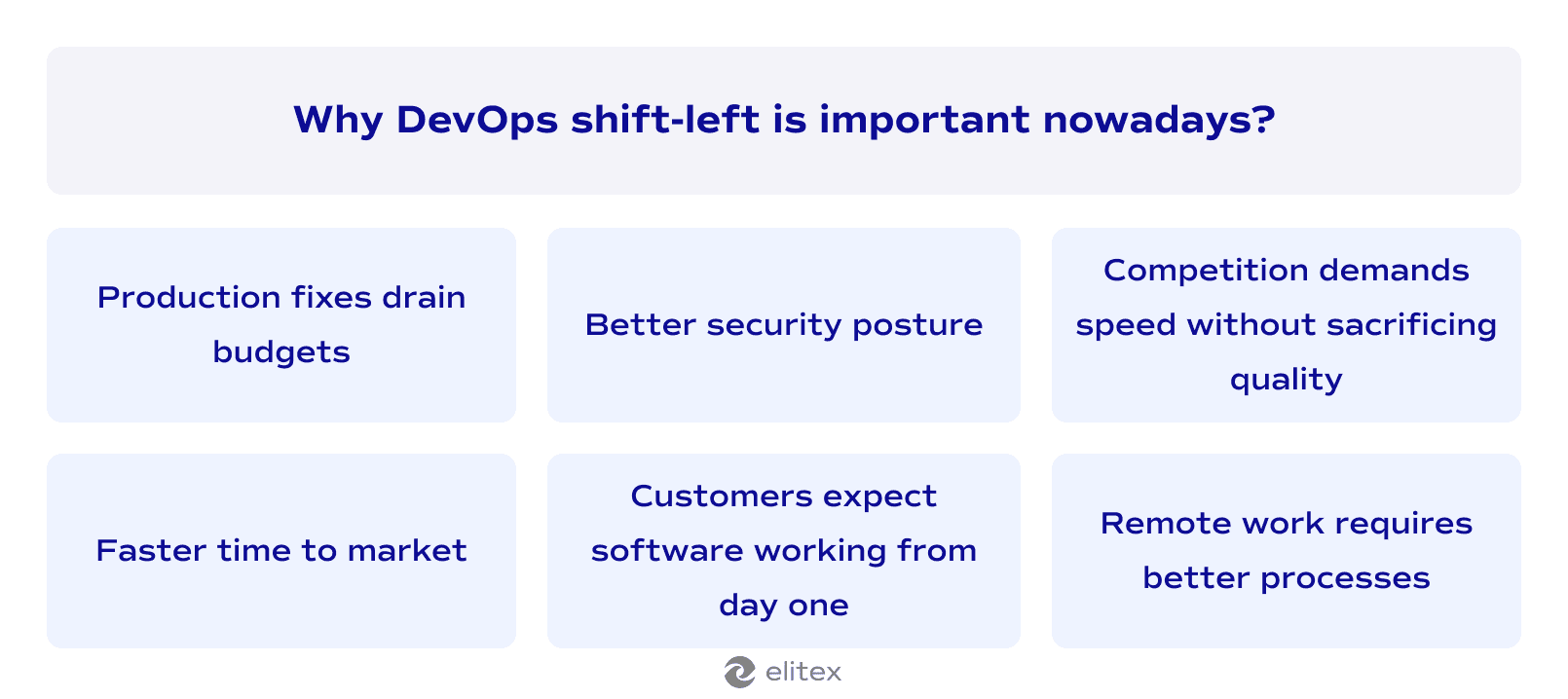
- Production fixes drain budgets: We start our text with it, because one of the biggest benefits of shift-left in DevOps is that it reduces costs during development. This mainly happens because problems found late in the development cycle require more time and resources to fix, which directly impacts project budgets.
- Faster time to market: Product teams ship features weeks faster when they don’t spend time fixing bugs in production.
- Better security posture: Businesses and organizations around the globe face growing pressure to protect customer data and meet compliance requirements. Security monitoring built into development catches vulnerabilities before they become breaches. This proactive approach reduces the risk of costly security incidents. Learn more in our compliance automation with DevOps article.
- Customer expectations have changed: In 2026, users expect applications to work perfectly from day one. Poor performance evaluation during development leads to slow response time in production, which drives customers to competitors.
- Competition demands speed without sacrificing quality: Companies that deliver reliable software quickly win market share.
- Remote work requires better processes: Distributed teams need clear workflows that catch problems early. When issues appear in production, coordinating fixes across time zones becomes complicated. That’s why early detection matters more than ever for global development teams.
How do you implement a shift‑left strategy in a DevOps environment?
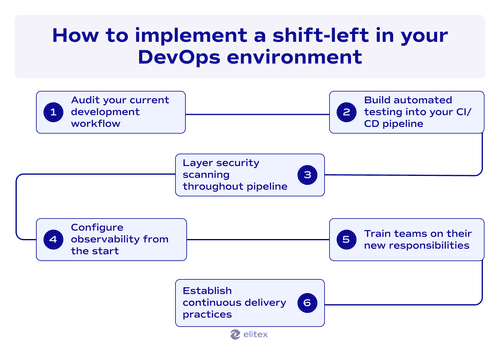
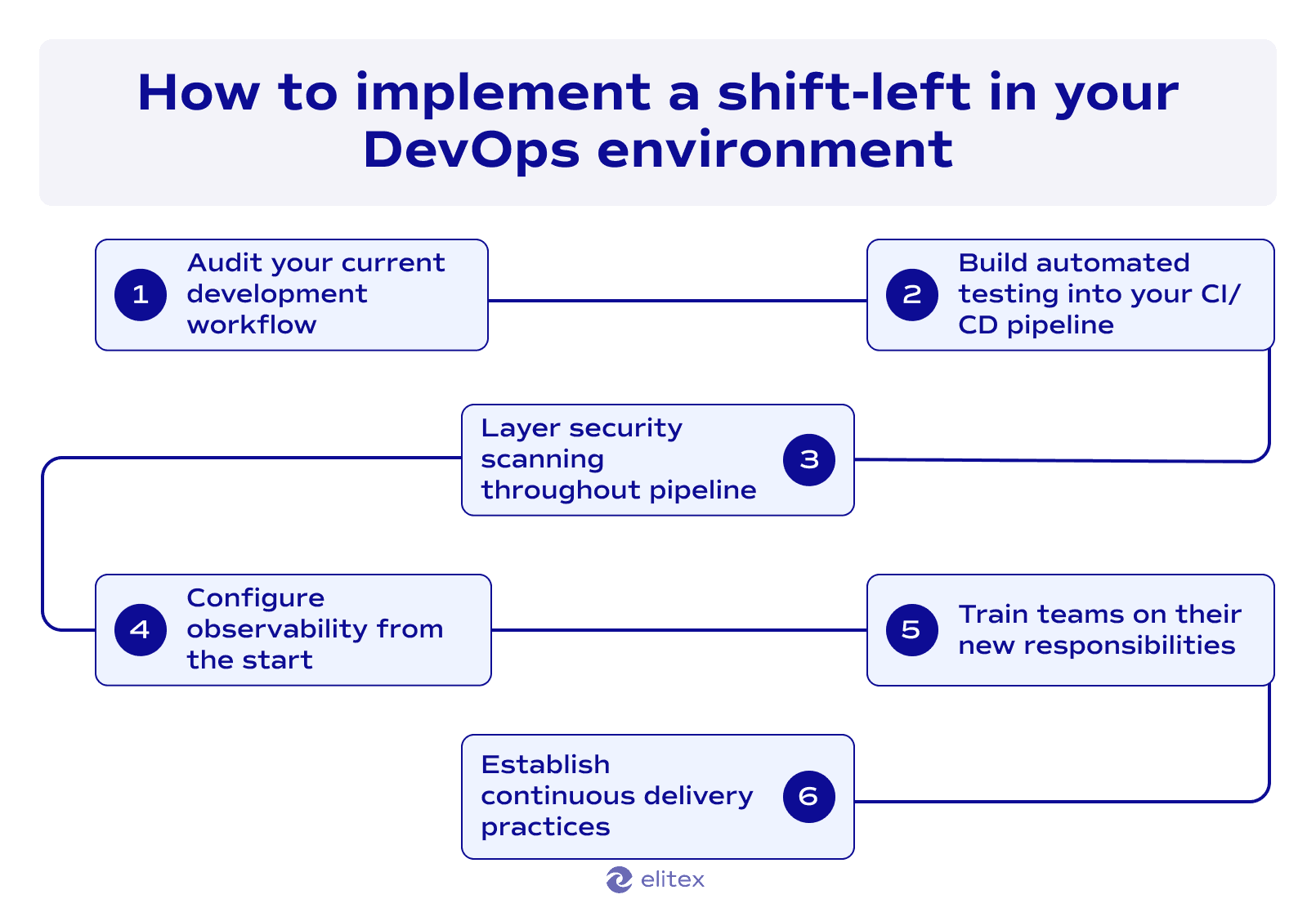
- Step 1. Audit your current development workflow: Start by documenting where testing, security checks, and quality controls currently happen in your process. This mapping exercise reveals which activities occur too late in the cycle. Look for bottlenecks where teams wait for approvals or discover issues after code is already deployed. These pain points show you exactly where shifting left will deliver the biggest impact.
- Step 2. Build automated testing into your CI/CD pipeline: Begin with the foundation in the testing dimension, just as we discussed earlier. Configure your pipeline to run unit tests, integration tests, and performance tests automatically with each commit. This DevOps-based test automation creates the immediate feedback loop that makes shifting left effective. The pipeline should block merges when tests fail, which prevents problematic code from spreading to other team members.
- Step 3. Layer security scanning throughout development: Add static code analysis tools that scan every commit for security vulnerabilities. These tools will allow you to catch flaws at the earliest possible moment. Beyond static code analysis, configure dynamic application security testing to run in your staging environments. This two-layer approach strengthens your security posture before any production deployment happens.
- Step 4. Configure observability from the start: Set up logging, tracing, metrics, and profiling as your initial project setup. Test your alerting rules in staging environments so you can adjust thresholds before going live. This preparation means your team can troubleshoot issues quickly when they do occur in production.
- Step 5. Train teams on their new responsibilities: Your developers need to understand how to write effective tests and recognize common security vulnerabilities. Operations engineers should learn how to collaborate with the rest of your product teams during the design phase. Security specialists must adapt to providing guidance throughout the entire development process. Such kind of training ensures everyone can contribute to the product quality from day one.
- Step 6. Establish continuous delivery practices: Build a deployment pipeline that can release code to production at any time. Continuous delivery relies on the quality checks you’ve already built into earlier stages. Each release carries less risk because testing, security scanning, and monitoring validation have already happened. This final step completes your shift-left transformation by connecting all the previous improvements into a reliable release process.
What are actionable tips to start shifting left today in your DevOps practice?
| Practice | Why and what it means |
| Add pre-commit hooks to run linters | Your developers get instant feedback on code quality before they even commit. This catches formatting issues and basic errors in seconds, which prevents them from entering the codebase at all. This simple automation is where the shift left in DevOps begins for most teams. |
| Run unit tests locally before pushing code | Developers catch breaking changes on their own machines. This practice is fundamental to shift left testing in DevOps because it reduces failed builds in your CI/CD pipeline and saves the entire team from dealing with broken code. |
| Set up development environments that mirror production | As a result, your code behaves the same way across all environments. This consistency eliminates surprises during deployment and reduces the “works on my machine” problem we mentioned earlier. |
| Add logging statements while writing new features | You build observability into your code from day one. When issues appear in production, your team already has the instrumentation needed to diagnose problems quickly. |
| Create automated tests for every bug fix | Each bug becomes a regression test that prevents the same issue from recurring. This practice gradually builds a comprehensive test suite that protects your codebase over time. |
| Review infrastructure code alongside application code | This allows your team to catch misconfigurations before deployment. Such a review process applies the same quality standards to IaC that you already use for application code. |
| Configure automated dependency scanning | Your build pipeline checks for vulnerable packages with every commit. This simple automation catches security risks in third-party libraries before they reach production, which protects your application from well-known exploits. |
| Implement code review checklists with security items | Your team reviews pull requests for common vulnerabilities like input validation and authentication flaws. This human layer catches issues that DevOps automation tools might miss. |

Shift-Right in DevOps. An alternative, or should you use both?
The shift left approach in DevOps catches most problems before production, but it can’t catch everything. That’s where shift-right comes in. This complementary strategy extends testing and monitoring into production environments with real users and real data.
The logic behind shift-right is simple. Some issues only appear under actual production conditions. Your staging environment might handle 100 test users perfectly, but what happens when 10,000 real users hit your application simultaneously? How do users actually navigate through your features compared to how you expected them to? These questions can only be answered in production.
So, shift-right includes:
- Production monitoring and observability
- A/B testing with real users
- Canary deployments (releasing to small user groups first)
- Feature flags to enable/disable features without redeploying
- Chaos engineering (intentionally breaking things to test resilience)
- Real user monitoring to see how actual users experience your application.
The ideal approach: Modern DevOps teams use both strategies together:
- Shift-left catches bugs, security flaws, and performance issues during development;
- Shift-right validates assumptions and catches issues that only emerge with real users and real data.
So, it’s not “shift-left failed, now we do shift-right.” It’s intentionally testing in production with safety measures in place.
Successful Shift-Left Adoption in DevOps: Real-World Examples
Capital One: What does it mean to shift left in DevOps for a fintech giant
The problem: Manual security evaluations created deployment bottlenecks, while the late 2010s data breach exposed weaknesses in their cloud security controls.
What they did: Capital One automated security scanning throughout their CI/CD pipeline and shifted security responsibilities directly to development teams.
Capital One is one of the largest banks in the US with millions of customers and strict regulatory requirements under PCI-DSS compliance standards. After experiencing major security breaches by a misconfigured firewall, the company completely revamped their approach to DevOps by implementing a shift-left security strategy. They integrated Qualys APIs for automated security scanning of container images and enabled self-service scanning so developers could check their own code without waiting for security team reviews. The results were significant: Capital One passed PCI-DSS audits with reduced manual overheads, improved their deployment velocity, and reduced vulnerabilities at scale. By embedding security check automation into their pipelines, they significantly reduced security vulnerabilities in production environments while maintaining the speed needed to compete in digital banking.
The next example is ELITEX’s firsthand experience:
Standard Practice: Securing a healthcare AI platform for HIPAA compliance
The problem: A healthcare AI startup needed to meet HIPAA security requirements while scaling from manual deployments to automated infrastructure:
What they did: ELITEX helped Standard Practice automate security checks early in their CI/CD pipeline and build test coverage into development from day one.
Standard Practice automates insurance verification calls for medical clinics across the US. The company's existing infrastructure used manual SSH deployments, which made it harder to maintain the rigorous security standards required for handling patient data. ELITEX implemented automated security hardening following HIPAA best practices directly into the deployment pipeline. Every code change now passes through security checks before reaching production. The ELITEX team also implemented monitoring and logging directly in development environments, so Standard Practice’s developers could spot security issues during the coding stage. This shift-left approach means security problems are identified and fixed during the development phase, allowing Standard Practice to scale to thousands of clinics while maintaining strict healthcare data protection standards.
Conclusion
Shift-left in DevOps fundamentally changes how product teams build software. Moving testing, security checks, and quality controls earlier in the development lifecycle reduces costs and changes the entire rhythm of how developers work. Problems get caught when they are easiest to fix, security becomes a collaborative effort, and teams spend less time firefighting in production. However, as we saw today, the shift-left strategy in DevOps transcends testing alone and touches broader dimensions of the development process. From security scanning and system testing to monitoring, collaboration, and infrastructure validation, each dimension reinforces the others to create a complete transformation.
We examined it with our real-world examples that prove that such a comprehensive approach really works. We demonstrated how shifting left in DevOps delivers measurable results in deployment speed and security strength while maintaining the strict compliance that regulated industries require. This comprehensive practice, especially when paired with shift-right practices that validate assumptions in production, gets you a complete DevOps strategy that covers the entire software lifecycle.
At ELITEX, we've built our practice around direct access to the engineers who actually build your systems. This eliminates the communication delays that often slow down DevOps transformations. Our team brings over a decade of experience across healthcare, finance, publishing, and technology sectors, which means we understand both the technical challenges and the business context behind your shift-left adoption. Whether you are looking for further consultation on shift-left in DevOps, end-to-end DevSecOps services, CI/CD consulting, or automation strategy consulting, ELITEX have what to offer. Our approach combines technical depth with cost efficiency because we've refined our processes over years of helping organizations implement these practices successfully. Don’t hesitate to schedule your free consultation today with a technical partner beyond expectations!
FAQs
What does shift left mean in DevOps?
Shift left in DevOps means moving testing, security checks, and some other aspects of quality control, such as monitoring, earlier in the software development lifecycle. The name comes from shifting these activities left on a timeline that shows development stages from left to right. This practice allows your product teams to catch the problems when they are cheapest and fastest to fix, before code reaches production.
What are the main benefits of shift left in DevOps?
The DevOps shift left benefits include reduced costs because problems gets fixed during development when they require less time and resources. The teams also ship features faster because they spend less time fixing production bugs. Security improves because vulnerabilities get caught before they become breaches. Additionally, overall development quality increases because developers address issues while the code structure is clear in their minds.
How does shift left security in DevOps work?
Shift left security in DevOps brings security checks back into the development workflow. Static code analysis runs on every commit to scan for vulnerabilities as developers write code. Engineers also examine container configurations during development to prevent misconfigurations. Security specialists join architectural discussions early so teams consider potential threats when making design decisions.
What are shift-left testing principles in DevOps?
Shift-left testing principles in DevOps focus on running tests as early as possible in the development cycle. Developers write unit tests alongside their code and run integration tests before merging changes into the main codebase. Performance testing happens in lower environments to catch bottlenecks before they affect actual users. The core principle behind these practices is timing: tests run during development to give developers immediate feedback on their code. This immediate feedback loop means problems get caught while developers still have full context about what they just built.
How does shifting left to reduce failure in DevOps work?
The shift-left to reduce failure concept in DevOps works by catching defects during development when they are easier to fix. Automated tests run with every code commit to block problematic changes before they spread to other team members. This early detection prevents failures from reaching production, where they would affect users and require more resources to fix.
What is the shift left in DevOps compared to traditional DevOps?
Traditional DevOps often treats testing and security as gates before deployment. Shift left integrates these activities throughout the development process from the very beginning. Development teams test their code continuously as they write it. Security checks happen during development, not just before release.
Why should you implement shift left in DevOps?
You should implement shift left when you notice a pattern of problems appearing in production. These issues signal that your quality checks are happening too late in the process. The approach becomes especially valuable when compliance requirements add pressure to your security practices, or when releases keep getting delayed by last-minute discoveries. Teams working across different time zones find shift left particularly helpful because troubleshooting production issues across schedules creates delays that early detection would prevent.
POSTED IN: