



- TL;DR: A DevOps strategy is a structured plan connecting development and operations practices across the full software development lifecycle. In this article, we explain what it is and why tooling alone is not enough.
- We cover what makes DevOps successful and introduce the seven Cs framework as the most widely used way to structure that thinking.
- We walk through the core components of any DevOps strategy, from branching and CI/CD pipeline design to testing, security, deployment models, and observability. We explain how together these components create a comprehensive strategy.
- We also provide a six-step implementation roadmap, explaining how you can build a custom strategy for your organization from auditing your current delivery state to iterating based on real data.
- Also, we cover the most common failure points and explain how to navigate them with the latest DevOps practices.
- Additionally, we address how DevOps strategy adapts across enterprise, government, and Salesforce contexts.
Most engineering teams have the right DevOps tools. In 2026, that part is largely solved. What fewer have, regardless of company size and industry, is a coherent DevOps strategy. The difference between having tools and having a strategy is the difference between owning a blueprint and knowing how to build. Tools handle execution. Strategy defines what you're executing toward: how code moves from idea to production, who owns each stage, and how the whole system learns from itself over time. Without this structure, even well-resourced teams end up firefighting and missing releases.
At ELITEX, we work as a DevOps automation services and solutions provider, and over a decade of software development consulting has given us a clear view of where DevOps strategies succeed and where they break down. The patterns repeat across industries and team sizes. This guide is our attempt to map them honestly.
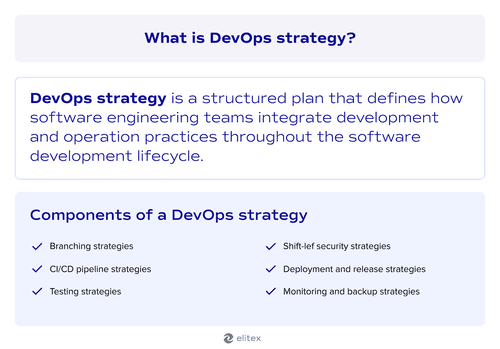
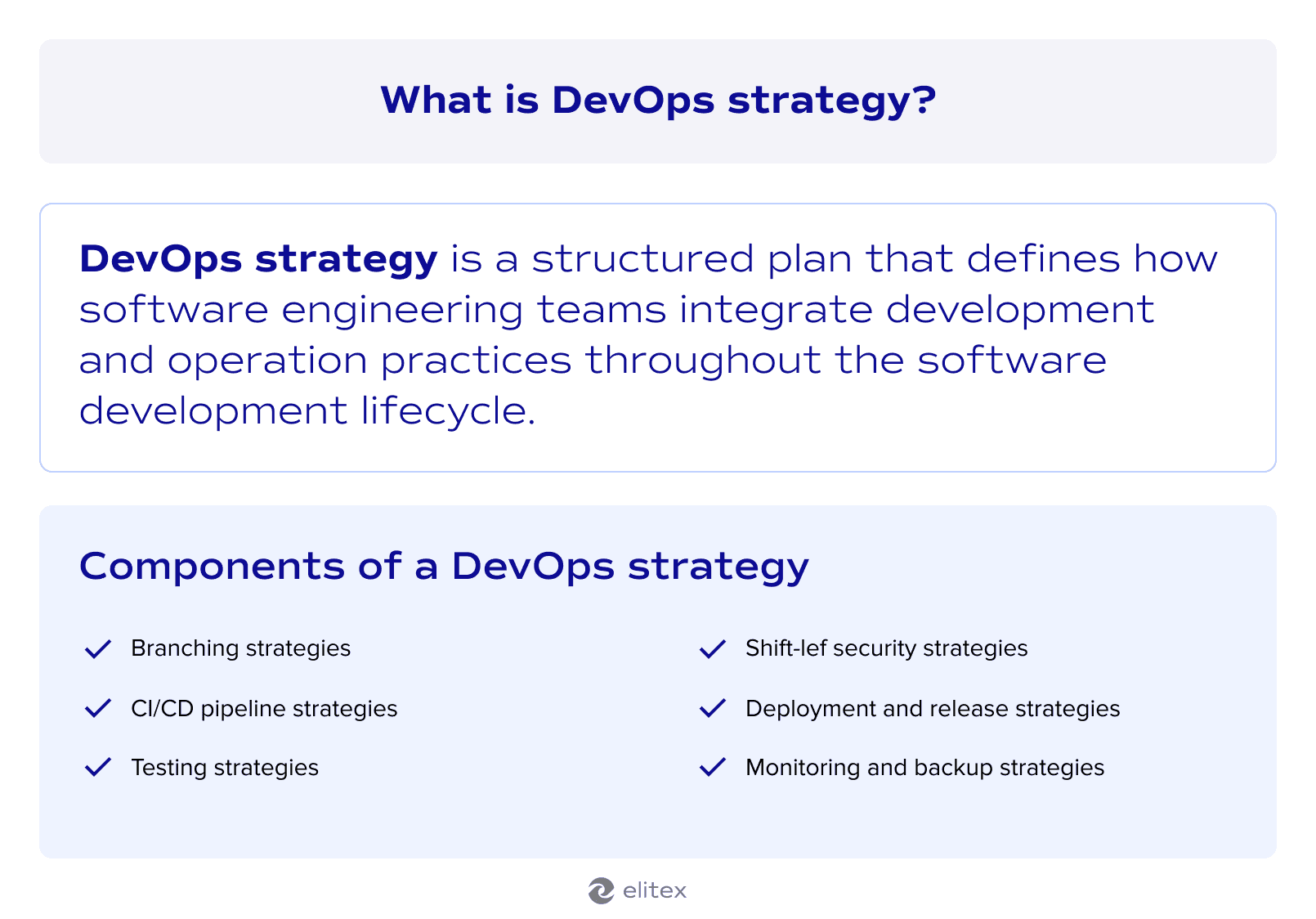
What is a DevOps strategy?
A DevOps strategy is a structured plan that defines how software engineering teams integrate development and operations practices throughout the software development lifecycle. As mentioned above, it goes far beyond tooling choices. Your DevOps strategy sets out the principles, workflows, and cultural expectations that shape how your teams build, test, release, and maintain software. Different DevOps strategies suit different organizational contexts, which is why there is no universal template. What they share is a common goal: making software delivery faster, more reliable, and genuinely sustainable. For companies moving from siloed, manually managed delivery pipelines, building that strategy is also the first real step in a broader DevOps transformation, shifting from scattered practices toward a coherent operating model.
What are the benefits of a successful DevOps strategy?
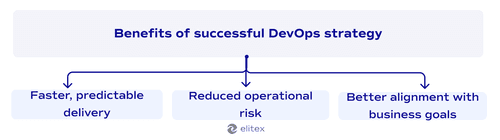
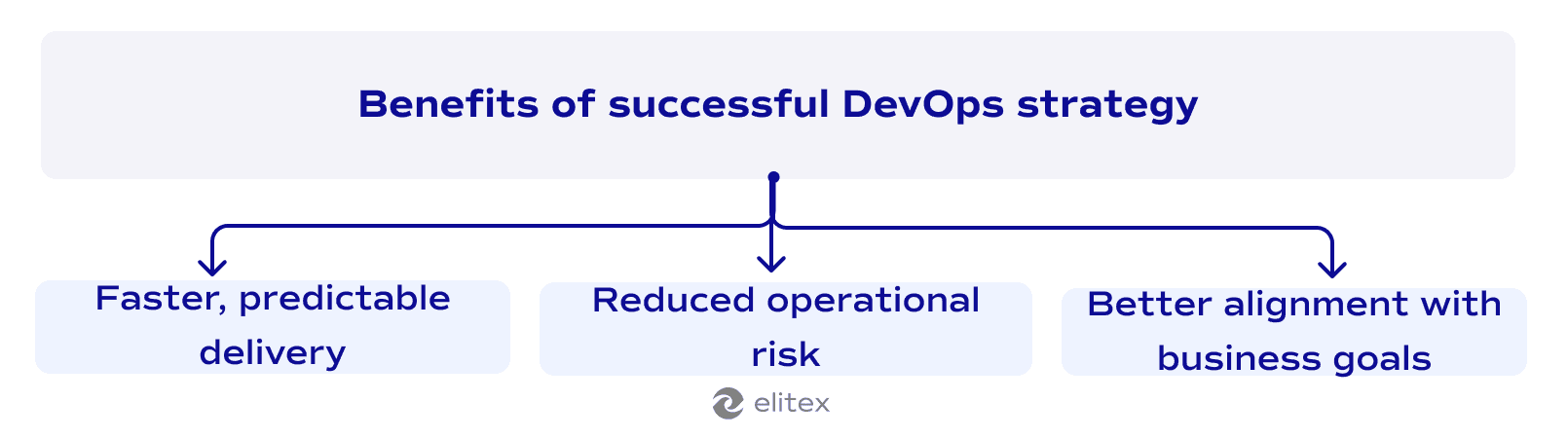
- Faster and more predictable software delivery: When automated delivery pipelines are built on a clear strategy, release cycles shorten and release dates become actual commitments. Development and operations teams stop asking whether they're ready and start asking what's next.
- Reduced operational risk: A well-designed DevOps strategy embeds quality checks, rollback mechanisms, monitoring, and automated recovery directly into the delivery process. Problems surface earlier and get resolved faster, which matters significantly in regulated or high-availability environments where a single failed deployment can trigger compliance issues or real revenue loss.
- Stronger alignment between development and business goals: Strategy forces a conversation about what success looks like. Development and operations teams stop optimizing in isolation and start working toward shared outcomes tied to actual business priorities.
As well as higher customer satisfaction and better software quality metrics, which are a direct result of the better work of your engineering teams.
What makes DevOps successful?
Before getting into the components of a DevOps strategy, it is worth stopping on what makes DevOps work in the first place. Successful DevOps is not measured by the tools a team uses or the speed of individual deployments. It shows up in how predictably software moves from development to production, how quickly failures are detected and resolved, and how well delivery practices adapt as the product and the team grow. Reaching that point requires deliberate planning.
Good DevOps strategy planning starts with understanding that DevOps is a set of continuously evolving practices. Those teams that treat it as a fixed implementation project with a completion date tend to plateau quickly. For understanding these, we should take a look at 2 concepts: DevOps metrics and the 7 Cs. Since we have a dedicated article for DevOps metrics, let’s stop on the 7 Cs. Here, each C represents a distinct capability that mature DevOps teams build and maintain over time:
- Continuous planning keeps delivery aligned with shifting business priorities.
- Continuous integration keeps codebases stable by merging and validating changes frequently, catching conflicts before they compound into something that takes a sprint to untangle.
- Continuous testing ensures quality is verified at every stage, not piled up at the final gate before release.
- Continuous delivery automates the path from a passing build to a release-ready artifact, removing manual handoffs from the equation.
- Continuous deployment takes that further, pushing validated changes to production automatically when all checks pass.
- Continuous feedback closes the loop between what gets shipped and how it actually performs in production.
- Continuous improvement ties everything together, turning operational data and team retrospectives into concrete changes to process and tooling.
No single C works in isolation. Teams that see real returns from DevOps treat all seven as ongoing practices, not one-time checkboxes. Learn more about the subject in our guide on the DevOps lifecycle.
Core components of a DevOps strategy
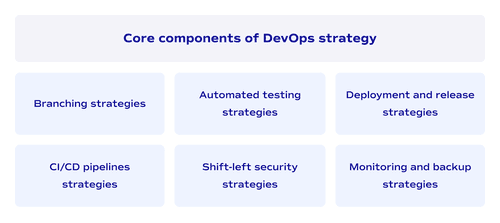
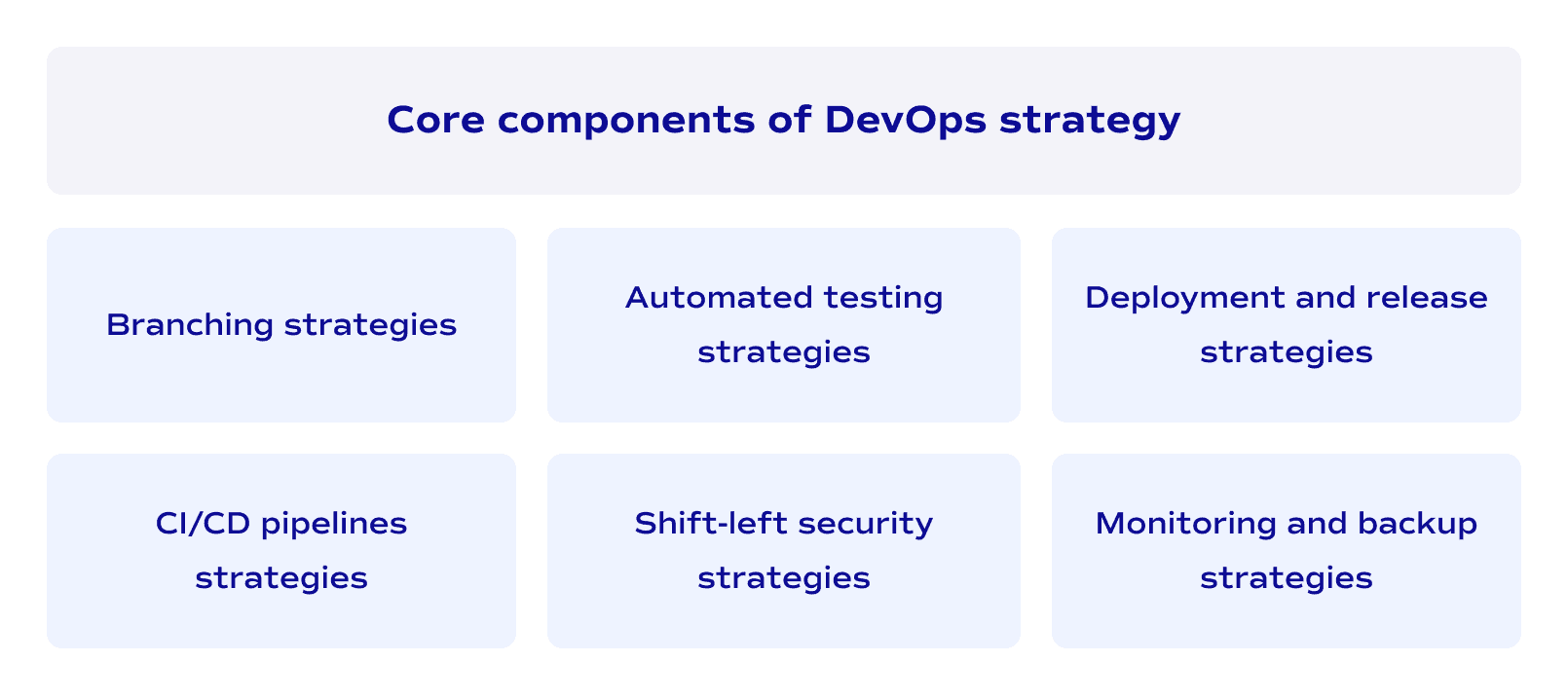
Any DevOps strategy framework is not a single practice but a layered set of capabilities that work together. In the image above, we divided this framework in 6 components. Each component covers a specific phase of the software development lifecycle, from how code branches are managed to how production systems are monitored after deployment. Below, we cover the ones that matter most in practice.
Branching strategies in DevOps
A code branching strategy defines how developers work with branches within a shared codebase, covering everything from naming conventions to merge workflows. The choice of model affects how quickly changes reach production and how safely concurrent work can happen.
- Trunk-based development suits teams shipping multiple times per day, where long-lived branches create integration pain.
- Gitflow works better for products with scheduled release cycles and parallel version maintenance.
- Feature branches are a practical middle ground for teams that need isolation per ticket without the overhead of full Gitflow
Branching strategies in DevOps are also tightly connected to CI/CD pipeline design (we’ll cover them right in the next section). Feature branches work well when each branch triggers its own automated test suite before merging. Without that connection, branching functions as a coordination mechanism and nothing more.
CI/CD pipeline strategy
CI/CD pipelines are the backbone of modern software delivery processes. A well-designed pipeline strategy maps out the automated gates code must clear before reaching production, with clear definitions of what triggers each stage and what counts as a blocking failure. A practical example: a pipeline might run unit tests on every push, integration tests on merge to main, and performance tests only on release candidates. Each gate needs a defined owner and a defined response time. Without that specificity, pipelines become a list of steps that nobody trusts enough to enforce, and software delivery processes slow down in ways that are hard to diagnose.
DevOps testing strategy
Another aspect is testing. A strong DevOps test strategy treats testing as a continuous activity woven into every stage of delivery. The goal is to catch defects as close to their source as possible, where fixing them is cheapest and fastest.
A practical DevOps test automation strategy typically covers the design of:
- Unit testing that runs automatically on every commit, validating individual components in isolation before any integration work begins. A practical starting point is requiring 80% code coverage as a merge condition, which surfaces gaps without creating an unworkable maintenance burden.
- Integration testing that verifies that services and modules work correctly when connected, catching contract violations that unit tests cannot surface on their own. Consumer-driven contract testing tools like Pact are commonly used in microservices environments for exactly this layer. Read more about the role of microservices in DevOps.
- Performance testing that runs against staging environments to expose bottlenecks before they appear under real production load. Tools like k6 or Gatling let engineering teams define load scenarios as code and version them alongside the application itself.
- Security testing that checks for known vulnerabilities in code and dependencies at the pipeline level, well before any change reaches production. SAST tools like Semgrep or Snyk integrate directly into most CI platforms and add minimal overhead per run.
- End-to-end testing validates full user workflows, confirming that the system behaves correctly from the user's perspective across all integrated components. Playwright and Cypress are the most widely adopted tools for this layer, with Playwright gaining ground in teams that need cross-browser coverage.
Shift left strategy in DevOps
The DevOps shift left approach means moving testing and security checks earlier in the development process, toward the moment code is written. The logic is straightforward: a vulnerability found during development costs a fraction of what the same vulnerability costs after deployment. Shift left is a design principle for how pipelines and team responsibilities are structured, and it has direct implications for how DevSecOps services are scoped and delivered. And any DevOps strategy should cover such a shift-left.
In practice, shift left relies heavily on security automation built into the CI/CD pipeline from the start. When done properly, security check automation runs at the code commit stage, giving developers immediate feedback on security posture without waiting for a dedicated security review cycle. A common implementation starts with adding dependency scanning to every pull request, so that known CVEs in third-party packages are caught before they reach the main branch. This is what makes shift left sustainable at scale, turning security from a periodic review into a continuous, automated feedback signal.
Deployment and release strategy in DevOps
Deployment strategy in DevOps covers how validated code reaches production and how risk is managed during that transition. Each model below solves a different part of that problem.
- Blue/green deployment maintains two identical environments and switches traffic between them, giving engineers a clean rollback path when something goes wrong. Database schema changes that are difficult to reverse benefit from this model because the old environment stays live until the new one is fully verified.
- Canary releases take a more gradual approach, exposing changes to a small percentage of users before a full rollout. This works well for high-traffic products where even a low error rate affects a meaningful number of real users.
- Feature flags decouple deployment from release entirely. Code ships to production but stays invisible to end users until specific conditions are met, whether that's a date, a user segment, or a manual trigger from the product team. This gives product and engineering teams independent control over what gets released and when.
- Release strategy sits one level above deployment mechanics. It defines the criteria a build must meet before any deployment model is applied: who signs off, what test coverage is required, what rollback conditions are pre-agreed. Without a release strategy, even a well-configured deployment pipeline still depends on informal judgment calls at the worst possible moment.
Monitoring and backup strategy
In DevOps, monitoring strategy is often considered by the broader term “observability”. DevOps observability is the practice of instrumenting a system so that its internal state can be inferred from the data it produces at runtime. This includes logs, performance metrics, distributed traces, and infrastructure health signals. Where traditional monitoring tells you whether something is up or down, observability tells you why a system is behaving the way it is, which is what engineers actually need when diagnosing production issues. Implementing observability requires choosing monitoring tools that integrate with the delivery pipeline, so that signals detected in production feed directly back into development priorities. DevOps automation tools, such as Prometheus combined with Grafana, are a common open-source stack for this purpose. Datadog covers similar ground with more out-of-the-box integrations for cloud environments, making it a frequent choice when managing multi-cloud infrastructure.
Observability tells you what happened. DevOps backup strategy is the reverse side of the coin. It determines what you can recover when something goes wrong badly enough that recovery is the only option. The starting point is agreeing on recovery time objectives and recovery point objectives before an incident happens. From there, backup verification gets automated so that restorability is tested on a regular schedule. The final piece connects directly to modern infrastructure practices: when infrastructure state is managed as code using tools like Terraform or Pulumi, entire environments can be rebuilt from source control. This turns recovery from a manual, high-stakes operation into a repeatable, version-controlled process.
DevOps strategy roadmap: How to implement it in your organization
Knowing how to build a DevOps strategy is one thing. Sequencing the DevOps strategy steps correctly is another. The roadmap below reflects what works in practice across different team sizes and maturity levels.
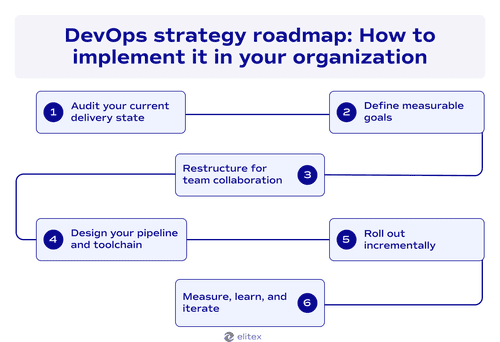
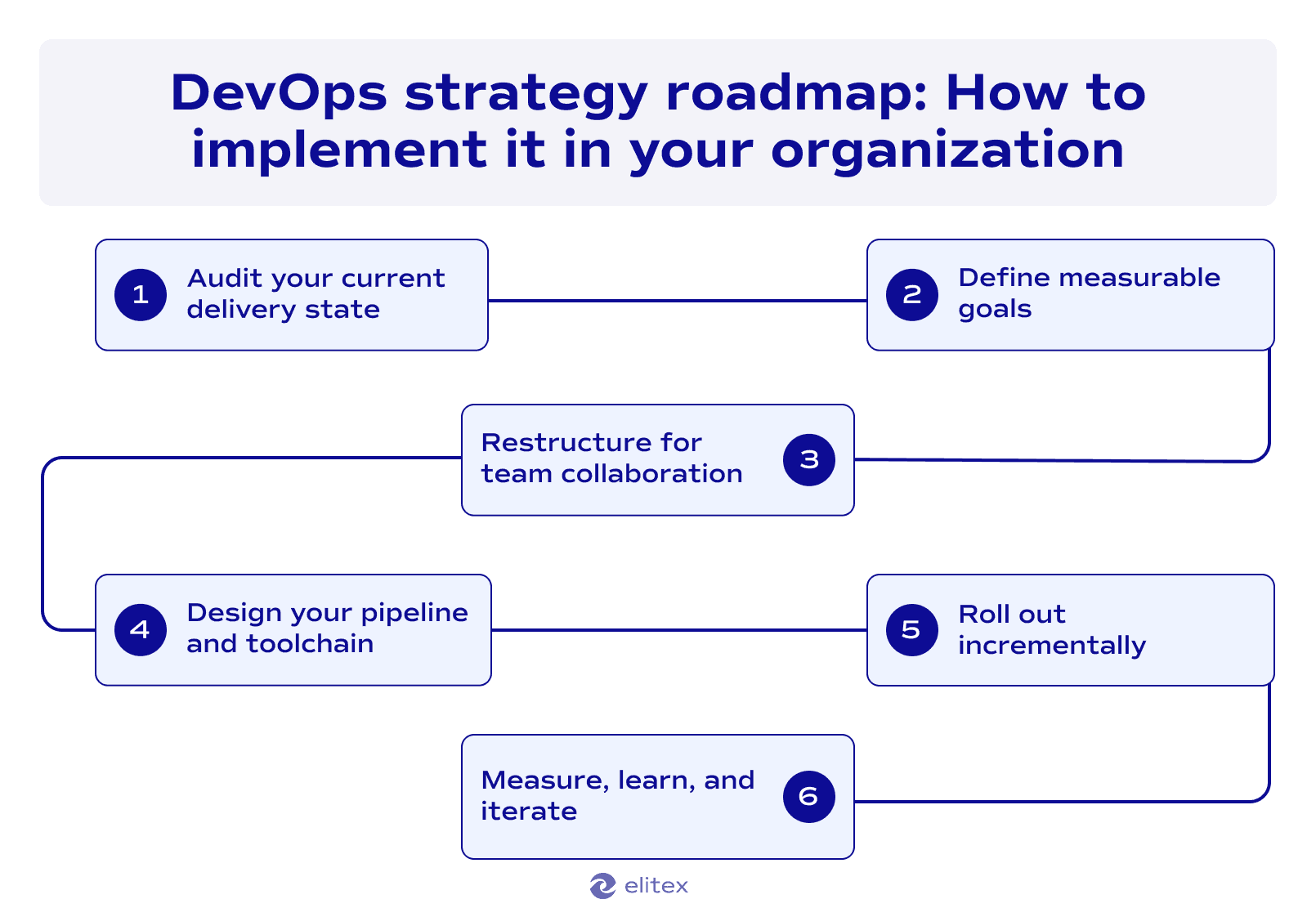
- Step 1: Audit your current delivery state. Map where you actually are before planning where to go. That means reviewing existing pipelines, deployment frequency, incident response times, and how development cycles run from commit to production today.
- Step 2: Define measurable goals. Decide what success looks like in concrete terms. The DORA metrics provide a reliable baseline: deployment frequency, lead time for changes, mean time to recovery, and change failure rate.
- Step 3: Restructure for team collaboration. DevOps works when development and operations engineers share ownership of the delivery pipeline. Reorganizing around product streams rather than functional silos is the most common structural change at this stage, and also the most resisted one.
- Step 4: Design your pipeline and toolchain. Define the automated gates code must pass before reaching production. Toolchain decisions made here shape every subsequent step, so this is where over-engineering costs the most time.
- Step 5: Roll out incrementally. Start with one team and one service. Prove the model works at small scale before expanding it.
- Step 6: Measure, learn, and iterate. Track the metrics defined in step 2 from day one, review them on a regular cadence, and treat deviations as input for the next planning cycle. A DevOps strategy that never gets revised based on real delivery data is already becoming outdated.
Challenges of implementing a successful strategy and DevOps best practices to navigate these challenges
| Challenge | Best practice to navigate it |
| Cultural resistance from development and operations teams accustomed to working in silos | Start with a shared on-call rotation. Shared pain creates shared ownership faster than any process document. |
| Toolchain sprawl across teams with no agreed standards | Define a reference architecture early and treat tool additions as architectural decisions requiring review. |
| Measuring ROI in the early stages when pipelines are still maturing | Adopt DORA metrics from day one so there is a baseline to compare against, even when numbers look unflattering. |
| Legacy infrastructure that was never designed for automated delivery | Containerize incrementally. Start with new services and avoid forcing legacy systems into a pipeline model they were not built for. |
| Security treated as a gate at the end of delivery rather than a built-in control | Integrate SAST and dependency scanning at the pull request stage so security feedback reaches developers before code is merged. |
| Unclear ownership of pipeline failures in cross-functional teams | Define a named owner for each pipeline stage during setup, not after the first production incident. |
Learn more in our article about what are Devops security best practices.
DevOps strategies in specific contexts
A DevOps strategy and implementation that works for a 40-person SaaS startup looks very different from one designed for a government agency or a Salesforce-heavy enterprise. The core principles stay consistent. The constraints, compliance requirements, and tooling ecosystems do not. Below are three contexts worth addressing separately.
Enterprise DevOps strategy
Enterprise DevOps strategy deals with a problem that smaller organizations rarely face: scale without chaos. Large engineering organizations typically have dozens of teams, multiple legacy platforms, and governance layers that slow down the kind of autonomous decision-making DevOps depends on. DevOps strategy and planning at this scale means defining standards that apply across teams without eliminating team-level autonomy. Platform engineering teams are increasingly the answer here, building internal developer platforms that give product teams fast, self-service access to compliant pipelines without requiring each team to reinvent infrastructure from scratch.
DevOps strategy for government
Government environments add compliance and security requirements that shape every layer of a DevOps transformation strategy. FedRAMP authorization, air-gapped environments, and strict change management processes are not optional constraints to work around. A practical DevOps implementation strategy in government contexts starts with identifying which compliance controls can be automated and which require manual sign-off, then building pipelines that satisfy both without creating two parallel workflows. The goal is the same as in commercial environments: faster, more reliable delivery. The path to get there runs through the compliance framework, not around it.
Salesforce DevOps strategy
Salesforce introduces a specific set of DevOps challenges because the platform blends declarative configuration with programmatic development in ways that standard Git workflows were not designed to handle. Metadata changes, org dependencies, and sandbox refresh cycles all affect how DevOps strategy and planning needs to be structured. Tools like Copado, Gearset, and Salesforce's own DevOps Center exist specifically to bring CI/CD discipline to Salesforce delivery. In the case of Salesforce, A viable DevOps transformation strategy defines source of truth clearly, enforces deployment through pipelines rather than direct org changes, and treats sandbox environments with the same rigor applied to traditional staging infrastructure.
A brief conclusion: To wrap things up
The contexts above share a common thread: the technical decisions are rarely the hardest part. Figuring out where to start, what to prioritize, and how to build internal buy-in is where most DevOps strategies stall. That is where external experience shortens the path significantly.
At ELITEX, we offer both DevOps consulting and automation strategy consulting services, depending on what a given engagement actually needs. Some clients come with a clear technical direction and need help building the pipeline infrastructure to support it. Others are earlier in the process and need a structured DevOps strategy and planning before any tooling decisions are made. We work across hospitality, healthcare, fintech, ecommerce, real estate, and publishing, which means the compliance constraints, scaling patterns, and legacy system challenges that come up in your context are ones we have likely navigated before. Regardless of the industry and scope of the project, choosing ELITEX you choose dedicated software professionals that bring results beyond initial expectations. 90% senior developers, perfect soft skills, honest communication, and zero bureaucracy are what make us the best strategic choice for small and mid-sized businesses across the globe.
If you are building a DevOps strategy from scratch or reworking one that has stopped delivering results, we are happy to take a look at where you are and what a practical next step looks like. Contact us today to schedule your DevOps strategy consultation tomorrow!

FAQs
What should a DevOps strategy document include?
A DevOps strategy document should cover your current delivery state, measurable goals tied to DORA metrics, pipeline design decisions, toolchain standards, team ownership structure, and a phased rollout plan. It is a working reference, not a one-time deliverable, so it needs to be versioned and revisited as your delivery practice matures.
What is a DevOps deployment strategy and which model should I choose?
A DevOps deployment strategy defines how validated code reaches production and how risk is controlled during that transition. Blue/green deployment suits scenarios where rollback needs to be immediate and clean. Canary releases work better when you want to validate changes against real user traffic before a full rollout. Feature flags are the right choice when you need to decouple deployment timing from release decisions entirely.
What is a DevOps branching strategy and why does it matter?
A DevOps branching strategy defines how code changes are isolated, reviewed, and merged within a shared repository. The choice directly affects pipeline design: a branching model that does not trigger automated testing on each branch creates integration risk that compounds over time. Trunk-based development, Gitflow, and feature branching each suit different release cadences.
What is a rollback strategy in DevOps?
A rollback strategy in DevOps is a pre-agreed plan for reverting a deployment when it causes unexpected failures in production. It should be defined before deployment, not after an incident. Blue/green deployments make rollback straightforward because the previous environment stays live. For canary releases, rollback means redirecting all traffic away from the new version before it reaches full rollout.
How does a DevOps migration strategy differ from a standard implementation?
A DevOps migration strategy applies when an organization is moving from an existing delivery setup to a DevOps model, which adds constraints that greenfield implementations do not face. Legacy infrastructure, existing release processes, and institutional habits all need to be accounted for. The practical approach is to migrate service by service, starting with lower-risk workloads, and avoid forcing legacy systems into pipeline models they were not designed for.
What are the latest DevOps best practices in 2026?
Platform engineering has become the dominant model for scaling DevOps in larger organizations, replacing the older pattern of each team managing its own toolchain. AI-assisted code review and anomaly detection are now standard additions to mature pipelines. Shift left security, treating compliance as code, and using DORA metrics as the primary measurement framework remain foundational practices that have only become more widely adopted.
POSTED IN: