



Imagine you’re searching for your next property, whether it’s an office for your company or a house to live in with your family. You found an excellent real estate company that should help you find the perfect match you’ve always dreamed about. However, when it comes time to see the available options, instead of looking at a user-friendly website with detailed listings, they hand you a few printed photos with brief descriptions on top of them. There’s no website to explore, no way to filter properties by your preferences, and no virtual tours to give you a sense of the space you were looking for. Doesn’t sound impressive, does it?
Although hypothetical, this scenario anyway highlights the crucial role front-end development services play for real estate businesses. However, a well-crafted website doesn’t just display properties; it means way more for any modern business with a digital presence. High-quality images, detailed descriptions, and intuitive navigation are no longer an advantage but rather a necessity. However, let’s go through the topic gradually, answering the questions about this, perfect digital experiences, and the role of the frontend in all of those above one by one.
Overview of front-end development in real estate
The importance of front-end development for real estate cannot be overstated. It shapes every online interaction between potential buyers and property. An effective front-end includes many advanced features, such as responsive layouts, high-quality images, and interactive tools like virtual tours and detailed search filters. These elements work together to create an ultimately good image and intuitive user experience. However, let’s begin by describing the front-end itself.
What is front-end development?
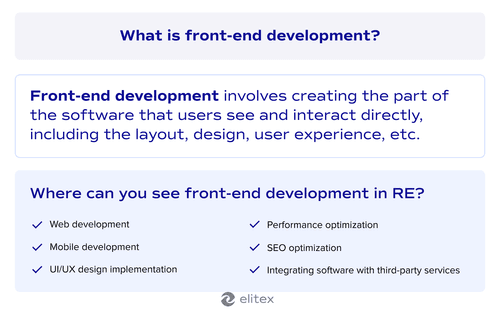
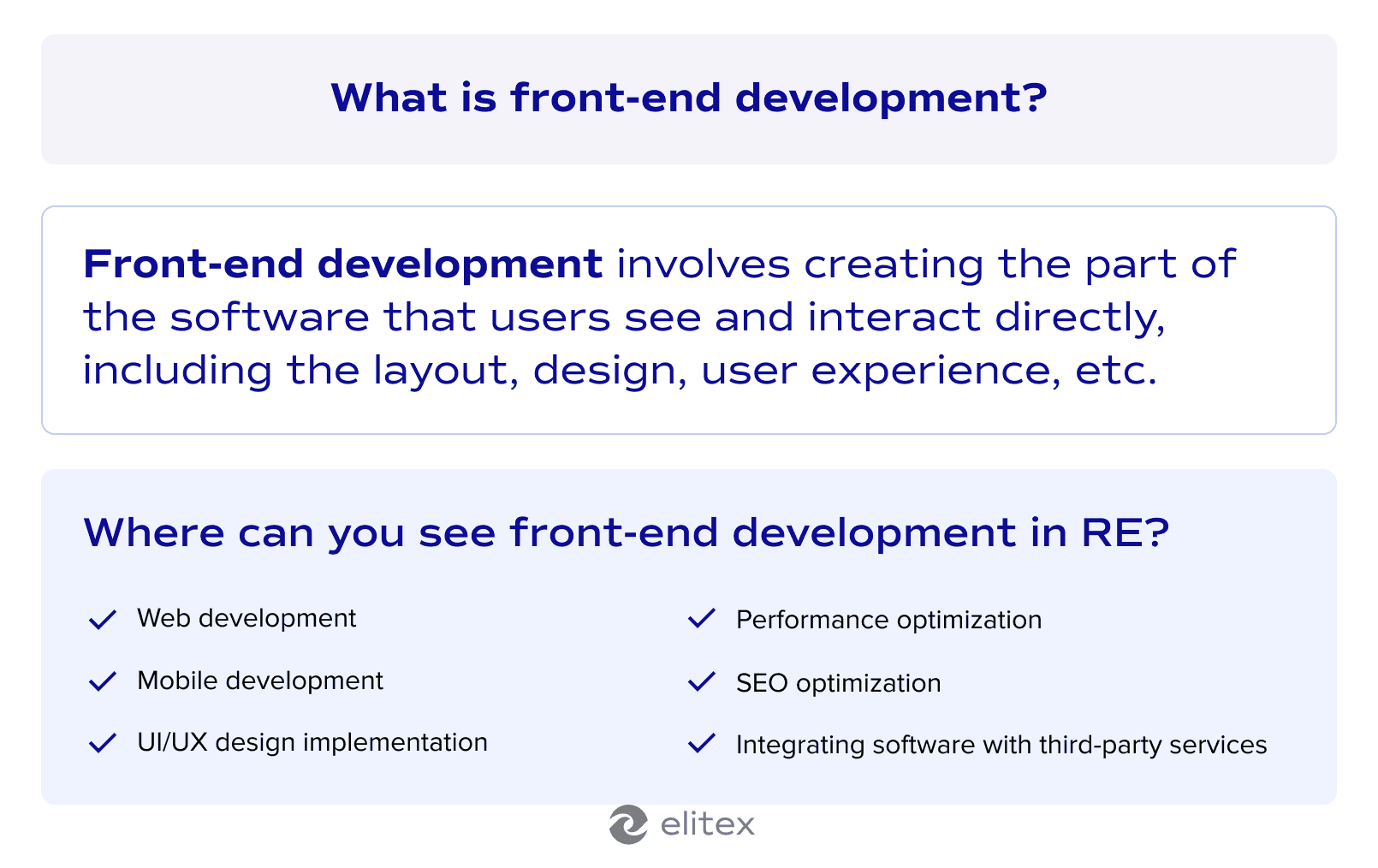
In the context of real estate, front-end development refers to the creation of the visible parts of the software (primarily web and mobile apps) users can see and directly interact with. For instance, if we take any real estate website, the front-end part will be the part users see and use when searching for properties, looking at images, using the search filters, etc. In contrast to the back-end development, which manages the hidden parts of the web application (for instance, database management), the results and quality of front-end development are immediately visible to both stakeholders and end users.
The list of front-end development services typically involves several specific offerings, including essentially UI development (building user-facing parts of the software’s interface), ensuring design responsiveness, implementing user-friendly navigation, performance optimization, and some other particular options depending on the specific project requirements. These services typically involve using the latest front-end frameworks combined with HTML, CSS, and best coding practices to implement a seamless and engaging user experience online. By focusing on these aspects of web development, front-end developers ensure that real estate platforms are both functional and visually appealing, meeting the needs of both users and stakeholders.
The intersection of real estate and front-end
As seen from the aforementioned, front-end and real estate intersect where technology meets the needs of homebuyers and renters. To be a bit more precise, let’s say that front-end development shapes the real estate industry’s online presence; it’s the area of software development responsible for what you see on websites and how it feels to use them. Front-end is key to creating user-friendly real estate websites that turn finding and exploring properties into an easy and enjoyable web experience. And, almost any real estate company with a website benefits from strong front-end development services in the following way:
What are the main benefits of front-end development in 2026?
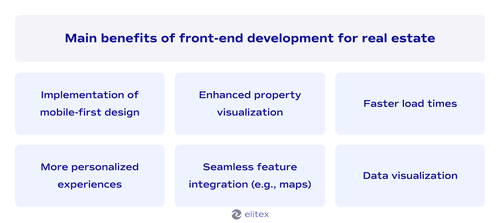
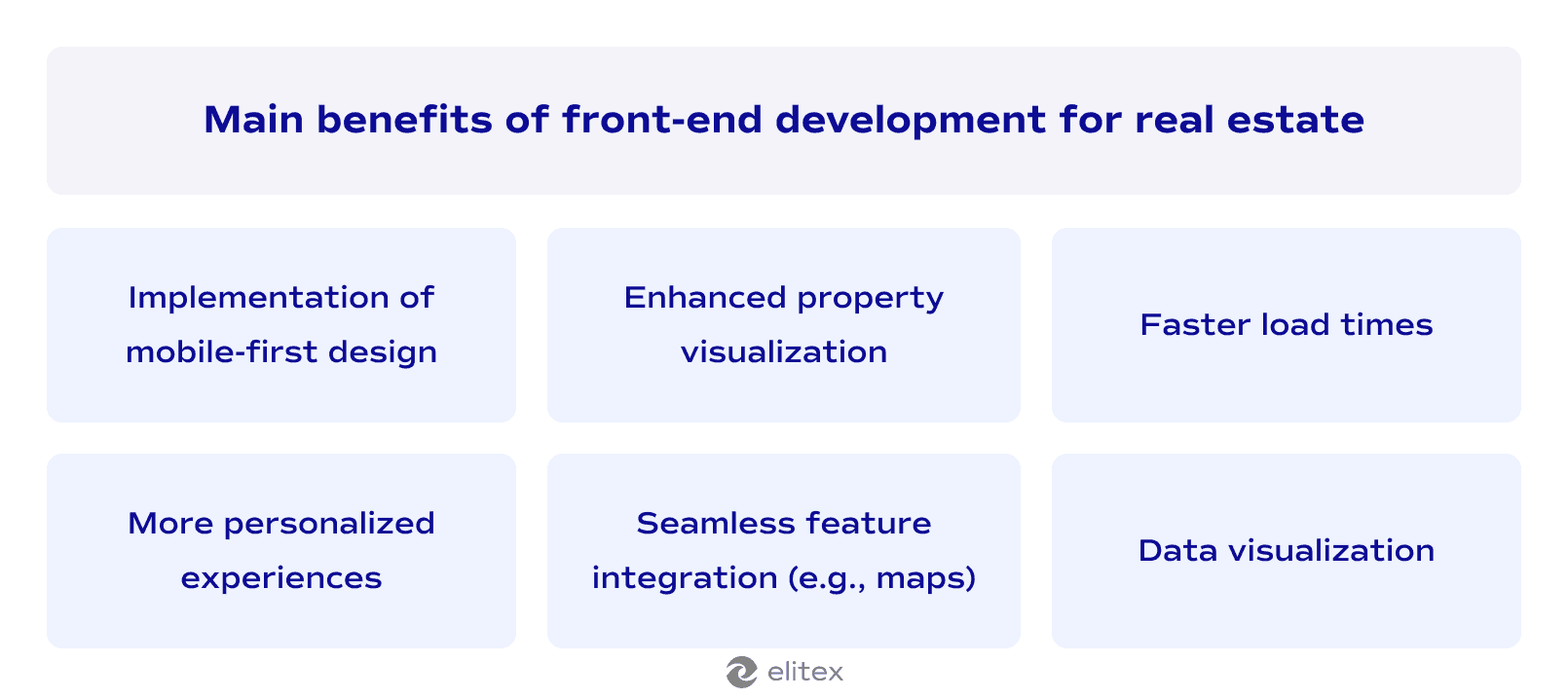
From boutique agencies to major property portals, every single player in the real estate industry with an online presence strongly benefits from having a good web presence and, consequently, from front-end development. In 2026, the front end itself continues to evolve and can offer new ways to showcase properties and engage clients. Here are some of the benefits front-end development can make for real estate:
Also read our article about legacy software integration in real estate.
Mobile-first design
With over 60% of property searches now starting on mobile devices, responsive design has become a cornerstone of real estate websites. Most modern front-end developers prioritize mobile-first approaches, ensuring that everything, including property listings, search functions, and contacts, works perfectly on smartphones and tablets. Such a focus on mobile usability means that potential buyers can easily browse your property listings during their commute, lunch break, or just while relaxing at home. As a result, engagement increases, and there is a higher likelihood of direct contact with real estate agents or scheduling viewings.
Enhanced property visualization
Experienced front-end developers now create stunning 3D tours and virtual staging tools that transform how buyers explore properties just from their homes. Such an immersive experience allows users to walk through homes or offices directly from their devices, examining every corner and visualizing different furniture layouts. This technology not only saves time for both buyers and real estate agents by reducing in-person visits during the initial stages of search but also expands the potential buyer pool to include out-of-town or even international clients. The result is a more efficient sales process and increased interest in listings that might otherwise be overlooked based on photos alone.
Faster load times
In fast-paced industries, such as real estate, every second counts. Front-end developers employ the best techniques like lazy loading (where images load only as the user actually scrolls) and code splitting (breaking the entire JavaScript code into smaller code chunks) to reduce page load times drastically. Any speed boost is crucial for keeping impatient house hunters engaged with property listings. Additionally, faster websites also rank higher in search results, giving real estate businesses an edge in terms of search engine optimization. The impact is clear: quicker load times lead to lower bounce rates and higher conversion rates for property inquiries.
Personalized user experiences
Modern JavaScript frameworks enable real estate platforms to deliver dynamically personalized content to each customer. By analyzing browsing history, search preferences, and even location data, these sites can showcase the properties that are most likely to interest each particular buyer. This tailored approach extends beyond just listing suggestions, as it can also customize the entire user interface, highlighting features like school district information for family house buyers or investment potential for property investors. The result is a more engaging and relevant experience that keeps users coming back to the platform.
Seamless feature integration
Experienced front-end development providers can easily build a seamless integration of advanced features, such as maps, with existing websites. Let’s take a closer look at maps. Front-end developers have mastered the art of integrating mapping APIs to new heights. These maps don’t just show a property’s location now; they layer on data about nearby amenities, school districts, transit options, and even neighborhood demographics. Users can visualize commute times, explore street views, and get a real sense of the area without leaving the listing page. This context-rich approach helps potential customers make more informed decisions and often leads to increased interest in properties that might have been overlooked based on address alone.
Data visualization
Complex market trends become digestible through front-end data visualization techniques. Developers create interactive charts, graphs, and heat maps that transform raw data into insightful visual stories. These tools help both real estate agents and potential customers understand market trends, property value fluctuations, and investment potential at a glance. For example, a simple line graph can show historical price trends in a neighborhood, while a heat map might reveal hotspots of buyer activity. This data-driven approach makes the decision-making process even more informed for all parties involved.
Case studies: Successful real estate websites
Previously, we have written a complete guide on real estate app development process, breakdown of real estate app development costs, guide on real estate CRM development process, and top real estate tech development companies. Don't hesitate to check these articles!
Several real estate websites stand out for their effective use of front-end technologies. Zillow a real estate market leader, employs user-friendly interfaces with advanced search filters and a “Zestimate” feature that provides estimated home values. Their mobile app, which accounts for a significant portion of their traffic, showcases the best responsive design principles. Redfin, another real estate giant, combines map-based search with real-time updates, allowing users to see new listings as soon as they hit the market. Their integration with backend systems enables seamless scheduling of home tours directly through the real estate platform.
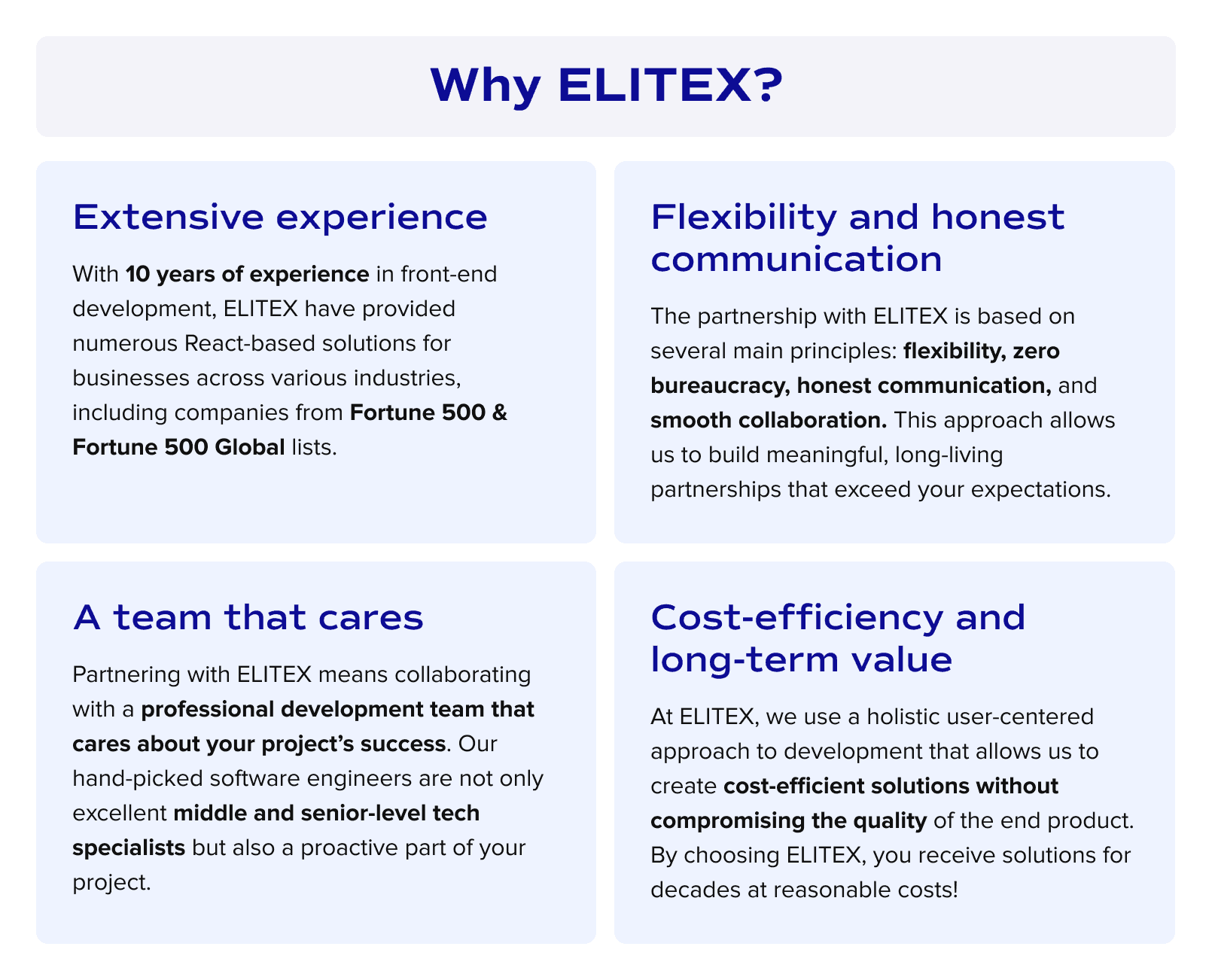
ELITEX is a trusted front-end development service provider that offers cutting-edge solutions across multiple industries, including property management and real estate. Our development teams craft custom interfaces that blend visual aesthetics with high functionality, tailoring each project to the unique needs of real estate businesses. ELITEX’s approach in property-specific front-end development focuses on UI modernization and optimizing user experience, ensuring your real estate platform is not just visually appealing but also easy to navigate and enjoyable to interact with. By staying ahead of front-end trends, ELITEX enable real estate professionals to get web solutions beyond all initial expectations!
Challenges and future trends in front-end development for real estate
However, several challenges specific to the front-end for real estate stay on the stage. What’s more interesting is that new trends seem to be able to help solve many of these challenges. Well, let’s check how the future can help with the common issues of the present.
| Challenges in real estate front-end | Future trends to address challenges |
| Cross-device compatibility issues | More adoption of progressive web apps (PWAs). These apps provide an app-like experience across all devices and screen sizes, ensuring consistency. |
| Complex search interface clutter | AI-powered search engines. Such a solution simplifies user interfaces while offering smarter, more intuitive search options. |
| Multiple API integration complexity | Micro-frontend architecture. This approach allows easier management of various features and integrations. |
| Real-time data update challenges | WebSocket technology for live updates. As one of the most popular ways to connect front-end and back-end, WebSockets enable instant property status changes without page reloads. |
| Image-heavy pages slowing load times | WebP image format and lazy loading. Adopting these relatively new techniques optimizes image delivery without sacrificing quality. |
| Complicated transaction interfaces. | The usage of blockchain for property transactions may be an interesting solution. |
| Scaling design systems challenges | Design tokens and component libraries are the key. These ensure consistent styling and easier updates across large platforms. |
Final thoughts on the importance of front-end development in real estate
Front-end is a cornerstone of real estate web development. It shapes the way potential buyers interact with property listings, turning what could be a tedious search into an engaging, informative, and ultimately enjoyable positive experience. From mobile-first approaches that cater to on-the-go house hunters to immersive 3D virtual tours that save time for both buyers and agents, front-end technologies are reshaping the real estate market.
As real estate continues to embrace digital transformation, the role of front-end development in creating user-friendly, fast-loading, and feature-rich platforms will only grow in importance. In this vein, looking for a technically competent person with extensive experience dealing with property can be quite a challenging task. However, as you’re reading this text, you’re on the right side of the Internet. Whether you’re looking for dedicated teams to enlarge an in-house team on an existing project, a service provider for real estate website development, or just a software partner for tech consulting, don’t hesitate to contact ELITEX. With ELITEX, you always receive future-proof results beyond your expectations.
FAQs
What is front-end development in the context of real estate?
Front-end development is a part of web development that is responsible for creating the visible parts of real estate websites and apps the users interact with and building the logic of these interactions. Examples of front-end development include property listings, images, search tools, and every other visible element on the website.
Why is front-end development important for real estate websites?
High-quality front-end development can help your website receive enhanced user experience, making it easier for buyers to find and explore properties online. Together with enhanced visual appeal, this can lead to more conversions.
What is the role of a front-end developer in real estate?
A front-end developer in real estate designs and builds user interfaces and implements user experience, ensuring the site is easy to use, visually appealing, optimized, and responsive.
How is front-end development connected with design in real estate?
Front-end development brings design concepts to life by coding layouts, images, as well as interactive elements to create seamless user experiences across all devices.
What future trends in front-end development could impact the real estate industry?
Virtual tours, more advanced search filters, better map integrations, VR/AR integration, AI-powered personalization, and improved mobile responsiveness are the main trends that shape front-end development for the real estate industry.
What are the benefits of investing in high-quality front-end development services for real estate companies?
High-quality front-end development attracts more users and improves engagement, ultimately increasing the likelihood of closing deals.
POSTED IN: