



- TL;DR: Digital transformation replaces manual real estate workflows with integrated technology systems that connect scattered platforms automatically.
- Today, we’ll examine how exactly digital transformation in real estate eliminates repetitive tasks like document preparation and follow-up emails that consume valuable agent hours.
- We cover where digital transformation delivers the most value, from virtual tours reducing wasted viewings to AI-powered analytics processing millions of data points for investment decisions.
- This article explores key technologies driving change, including AI for property valuation and customer service, VR/AR for remote property tours, IoT sensors for smart building management, and blockchain for secure transactions.
- We also have two real-world examples from the industry giants that gained measurable results from digital transformation.
- Additionally, we cover the most common implementation challenges like high upfront costs, employee resistance, and vendor lock-in risks, providing specific mitigation strategies for each obstacle.
- Finally, we outline a practical six-step framework for starting your own transformation journey.
Many real estate firms around the globe still waste hours on manual tasks that drag every, even the smallest, transaction into weeks of work instead of days. As a custom real estate software development company with a decade of experience, we at ELITEX understand how these inefficiencies compound across every deal and team member. Agents chase paperwork while buyers wait for responses. Then, more delays stack up because systems don’t communicate with each other. We saw thousands of stories like these. But today, we want to offer a straightforward solution to handle this inefficiency.
Digital transformation in real estate allows businesses to break the cycle of manual bottlenecks and constant delays by replacing outdated processes with technology that actually speeds workflows up. After digital transformation, the information flows automatically between software systems that were previously scattered. Now, properties move from listing to closing faster, and agents focus on building client relationships instead of hunting down documents.
However, this shift goes beyond simply adding new software. Digital transformation is a concept that explains systematic change, reshaping how real estate companies operate at every level. Data that once sat in spreadsheets now drives decisions in real time. Tasks that required multiple people now run automatically through integrated systems. But what does this transformation look like in practice, and which technologies deliver the most value? Let’s figure it out together!
What is digital transformation in real estate?
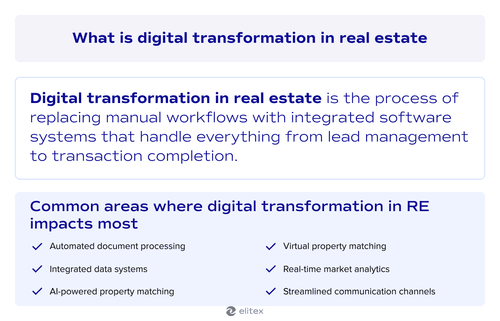
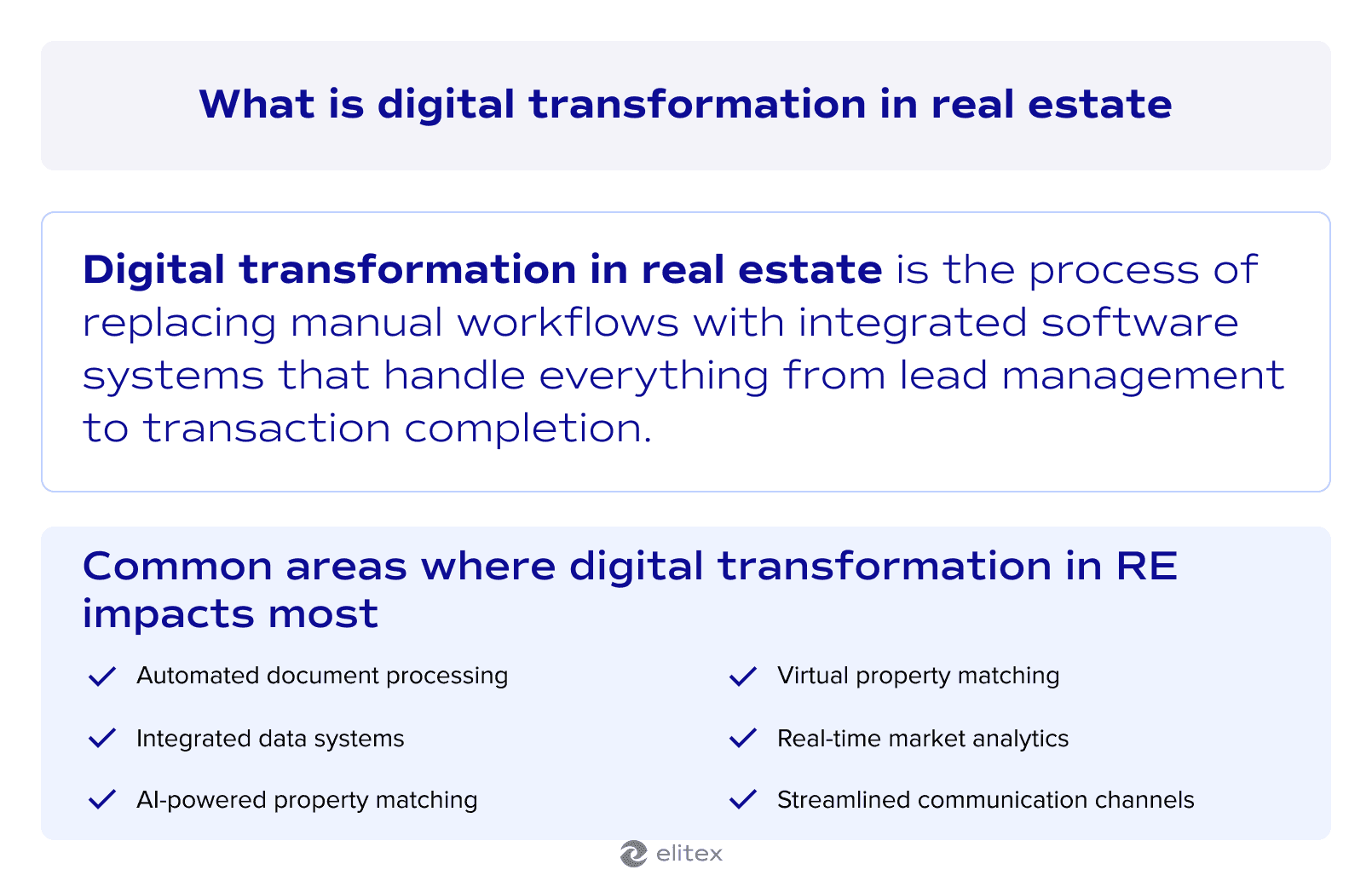
Digital transformation in real estate is the process of replacing manual workflows with integrated technology systems that handle everything from lead management to transaction completion. A successful digital transformation typically touches every part of the business by changing how information moves through the organization. Instead of data sitting in isolated spreadsheets or email threads, after the digital transformation, it flows between connected systems that work together.
Why does digital transformation matter for the real estate industry?
Automate repetitive work
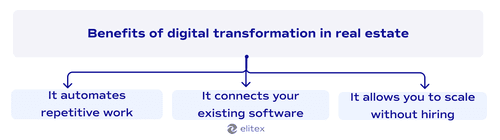
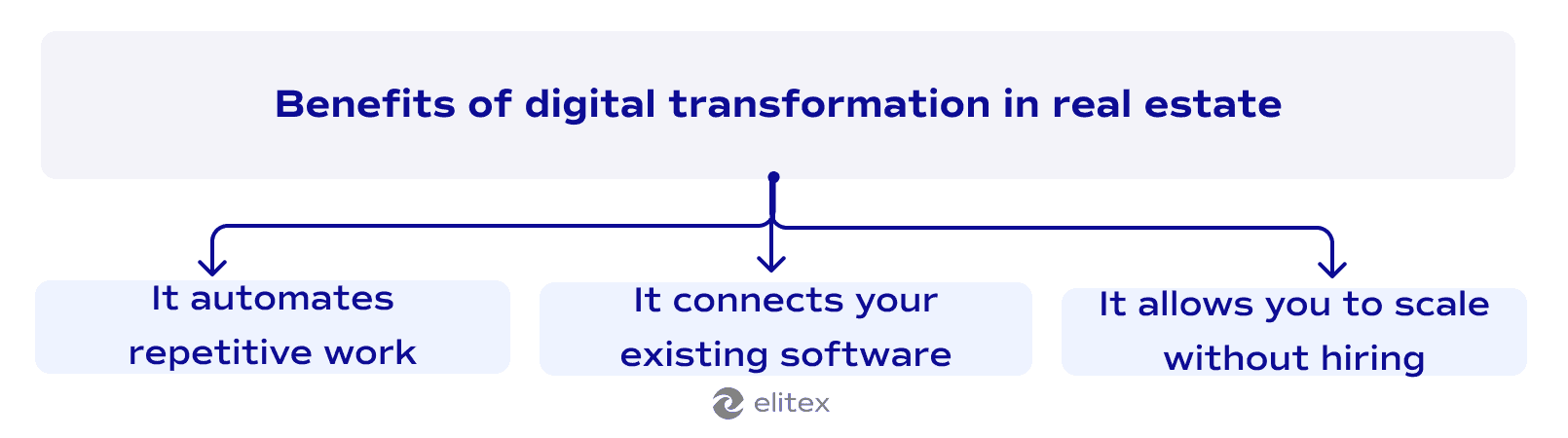
Traditionally, agents spend hours on tasks that follow the same pattern. For instance, contract preparation pulls data from multiple sources every single time. Follow-up emails to prospects require checking what was already sent. Processes like these eat up valuable hours just because they’re manual. When done properly, digital transformation in real estate allows you to handle these workflows without human input. Digital solutions now generate documents and track communications automatically. So your team focuses directly on negotiations and client relationships, not on mundane tasks. Eventually, the result is faster deal closure because agents work on what actually matters.
Connect your platforms
According to Deloitte’s commercial real estate outlook, 61% of global real estate owners and investors are still dependent on legacy technology infrastructures. What does it practically mean? Real estate companies often run on different platforms that don’t share data with each other. Typically, it works like this: your CRM has client information, while your MLS stores listings. When your agent needs complete information about a transaction, they check three or four different applications. That’s exhausting and slow.
Custom digital solutions, a foundation for any real estate digitalization, enable you to connect all these scattered tools into a single platform. Now, information flows automatically between different applications without manual data transfer, so your agents see everything they need in one place. Building a custom solution allows you to link your software to whatever platforms your company already uses. The result is simple: your team stops wasting time switching between software solutions and focuses on closing deals instead.
Scale without adding staff
Traditionally, growing your business meant hiring more people. A firm processing 50 transactions per month needs some administrative staff. That same firm at 200 transactions typically needs a 3-4 times bigger team. Digital transformation through custom software can help you break this pattern. A well-designed platform handles increased volume at the same operational costs, so growth actually improves profitability instead of just increasing expenses.
Where does digital transformation deliver the most value in real estate?
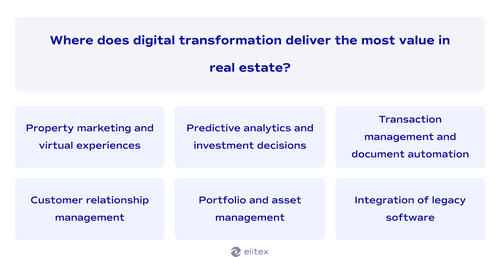
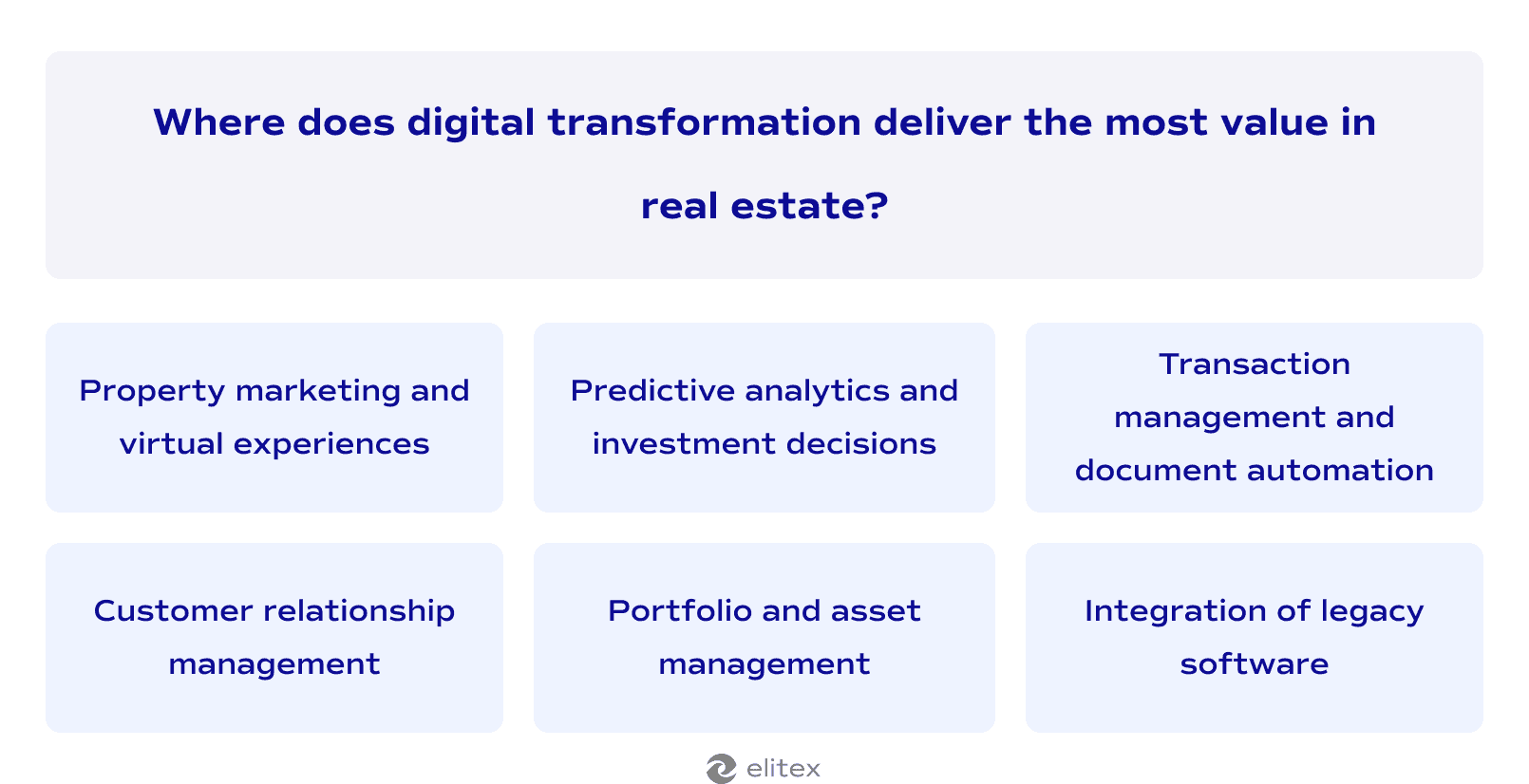
Property marketing and virtual experiences
Virtual tours and immersive property experiences represent one of the biggest shifts in how real estate firms attract buyers. Virtual tours reduce wasted property viewings by 40%, allowing potential buyers to filter options before scheduling in-person visits. This technology allows buyers to explore multiple properties from their homes and make faster decisions about which ones deserve in-person visits.
AI in Predictive analytics, investment decisions, and beyond
AI-driven market analysis changes how investors evaluate opportunities and price properties. The technology now processes millions of data points to predict market trends, property values, and investment returns with precision that manual analysis can’t match. McKinsey estimates that generative AI could generate $110 billion to $180 billion in value for the real estate industry through improved decision-making and operational efficiency.
Transaction management and document automation
Digital document workflows eliminate the bottlenecks that slow closings to a crawl, just as mentioned in the section above. When your software handles the entire document lifecycle from initial generation through final signature and storage without manual coordination – that’s a huge difference. Overall, document automation is one of the spheres where digital transformation brings the most value.
Customer relationship management
Another aspect of work significantly impacted by digitalization is CRM. Integrated CRM platforms track every interaction between agents and clients in one centralized system. Now, with a better level of automation and widespread usage of artificial intelligence, nothing falls through the cracks. Better tracking means faster response times and more personalized service, which directly impacts conversion rates and client satisfaction.
Portfolio and asset management
Managing multiple properties across different markets creates another layer of complexity that digitalization addresses directly. Traditional portfolio management relies on separate reports from each property that arrive at different times with inconsistent formatting. Modern platforms pull all this scattered data into unified dashboards that update in real time, so owners spot trends and problems as they happen rather than weeks later when it’s too late to act.
Integration of old software
Most real estate firms face a difficult choice between keeping familiar tools and replacing everything at once. As we mentioned previously, 61% of global real estate owners and investors still depend on legacy technology infrastructures, which creates serious operational friction. Software integration for real estate solves this exact problem. Legacy software integration connects existing platforms without forcing complete replacement. It leads to similar results like building a custom software solution, but in many scenarios allows you to save more time and resources.
Key technologies and aspects of driving real estate transformation
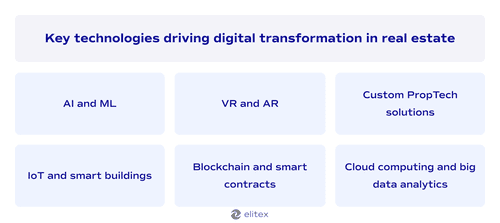
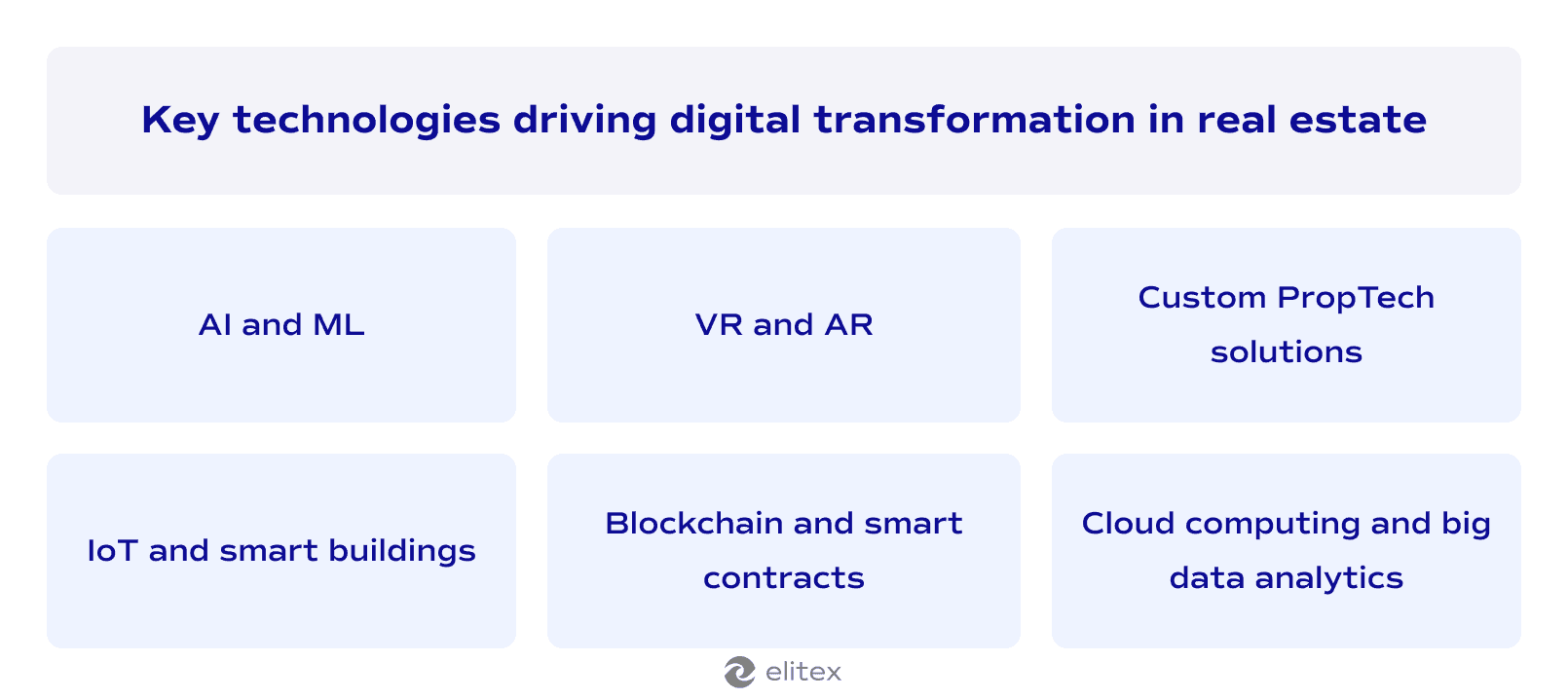
Artificial intelligence and machine learning
AI changes almost every sphere of the real estate business.
According to PwC's global AI study, AI could contribute up to $15.7 trillion to the global economy by 2030, representing a 14% increase in global GDP. And the real estate industry definitely won’t stay aside from this growth. For instance, in 2026, machine learning algorithms process vast amounts of historical transaction data to predict property values more accurately than traditional appraisal methods. What makes AI/ML powerful is how the technology learns from each new sale. It continuously refines its understanding of what drives prices in specific markets.
Beyond valuations, AI-powered chatbots already handle initial customer inquiries around the clock. You can check it by simply visiting the sites of big real estate agencies, like Zillow or Redfin, both of which have integrated AI assistants to guide potential buyers through their journey. This shift allows agents to focus their energy on qualified leads instead of answering the same basic questions repeatedly. As a result, customer experience improves dramatically because responses arrive instantly rather than after business hours. Buyers get the information they need when they need it. Agents spend their time where it actually matters.
But AI goes even beyond this. Here are some additional examples of the implementation of AI for real estate:
- AI powers property recommendations that match buyers with suitable listings based on their search behavior.
- AI automates marketing campaigns that reach the right audience at the right time.
- Lead generation becomes more efficient when AI scores prospects based on their likelihood to convert.
- Market forecasting helps investors identify opportunities before they become obvious to competitors.
- Document processing speeds up transactions by extracting key information from contracts automatically.
Virtual reality and augmented reality
VR and AR technology eliminates geographic barriers by letting buyers tour properties without travelling.
Virtual reality creates immersive 3D environments where potential buyers walk through homes from their couches. Augmented reality takes this further by overlaying digital information onto physical spaces through smartphone cameras. So buyers can see how their furniture fits in the room before making purchase decisions. First, the pandemic accelerated the adoption of these tools, but they have continued to grow recently because VR/AR fundamentally enhance experience through convenience and accessibility. When combined, these two digital technologies save significant time for both clients and real estate companies. VR/AR helps agents show property only to genuinely interested prospects. Everyone’s time gets maximized, which increases the likelihood of successful transactions.
Custom PropTech platforms
PropTech solutions centralize real estate operations by bringing multiple functions into unified digital platforms.
Proptech platforms are the backbone of modern real estate digital transformation. These specialized systems handle property listings, tenant management, transaction processing, lead tracking, document storage, communication logs, payment processing, marketing, analytics, and most of what a real estate company actually needs in one place. These software solutions are tailored to property workflows. They are typically built by top real estate tech companies that understand the industry’s unique challenges.
The shift towards custom solutions continues accelerating. Firms recognize that off-the-shelf products can’t match their specific operational needs. That’s where custom real estate app development becomes essential. As a result of the collaboration between the custom development company and the real estate agency, software engineers study how agents actually work before writing a single line of code. This research informs every feature decision. So, when the platform launches, it integrates existing software into the workflow seamlessly.
Such an investment makes sense for growing firms. Custom development requires higher upfront costs than purchasing ready-made solutions. The cost to develop a real estate app varies based on feature complexity and integration requirements, starting from $50,000. However, the return on investment also becomes clear quickly. Tailored functionality improves efficiency across every transaction. Agents close deals faster. Administrative overhead decreases. The technology scales with the business instead of constraining it.
Internet of Things and smart buildings
IoT devices turn properties into intelligent spaces that monitor themselves and optimize energy usage automatically.
IoT technology represents a fundamental shift in property management. Smart sensors track environmental conditions continuously throughout the properties. Central systems collect this data and look for patterns in how people actually use the space. For instance, when the system detects that a conference room sits empty every afternoon, it reduces heating and cooling during these hours. This responsive approach means energy consumption drops while comfort levels stay exactly where tenants expect them. The building learns from real usage patterns instead of following rigid schedules that waste resources. Property managers gain unprecedented visibility into building performance, which transforms maintenance from reactive to proactive. Sensors detect potential problems before they escalate into expensive repairs. This early warning system prevents tenant complaints while extending equipment lifespan.
Additionally, these IoT systems support data-driven decisions about capital improvements. Detailed performance metrics reveal which building systems consume the most resources, so property owners can prioritize upgrades based on actual data rather than estimates. Digital technology proves its value through measurable cost reductions. As a result, operating expenses decrease while property values increase. Smart buildings deliver better customer experience through responsive environments that adapt to needs automatically.
Blockchain and smart contracts
Blockchain technology creates tamper-proof transaction records and automates contract execution without intermediaries.
Smart contracts execute automatically when predetermined conditions are met, so property transfers happen faster. The blockchain stores ownership records in a distributed ledger that no single party can alter. This transparency reduces fraud risk and speeds up title searches that traditionally took weeks. While blockchain adoption in real estate remains limited compared to other technologies, early adopters see significant time savings in cross-border transactions where the digital technology eliminates many manual verification steps.
Cloud computing and big data analytics
Cloud-based systems give real estate firms access to powerful computing resources and massive datasets without expensive infrastructure.
Cloud platforms store all property information and transaction histories in centralized locations accessible from anywhere. The technology scales automatically as firms grow. With cloud platforms, companies avoid the expense of building their own server infrastructure. Cloud technologies, in turn, enable wider usage of big data tools. Big data analytics tools process information from multiple sources. They reveal patterns that would take humans months to identify. With the power of big data, real estate firms spot emerging opportunities before competitors notice the same trends. This transforms the decision-making process from reactive to proactive. Investment timing improves because choices rest on actual market signals rather than intuition. The cloud also enables real-time collaboration across teams. Geographic distance becomes irrelevant when everyone accesses the same information simultaneously. Teams coordinate faster because they work from a single source of truth. This shared visibility accelerates the decision-making process throughout the organization.
Challenges of implementing digital transformation in real estate companies and how to mitigate them
| Challenge | How to mitigate |
| High initial investment costs | Start with pilot projects in one department before expanding organization-wide. Focus first on areas where automation delivers immediate cost savings, such as document processing or lead management. This approach demonstrates ROI with concrete numbers, making it easier to secure budget approvals for broader implementation. |
| Employee resistance to new technology | Involve staff in the selection process from the beginning. When agents help choose the tools they’ll use daily, adoption rates increase because they feel ownership over the decision. |
| Data security and privacy concerns | Choose cloud providers that comply with industry standards and offer encryption. Conduct regular security audits and establish clear data governance policies. Train all staff on security best practices because human errors are the main reason for most data breaches. |
| Inadequate training and support | Create ongoing training that goes beyond one-time sessions. Appoint internal champions who understand both the technology and real estate operations. Build a knowledge base with answers to common questions and schedule regular check-ins during the first three months after launch. |
| Difficulty measuring ROI | Establish baseline metrics before implementation begins. Track specific KPIs like time spent on administrative tasks, days from listing to closing, and lead conversion rates. Compare these numbers quarterly against your baseline to quantify impact in concrete terms. |
| Managing organizational change | Communicate the reasons behind the transformation consistently. Be transparent about how technology will change roles and emphasize that automation handles tedious work so staff can focus on activities requiring human judgment. |
| Vendor lock-in risks | Prioritize platforms that offer data export capabilities and open APIs. Review contracts for terms that make it difficult to switch providers later. Build solutions on technologies with large developer communities rather than proprietary systems. |
Real-world examples of real estate digital transformation
CBRE: AI-powered property management and virtual reality tours
The challenge: Managing vast global property portfolios across different markets with varying compliance requirements created massive operational bottlenecks.
Why digital transformation: CBRE needed scalable solutions to provide effective service to international clients without physical property visits.
CBRE, one of the world’s largest commercial real estate firms with $32 billion in annual revenue, built an AI-driven facilities management system that now operates across 1 billion square feet of property. The company deployed VR/AR tours that let international investors explore spaces remotely, eliminating the wasted viewings mentioned earlier in our discussion of property marketing. CBRE’s Smart FM platform uses monitoring IoT sensors to automate maintenance tasks and optimize energy usage automatically, mirroring the smart building technology we covered in the IoT section. The firm also developed proprietary data analytics tools that process over 39 billion data points from 300 global sources to predict market trends and property performance. This digital transformation in the real estate industry generated $7 million in efficiency gains through robotic process automation alone, proving that the investment pays off quickly when done right.
Keller Williams: Building proprietary AI platform
The challenge: The franchise depended entirely on third-party technology providers who built solutions outside the company's walls, creating vendor lock-in risks.
Why digital transformation: Keller Williams recognized that controlling their technology roadmap was crucial for maintaining a competitive advantage as a tech-driven company.
Keller Williams, one of the world’s largest real estate franchises by agent count, with over 170,000 agents, invested $177 million starting in 2015 to build the Keller Cloud platform from scratch. The company created Kelle, an AI-powered assistant that helps agents manage deals, track referrals, and monitor career progress in real time. The platform integrates with partners like Google and DocuSign while maintaining full data ownership, avoiding the vendor lock-in problems we identified earlier. By 2019, Command (their main platform) reached 100,000 active users who added 40 million client contacts, while Kelle attracted 85,000 active users. The transformation changed how agents handle the document workflows and CRM systems, allowing them to customize every aspect of their business operations through a single unified interface.
How to start a digital transformation journey in real estate?
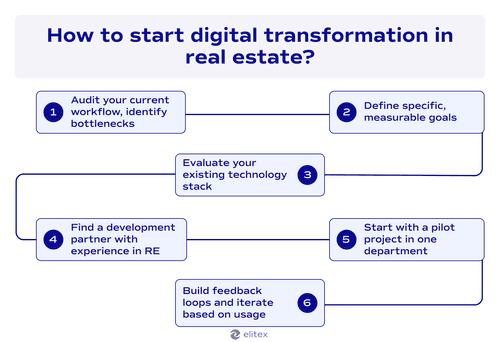
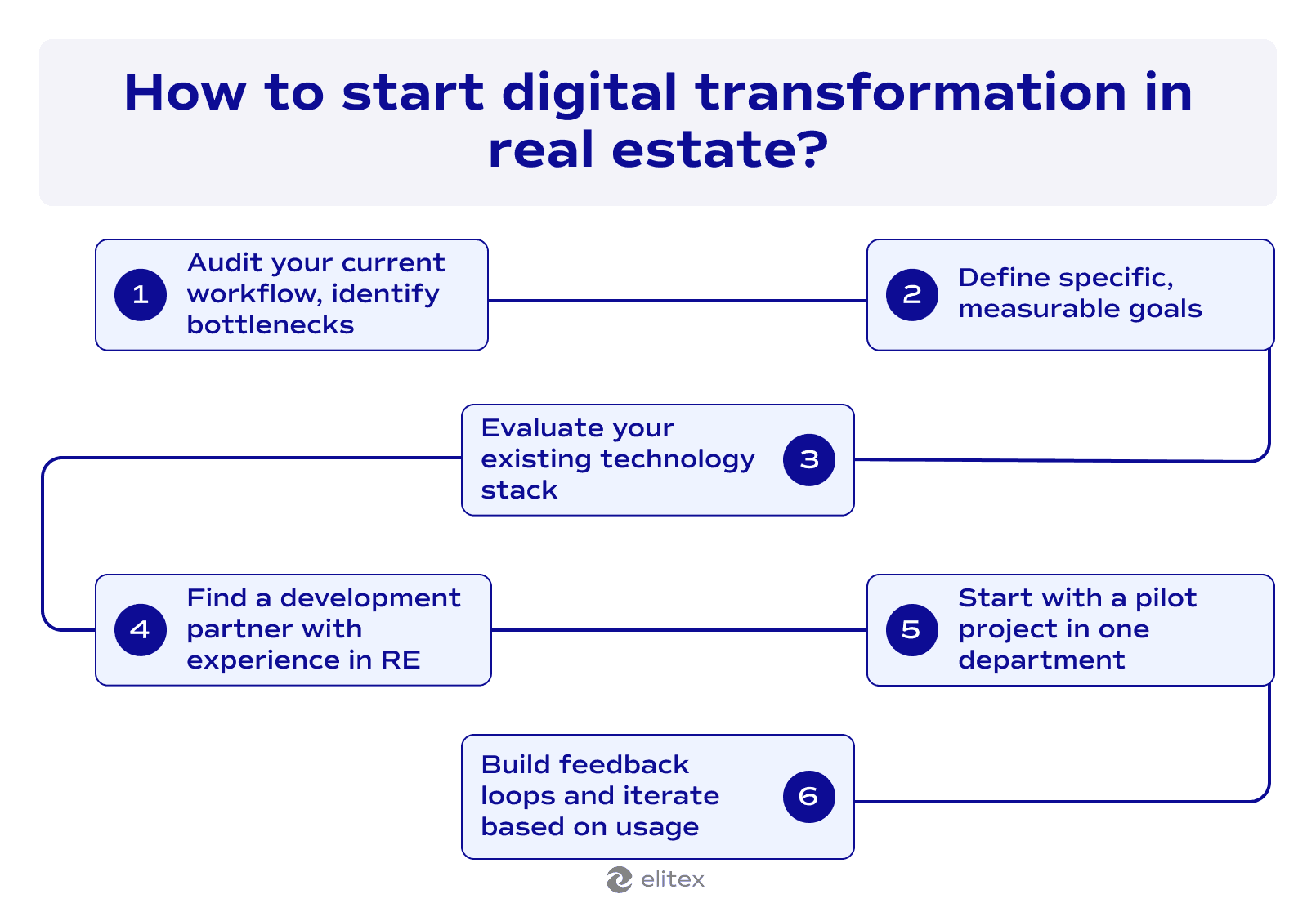
Step 1: Audit your current workflows and identify bottlenecks
Start by mapping exactly where your team loses time each day. Track how long it takes to move a property from listing to closing, then identify which manual tasks create the longest delays. Most firms discover that document handling and data entry between disconnected systems eat up more hours than they realized.
Step 2: Define specific, measurable goals
Choose one or two pain points that cost your business the most money or time. Set concrete targets like reducing transaction processing time by 30% or cutting administrative overhead by $50,000 annually.
Step 3: Evaluate your existing technology stack
List every platform your team currently uses and determine which one must stay. As we discussed earlier, 61% of real estate firms still run on legacy systems that can’t simply disappear overnight, so integration often makes more sense than replacement.
Step 4: Find a development partner who understands real estate operations
Your development partner should know how your agents actually work before proposing solutions. Look for firms that ask detailed questions about your specific workflows rather than pitching pre-built products immediately. A good partner will invest time in understanding your business model, existing systems, and team capabilities before writing any code.
Step 5: Start with a pilot project in one department
Choose a single team or process for your first implementation. This approach lets you demonstrate ROI with concrete numbers before requesting a budget for broader changes, just as we recommended in the challenges section above.
Step 6: Build feedback loops and iterate based on actual usage
Launch your first solution, then track how your team actually uses it daily. Schedule weekly check-ins during the first month to catch problems early and adjust features based on real behavior rather than assumptions.
How do ELITEX help real estate companies go digital?
As a custom software development company with a decade of experience in real estate technology, ELITEX build PropTech platforms, transaction management systems, CRM integrations, and other bespoke solutions that handle everything from lead generation to closing. We offer flexibility in how we work with you: either building a dedicated development team for your project or reinforcing your existing in-house team with specialized expertise. This approach lets you choose the collaboration model that fit your business best.
ELITEX also offer legacy software modernization services that solve the exact problem facing most real estate firms today. We know how to connect your existing platforms without forcing you to abandon familiar tools that still work, or build entirely new solutions when replacement makes more sense. Either way, our decade-long tech experience means we anticipate problems before they escalate and recommend solutions based on what actually works, not what sounds impressive. We maintain transparency about timelines, costs, and technical challenges throughout the project, so you always know exactly where things stand. Choosing ELITEX means choosing a tech partner that delivers results beyond initial expectations.
FAQs
What is digital transformation in real estate?
Digital transformation in real estate is the process of replacing manual workflows with integrated technology systems that handle everything from lead management to transaction completion, allowing information to flow automatically between previously disconnected platforms.
What are the main benefits of digital transformation in the real estate sector?
Digital transformation in real estate automates repetitive tasks, connects scattered platforms into unified systems, and enables firms to scale transaction volume without proportional staff increases, turning growth into profitability rather than just additional expenses.
How much does custom real estate app development cost?
Custom real estate app development starts from $50,000, with final costs varying based on feature complexity and integration requirements.
Why do real estate firms struggle with digital transformation in commercial real estate?
Most firms struggle with high initial investment costs, employee resistance to new technology, difficulty measuring ROI, and the challenge of managing organizational change while maintaining daily operations.
Where does digital transformation in real estate deliver the most value?
Digital transformation in real estate delivers the most value in property marketing through virtual tours, transaction management through document automation, customer relationship management through integrated platforms, and portfolio management through real-time unified dashboards.
POSTED IN: