



- TL;DR: This guide explains how to build custom CRM software for real estate agencies. Here’s what we’ll learn:
- What makes real estate CRM different from generic customer management platforms
- Essential features that specialized CRMs need to handle property transactions
- How custom development compares to off-the-shelf solutions like Propertybase and Follow Up Boss
- The development process from discovery to launch
- Detailed development costs (typically starting at $70,000 per basic system)
- Best practices that prevent common CRM implementation failures
Digital transformation in real estate unfolds at breakneck speed. While real estate agencies rush en masse to adopt virtual tours and automated listing systems, many overlook the technology that could transform the very core of their business: client relationships. What separates thriving brokerages from struggling ones? Often, it’s specialized software that manages the complete client journey. CRMs specifically designed for the real estate industry capture crucial touch points from first inquiry through closing and beyond, turning fragmented client data into actionable intelligence.
Custom real estate software development services providers like ELITEX create solutions that mirror how successful agents actually work. By studying agent workflows and client interactions, software engineers design real estate CRM software development projects that eliminate the common frustration of forcing unique business practices into rigid generic platforms. These tailored systems adapt to existing workflows rather than disrupting them, centralizing communications and tracking activities that drive deals forward. Unlike mass-market alternatives, custom CRMs transform relationship management from an administrative burden into a strategic advantage, exactly why forward-thinking brokerages increasingly view them as essential infrastructure rather than optional technology.
What is a real estate CRM?
Real estate CRM systems are software solutions that track client relationships throughout the property buying cycle. Just like in any other economic domain, real estate CRMs centralize contact information, property preferences, and interaction history in one accessible platform. These tools also automate follow-ups and organize leads by purchase readiness, helping agents understand their clients better and prioritize their time based on this info.
But what differentiates CRM software for real estate from generic industry-neutral CRMs? Let’s examine the key features that distinguish them from generic solutions.
Key features of a real estate CRM
First of all, any real estate CRM is a CRM. It should work as a customer relationship management system. A complete solution should include:
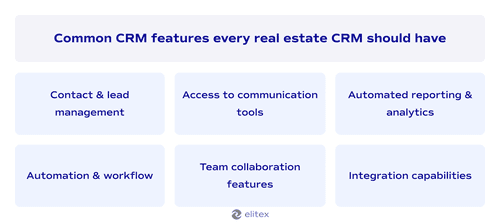
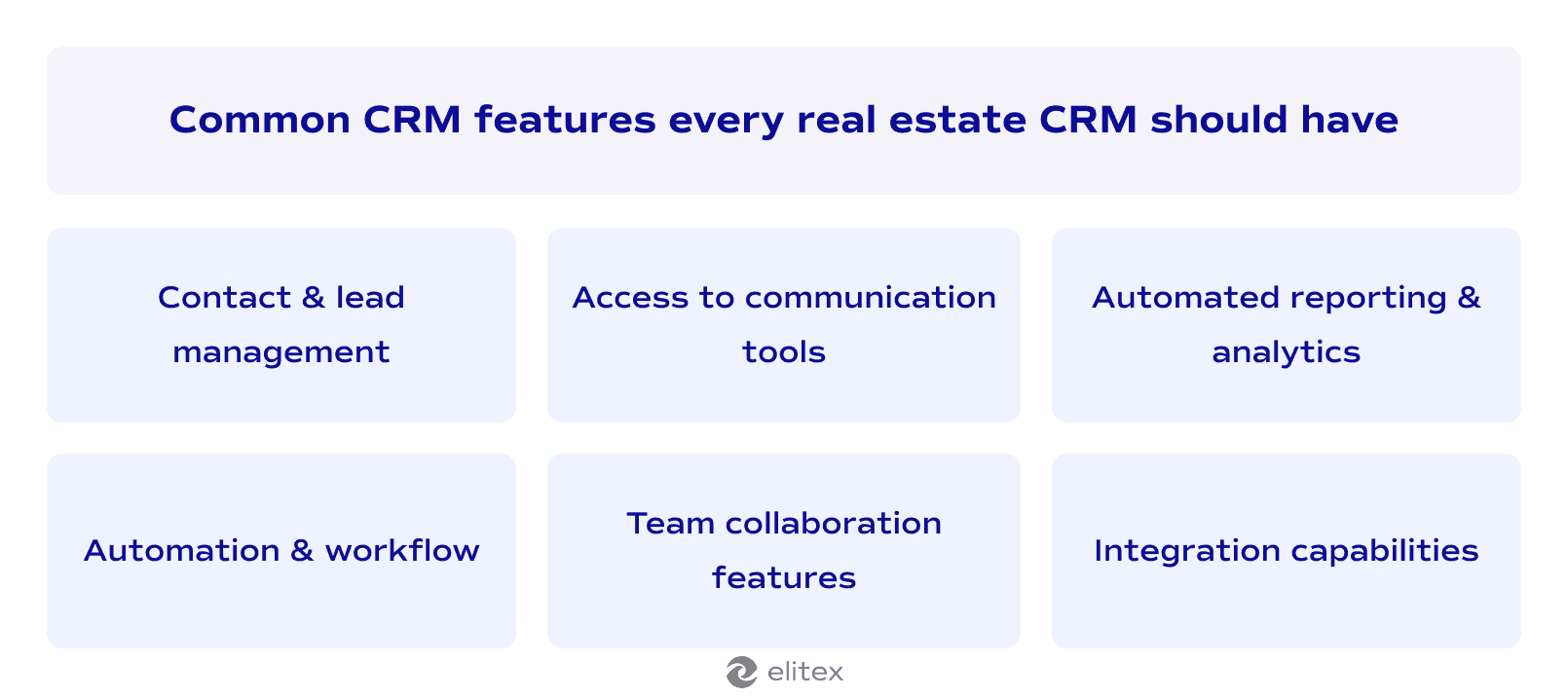
Contact & lead management
CRMs build detailed client profiles that evolve with each interaction between the client and a representative of the company. That’s why the system should be able to capture preferences and track the complete relationship history. It allows agents to know who’s ready to buy and who needs more time.
Automation & workflow
Repetitive tasks drain agent productivity across the entire sales cycle. Modern CRMs identify these patterns and eliminate the manual work. That's how automation frees agents to focus on relationship building instead of administrative overhead. The system also provides visual pipelines that show where deals stand and what actions move them forward.
Communication tools
Every client conversation builds on previous exchanges. That's why CRMs integrate with communication platforms to keep this history intact across all channels. When email systems sync automatically, agents can reference past discussions at any moment. Mobile access extends this capability beyond the office, so context follows agents to property showings and client meetings wherever they happen.
Team collaboration
Multiple agents often work the same deals or pass clients between team members. The CRM coordinates these handoffs inside the platform, which eliminates the chaos of email chains and verbal updates. This coordination starts when new prospects arrive and need assignment to the right agent based on territory or expertise. Beyond that initial routing, the system shows what each team member is doing with their clients. This visibility prevents the embarrassing scenario where two agents unknowingly contact the same person.
Reporting & analytics
Gut feelings about what works don't scale a real estate business. Automated reporting transforms raw activity data into meaningful conversion metrics. The system calculates actual acquisition costs and reveals which marketing channels produce qualified leads. In modern CRMs, these insights expose patterns that manual tracking simply can't capture at scale.
Integration capabilities
Real estate professionals juggle multiple tools for scheduling, document signing, and market data. The CRM needs to connect with these systems rather than exist as another isolated platform. Calendar sync prevents double-booking disasters across the team while keeping everyone's schedule visible in one place. Document storage builds on this centralization by pulling contracts and inspection reports into the same hub. These connections transform how agents work by putting everything they need in one location instead of forcing them to switch between disconnected tools.
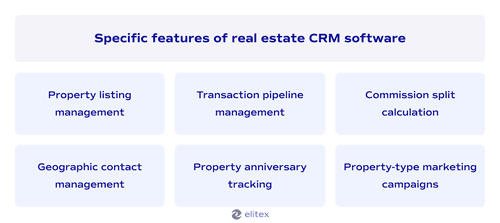
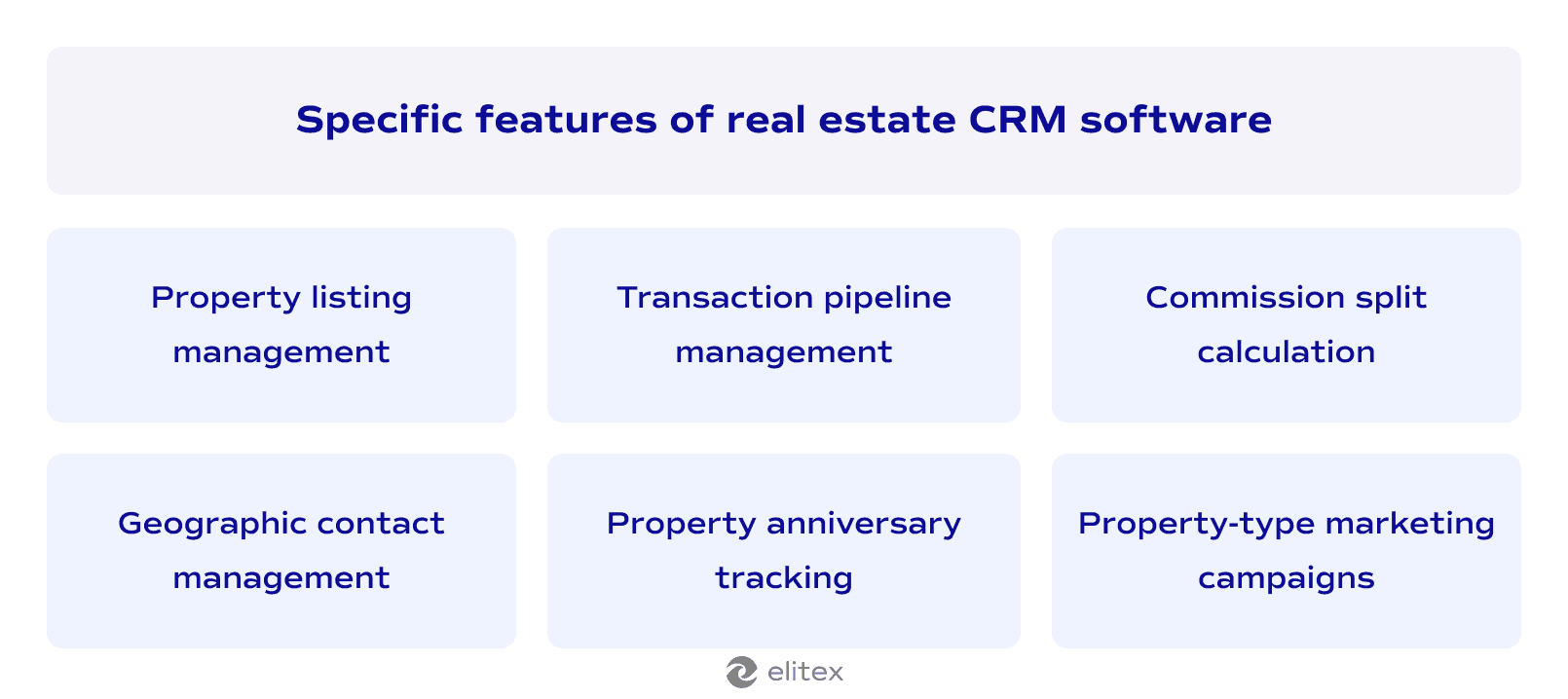
However, real estate CRM software also offers specialized features that generic platforms lack. These systems streamline the unique workflows real estate professionals face daily.
Property listing management
In specialized CRMs for real estate, MLS listings flow directly into client profiles. Agents see property matches instantly when new homes that fit buyer criteria hit the market. Such digital matchmaking, turning hours of manual searching into automated opportunity alerts for both real estate agents and potential customers, is a nice complement to any real estate CRM.
Transaction pipeline management
Property deals follow unique stages for each point of the real estate sales funnel that is unknown in other industries. Each transaction juggles inspection contingencies, mortgage approvals, title searches, and disclosure requirements simultaneously, and it’s a more complicated process compared to most other industries. With a good CRM, real estate businesses should be able to customize these pipelines to reflect this complexity with both local regulations and specificity that vary by market.
Here’s how customizable features may looks in practice:
- critical deadline alerts preventing costly contract voids when paperwork deadlines approach;
- document collection triggering automatically at each milestone of the real estate sales funnel;
- client updates flowing through customized communication channels as deals progress,
- property-specific details, like HOA restrictions, flood zone requirements, zoning classifications, and transfer tax obligations, get tracked in specialized fields that generic customer relationship management systems lack.
Commission split calculation
The money train in real estate splits in complex directions. Brokers, team leads, referring agents, and transaction coordinators all claim pieces of each completed sale. The best real estate CRM software should be able to calculate these divisions instantly based on tiered structures and production levels, offering a solution that reflects the complex nature of real estate operations.
Geographic contact management
A good CRM software for real estate often offers location-based client organization. With it, real estate professionals receive instant property alerts matching specific buyer criteria within school zones, tax districts, flood plains, and neighborhood boundaries without any manual efforts. Also, geographic intelligence may help understand your customers better. For instance, customers’ viewing patterns may unmask where serious buyers truly want to live versus where they claim interest. CRMs with geographic contact management transform average real estate agents into sought-after neighborhood specialists with block-by-block market knowledge.
Property anniversary tracking
Effective client retention hinges on timing follow-ups to property milestones. Good real estate CRM examples flag equity-building opportunities and refinance windows based on purchase dates and market shifts. These calculated touchpoints generate both repeat business and fresh referrals when past clients connect reliable real estate agents with neighbors considering real estate transactions.
Property-type marketing campaigns
First-time buyers need fundamentally different guidance than seasoned investors. A specialized real estate CRM should be able to adapt content delivery based on property goals rather than generic sales messaging. Market analysis is tailored differently for condo hunters versus luxury estate shoppers, so an ability to tailor marketing content to specific customer segments is essential for any effective real estate CRM.
Besides all these highly specific features, real estate CRMs should also work well just as CRM. A complete solution needs to be able to:
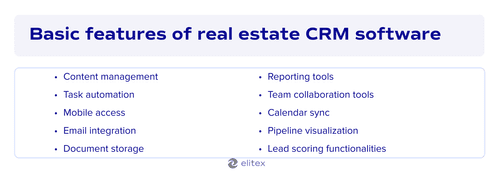
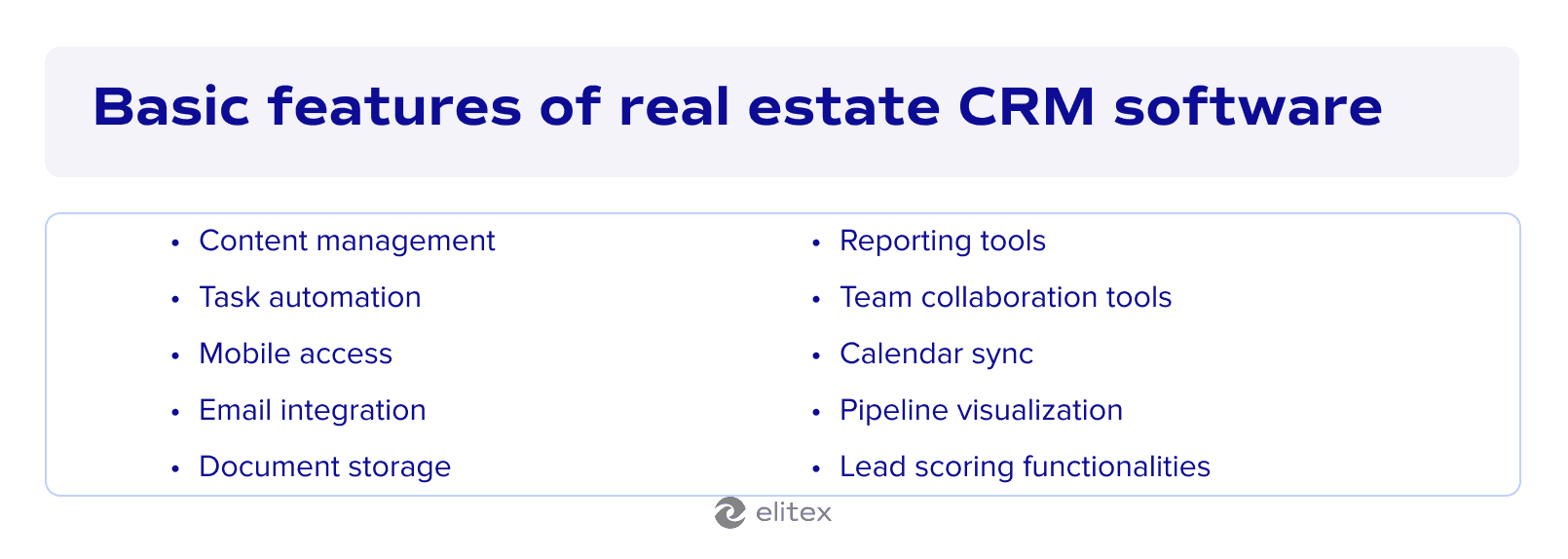
- Contact management: Store comprehensive client details including family members, preferences, and transaction history;
- Task automation: Schedule follow-ups, showings, and client meetings with automated reminders;
- Email integration: Sync with email accounts to track all client communications in one place;
- Mobile access: Allow agents to update records and access information from property showings;
- Document storage: Maintain digital copies of contracts, disclosures, and inspection reports;
- Reporting tools: Generate metrics on lead conversion, sales volume, client acquisition costs, and marketing ROI;
- Team collaboration: Enable real estate agents to coordinate on shared listings, transfer leads, etc;
- Calendar sync: Integrate with scheduling tools to manage appointments, block showing times, coordinate team events, and track market activities;
- Pipeline visualization: Track deals through stages with probability forecasting, revenue projections, and bottleneck identification;
- Lead scoring: Prioritize prospects based on engagement level, purchase readiness, budget alignment, and communication frequency.
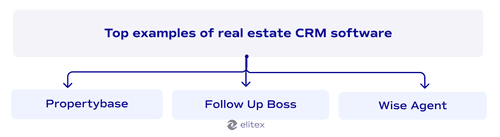
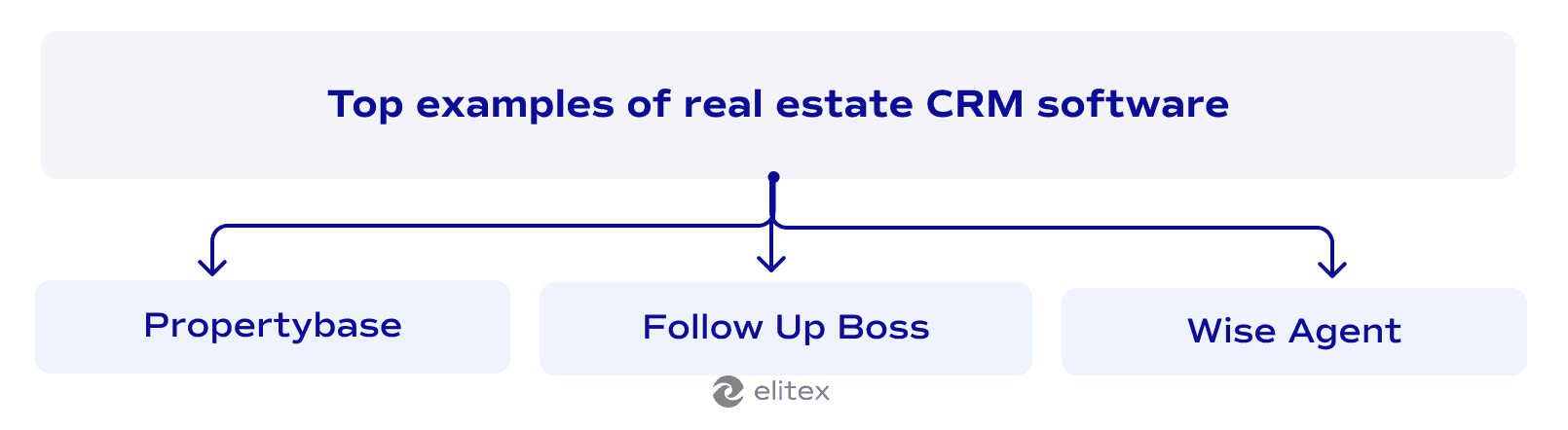
Top 3 real estate CRM examples in 2026
Propertybase
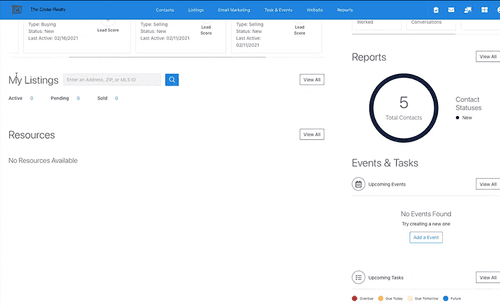
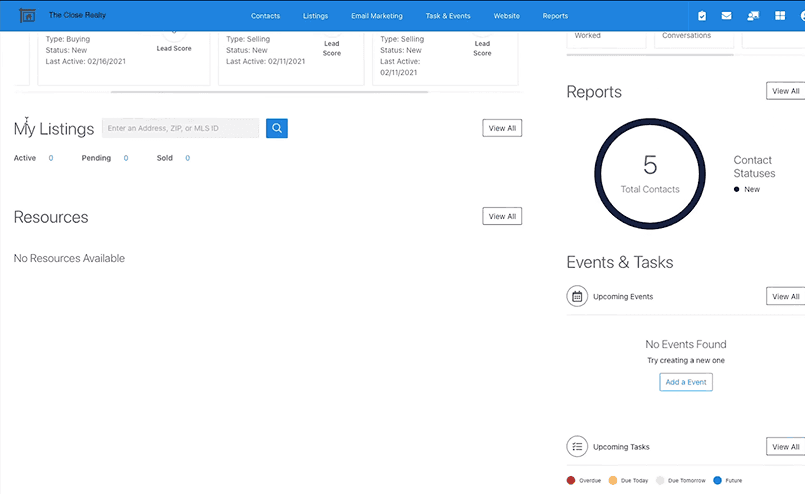
Propertybase empowers real estate companies with a comprehensive Salesforce-based CRM platform built for high-volume business operations. The system automates repetitive tasks through intelligent workflows while managing the entire client base from lead capture through closing. Its IDX website automatically funnels prospects into customized pipelines based on property interests and engagement levels. Despite higher pricing and a steeper learning curve, Propertybase delivers exceptional reporting capabilities that give brokerages actionable intelligence on team performance, market trends, and revenue forecasting across multiple locations.
Follow Up Boss
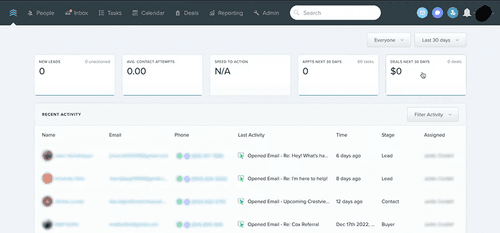
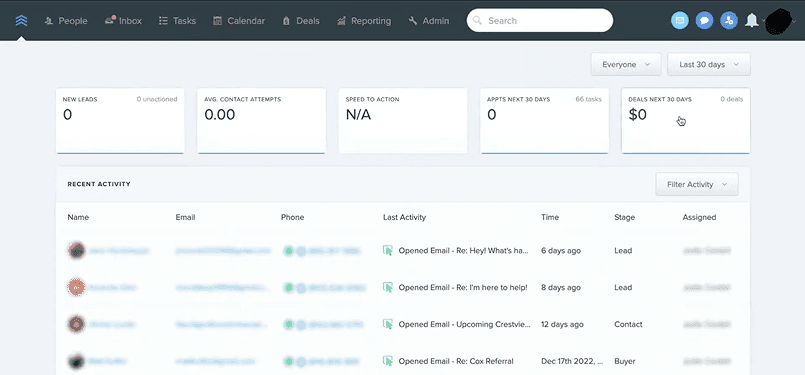
Follow Up Boss conquers the efficiency gap plaguing real estate agencies with lightning-fast lead management that eliminates as many routine tasks as possible. The platform’s mobile-first approach delivers instant notifications, prospect assignments, and follow-up tracking from anywhere agents work. Its intelligent lead routing automatically distributes potential clients based on agent performance metrics, response times, and geographic territories—creating accountability across the teams. While lacking the robust transaction management of competitors, Follow Up Boss excels throughout the early sales cycle stages where most deals are won or lost. The system’s streamlined interface, rapid syncing, and focus on speed-to-lead conversion make it ideal for high-volume agencies where response time matters more than overcomplicated customization.
Wise Agent
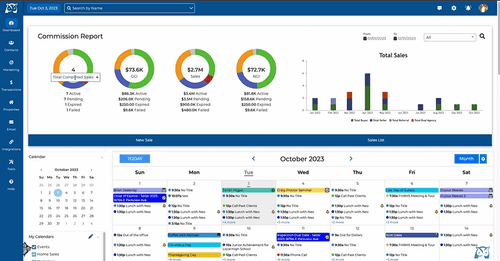
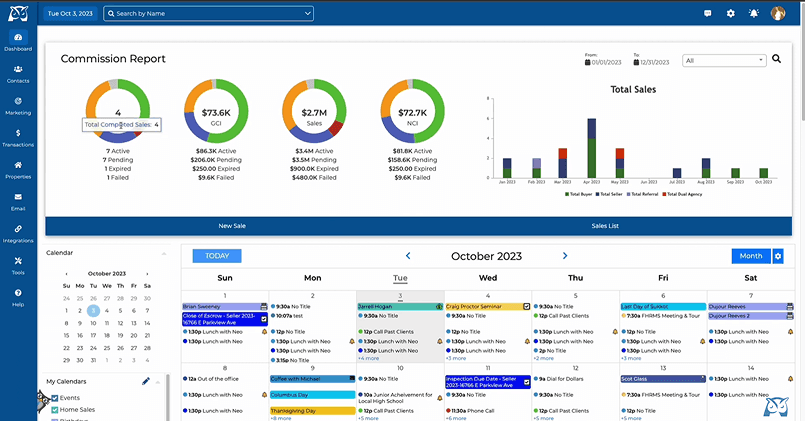
Wise Agent delivers versatile functionality for small and mid-sized real estate business through an all-in-one centralized platform that balances affordability with key features required for successful deal closures. The system streamlines the complete sales process from lead capture to closing deals with customizable transaction checklists that adapt to local requirements. While its user interface lacks the polish of premium alternatives, the platform compensates with practical tools, white-label landing pages, drip campaigns, and comprehensive calendar management, that directly support business growth without overwhelming complexity. Despite limited reporting capabilities, Wise Agent’s combination of unlimited contacts, document storage, and 24/7 support makes it ideal for teams seeking comprehensive functionality without enterprise-level investment or steep learning curves.
Why develop a custom real estate CRM?
But if there are so many available alternatives for the real estate sector, why is custom real estate CRM software development worth it?
While platforms like Propertybase or Wise Agent offer advanced features, they rarely align perfectly with the unique workflows of the specific real estate business. The main advantage of custom software development is that it mirrors your existing processes rather than forcing agents to adapt, dramatically improving adoption rates and maintaining your competitive edge in today’s overcrowded market.
The real estate business operates differently across various markets, with local regulations and practices that off-the-shelf solutions often can’t accommodate. Custom real estate CRMs integrate seamlessly with regional MLS platforms and specialized commission structures. Additional features can be implemented based on actual returns rather than paying for bundled functionality your team may never use.
Also, workflow automation in custom CRMs targets your agency’s specific bottlenecks rather than generic inefficiencies. By analyzing where your agents actually spend time, developers create precision software tools that eliminate redundancies and mundane tasks while strengthening customer relationships. Unlike packaged solutions that prioritize universality, custom development focuses on practical efficiencies that directly impact your closing rates and client satisfaction.
Step-by-step real estate CRM software development process
Although each agency's needs and, therefore, development process differ, there is still a common ground in most projects. Previously, we have written a full real estate software development guide, which outlines the average development lifecycle in detail, so don’t hesitate to check it.
Here’s a brief overview of the six main development stages:
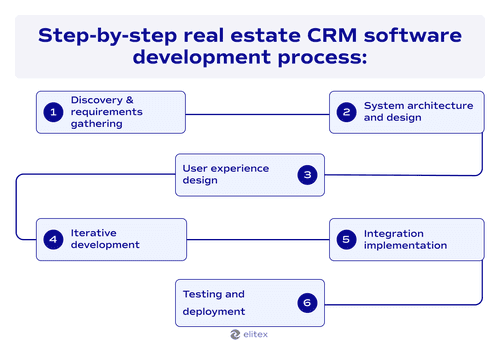
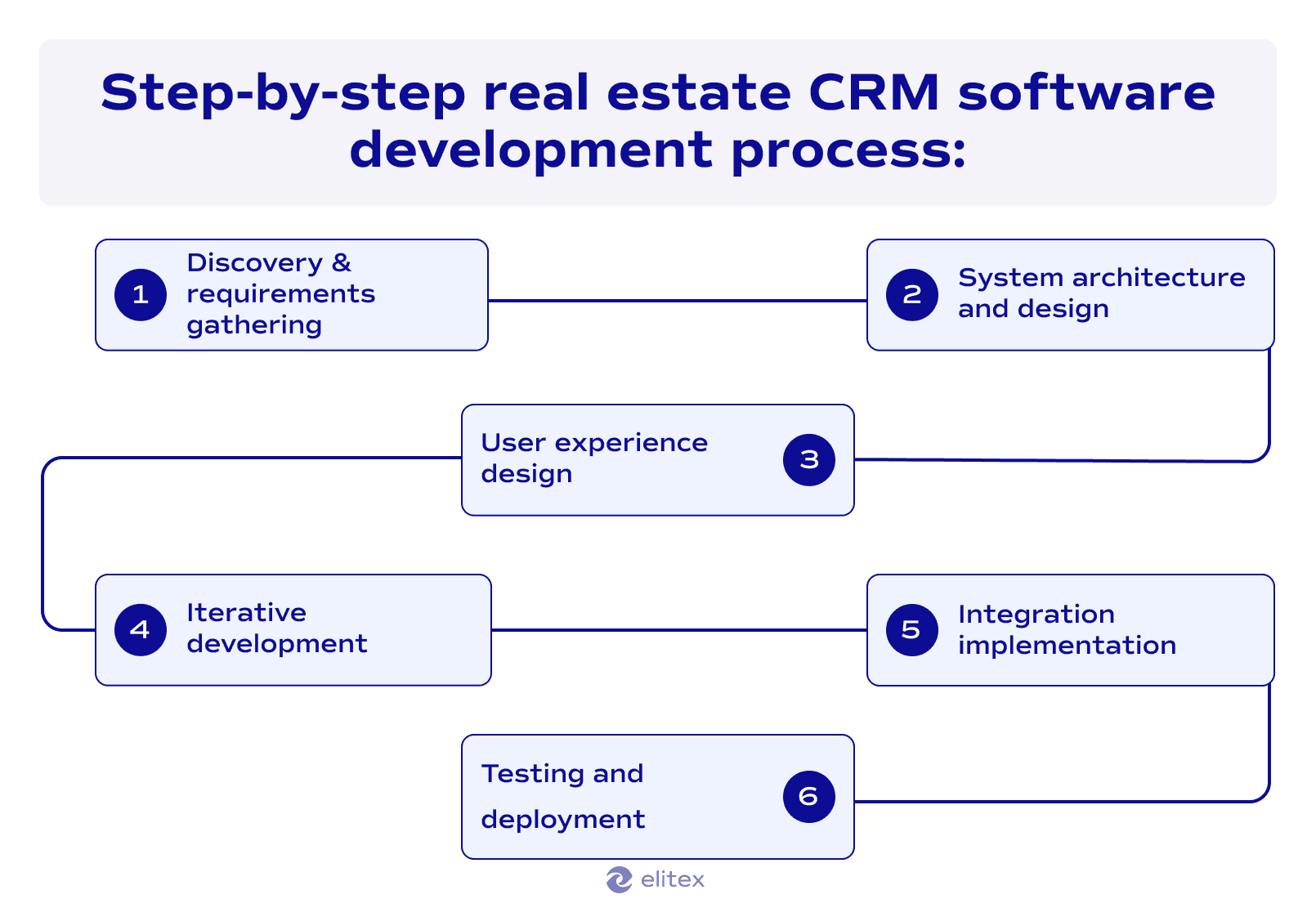
Discovery & requirement gathering
Mapping of existing processes through agent interviews and workflow analysis. Documenting pain points and market-specific requirements that generic solutions miss, enabling informed decisions throughout development.
System architecture design
Creating a technical blueprint detailing database structure and integration points. This foundation must accommodate a wide range of interactions while supporting future scalability as your brokerage grows.
User experience design
Developing wireframes focused on agent efficiency rather than unnecessary complexity. The interface should prioritize quick access to critical information and minimize clicks for common tasks.
Iterative development
Building the system through short development cycles that deliver testable features every few weeks. This approach allows stakeholders to provide feedback on real estate CRM software development as it progresses rather than waiting until completion.
Integration implementation
Connecting your CRM with essential third-party services including MLS databases and document systems. Third-party connections transform the platform into a complete hub supporting the entire customer lifecycle, rather than remaining an isolated tool that creates additional work for agents.
We have a dedicted article about legacy software integration with modern real estate software solution. Don't hesitate to check it!
Testing & development
Conducting thorough testing with actual agency data and real-world scenarios. At this stage, you should begin to train staff gradually while gathering feedback before the full launch. It ensures smooth adoption and successful launch.
Cost of developing real estate CRM
Real estate CRM development costs typically start at $70,000 for a minimum viable product, as detailed in our real estate app development costs article. This entry point covers essential features like contact management, property listing integration, and basic workflow automation delivered over a 4-5 month development cycle.
The average cost increases significantly when adding advanced functionality such as AI-powered recommendations, custom financial tools, or advanced automations/integrations. For comprehensive solutions with complete feature sets, expect investment in the six-figure range, particularly when including third-party integrations and specialized security implementations.
Best practices for real estate CRM development
Workflow flexibility
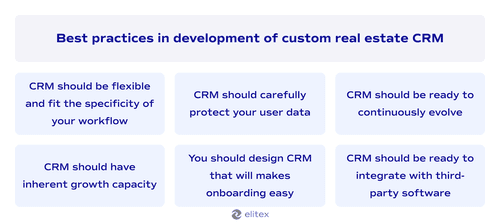
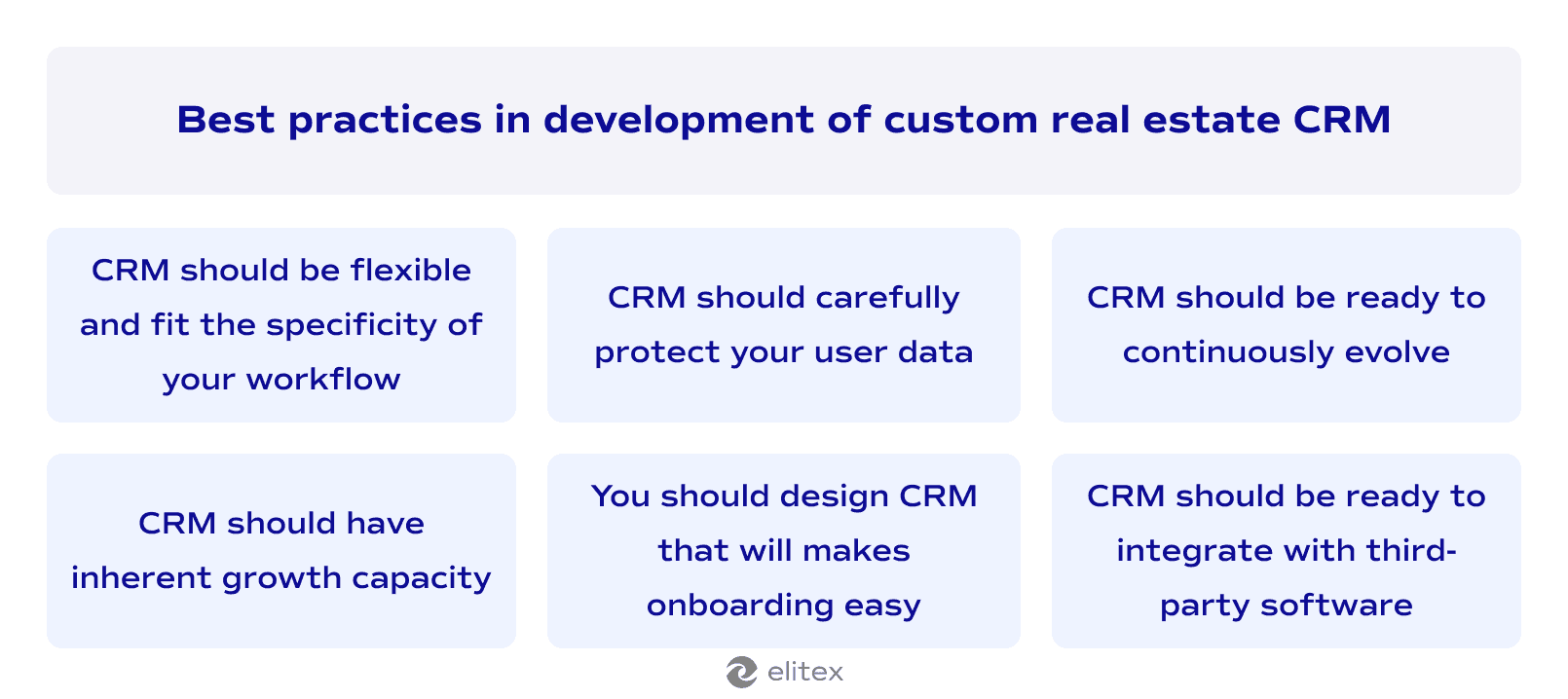
Real estate agencies operate differently based on market conditions and team structure. The CRM needs to adapt to these existing processes rather than forcing agents into rigid workflows. This flexibility means the system bends to match how your team actually operates, whether that’s your lead categorization approach or your deal progression stages. When the software fits your business naturally, adoption happens without resistance.
Growth capacity
A CRM that works for five agents might collapse under fifty. The system architecture needs to handle expansions without performance degradation as your brokerage grows. This means building infrastructure that scales alongside increasing business demands rather than hitting artificial limits. Planning for growth from day one prevents the expensive migration projects that happen when companies outgrow their software.
Data protection
Real estate transactions involve sensitive financial information and personal details that require serious protection. The CRM must secure data through encryption and verify user identities through multi-factor authentication. Regular security audits catch vulnerabilities before they turn into breaches. This protection matters because a single data leak can destroy client trust and expose your agency to legal liability.
Agent onboarding
Even the best CRM fails if agents don't use it properly. Comprehensive training programs teach teams how features connect to their daily work rather than just explaining buttons and menus. Ongoing support addresses questions as they arise during real usage. This investment in education determines whether your CRM becomes a productivity tool or expensive shelfware.
Continuous evolution
Market conditions shift and new technologies emerge faster than any initial development cycle can anticipate. The CRM needs regular updates that add capabilities based on actual agent feedback and industry changes. This iterative approach keeps the platform relevant as your business evolves. Software that stops improving becomes a limitation rather than an advantage.
Integration readiness
Real estate professionals rely on external systems for MLS data, document signing, marketing, and accounting. The CRM should connect with these services through modern APIs rather than requiring manual data entry. This integration architecture turns the platform into a central nervous system for your operations. When information flows automatically between tools, agents spend time serving clients instead of copying data around.
Why choose ELITEX as your custom real estate software development partner?
Among thousands of real estate tech companies, finding a reliable development partner can be challenging. ELITEX stand out with over a decade of experience specifically in the property sector, delivering solutions from streamlined CRMs to comprehensive property management systems. Our proven track record includes developing a complete hotel management SaaS platform that unifies property operations, booking, and distribution channels, and many more.
ELITEX offer transparent communication with direct developer access, eliminating intermediaries that slow progress. Our team consists of 90% senior and mid-level engineers who understand both technical requirements and real estate business processes. We maintain the same core development team throughout your project, ensuring accumulated knowledge translates to faster iterations and cost-efficient development with every feature tailored to your specific operational needs. With ELITEX, your competitive edge is just one decision away.
FAQs
What is real estate CRM software?
Real estate CRM software is a specialized custom relationship management software system that tracks client relationships throughout a complex lifecycle of property transactions. This software centralizes contact information, property preferences, and communication history while automating certain routine tasks, such as follow-ups, streamlining the overall sales process.
Why does a real estate business need specialized real estate CRMs?
Generic CRMs lack features for property listing integration, transaction pipelines, commission splits, and other options specific to the real estate sector. Specialized CRMs for real estate support location-based client organization and property-specific marketing that directly impacts closing rates.
How long does the development of a CRM for real estate take?
A very basic system (for instance, MVP) typically requires 3-4 months, while more complex solutions with advanced features may take 6-12 months of intense development and long maintenance and enhancement cycles.
Is it better to build custom or use off-the-shelf real estate CRM?
Custom development mirrors your specific workflows and integrates with local MLS systems. Off-the-shelf solutions are, of course, cheaper and faster to implement, but force adaptation to standardized processes. So, the final solution depends on your budget.
POSTED IN: