



The web evolves rapidly, and web development, a mainstay of the modern Internet, keeps up. This is especially true for front-end development, which directly shapes the online user experiences we see on the Internet today. New tools and techniques emerge constantly, transforming how skilled front-end development service providers craft websites and applications. As user expectations soar, the industry adapts, introducing new fresh approaches to both visual design and functionality. These trends in front-end development expand the limits of web browsers. They push web tech into uncharted territory, opening up fresh possibilities for online experiences. And today, we’re going to take a closer look at them. So, without further ado, let’s go!
Brief overview of front-end development in 2026
Front-end web development in 2026 is experiencing a seismic shift driven by the rapid integration of AI tools into the development workflow and innovative approaches to front-end frameworks (we’ll revisit the frameworks a bit later). The market is buzzing with new technologies that promise to speed up UI creation, which is the most important part of the work of any front-end developer in 2026. Now, with the latest front-end trends, developers are able to build complex user interfaces in a fraction of the time it took just a year ago.
Despite the latest advancements in AI and popular frameworks, the industry faces a balancing act. While tools like shadcn UI and AI-assisting coding platforms offer unprecedented productivity gains, they also raise questions about code quality and the long-term impact on developer skills. The front-end community is divided on new AI technologies. Some embrace them, while others warn against overreliance. This split sparks debate about the overall future of front-end development. At the same time, developers from both sides of the discussion are rethinking their roles and the skills they’ll need to stay competitive.
The importance of staying updated with trends
New trends in front-end development are akin to the latest fashion—they come and go but some stick around to reshape the entire industry. However, in contrast to fashion, keeping tabs on the development trends isn’t just about chasing the new shiny things. It’s more about understanding the evolution of the web and future user expectations. In this vein, understanding front-end trends is useful not only for the developers themselves but for virtually anyone curious about the current state of the web:
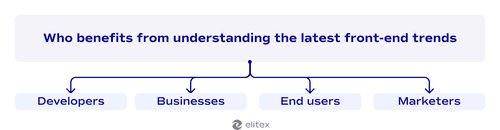
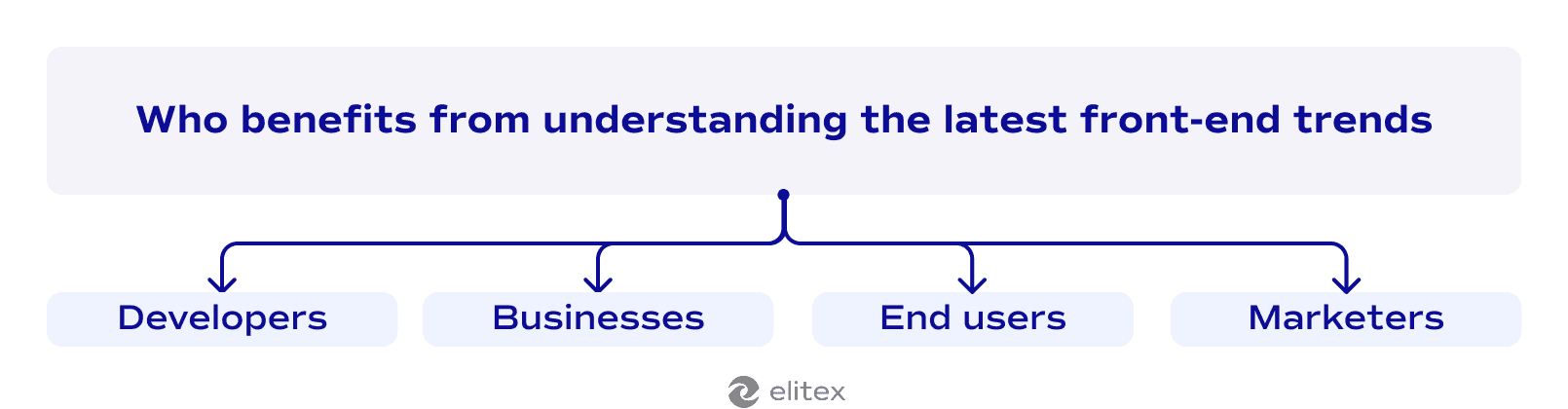
For developers:
Knowing trends helps developers stay relevant and adjust their skills according to the current state of the industry. It allows them to pick the best innovative tools for their projects and can open doors to exciting job opportunities.
For business owners:
Understanding trends helps business owners make smart choices about their digital products. It lets them meet user expectations and stay ahead of competitors in the digital space.
For end users:
Trend awareness helps users understand what’s possible online and what they should expect to see. This allows them to make better use of new features and have more engaging and satisfying digital experiences.
For digital marketers:
Knowing the latest front-end development trends helps digital marketers build more effective online campaigns that achieve better user engagement and conversion rates.
10 latest front-end development trends to follow in 2026
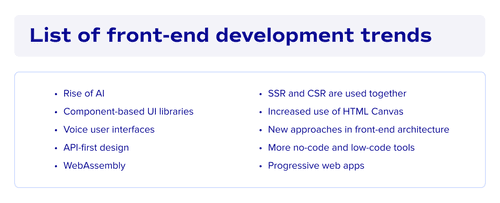
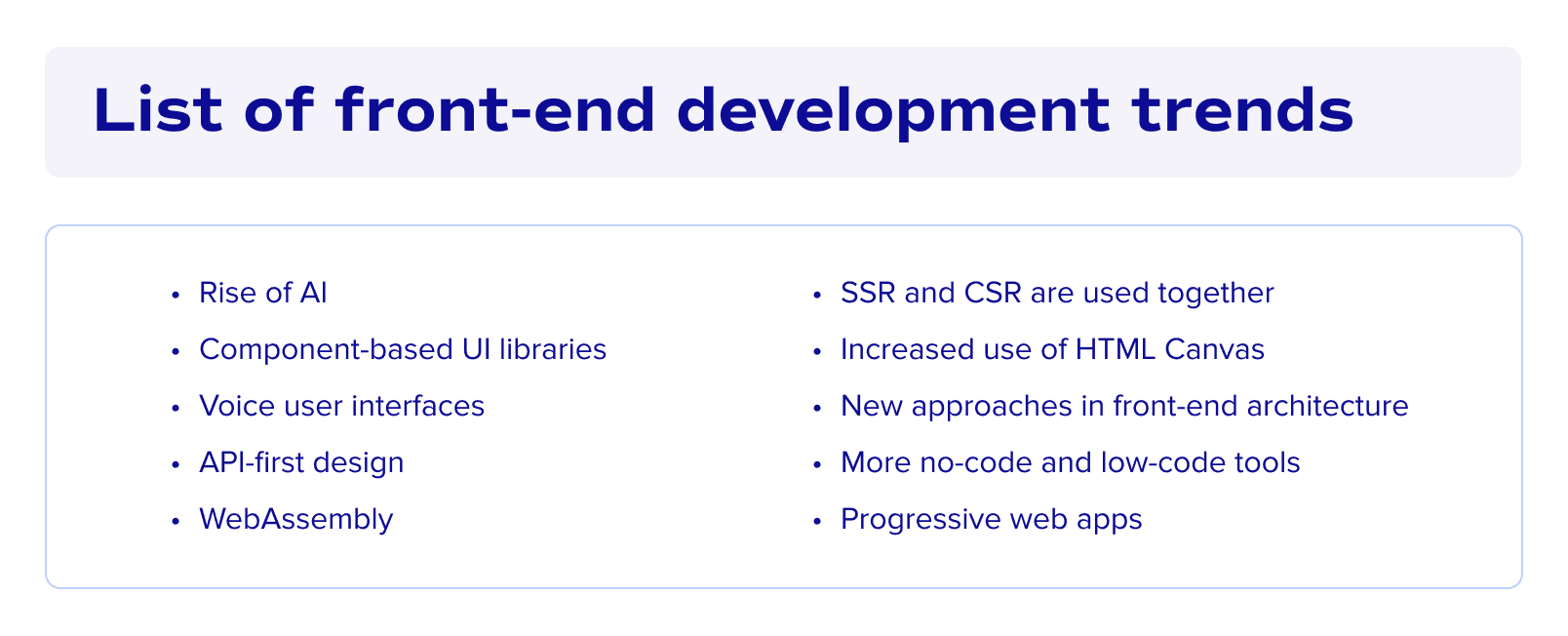
Rise of AI in front-end development
Much has been said about the role of AI in front-end development. In general, artificial intelligence is changing every aspect of how developers write code. These smart assistants suggest code snippets and complete lines as you type. AI tools learn from vast codebases to offer intelligent help in popular code editors and development environments. With AI, front-end developers can focus more on the application logic and less on syntax and routine bug fixing. But this trend has sparked controversy. Some worry that relying too much on AI-generated code might weaken coding skills over time. Despite these concerns, AI coding assistants are becoming a common sight in development teams worldwide.
Component-based UI libraries
A new wave of UI libraries also changes the way development teams build interfaces. Tools like shadcn UI introduce a fresh approach to component management. Instead of importing entire libraries, developers copy individual components into their projects. This method allows for easier customization and lighter code. These libraries often work with popular tools like Tailwind and Radix, and, in some sense, they provide a balance between consistency and flexibility. The rise of component-based UI libraries makes writing front-end code faster and more adaptable.
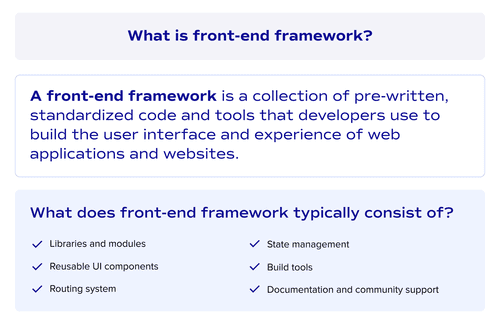
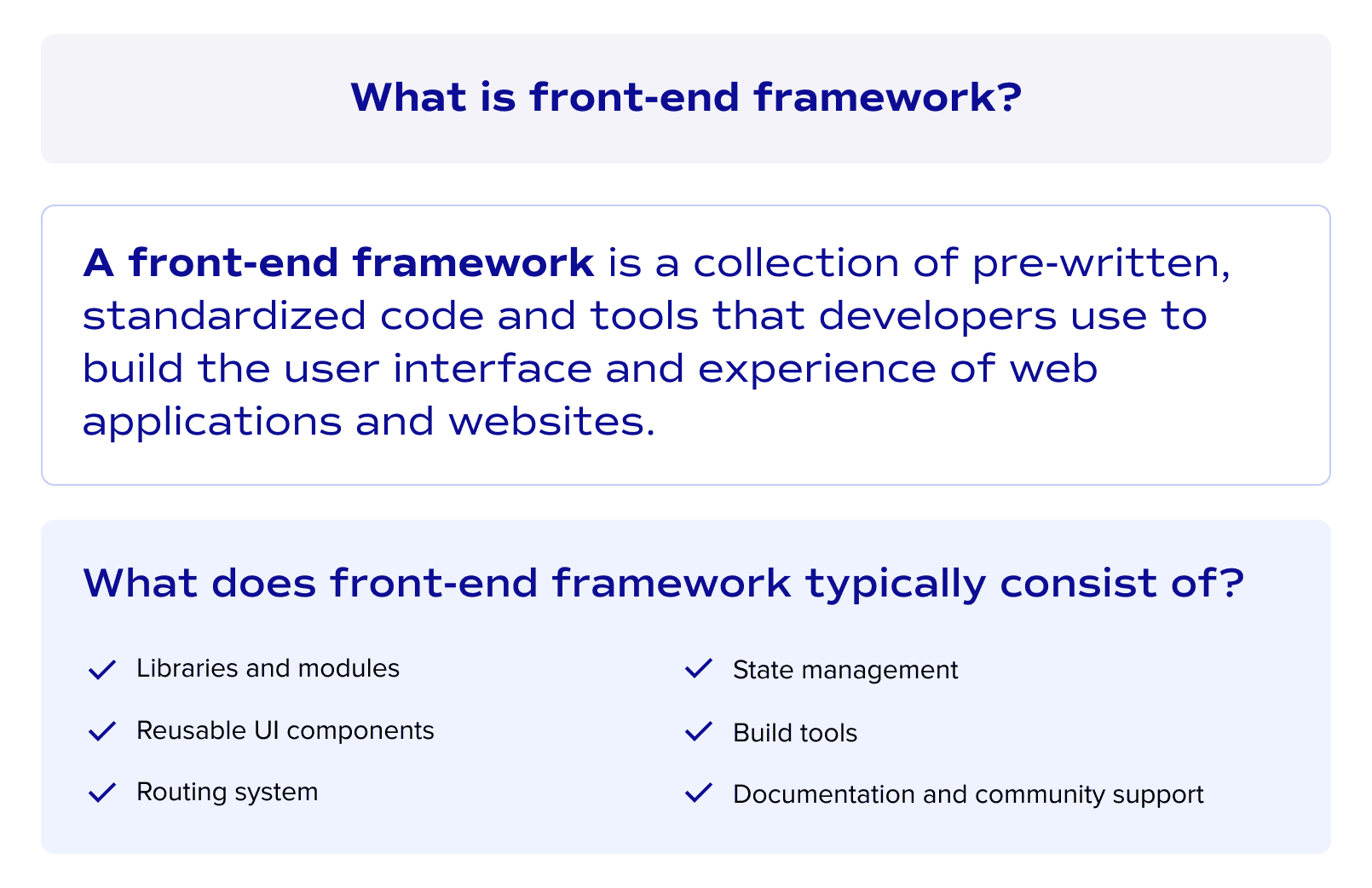
When it comes to traditional ‘big JavaScript frameworks’, such as React, Angular, Vue.js, Svelte, etc, it seems like the differences between them will soon be not that important from the developers’ perspective. Developers will probably care less about syntax differences and more about how quickly they can generate UI components. Given current trends, it wouldn’t be surprising to eventually see prompt-based UI frameworks.
Voice user interfaces
Voice UIs are becoming more common in modern front-end web development. They allow hands-free interactions with websites and complex web applications. This trend is part of a broader concept of a more accessible web, and it’s just an aspect that evolves especially quickly. But why do we write about this evolution now? The answer is quite simple. The rapid development in voice UIs is driven by advances in speech recognition. Voice UIs often complement traditional interfaces, opening new ways to interact with web content for users who benefit from it.
API-first design
The API-first design approach prioritizes creating APIs before building the front end. It allows developers to decouple the front end from the back end. This approach improves collaboration between teams working on different parts of the project as well as simplifies connecting the front end with the back end. It makes the overall development process more flexible, allowing for faster changes. Many companies are adopting API-first design to streamline the development workflows.
WebAssembly
WebAssembly runs high-performance code in browsers bypassing some performance limitations of JavaScript. This technology allows programming languages like C++ to run on the web. This opens up new possibilities for web applications. Games and complex visualization benefit greatly from WebAssembly. WebAssembly works alongside JavaScript. It makes the web a more powerful platform for creating virtually anything.
SSR and CSR are used together now
Modern web development often blends server-side rendering and client-side rendering for optimal performance. This hybrid approach loads initial content quickly with server-side rendering (SSR) and then uses client-side rendering (CSR) for dynamic updates. Combining both offers faster page loads and better search engine visibility from SSR, plus the smooth interactions of CSR. Professional developers can serve static content rapidly while allowing real-time updates for interactive elements. This method works well for content-heavy sites that also need user interactivity. Frameworks like Next.js make it easier to implement this dual strategy in React applications. By combining SSR and CSR, developers create web apps that are both fast-loading and highly responsive. This balanced technique addresses the diverse needs of today’s web users and search engines.
HTML Canvas
The HTML <canvas> element is one of the front-end trends gaining traction recently. It allows creators to draw graphics and animations directly in web browsers. With Canvas, professional developers can craft intricate visualizations and interactive experiences previously unseen on the web. This tool opens up new possibilities for data representation, game development, and artistic expression online. However, Canvas content poses challenges for search engine optimization. Search engines struggle to interpret the graphical information within Canvas elements, potentially impacting a site’s visibility in search results. So, development teams must weigh the visual benefits against potential SEO drawbacks when deciding whether to use Canvas in their projects.
New architectural approaches
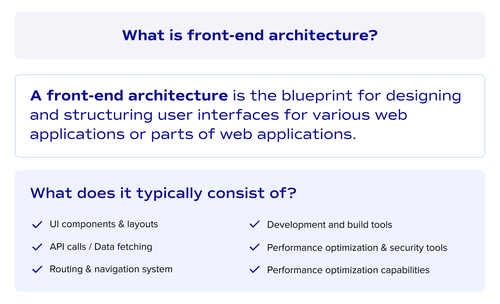
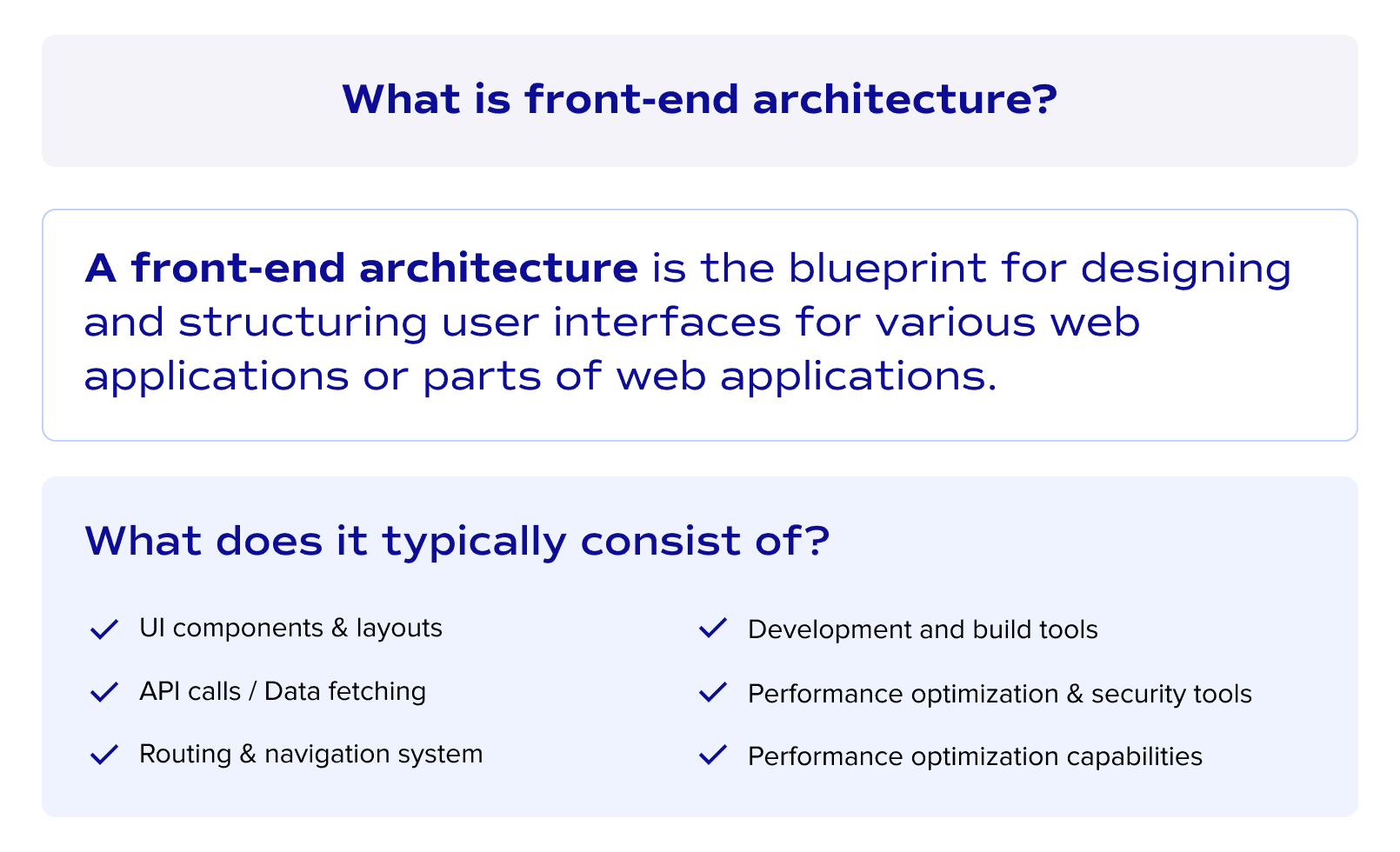
New front-end architecture approaches are changing how developers build websites and web apps. For instance, the front-end in headless CMS systems separates content from display, giving more flexibility in developing web applications. Micro frontends break large apps into smaller pieces that teams can work on separately. Serverless setups allow developers to focus on writing programs, not managing servers. These methods offer fresh ways to create and run web projects. They can speed up work and reduce costs. But they also bring new challenges in testing and integrating components.
More no-code and low-code development
No-code solutions allow non-developers to build web apps that look great and work perfectly. Low-code platforms are sets of tools that speed up the development process for professionals. Both types of platforms are becoming more powerful and flexible, changing the role of traditional front-end developers. Some see them as a threat, others as a complement. However, the truth is that this trend makes front-end development more accessible.
Progressive web apps
Progressive web applications (PWAs) remain a key trend in web development. These apps blend the best features of websites and mobile applications. PWAs work offline and users can install them on their devices. They load quickly and run smoothly, much like native apps. PWAs use less data than traditional mobile applications, making them more efficient. Many companies now prefer PWAs over building separate native apps for each platform. This approach offers a consistent user experience and native performance across different devices. Despite being around for several years, PWAs show no signs of fading from front-end development trends. Their ability to provide app-like experiences through web browsers continues to attract developers and businesses alike.
Transformations in the front-end development industry
Now that we’ve covered the front-end development trends, let’s move to the industry in a broader sense. The front-end development industry has also seen major shifts in recent years. Companies now place more value on building a consistent user experience, leading to higher demand for skilled developers. This shift has resulted in a surge in specialized training programs and a growing emphasis on industry-specific knowledge.
Job roles in front-end development have become more specialized. Developers now often focus on specific areas like mobile optimization, accessibility, or particular frameworks. This specialization allows teams to tackle complex projects more effectively but also requires developers to continually update their skills to stay relevant in the job market.
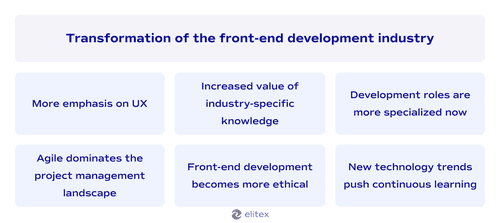
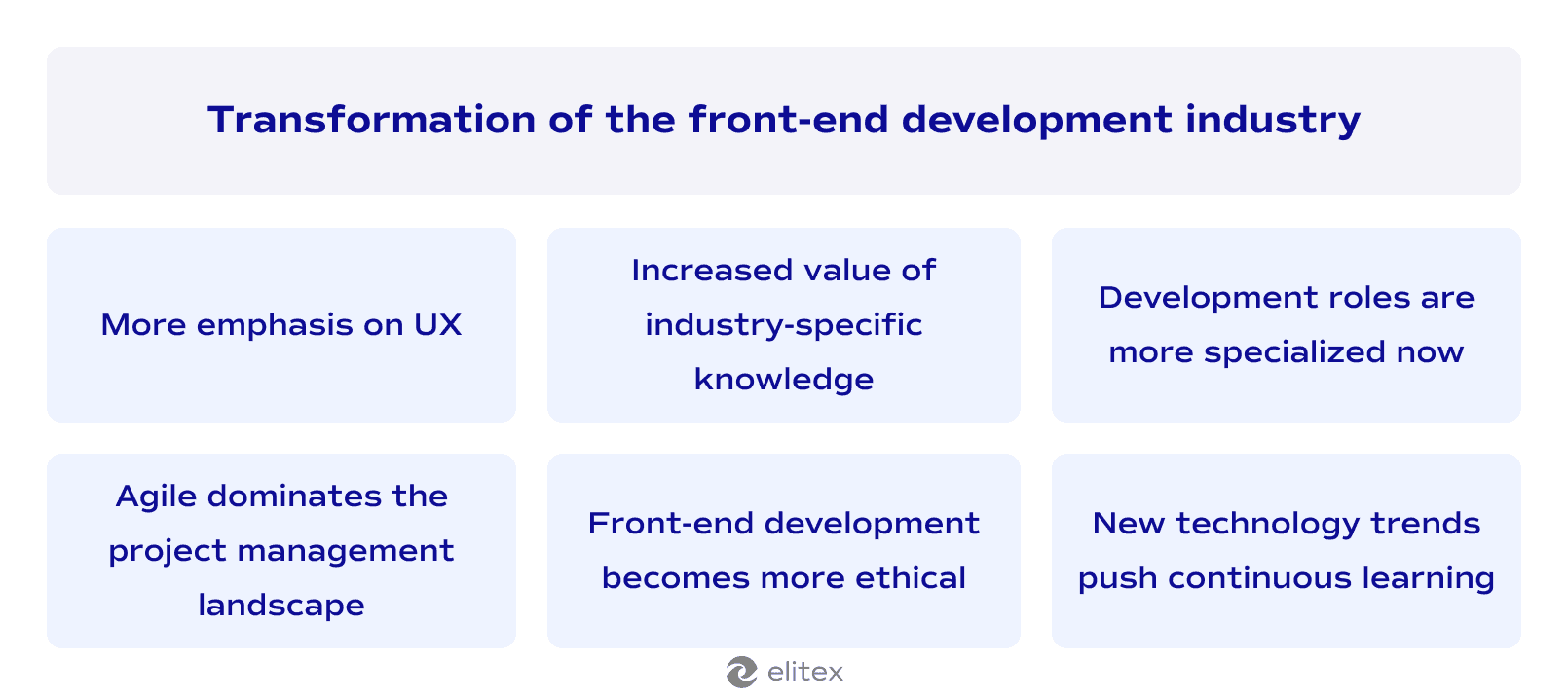
Key transformations in the industry:
- Both companies and clients now emphasize a seamless user experience. Good user experiences have become a top priority for businesses across sectors;
- Industry-specific knowledge is now valued alongside technical skills. For development companies, this means they will aim to find their industry-specific niche;
- The rise of specialized roles has changed team structures;
- Continuous learning has become essential to keep pace with industry changes;
- We can see more remote work virtually everywhere;
- Agile methodologies are now the dominant project management methodology;
- The gig economy has grown, offering more flexible work arrangements;
- Cross-functional collaboration between designers and developers has increased;
- We can also see that now, there are more performance metrics to evaluate front-end work;
- Ethical considerations, such as data privacy, have become more prominent in the development process.
The future path of front-end development
Predicting the future of front-end development is always a challenge. The field changes rapidly, with new tools, approaches, and techniques emerging every week. While trends like AI integrations and low-code platforms are gaining ground, their long-term impact remains unclear. However, the core principles of creating fast, accessible, and user-friendly websites will likely remain crucial. Developers who stay flexible and continue learning will be best positioned to adapt to whatever changes come next. The only certainty is that the landscape will keep evolving driven by user needs and technological progress.
Predicting the future of technology is always risky, and ELITEX don’t claim to have a crystal ball. While we can’t see the future, we offer something more tangible: our expertise in front-end development and a commitment to open communication. If you have any further questions about current front-end trends, need help choosing technologies, or enhance your in-house team’s skills, don’t hesitate to contact ELITEX. With ELITEX, your project will always succeed by not only meeting expectations but significantly exceeding them!
FAQs
What are the latest trends in front-end development?
The rise of AI-assisted development, new UI libraries, voice user interfaces, new approaches to front-end architectures (e.g., headless architecture, micro front-ends), no-code and low-code solutions, PWAs, voice UI, using HTML canvas, and simultaneous utilizing of SSR and CSR are the latest trends that shape front-end development landscape and developer experience in 2025.
What is the role of AI in front-end development in 2025?
AI helps developers write code faster by suggesting snippets and fixing bugs. AI tools also help automate repetitive coding tasks, allowing developers to focus on more complex problems. As of 2025, the situation looks like following: a front-end developer with AI is generally more efficient than a developer without AI.
How are no-code and low-code platforms affecting front-end development?
No-code platforms let non-developers build web apps, while low-code platforms help developers work faster. Both tools are changing the role of traditional front-end developers by democratizing building websites for virtually anyone.
What are the latest front-end framework trends?
The main popular frameworks are still React, Angular, Vue.js, and Svelte. However, with the new UI libraries, the importance of choosing the right framework slowly goes down, as the development process depends more and more on choosing the library with the right components.
What trends in front-end development should we expect in the near future?
In the near future, expect more AI-driven development tools, even wider adoption of PWAs, and more complicated cases of using server-side rendering. We’ll also see a focus on accessibility, modular frameworks, and tools that simplify complex state management and improve performance.
POSTED IN: