



A wisely chosen type of front-end architecture may predetermine the overall success of the web application. Micro front-end architecture (MFE) is an approach particularly suited for complex projects where scalability and flexibility are required. This approach is a practical solution that allows front-end developers to break large applications down into smaller pieces where different individual teams can collaborate without disrupting each other’s workflows. That sounds good, but how does it work in practice? What is the micro frontend approach, what’s behind it, and how can it be used in front-end development services? Let’s explore together!
What are micro front-ends?
A short disclaimer: We have previously covered the basics of front-end architecture and its types in a separate article as well as front-end development for headless CMS (as a type of architecture), so here, we will focus on MFE architecture. Make sure you check it, and let’s go:)
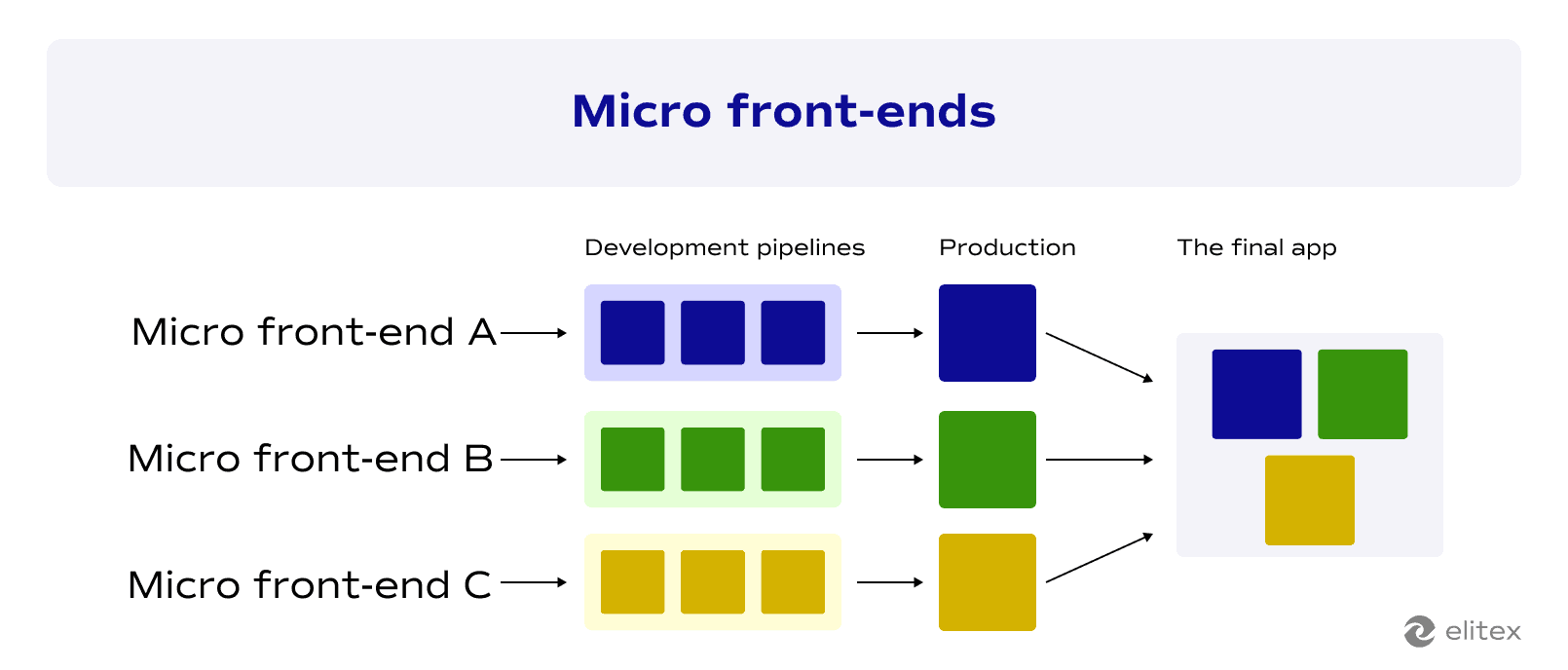
The concept of micro front-ends began to appear in the mid-2010s, offering a new way to build and structure web applications. As mentioned above, this approach involves splitting the front-end part of a web app into smaller, independent pieces. The initial idea is that each of them will be responsible for a specific part of the website functionality (or business functionality in certain cases).
A web application based on the micro front-end approach should be considered as a composition of components. Each component, or each micro front-end, can be developed, tested, and deployed independently from the rest of the application by separate teams (independent teams aren’t a must-have component, but they are often associated with MFE architecture). This architecture approach allows for the use of different frameworks and technologies within the same application, as independent teams can use their own way to build independent components.
In this way, micro front-ends enable a scalable and flexible approach to building large-scale applications. With MFE architecture, updates and changes can be made to individual components of the web application without affecting the whole. This method greatly reduces the complexity often encountered in monolithic front-end codebases, making it easier to manage and evolve over time.

Comparing micro front-ends to monolithic front-end architectures
Monolithic architectures are the most obvious architectures micro front-ends can be compared to. In some way, we are talking about the opposite approaches, which are suited to different needs and project complexities. Here’s what this comparison practically looks like:
| Aspect | Monolithic front-ends | Micro front-ends |
| Definition | A single codebase handles all the front-end functionalities of a web app | Composed of multiple smaller front-ends that operate semi-independently |
| Complexity | Lower initial complexity becomes complex as the application grows | Higher initial complexity due to multiple components but manages growth better |
| Tech stack | Typically uses a single technology stack for all aspects of development | Allows for diverse technology stacks per component |
| Deployment | The entire application deployed together | Independent deployment of individual components |
| Maintenance | Maintaining a large codebase can become cumbersome | Easier to maintain due to smaller, manageable codebases |
| Scalability | Scaling can be challenging as changes might affect the entire front-end | Easier to scale specific parts of the application without impacting others |
| Development speed | Faster in the early stages of software development and slows down as the application scales | Slower initially due to the setup of multiple components, but faster iteration once established (due to independent deployment of the components) |
| Team structure | Typically requires a centralized development team | Supports autonomous teams working on different parts of the front end |
| Use case | A common choice for the application with a straightforward deployment process | Can be overkill for building a simple website, typically used for complex web projects with complicated deployment process |
Previously, we have compared microservices vs. monolithic architecture for eCommerce applications. Here, you will find a more detailed comparison between the two architectural approaches.
Simplifying micro front-end decisions: When should you use them?
The use of micro front-end architecture benefits in several situations.
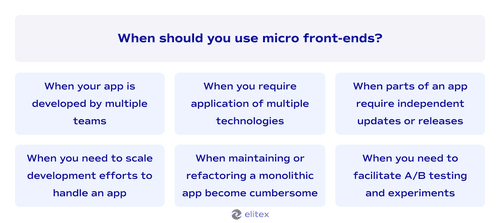

First of all, you should consider MFE when your application is developed by multiple teams. It’s quite a natural choice for this scenario because micro front-ends allow each team to work independently. Compared to, for instance, monolith architecture, MFE reduces coordination overhead and lets teams focus on their specific features without waiting for others.
Secondly, you should consider MFE when a single application requires the integration of various technologies and frameworks. Micro front-ends are ideal not only with separate teams but also with various technology stacks scenarios. With MFE, each component may use the best-suited tech solution for its functionality.
Similarly, as in the case of technologies, micro front-ends work well when parts of an application need independent updates or releases. By building complex web applications based on micro front-ends, developers can update or release individual components without affecting the entire application, allowing for more frequent and safer updates..
Consider choosing MFE architecture when maintaining or refactoring a large monolithic application becomes too cumbersome. Large monolithic frontends can be difficult to maintain and refactor due to their complexities and interdependencies. Micro front-ends are a way to make maintenance and refactoring more straightforward and less risky.
Choose micro front-ends when you need to facilitate A/B testing and experiments. With micro front-ends, you can easily deploy different versions of a component to test new features or designs.
Micro front-end architecture challenges and solutions
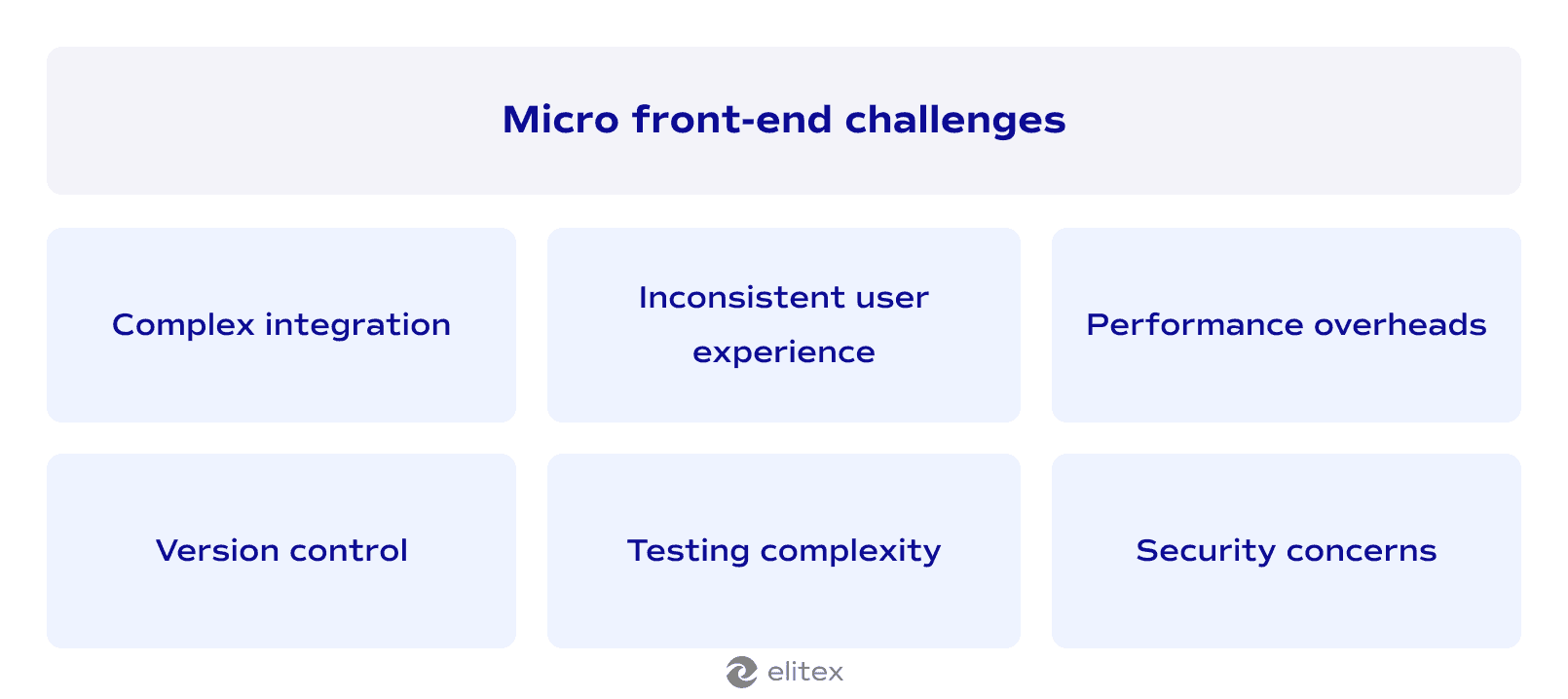
The micro frontend approach, while beneficial, also presents several associated challenges. Here’s a straightforward look at some of these challenges, along with practical solutions:

Complex integration
One of the main challenges associated with micro front-ends is the complexity of integrating multiple parts of the front-end that may have been developed independently. This complexity often arises when managing communication and dependencies between individual components. To handle this, it’s important to establish clear APIs and contracts that outline the way components should interact. You should use shared libraries sparingly and always combine them with comprehensive documentation to guide and make the integration of separate components easier.
Consistent user experience
Ensuring a consistent look and feel across different application parts can be difficult when each section might be built by an autonomous team using different technologies. To overcome this challenge, you should implement a consistent design system from the very beginning of the development process. This system would provide a set of common UI components and style guidelines, which every single team involved in the project can use to ensure uniformity across the user interface.
Performance overheads
Micro front-ends might lead to longer load times and higher resource use, as each segment might include duplicate code or rely on substantial frameworks. To mitigate this, teams should focus on optimizing how resources are loaded. Techniques like lazy loading specific parts of the application only when needed, sharing common dependencies, and choosing lightweight frameworks where appropriate can significantly improve performance.
Version control
Managing different versions of each micro front-end and ensuring they all work well together requires careful coordination. The best approach in this case is to set up strict version management practices and maintain backward compatibility as much as possible. This ensures that updates in one part of the front end do not break other parts.
Testing complexity
Testing a system composed of various micro front-ends can be complex due to the multiple interactions and dependencies involved. A thorough testing strategy that includes a mix of unit tests for individual components, integration tests for interactions, and end-to-end tests for the overall system is crucial. Each type of test ensures that both isolated functionality and the integrated application meet the required standards.
Security concerns
With more endpoints and interactions between different front-end components, security risks can increase. However, to address this issue, you can standardize front-end security approaches and practices across all micro front-ends. Implementing strict access controls, thorough data validation, and regular security audits helps prevent vulnerabilities.
Best practices for micro front-end development
Here are several additional straightforward practices that can improve your micro front-ends architecture experience:
Set clear boundaries
Define specific roles and responsibilities for each micro front-end. This approach ensures that components don’t overlap in functionalities, making them easier to manage and maintain.
Establish standard communication protocols
Decide on a standard method for app components to communicate, such as using a message bus or shared state. This consistency is crucial for ensuring that different parts of your application work well together.
Implement automated testing and deployment
Develop automated testing for each micro front-end to guarantee quality and functionality independently and as part of the whole application. Also, use CI/CD to automate the release process, enhancing reliability and efficiency.
Ensure decentralized control
Allow individual teams autonomy over their specific components. Teams should choose the tools and micro front-end frameworks that best suit their needs, provided they adhere to overarching architectural principles and communication standards.
Micro front-end architecture in action: Real-life examples

AmEx (American Express)
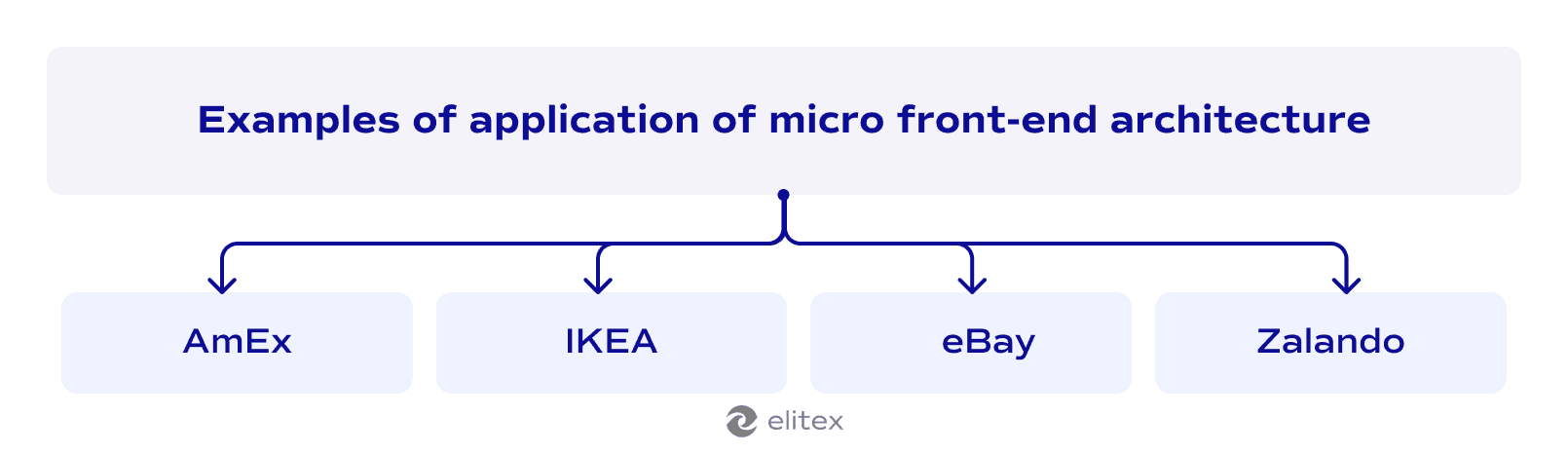
American Express used micro front-ends for their customer-facing applications. AmEx has been a pioneer in adopting micro front-ends as an approach to frontend architecture since 2016. From the words of AmEx themselves, micro front-ends have helped them with scaling issues and speed up the development cycles.
Zalando
Zalando, one of the biggest European e-commerce companies, has openly documented their transition to a micro front-end architecture. Different teams handle each product category (like men’s wear, women’s wear, shoes, etc.) using their preferred front-end frameworks and tools. This separation allows specialized teams to innovate and update their section without coordination overhead, resulting in quicker enhancements and optimizations.
eBay
eBay is another company that adopted microservices and micro front-end architecture relatively early. Besides basic benefits, such as separating teams that enabled them to develop the front end at their own pace, micro front-ends allowed eBay to make navigation more user-friendly and intuitive. By using the separation of components (e.g., bidding systems, search functionalities, user account management, and payment systems), eBay received the flexibility to innovate without the risk of widespread impact.
Upwork
Upwork was another company that adopted microservices and micro front-end architecture relatively early. Besides basic benefits, such as separating teams that enabled them to develop the front end at their own pace, micro front-ends allowed Upwork to make navigation more user-friendly and intuitive. At the same time, the segmentation of the front-end development process into several flows allowed Upwork to introduce new features and fix issues faster.
IKEA
IKEA implemented micro front-ends for their website, dividing sections like product pages, checkout processes, and user profile management into components that were developed independently. This approach helped IKEA iterate rapidly on specific features based on user feedback and testing, significantly improving the site’s overall performance and ensuring seamless user experience.
Future trends and innovations of the micro front-end architecture
As the front-end development evolves, so does the micro front-end approach. Especially when it comes to using MFE in large-scale projects where scalability, maintainability, and team autonomy are critical. Here is the short list of what, in our opinion, you should expect from the MFE approach in the near future:
Native Federation instead of the classic Module Federation
One of the most significant trends in micro front-end development is the shift from Module Federation to Native Federation. The industry is moving towards greater independence from specific tooling and deeper integration with modern web standards like ECMAScript modules and importmaps. This approach enhances flexibility and helps developers build future-proof applications that can withstand rapid technology changes.
Micro front-ends in mobile development
At the same time, the very concept of micro front-ends extends beyond web applications to include mobile development. Using native-like tools and technologies (e.g., React Native), developers can apply micro front-end principles to mobile apps, allowing different features and components of the app to be developed and deployed independently.
Server-side rendering with micro front-ends
More organizations are combining SSR with micro front-ends to improve SEO and initial load performance. This approach is crucial for content-driven sites that benefit from faster server responses and pre-rendered pages. Read more on how to connect frontend to backend efficiently.
If you can’t decide what kind of architecture your project needs, are looking for a development partner who can help you build micro frontend applications from scratch, or just have some other questions regarding MFE, don’t hesitate to contact ELITEX! At ELITEX, we are front-end development experts in all modern architectural approaches with a decade-long experience in building custom web solutions for various business requirements and business domains. Choosing ELITEX means choosing a cost-efficient development partner beyond your expectations!


Micro front-end architecture FAQ
What is a micro front-end?
A micro front-end is a segment of a web application’s user interface designed to be developed, tested, and deployed independently.
What is an MFE?
MFE stands for micro frontend. Micro frontends commonly refer to web app components that can be developed and deployed individually by independent frontend teams.
What is a micro front-end architecture diagram?
MFE architecture diagram is a visual representation that outlines how individual micro frontends are structured and interact within an application.
What are the main benefits of using micro front-ends?
MFEs allow for independent development of components, easier scaling of applications, flexible technology and framework choices, and rapid development.
What are popular micro frontend applications?
Examples of products built using micro frontend logic include Zalando, American Express, Spotify, HelloFresh, and IKEA.
How do micro frontends differ from the monolithic approach?
Micro frontends are developed, deployed, and scaled independently, unlike monolithic approaches, where the entire frontend is a single interconnected codebase.
POSTED IN: