



AI is on everyone’s lips. Everybody has probably seen headlines about how AI can replace actual software engineers or something like that. Although, in our opinion, such headers, to put it mildly, slightly embellish the reality, we won’t deny the role of AI in increasing developers’ productivity. And, in fact, there’s nothing to deny; AI is truly a great assistant for any kind of software engineer. However, when it comes to this topic, hardly anyone remembers front-end development. Previously, we have written an article about the role of JavaScript, the principal front-end programming language, in AI development, and in some sense, today’s article would be a complement to it as we would look at the opposite phenomenon: the role of AI in client-side development and how AI-powered tools and practices can change the life of any front-end development services company forever. So, without further ado, let’s go!
Overview of AI in front-end development
Short disclaimer: We should note that we wouldn’t speak that much about big generative models, such as ChatGPT, Bing AI (Copilot), and Google Bard, as we have a special article dedicated to comparing them to each other. Although we will mention, for instance, AI-driven design tools, big and versatile generative AI models are still a subject for another topic.
AI is making significant strides in front-end development. First of all, we should mention automating routine tasks from the daily life of any front-end developer. Previously, developers spent hours coding elements like forms and navigation menus manually. Now, artificial intelligence can quickly generate ready-to-use code chunks, speeding up the coding process.
Besides automating repetitive tasks, AI can also help improve the web application’s user experience. AIs offer a great set of tools to analyze user data (in order to predict behavior), adjust website layouts (to highlight popular features), or simplify navigation. AI also helps with testing and quality assurance, which are crucial for the success of any project. AI tools simulate user interactions on different devices to find design flaws and bugs. Such testing ensures the final product is reliable and performs well. And those are just a few of the first things that come to mind. In fact, the scope of application AI in front-end development is much wider.
Comparing development with AI to traditional software development
Speaking in general terms, software development with AI doesn’t differ from development without AI that much. Can AI totally replace the software developer? Of course not! However, in some particular cases, a software engineer with AI can replace two software engineers without the AI. Why? For several reasons.
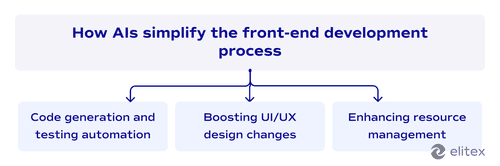
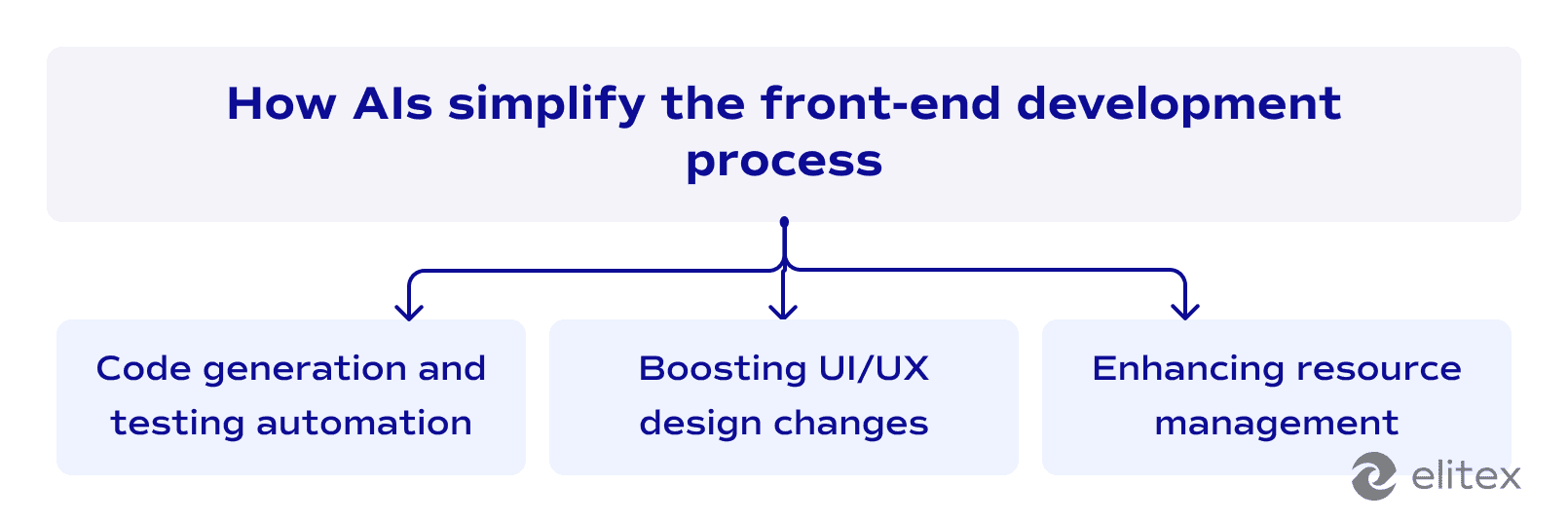
First of all, code generation. Writing extensive amounts of code manually is time-consuming and often prone to errors. Same with the testing process, which, when performed poorly, can miss subtle issues that affect optimization as well as the overall user experience. With AI, much of the coding and testing processes are automated. AI tools generate code for basic functions quickly and accurately, while a software developer just controls the quality of such solutions. This approach not only speeds up development but also improves software reliability and overall quality. Secondly, AI may speed up user interface adaptation. Unlike traditional development relying on user feedback, AIs may offer valuable insights based on vast amounts of user data immediately. The third factor is the facilitation of resource management during the software development process. Automating repetitive tasks frees up skilled developers to focus on more complex and innovative aspects of projects rather than on fixing bugs.
AI-enhanced development is generally faster and more efficient. However, there are two nuances to consider before coming to a conclusion. The first is that the human front-end developers are still required to manage the process anyway, and the second one is that AIs have some inherent issues (we will return to them a bit later), especially when it comes to creative or unusual, complex tasks. So, yes, to wrap things up, AI in front-end development process typically significantly simplifies the process, but human intelligence is still needed at every stage of the process.
The main ways to use AI in front-end development
OK, let’s check how it works in practice. Let’s say we need to build a front-end in the web app development process. First of all, we should decide what the development process looks like and then determine how AI can help us at every stage.
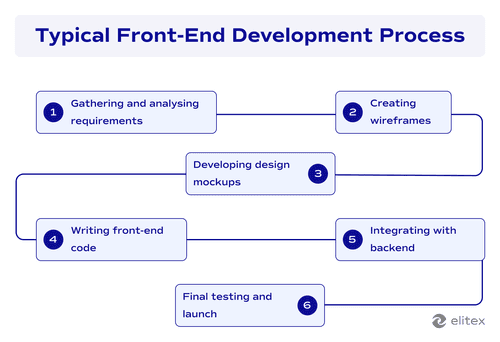

(This is a simplified model of the development process)
How can AI help with gathering and analyzing requirements?
This stage definitely requires a wide presence of human developers; however, AI can still help with some aspects of it. For instance, AIs can help analyze user data to define clear project requirements or employ natural language processing to interpret and organize user feedback into actionable specifications for front-end developers and designers.
How can AI help in creating wireframes?
Adoption of AIs can also streamline several parts of the design process, including building wireframes and prototypes. For instance, AIs can automatically generate layout options based on the provided user data and best design practices. They use pattern recognition to suggest improvements and optimize user flow. It allows developers and designers to quickly iterate on designs, focusing more on refining user experience than on initial layout challenges.
How can AI help in developing design mockups?
AI tools can analyze existing brand assets and user preferences to automatically generate design mockups that maintain visual consistency across the application. They offer multiple variations quickly, enabling developers to select the most suitable option and put less manual effort into it. Also, AIs can predict and integrate user-centric design trends, ensuring user-friendliness and functionality of mockups in just a few clicks, which simplifies the process significantly..
How can AI help in writing front-end code?
In our case, AI tools generate front-end code by translating design mockups directly into HTML, CSS, and JavaScript, significantly reducing manual coding time. The competent use of AI can also help with ensuring code quality and consistency. Additionally, AIs help in detecting and correcting errors in real time, enhancing the reliability and performance of the code.
How can AI help in integrating the frontend with the backend?
AI can help in integrating front-end and back-end systems by mapping data flows and identifying optimal connection points. Such an approach allows us to predict potential integration issues and suggest solutions to ensure seamless communication between the two layers. Additionally, AIs can dynamically adjust API calls based on real-time performance data, improving the efficiency and reliability of the application.
How can AI help with the final testing and launch?
AIs can easily expedite the final testing phase by automating the detection and identification of UI as well as functional defects in code (in the right hands, of course). AI can help with testing in numerous ways, but identifying and addressing issues before launch always helps developers deliver a more polished and user-friendly application on release.
AI tools for front-end developers
The new AIs appear faster than mushrooms after the rain, so there is no point in describing every particular front-end AI tool in our review. However, here is a top 3 list of best AI for front-end development from our personal experience that doesn’t seem to disappear in coming years.
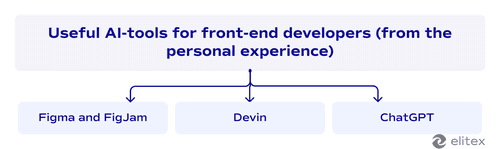
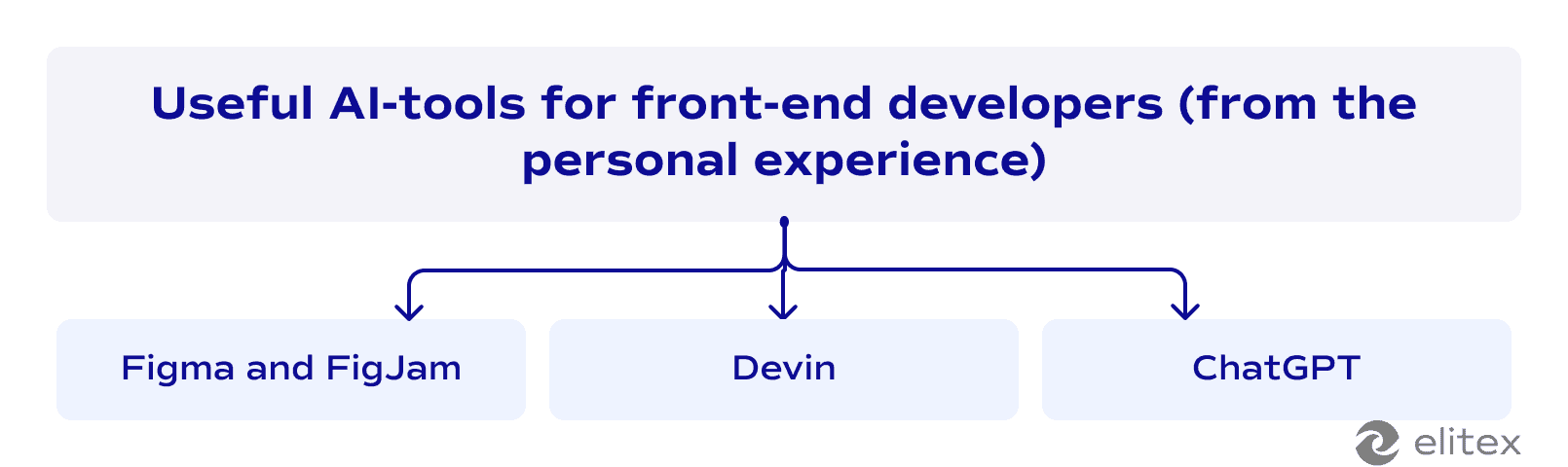
Figma and FigJam
Figma is probably the main tool for web designers and, consequently, front-end developers, and it offers FigJam. In a nutshell, Figma incorporates AI-powered features to improve collaborative design processes, enabling real-time feedback and iterative design sessions, along with smart suggestions for design improvements. It looks like the final goal of Figma is to create an AI-assisted designing process that requires minimum manual code-writing.
Devin
Devin is a brand-new AI tool that helps front-end developers write fewer lines of code manually. Although it’s not an AI tool for front-end development per se, it offers great coding capabilities, providing advanced AI-generated code and the ability to build, test, and deploy applications with minimal human interventions. It can be a great assistant for any front-end developer, and we definitely recommend you check it!
ChatGPT
ChatGPT is kind of a clickbait headline here, but the point is that any front-end developer actually needs a general-purpose AI tool for a wide range of mundane tasks every day. Whether we are talking about GPT, Google Gemini, Copilot, Claude, or another kind of AI assistant, any of them will significantly help in choosing a suitable tone for email, content analysis, or just looking for some answers to daily questions quickly.
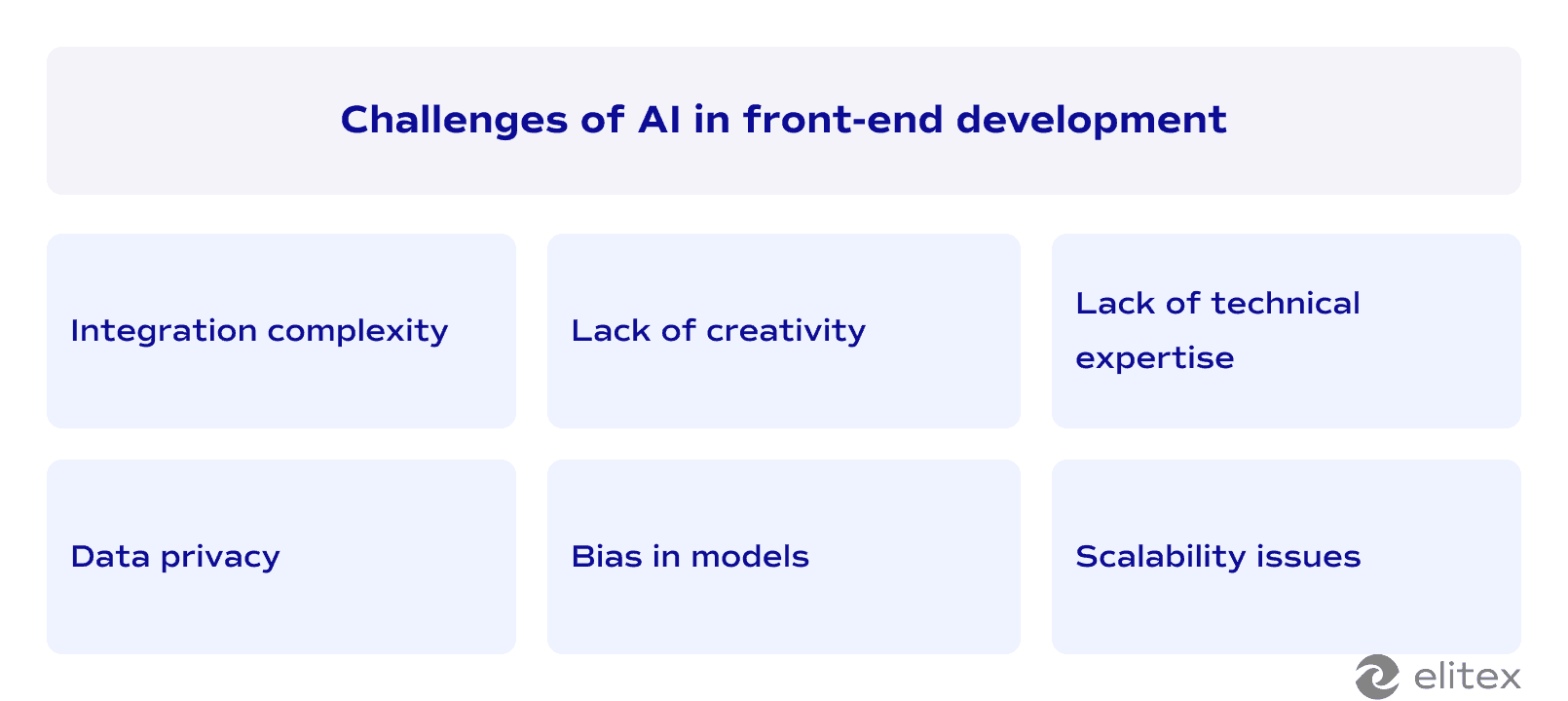
6 challenges of AI in front-end development
However, several inherent issues are common not only for front-end AI tools but for the whole artificial intelligence concept as we know it.
Integration complexity
Integrating AI with actual front-end frameworks is often complex. Developers must align AI functionalities with current systems without disrupting user experience. Besides this, code generation assistants often hallucinate, creating non-working code that can break the whole system. Integrating any chunk of AI-generated code can require significant checking, testing, and debugging from actual developers. Moreover, such an integration might demand updates to both software and hardware infrastructures.
Data privacy
Combining AI and front-end development raises serious data privacy concerns. AI systems need access to vast amounts of user data to function optimally. This challenge is particularly relevant for projects in industries that can work with sensitive personal data, such as healthcare or e-commerce (the best idea, in this case, can be seeking AI development services that will allow businesses to build their own AI from scratch). Ensuring this data is handled and stored securely is one of the main challenges for any AI developer. But.
Lack of creativity
One of the fundamental limitations of AI is its inability to replace the nuanced and inherently human capacity for creative thought. Artificial intelligence operates within the confines of pre-defined basic AI algorithms and data it has been trained on, which restricts its ability to generate truly novel ideas or solutions that deviate from learned patterns. Repetitive use of AI often results in outputs that might seem repetitive or uninspired without human intervention.
Bias in models
AI models can unintentionally learn and perpetuate biases present in their training data. Sometimes, this bias manifests in user interactions, potentially leading to high reputational costs. To be less biased, AI models must be continuously monitored and often updated. Only then will the risk of biased AI be lower.
Technical expertise
Integrating AI in workflow may require specialized knowledge that many front-end developers do not have. Of course, in this case, we aren’t talking about GPT, but rather about more complex AI-powered solutions. Training existing staff or hiring new talents with AI skills can be expensive and time-consuming. Keeping up with the extremely fast pace of AI technology also adds to the challenge. In some cases, the integration of AIs can even slow down the project implementation.
Scalability issues
In the scenario where AI solutions are deeply integrated into your working processes, scaling such a system to handle larger numbers of users simultaneously can strain the whole system. As user numbers grow, maintaining the performance and speed of the system with integrated AI becomes harder. Scaling the role of AI as a project grows requires careful planning (as well as human resources involved in this planning) and sometimes substantial infrastructure investments.
What lies behind: The future of AI in front-end development
The future of AI in front-end development from the user perspective seems quite obvious. We will see more personalized user experiences, AI-powered chatbots, personalized content delivery, AI-voice assistants, and other features of “tailored experience.” At the same time, the future of AI in the developers’ lives remains uncertain. We will definitely see more automatization of mundane tasks, but what exactly will be automated and where will largely depend on the specific industry trends.
As AI technologies advance, they could potentially suggest architectural improvements or optimize code in real time. Or even some deeper structural changes in the development processes. At the same time, the speed of adoption and integration of AI in development will likely vary by sector and will be influenced by specific industry needs.
To be honest, nobody really can predict the future and see what’s going on next. And we also cannot do this. However, what we can do at ELITEX is provide a wide range of custom development services. Whether you need a front-end development from scratch, building an AI with consequent integration into your project, or just a technical consultation regarding tech trends and tendencies, don’t hesitate to contact us. At ELITEX, we bring results beyond your expectations!


FAQs
What is the role of AI in front-end development nowadays?
AI automates repetitive coding tasks, enhances user interface design, and improves user experience through various personalization options.
How does AI streamline the front-end development process?
Using AI for front-end development brings numerous benefits. AI generates code, suggests design elements, and conducts AI-driven testing, spending up development and reducing errors.
What are some common AI tools used in front-end development?
The list of practical AI tools includes large generative AIs like Google Gemini, Claude, or ChatGPT, front-end design tools, such as Figma’s AI components or Adobe Sensei, and specific code-generating AIs, such as Devin.
What are the challenges and limitations of integration front-end development AI?
Integration complexity, high costs, lack of creativity, bias in models, scalability issues, and data privacy concerns pose significant challenges in using AI for front-end development.
What ethical considerations arise from using AI in front-end development?
Key ethical issues include ensuring user privacy, avoiding bias in AI algorithms, and maintaining transparency in AI-driven decisions.
POSTED IN: