



Artificial intelligence promises to change the way we interact with and perceive data in profound ways. However, at its essence, artificial intelligence is all about data itself. The point where artificial intelligence and data typically intersect for the first time is called machine learning. Of course, while the term “machine learning” might initially seem enigmatic or even mysterious, there is nothing inherently complicated about how it works and, by extension, how it serves as the foundation for broader AI development services (exactly those that promise to change the way we perceive data).
There is a very simple way to demystify machine learning. The only thing we need is just to delve into basic AI algorithms with a gentle nod to more complex concepts like neural networks and decision trees (very indirectly). Although these topics might initially sound daunting, we promise that there’s nothing to worry about. So, today, we will try to ensure that what might seem intricate is made clear and approachable — we will explore how AI and basic AI algorithms for machine learning work in simple words.
A brief disclaimer: That’s our first topic in the series of articles dedicated to artificial intelligence. We want to explain multifaceted concepts of AI in simple words, step by step. Today, we focus on artificial intelligence basic algorithms as an introductory yet vital part of understanding the big picture. So, without further ado, let’s go!
What is artificial intelligence?
Let’s begin with artificial intelligence itself. According to the book Artificial Intelligence: A Modern Approach by Stuart Russell and Peter Norvig (we highly recommend it for both novices and advanced), artificial intelligence or AI is the display of intelligence by machines, especially when it comes to computer systems. Simultaneously, AI also typically refers to a branch of computer science dedicated to creating and researching software as well as methods that allow machines to understand the environment. This branch of computer science primarily focuses on enabling AI systems to learn and apply intelligence in ways that enhance their ability to achieve pre-defined objectives.
Simply put, AI equips machines with tools/techniques to analyze their environment, make informed decisions, and perform tasks traditionally associated with human intelligence.
What is an AI algorithm?
An AI algorithm is a set of rules or instructions designed to make data-based decisions and solve certain problems based on predefined data. This data is usually called a dataset. Such simple AI algorithms, which are being trained on these datasets, form the core of AI systems. This training allows them to perform well-known AI-associated tasks such as recognizing patterns, making predictions, or generating responses, for instance. What differentiates basic AI algorithms from, let’s say, traditional algorithms is the fact that AI algorithms are capable of learning from data. It improves their accuracy and effectiveness over time without or with minimal human intervention.
The role of machine learning
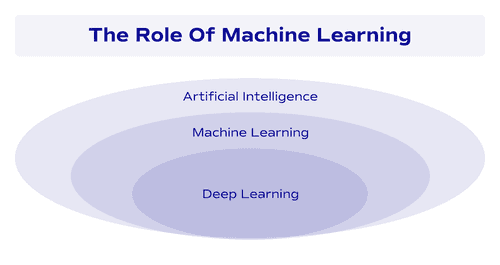

The most common type of artificial intelligence algorithms falls under machine learning. Machine learning algorithms use statistical techniques to give computers the ability to “learn” from data. This means they can improve their performance on a specific task with increasing amounts of data without being explicitly programmed for every particular scenario. They identify patterns and features in the data they process, using this information to make decisions or predictions.
Deep learning, in turn, is a subset of machine learning that uses structures similar to the human brain called neural networks. These networks consist of layers of nodes that mimic neurons, and they can learn and make intelligent and intelligent-like decisions on their own. Deep learning is particularly effective at processing large volumes of complex data, such as images and sound. When you hear that another AI offers a powerful tool for, for instance, voice recognition, driving a car, automated medical diagnosing, or whatever, most likely, it’s about being based on deep learning.
Mechanisms of AI algorithms work


Let’s see how they look in practice. We’ll take one of the most common tasks of machine learning, predictive modeling. There are a lot of AI algorithm examples, but we’ll take the simplest one. Imagine we need to build an algorithm that will predict the price of houses. First of all, we need to feed our algorithm with numerous houses, each with its own prices and sizes. (This algorithm should be way more complicated than the one we actually provided, but we try to keep it as minimalistic as possible). So, our dataset comprises information about three houses.
House#1: 1000 square feet, sold for $100,000
House#2: 3000 square feet, sold for $300,000
House#3: 6000 square feet, sold for $600,000
After we collect data, we can use this data to train a simple linear regression algorithm. This algorithm should learn a correlation between the size of the house and its selling price. In this particular case, the model might learn that every square foot increases the house cost by $1000. After the training phase, the model can make predictions of prices based on the size and vice versa, size based on the price. This simple AI algorithm can make relatively accurate predictions based on the linear correlation it has identified between size and price. It’s because of what is called machine learning.
But for sure, this model was deliberately simplified, as the actual house pricing prediction algorithm should consider way more variables, such as, for instance, the size of the land where this house stands, the overall location, and many more. We just illustrated the general principle of work.
Types of AI algorithms in 2026
There are several ways to classify basic AI algorithms in 2026. In our opinion, the book called Master Machine Learning Algorithms by Jason Brown Lee offers a slight but thorough approach to the typologization of AI algorithms.
First of all, artificial intelligence basic algorithms may be divided based on whether these algorithms make specific assumptions about the “form” (structure) of the model they are learning (we use model and algorithm almost interchangeably, again). This division leads us to two main types: parametric and nonparametric algorithms.
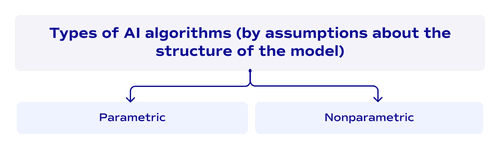
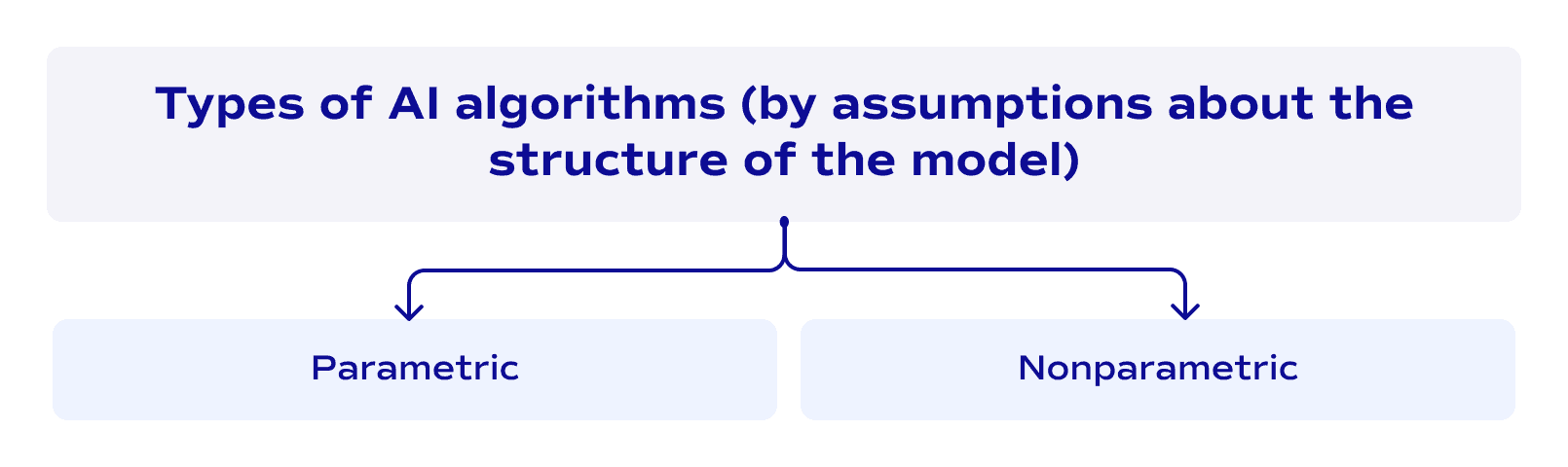
However, that’s quite a peculiar approach. Trying to speak in more general terms, parametric algorithms assume a specific form for the function that maps inputs to output, while nonparametric algorithms don’t make any assumptions. Parametric learning is commonly known as supervised learning, while non-parametric as non-supervised. However, that’s not the only two options to divide simple AI algorithms. Based on the type of data or feedback they are given, they can be divided into three main categories:
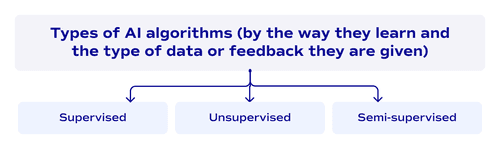
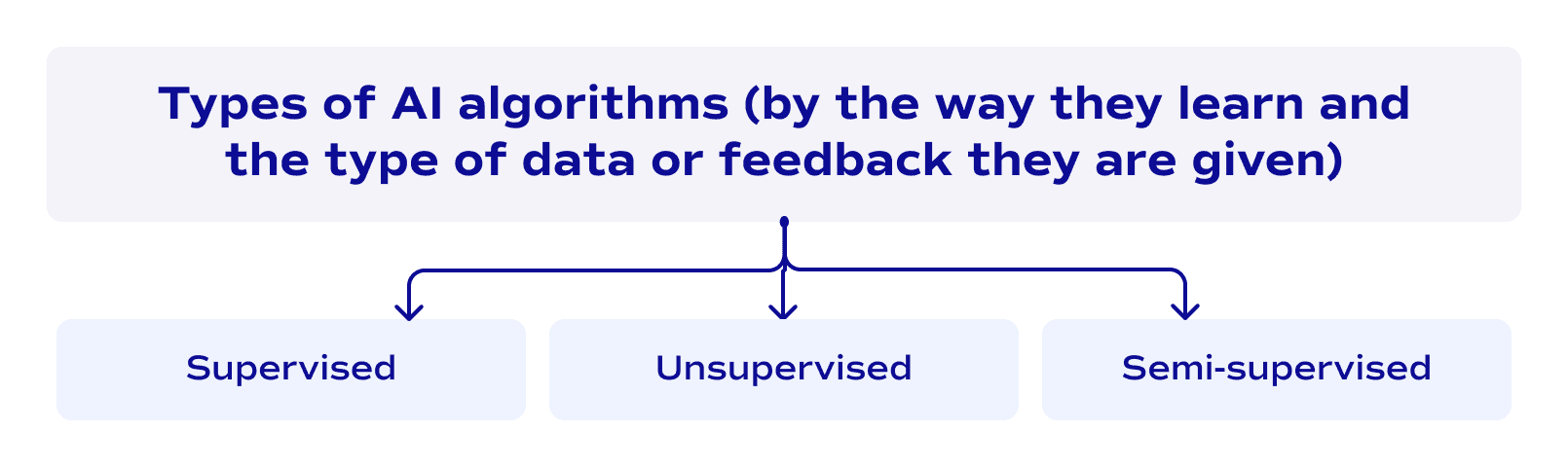
Supervised learning
Supervised learning algorithms are trained on labeled data. Labeled data basically means the training data includes both the input data and the corresponding correct outputs. The algorithm learns to map inputs to outputs based on this data and can then make predictions on new, unseen data.
- Examples of supervised learning: linear regression, logistic regression, support vector machines, decision trees, and random forests.
- Scope of application: image recognition, speech recognition, email filtering, and predicting consumer behavior.
Unsupervised learning
In unsupervised learning, basic AI algorithms are given data without explicit instructions on what to do with it. The system tries to learn the patterns and structure from the data by itself.
- Examples of unsupervised learning algorithms: Clustering algorithms like K-means, hierarchical clustering, and dimensionality reduction techniques like Principal Component Analysis (PCA) and t-SNE.
- Scope of application: Market segmentation, organizing large databases of information, and anomaly detection in network security.
Semi-supervised learning
Semi-supervised learning typically starts with a small set of labeled data to train a simple AI algorithm. Then, the algorithm uses the initial model to make predictions on the unlabeled data, effectively generating new labels. These predictions are used to refine the model iteratively. In some approaches, only the most confident predictions are added to the training set, or the model itself may be adjusted to better account for the new data based on certain assumptions about the data distribution.
- Examples of semi-supervised learning: self-training and self-labeled techniques, co-training, graph-based methods
- Scope of application: content categorization, natural language processing (NLP), image and video annotation, healthcare data analysis, etc.
Model evaluation
Earlier, we have mentioned underfitting and overfitting models. Although underfitting and overfitting aren’t types of machine learning models per se, they are still a valuable source of information about algorithms. Understanding both concepts (types of potential issues that can occur during the model training process) is important for understanding the effectiveness of various AI basic algorithms.
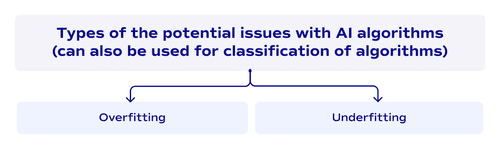

Overfitting
Overfitting occurs when an AI algorithm learns the details and noise in the training data to the extent that negatively impacts the performance of the model on new data. Overfitted models perform exceptionally well on test data but poorly on unseen train data. They have high variance and low bias. Techniques such as reducing the number of features (dimensionality reduction), increasing training data, using regularization methods (like L1/L2 regularization), and employing cross-validation can help prevent overfitting.
Underfitting
Underfitting occurs when a model is too simple to learn the underlying pattern of the data effectively. This can happen if the model doesn’t have enough parameters to capture the complexity of the data or if it is trained inadequately. Underfitted models perform poorly on training data, indicating that the model has not captured the trends of the data well. They have high bias and low variance. Adding more features, selecting a more complex model, or training a model for a longer time can help overcome underfitting.
We can divide machine learning algorithms with a wide range of other methods. For instance, algorithms can be divided into linear and nonlinear. However, delving deeper into numerous other ways to classify AI algorithms is a topic for another article, so let’s stop with what we have and proceed to the AI algorithms examples.
Basic AI algorithms
There are vast amounts of AI algorithms to speak about. But let’s focus on some of the most popular and useful ones.
Linear regression
Linear regression is a statistical method used to model the relationship between a dependent variable and one or more independent variables by fitting a linear equation to observed data. The coefficients of the equation are derived from the data to minimize the difference between the observed and predicted values.
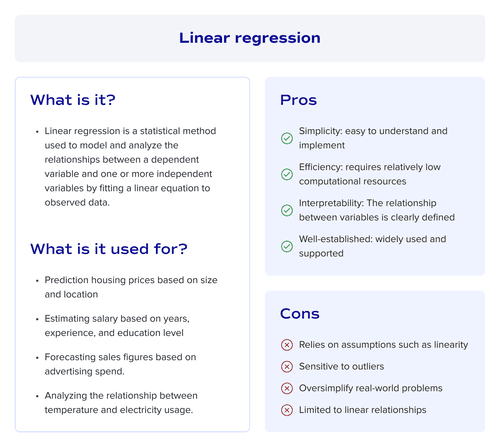
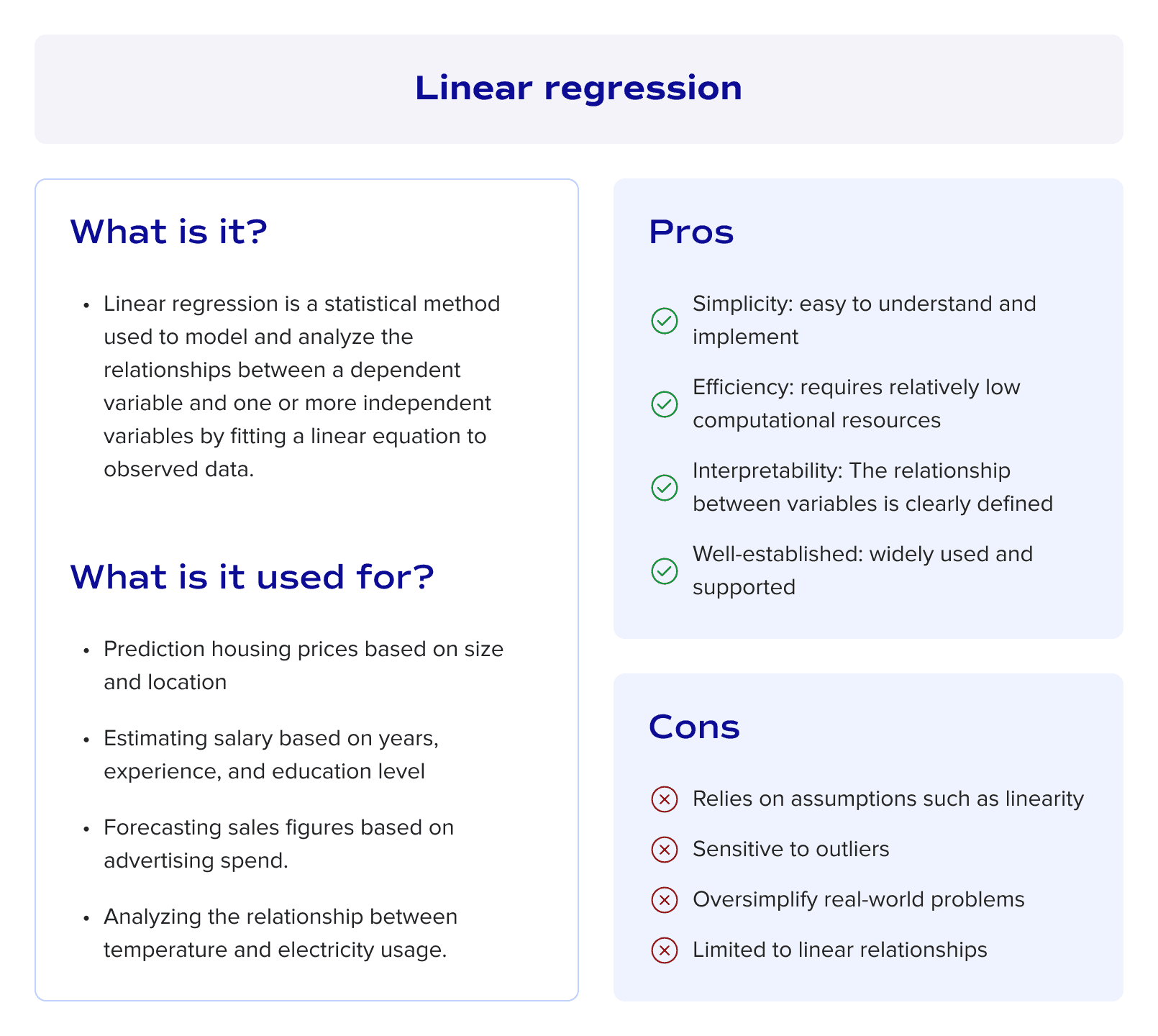
- Advantages: simple to implement and understand as well as efficient to train
- Disadvantages: Assumes a linear relationship between variables, sensitive to outliers, and can only model linear relationships.
- Examples of linear regression: predicting a house price based on features like size and location (the example we mentioned above), forecasting sales numbers, etc.
- Scope: a wide range of applications used in fields where relationships between variables are linear, such as economics, finance, and real estate
Logistic regression
Logistic regression is another algorithm based on statistical methods. It’s mainly used for binary classification. Logistic regression models the probability of a binary response based on one or more predictor variables. The output is the probability that the given input point belongs to a certain class.
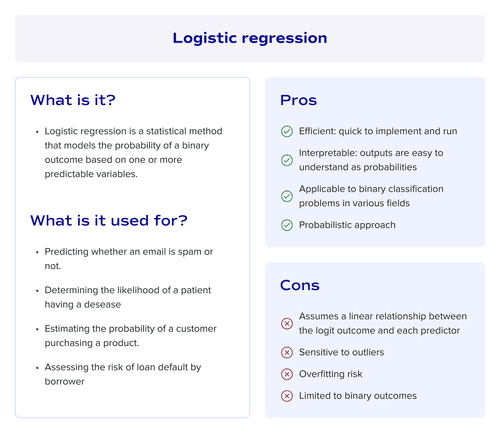
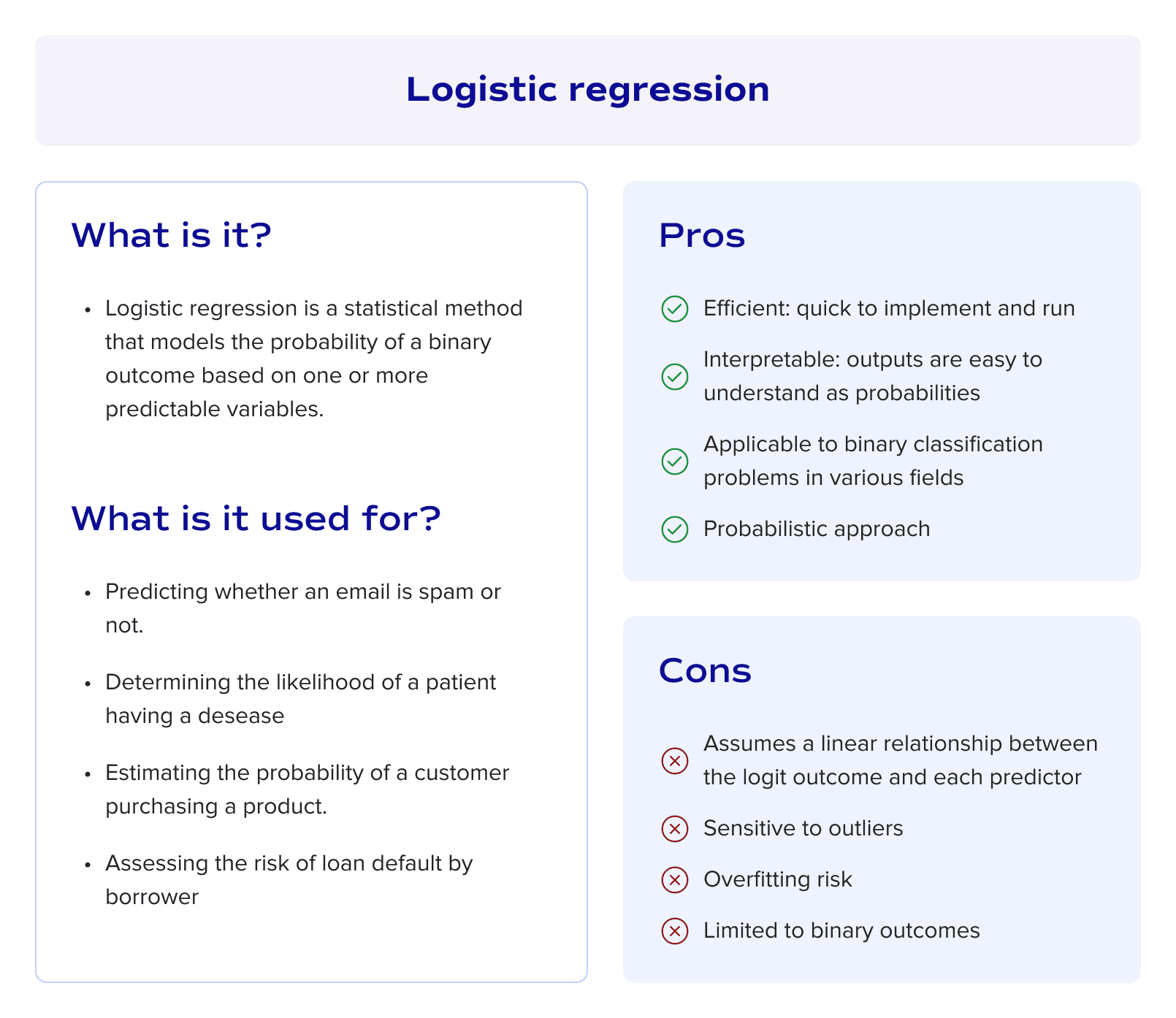
- Advantages: Straightforward and efficient for problems with a clear decision boundary. It also provides probabilities for predictions.
- Disadvantages: Can perform poorly if there are complex relationships in the data or if the features are highly correlated.
- Examples of logistic regression: Determining whether a loan is approved within the mobile application or predicting if a tumor is malignant or benign
- Scope of application: Commonly used in the medical field, financial services, and social sciences for binary classification tasks.
Classification and regression trees (CART)
CART algorithms create a decision tree to predict or classify data. Here, the tree means that the algorithm models decisions and their possible consequences as a tree-like structure. CART algorithms work by repeatedly splitting data into smaller subsets based on different criteria, creating a tree with both decision nodes and leaf nodes.
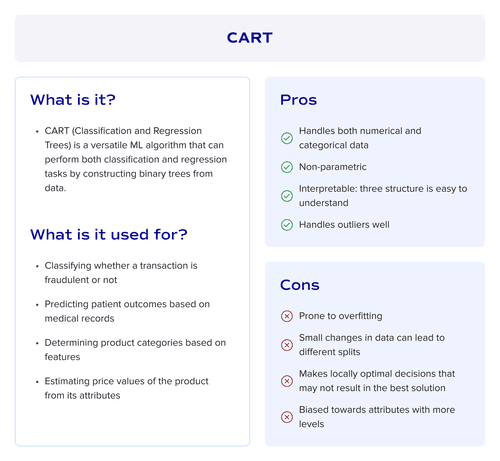
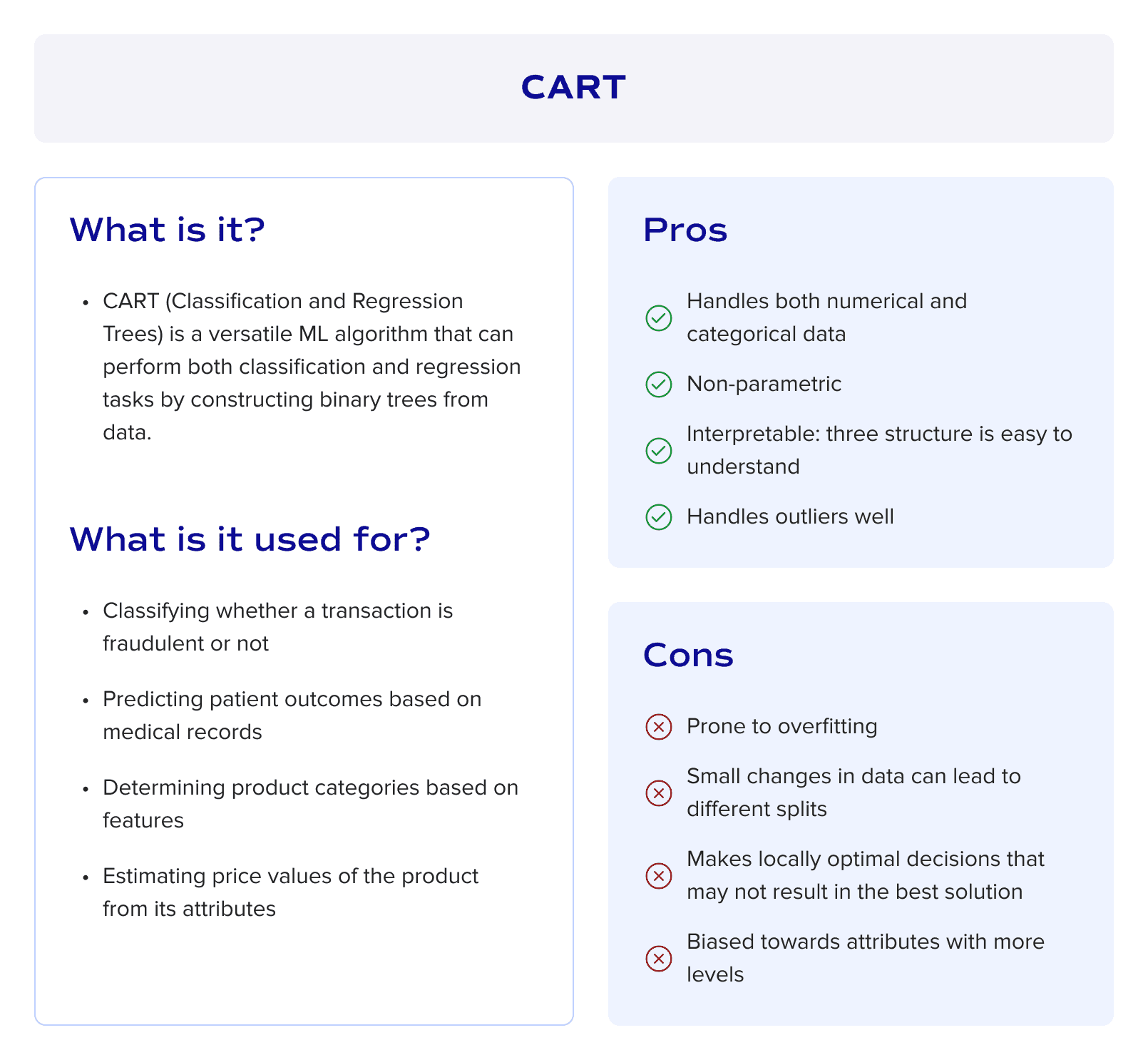
- Advantages: Trees are easy to understand and interpret. They can handle both numerical and categorical data.
- Disadvantages: CART algorithms can easily overfit the data, especially if the tree becomes too deep.
- Examples of CART algorithms: Evaluating risks in insurance, diagnosing patients based on symptoms.
- Scope of application: Useful in any field requiring decision-making processes, such as healthcare, insurance, finance, customer relationship management, etc.
K-Nearest Neighbours (KNN)
KNN is a simple, instance-based machine learning algorithm where predictions are derived based on the nearest data points in the feature space.
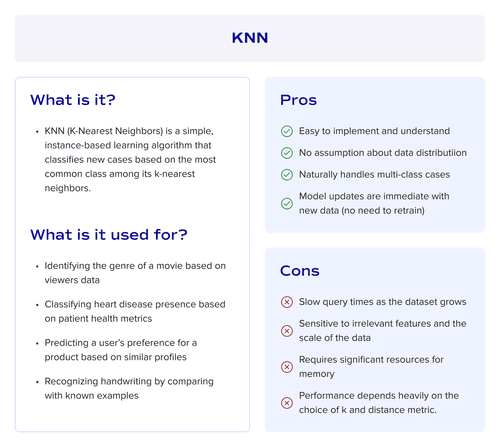
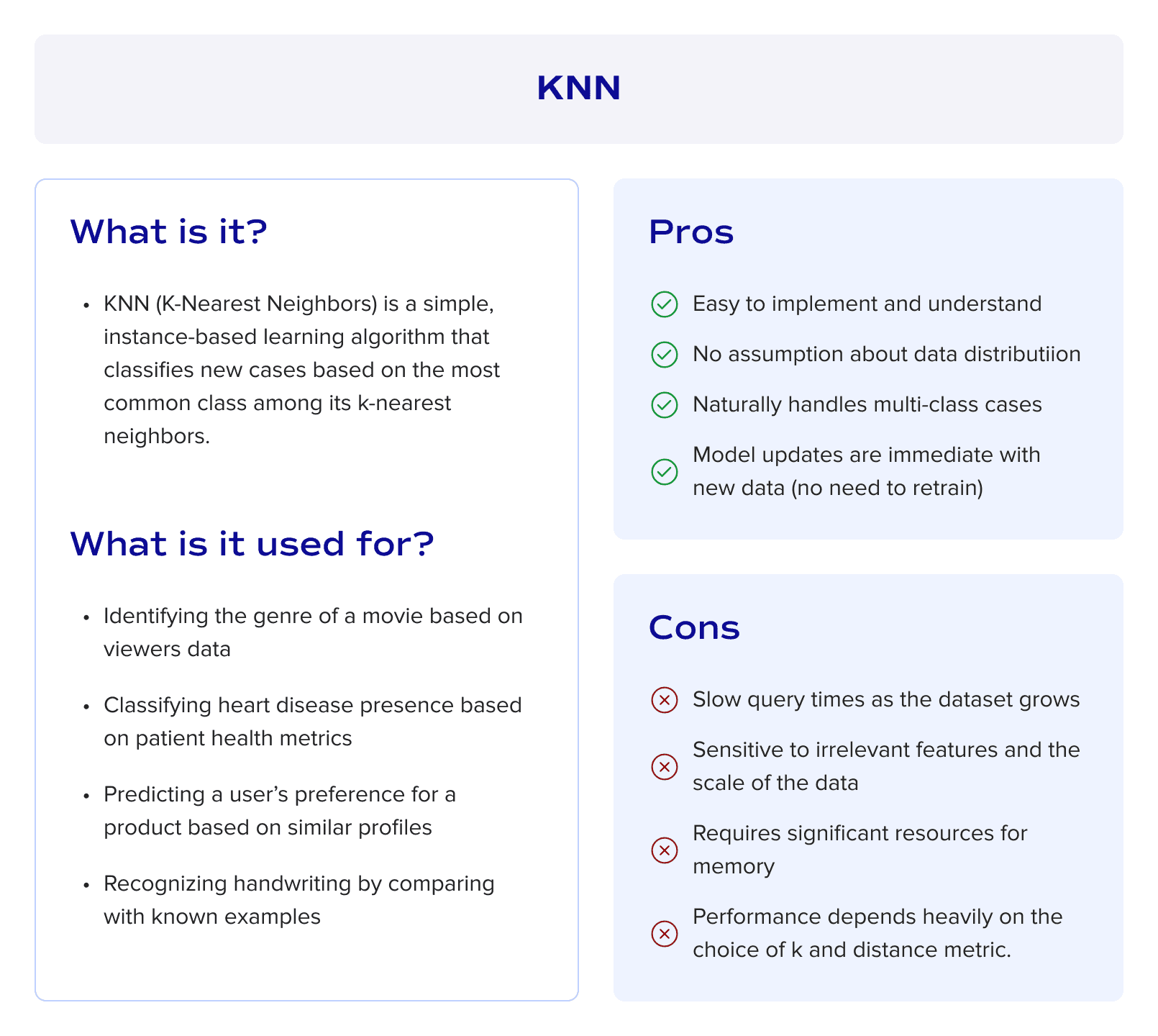
- Advantages: KNNs are very easy to implement and don’t assume anything about the underlying data distribution.
- Disadvantages: It becomes significantly slower as the amount of data increases, making it less suitable for really large datasets.
- Examples of KNNs: Recommending products based on customer buying behavior, classifying a piece of writing by its author.
- Scope of application: Widely used in retail for recommendation systems, security for pattern recognition, and healthcare for disease diagnosis.
Support Vector Machines (SVM)
SVM is one of the basic AI algorithms based on a classification algorithm that attempts to find a line (or a hyperplane in higher dimensions) that best separates different classes of data points. The goal is to draw this line with the maximum possible margin between the nearest points of each class, which are known as support vectors. This wide margin makes the classifier robust.
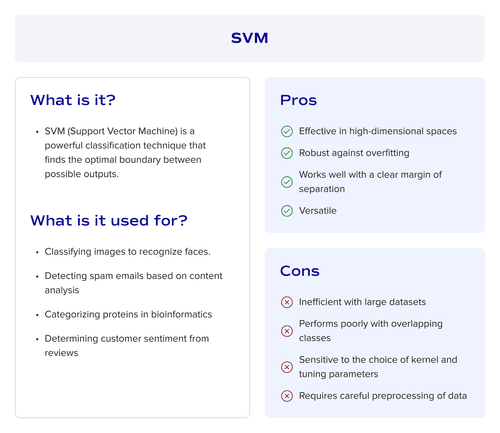
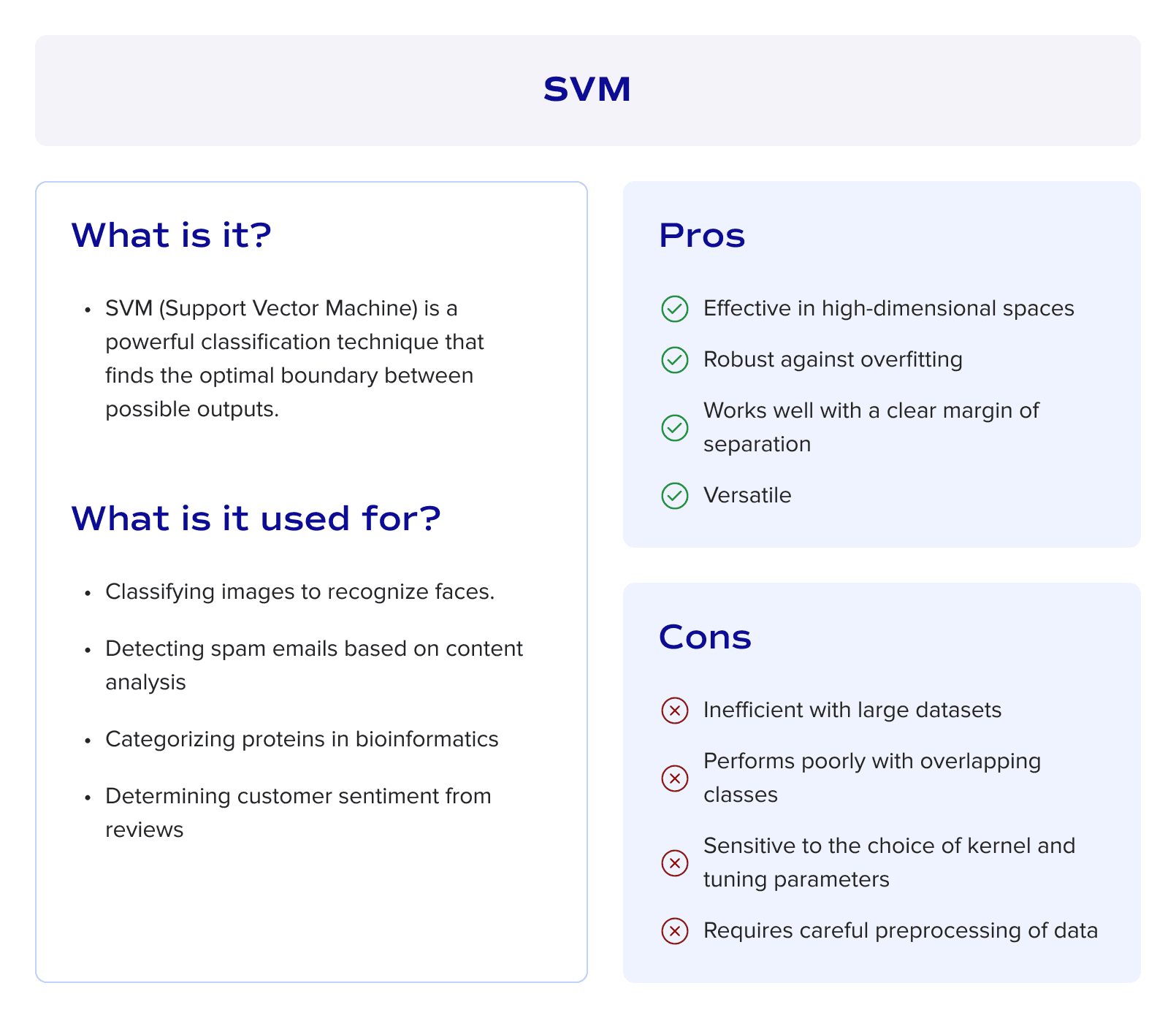
- Advantages: Effective in high-dimensional spaces and relatively memory-efficient
- Disadvantages: SVM algorithms are not suitable for larger datasets as their training time can be long; they are also less effective on datasets with lots of noise.
- Examples of SVM algorithms: Face detection, text category assignment, bioinformatics.
- Scope of application: Primarily used in image processing, text mining, and biological science where the dimensionality of the data is high.
And, that’s just a few particular examples of artificial intelligence basic algorithms. In fact, there are many more of them, but we just can’t cover them all in one topic.
AI algorithms for your business
Although we can’t cover everything in this text, we still can help you develop a custom AI solution for your business. ELITEX are software development partners that allow your business to spring, ensuring not only effective software solutions but also highly attractive for your end customer. With ELITEX, you always receive results that are beyond your initial expectations. Whether you are looking for a development partner or just need a consultation regarding technical aspects of your future AI model, ELITEX are here to build an AI algorithm your project needs. Partnering with ELITEX means quickly making an evident difference for your business!
FAQs
What is an AI algorithm?
An AI algorithm is a method or a set of rules that enables a computer to perform tasks in ways that mimic human intelligence, such as learning from data and making decisions.
How do AI basic algorithms work?
AI basic algorithms analyze input data to recognize patterns or make decisions. They adjust their actions based on the data they process to improve the overall level of accuracy over time.
What is the role of data in AI?
Data is crucial in AI as it’s the core of any AI system. Data provides the information that AI systems need to learn and make informed decisions. The quality and quantity of data directly influence the effectiveness of the AI model.
How do artificial intelligence basic algorithms handle large datasets?
Artificial intelligence basic algorithms use techniques such as sampling, data normalization, and parallel processing in order to manage and efficiently analyze large datasets.
How can basic AI algorithms be applied in real-world applications?
AI algorithms can be applied in various ways. For instance, automating routine tasks (probably the most popular motive for building an AI solution) or image generation. AIs have extremely wide scope of application, and we believe that we will soon apply them in all areas of life.
POSTED IN: