



- TL;DR: Cloud-native is an architectural approach where applications are designed specifically to run in a cloud environment, built around microservices, containers, and declarative infrastructure.
- The microservices model, common for cloud-native applications, multiplies deployment complexity. DevOps automation is what makes that complexity manageable. That’s why DevOps and a cloud-native approach fit together so well.
- The article breaks down six concrete outcomes of mature cloud-native DevOps. Delivery cycles get faster. Infrastructure costs drop. System resilience improves. Operational overhead shrinks. Security posture strengthens. And team alignment stops being an ongoing problem.
- In this article, we also provide a practical 6-step implementation guide: from delivery gap assessment to observability instrumentation.
- Also, we cover the core cloud-native DevOps tooling categories. Container orchestration, infrastructure as code, and observability cover the three layers every cloud-native DevOps stack needs.
- As a conclusion, we talk about where the field is heading. AI-assisted operations, platform engineering, and deeper security integration are the shifts defining cloud-native DevOps in 2026.
For most of software engineering's history, the team writing the code and the team running the infrastructure operated in separate worlds. One shipped features; the other kept servers alive. Cloud-native DevOps closes this gap. It brings together modern infrastructure design and an engineering culture built around fast, reliable delivery. Not as a one-time migration, but as a continuous operating model.
Such a shift matters because cloud-native architecture changes what infrastructure is capable of. When applications run as distributed services inside containers, infrastructure becomes programmable and disposable. It can self-heal and be rebuilt from code in minutes. That's a fundamentally different environment from the one traditional deployment pipelines were designed for. Here, DevOps practices become practically irreplaceable.
At ELITEX, our DevOps infrastructure automation services are built around this reality. We help engineering teams move from fragile, manually managed environments to systems that scale and recover on their own. And that experience is what this guide is built on. So, today, we’re going to explain what cloud-native DevOps is and what it means for the software teams across the globe.
What is cloud-native? (And what makes an application cloud-native)
Cloud-native is an approach to building and running applications that fully exploits the capabilities of cloud infrastructure. Not just hosting an existing app in the cloud, but designing it specifically to live there. That distinction shapes every decision in software development, from how the codebase is structured to how the development environment is provisioned and maintained. Cloud-native applications share a specific set of architectural traits.
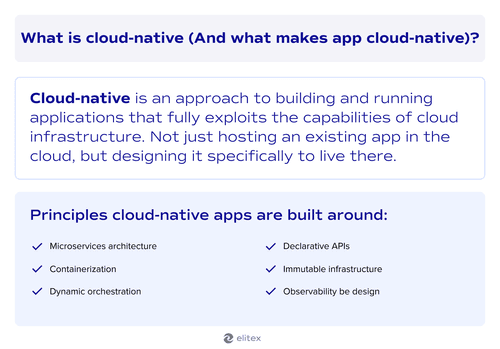
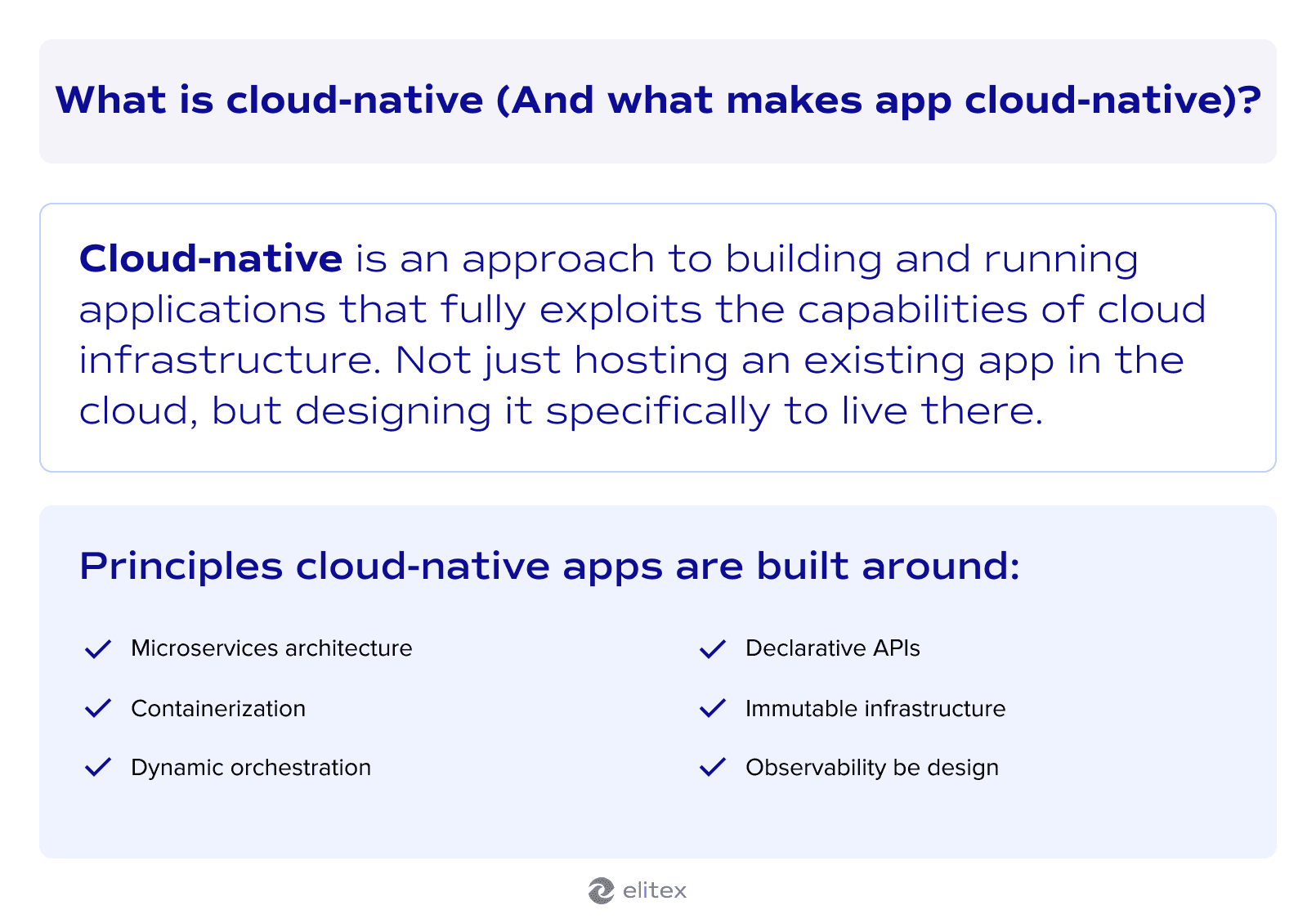
- Microservices architecture. The application is broken into small, independently deployable services, each responsible for a single function. Here we have a dedicated article about the role of microservices architecture in DevOps.
- Containerization. Each service runs in a container, making it portable across any environment without dependency conflicts.
- Dynamic orchestration. A platform like Kubernetes manages how containers are scheduled, scaled, and restarted automatically.
- Declarative APIs. Infrastructure and application behavior are defined in code, not configured manually through interfaces.
- Immutable infrastructure. Servers and environments are never patched in place. They are rebuilt from a defined state when a change is needed.
- DevOps observability by design. Logging, metrics, and tracing are built into the application from the start, not added after deployment.
The case for cloud-native architecture
Cloud-native architecture solves a problem that has followed software development for decades: the growing distance between how code is written and how it runs in production. When infrastructure is defined in code and rebuilt on demand, operations teams stop spending their cycles firefighting environment inconsistencies. They start contributing to delivery speed instead. The practical difference shows up quickly. Because individual services ship independently, deployment frequency goes up without putting the whole system at risk. Failures stay isolated, recovery is automatic, and infrastructure scales with actual demand rather than theoretical peak load.
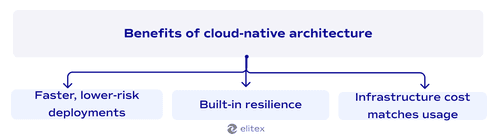
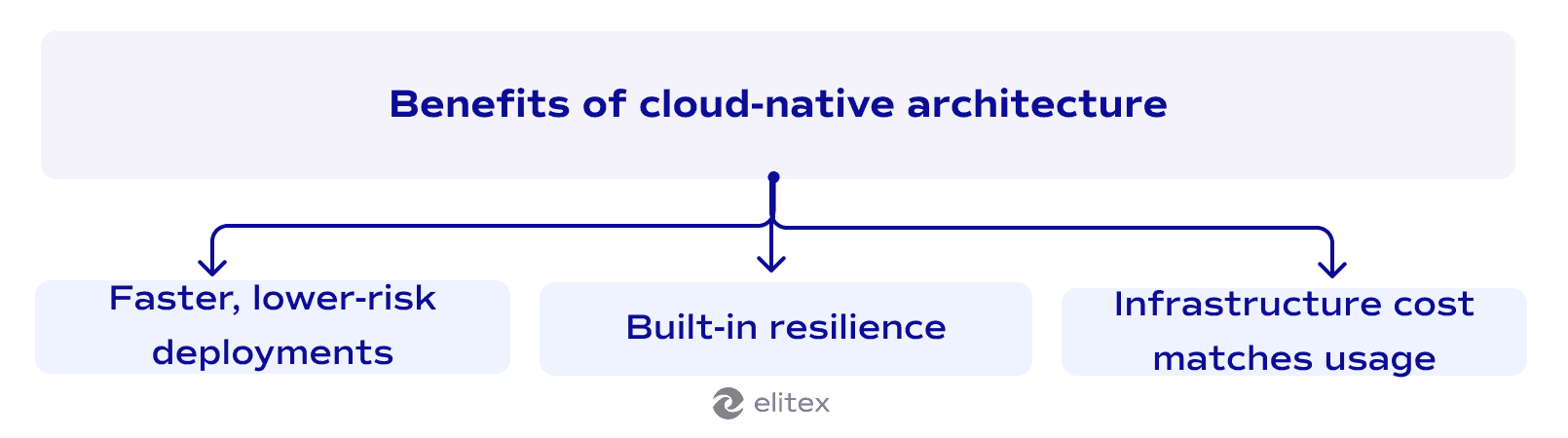
Faster, lower-risk deployments. Because services are independent, teams ship updates without touching the rest of the system. A change to the payment module doesn't require redeploying the entire application.
Built-in resilience. When one service fails, the failure doesn't propagate. The system continues running while the affected component restarts or gets replaced automatically.
Infrastructure cost that matches actual usage. Resources scale up under load and back down when demand drops. That removes the need to maintain expensive overcapacity as a buffer against traffic spikes.
What is cloud-native DevOps?
Cloud-native DevOps is a practice that aligns DevOps culture and automation with the architectural principles of cloud-native systems. It isn't a single tool or a vendor platform. Think of it as the operating model that makes DevOps for cloud-native environments actually work. Without it, teams often end up with modern infrastructure managed through outdated processes, which creates its own category of problems. With the right approach and the right managed services where needed, the entire delivery system becomes faster and more predictable.
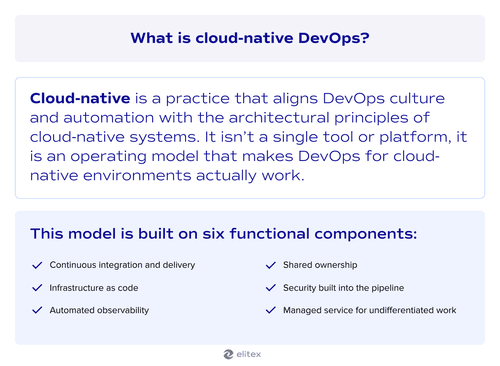
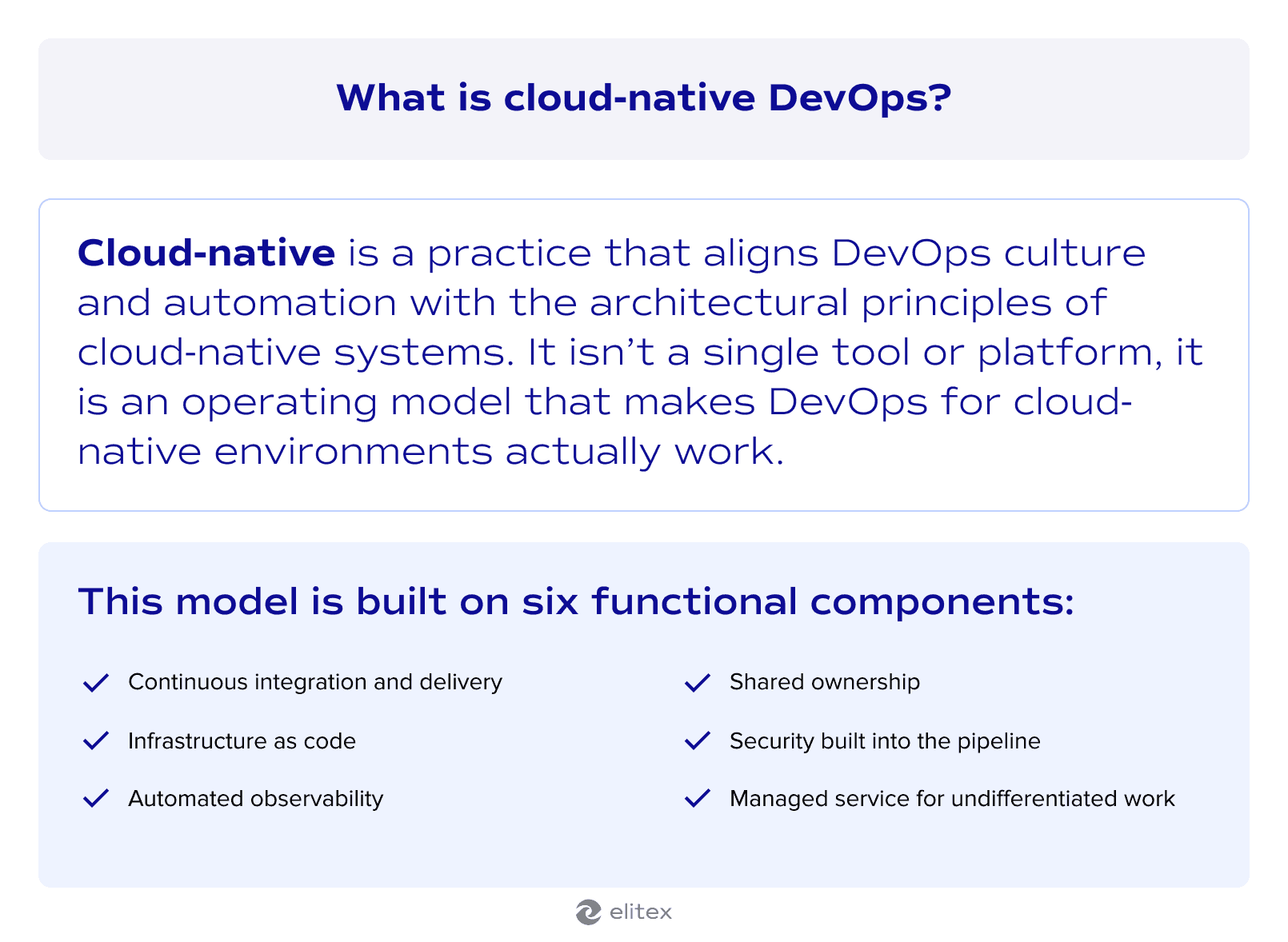
Such an operational model is typically built on six functional components:
- Continuous integration and delivery. Code changes are tested and shipped automatically, without manual handoffs between teams.
- Infrastructure as code. Every environment is defined in source files and reproduced consistently, rather than configured by hand.
- Automated observability. Monitoring, tracing and alerting are wired into the system from day one, not bolted on later.
- Shared ownership. Development and operations teams work from the same codebase and resolve incidents through shared processes.
- Security built into the pipeline. Vulnerability scanning, automated security checks, and compliance checks run as part of every build, not as a separate audit cycle.
- Managed services for undifferentiated work. Teams offload infrastructure layers that don't require custom engineering, so focus stays on product delivery.
Why DevOps and cloud-native architecture go hand-in-hand
Now, let’s take a closer look at why DevOps and a cloud-native approach match so seamlessly.
First and foremost, cloud-native apps are built to change constantly. Each service gets updated independently, and the infrastructure underneath is expected to rebuild itself from code when needed. In such a case, manual intervention is perceived more like the exception, not the norm. That only works if the delivery process operates at the same speed. For this, we have DevOps. Due to constant changes, the DevOps/cloud native combination isn't marketing. It's a structural necessity. The cloud-native architectural model creates demands that only a mature DevOps practice can meet.
Read more about DevOps maturity in our DevOps maturity model guide.
However, the connection runs both ways. DevOps without cloud-native infrastructure hits a ceiling. DevOps automation pipelines can only move as fast as the environment allows. Cloud-native architecture without DevOps practices is equally incomplete. The microservices model multiplies the number of independent components a team manages, which multiplies coordination overhead. Team velocity drops when each service needs its own manual deployment process. Together, these two approaches eliminate that bottleneck by making automation the default.
How DevOps enhances cloud-native architecture
Considering the paragraph above, we can conclude that DevOps brings the operational discipline that cloud-native architecture needs to function at scale. Without cloud-native DevOps automation, the microservices model creates more complexity than it solves. Each service carries its own deployment cycle and its own failure modes. Managing that manually across dozens of services doesn't scale.
DevOps automation services and solutions address this need directly by making infrastructure management and pipeline execution consistent across every service in the system. And what’s more interesting is that such consistency doesn't require a large platform or engineering team. Low-code DevOps tooling has matured enough to cover a meaningful share of pipeline and environment automation, which puts the same operational standard within reach for smaller engineering organizations.
Benefits of cloud-native DevOps
So, let's wrap up everything covered so far in several concrete benefits. Both how DevOps supports the cloud-native approach and how cloud-native DevOps reduces operational costs become much clearer when the outcomes are laid out directly:
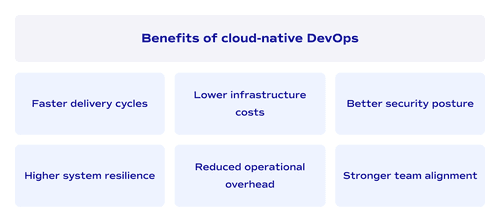
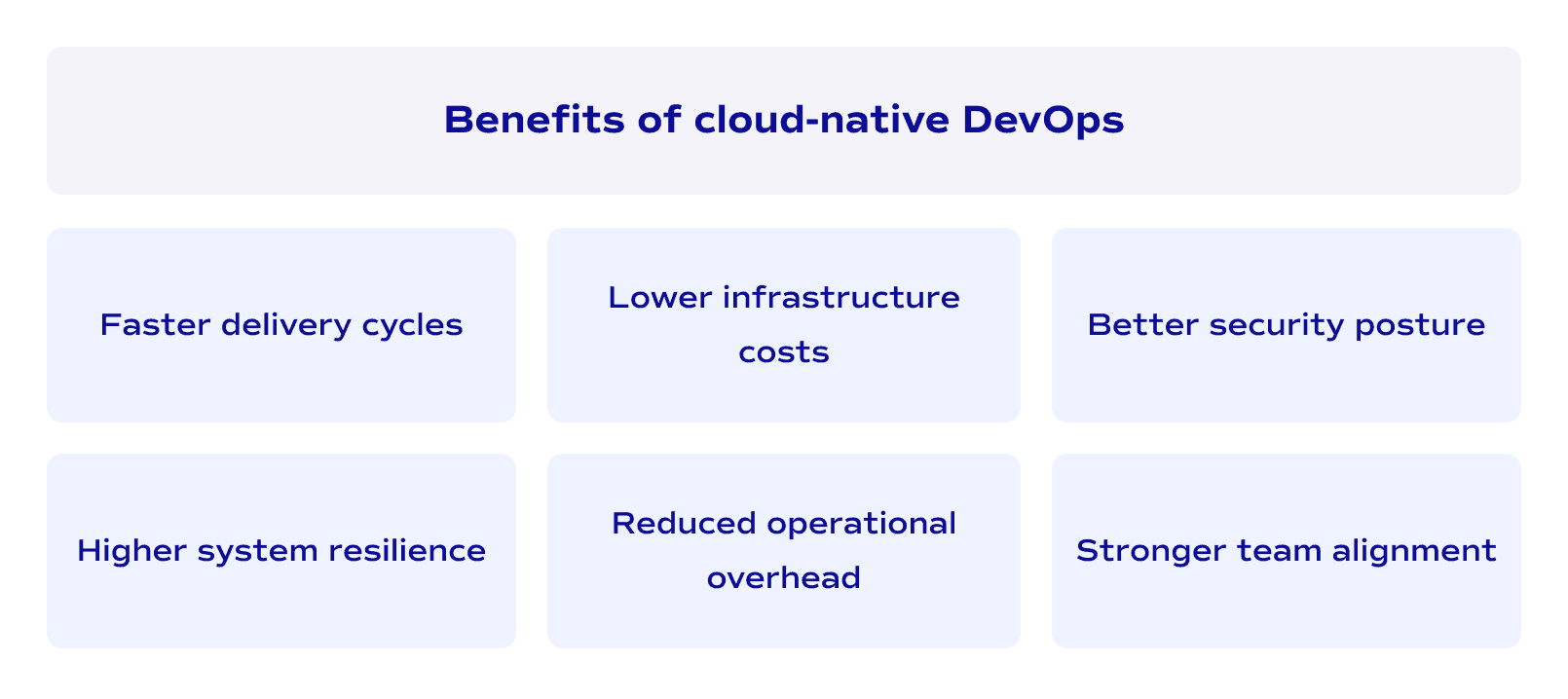
- Faster delivery cycles. Because each microservice has its own automated pipeline, a team can ship a bug fix or a feature update without coordinating a full-system release. At scale, that compounds. Organizations running mature cloud-native DevOps practices routinely deploy multiple times per day across independent services.
- Lower infrastructure costs. When everything is automated, resources scale with real demand. Overprovisioning disappears.
- Higher system resilience. When a service fails, cloud-native DevOps with Kubernetes restarts it automatically while the rest of the system keeps running. Combined with isolated failure domains, that means a crashed payment service no longer takes down the entire application. Recovery is measured in seconds, not in incident response hours.
- Reduced operational overhead. Automated pipelines replace manual deployments, so your team has less operational overhead.
- Better security posture. Vulnerability scans and compliance checks run inside the CI/CD pipeline on every commit. Security stops being a gate at the end of the release cycle and becomes a continuous signal throughout development, which is where it's actually useful.
- Stronger team alignment. Shared pipelines, shared ownership. Accountability stops falling through the gap between the two functions.
What you need to implement cloud-native DevOps in your team
Now, let's move to the practical part. Following the best practices for cloud-native DevOps doesn't require rebuilding everything at once. It requires a clear sequence. Here’s a basic template for this:
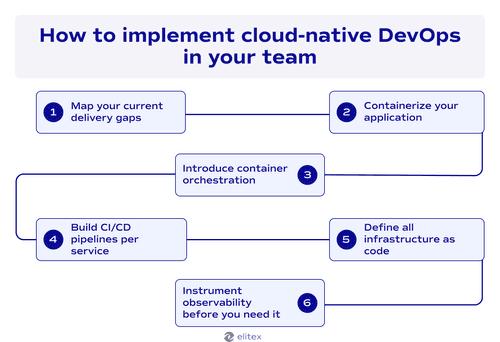
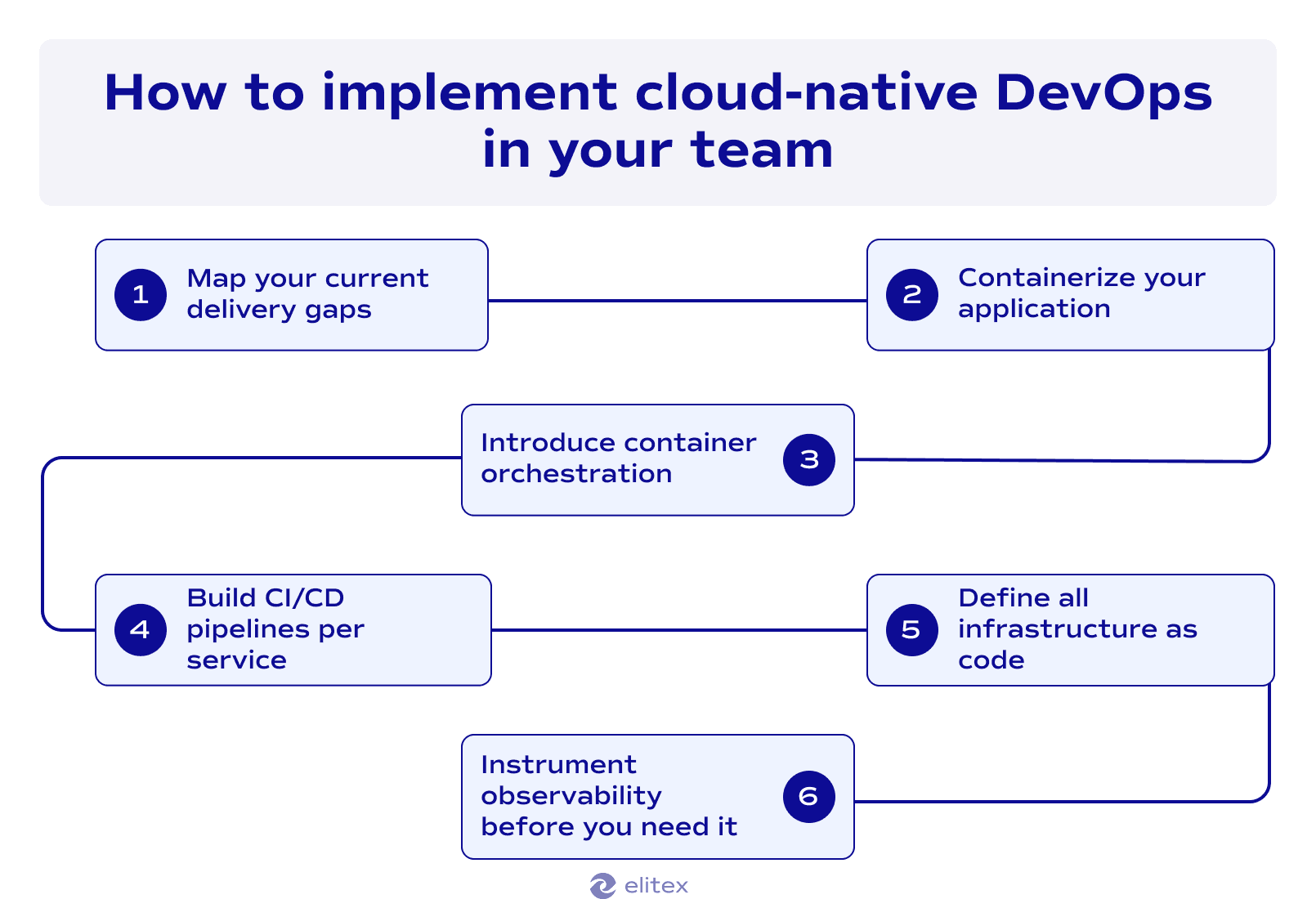
- Step 1: Map your current delivery gaps. Start with user story mapping to trace how work moves from idea to production. Where do handoffs stall? Where does IT operations spend most of its manual effort? Each bottleneck you identify here becomes a concrete automation target later.
- Step 2: Containerize your applications. Move each service into a containerized application with a consistent, reproducible runtime.
- Step 3: Introduce container orchestration. Deploy Kubernetes or a managed equivalent. Define health checks, resource limits, and restart policies from day one. Teams that skip this and add it later under production pressure consistently spend more time on it than those who set it up correctly at the start.
- Step 4: Build CI/CD pipelines per service. Learn how to leverage cloud-native DevOps pipelines by giving each service its own automated build, test, and deployment cycle. A single shared pipeline reintroduces the coordination overhead you're trying to eliminate.
- Step 5: Define all infrastructure as code. Make every environment reproducible from a version-controlled source file.
- Step 6: Instrument observability before you need it. Wire distributed tracing, structured logging, and alerting into each service during development. Following the best practices for cloud-native DevOps means treating observability as a build requirement, not an afterthought. Teams that wait until something breaks in production find themselves debugging without data during an active incident.
Cloud-native DevOps tools
We have a separate guide about DevOps automation tools that comprehensively covers the subject. Read it for more details. The cloud-native DevOps tools ecosystem is large, so rather than cataloguing everything, here are three categories where the right choice has the most impact.
- Kubernetes. Container orchestration is the operational backbone of any cloud-native setup. Kubernetes manages how containers are scheduled, scaled, and recovered across your infrastructure. Most teams don't run it on bare metal. Google Kubernetes Engine and Azure Kubernetes Service are the two most widely adopted managed options, and both remove the overhead of maintaining the control plane yourself.
- IaC tools. Terraform is the most widely adopted tool in this category. Rather than manual configuration or console clicks, teams declare the desired infrastructure state in source files, and Terraform handles execution. It tracks the current state of your environment and applies only the delta between what exists and what's defined. Development, staging, and production stay structurally identical because they're all built from the same files, which makes environment drift a non-issue.
- Observability tools. Prometheus collects metrics from every service in your cluster. Grafana turns those metrics into dashboards your team can actually read. Together, these cloud-native DevOps tools cover the observability layer that cloud-native systems depend on. Without visibility into how services behave under real load, you're operating blind.
Future of cloud-native DevOps
However, we should add that the way teams build and operate cloud-native applications with integrated DevOps principles is still evolving. Three shifts are worth watching closely in 2026:
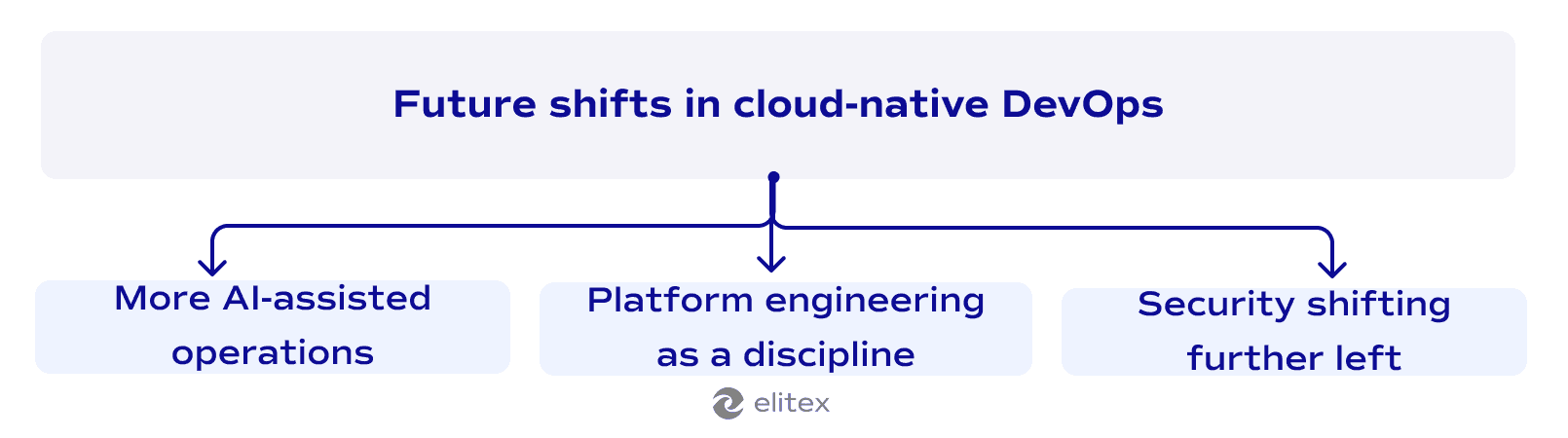
- AI-assisted operations. Anomaly detection, automated root cause analysis, and self-healing pipelines are moving from experimental to production-ready. The implication is significant: operations teams spend less time responding to incidents and more time preventing them.
- Platform engineering as a discipline. Internal developer platforms are becoming a standard layer between infrastructure complexity and application teams.
- Security shifting further left. We have previously written a text about shift-left in DevOps. However, compliance and vulnerability management are moving even more left, out of the release gate and into the earliest stages of the development cycle. As regulatory pressure on cloud environments increases, teams that have already embedded security into their pipelines will have a structural advantage over those still treating it as a final checkpoint.
Conclusion
Cloud-native DevOps is where architectural design and engineering culture meet. The article covered what cloud-native architecture actually means, why it creates a structural dependency on DevOps practices, and how that combination produces measurable outcomes in delivery speed, system resilience, and operational cost. The practical side is equally clear: implementation follows a sequence, the tooling ecosystem is mature, and the direction the field is heading makes early adoption a compounding advantage rather than a one-time investment.
If you're evaluating where to start or where you're stuck, that's exactly the kind of problem ELITEX works through with engineering teams. Our DevOps infrastructure automation services are built around cloud-native environments specifically. We've helped organizations move from manually managed, fragile infrastructure to systems that deploy independently, recover automatically, and scale with real demand. If that's the direction you're heading, ELITEX are a practical starting point.

FAQs
What is the difference between cloud-native and DevOps?
Cloud-native vs. DevOps is a common point of confusion, and the short answer is that they operate at different levels. Cloud-native is an architectural approach — it defines how applications are built and structured. DevOps is a cultural and operational practice — it defines how teams deliver and manage software. Neither replaces the other. Cloud-native architecture creates the conditions where DevOps practices become most effective, and DevOps provides the delivery discipline that cloud-native systems require to function at scale.
Do you need Kubernetes to run cloud-native DevOps?
Kubernetes is the most widely adopted orchestration platform for cloud-native environments, and for most teams it's the practical default. The best tools for cloud-native DevOps build around Kubernetes as a foundation. CI/CD systems, observability stacks, and IaC tooling all integrate with it natively. That said, managed options like Google Kubernetes Engine and Azure Kubernetes Service remove most of the operational burden of running it yourself.
How do you choose the right cloud-native DevOps tools?
Any cloud-native DevOps tools comparison should start with function, not brand. The three categories that have the most impact are container orchestration, infrastructure as code, and observability. Pick one mature tool in each category and integrate them properly before expanding the stack. The teams that struggle most are those that adopt too many tools before establishing a stable baseline.
How long does it take to implement cloud-native DevOps?
There's no fixed timeline. Teams that start from a legacy monolith with manual deployments are looking at a multi-month migration. Teams already running containers with partial automation can reach a mature cloud-native DevOps setup considerably faster. The sequence matters more than the speed. Containerization first, then orchestration, then pipelines, then observability. Skipping steps to move faster typically extends the overall timeline.