


- TL;DR: Cloud infrastructure management controls how applications run in the cloud while preventing cost overruns, which is important, considering that some researches show companies waste 27% of spending due to visibility gaps.
- Right cloud infrastructure management allows for faster resource allocation and predictable infrastructure costs.
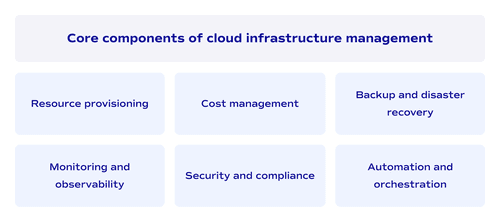
- Six core components power effective management: resource provisioning through infrastructure-as-code standardizes deployments, monitoring with DevOps observability tracks performance in real time, cost management tags resources to show where budgets go, security enforces access controls with network segmentation, backup and disaster recovery protect against data loss, automation orchestrates workflows that scale infrastructure during traffic spikes.
- In this article, we walk you through implementation of infrastructure management from initial resource audit to building automated optimization framework.
- Additionally, we cover 10 advanced infrastructure management practices, and take a closer look at common challenges and mitigation strategies.
- We also talk about future trends of cloud infrastructure and offer you an actionable insight into how to build successful cloud infrastructure management fast.
Cloud infrastructure management controls how your applications run in the cloud. It covers everything from provisioning servers to monitoring performance and controlling costs. Getting cloud infrastructure management right means your systems stay reliable while you avoid overspending on resources you don't actually need.
However, as our practice shows, most organizations struggle with this kind of visibility. In fact, it’s not only about our intuition; Flexera’s 2025 research found that companies waste 27% of their cloud spend on average because they lack clear processes for tracking what's running and why. Teams lose track of active resources. A developer spins up a test environment, forgets about it, and it runs indefinitely. The same pattern repeats across departments until the monthly bill reveals the damage.
As a DevOps automation services and solutions provider, we've tackled this visibility gap across hospitality PMSs, healthcare platforms, fintech applications, and ecommerce systems. What we’ve actually noticed is that the waste patterns look identical regardless of industry. So, based on our decade-long DevOps experience, we created this guide to explain how to prevent these patterns in your infrastructure. Without any further ado, let’s go!
What is cloud infrastructure management?
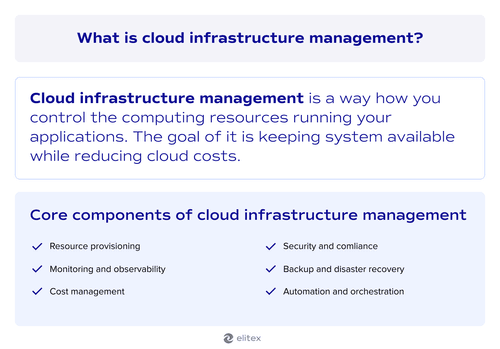
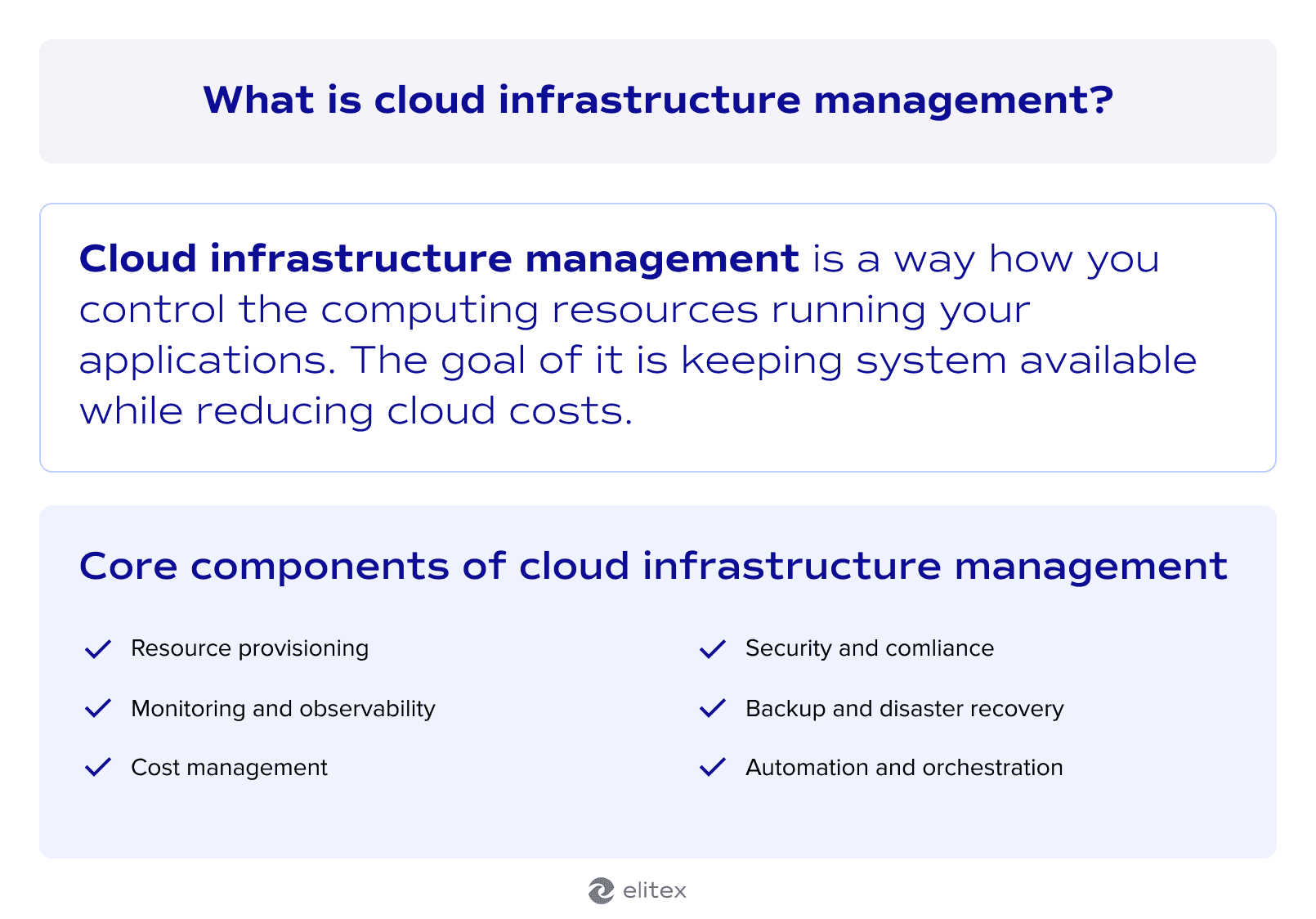
Cloud infrastructure management is how you control the computing resources running your applications. This includes the servers processing requests, storage holding your data, networking connecting everything together, and the tools monitoring performance. The goal is to keep systems available while controlling costs. Without active management, infrastructure grows chaotic. Proper cloud infrastructure management establishes visibility into what's running and why. This visibility enables confident scaling decisions based on actual usage patterns rather than guesswork about future needs.
Core components of cloud infrastructure management
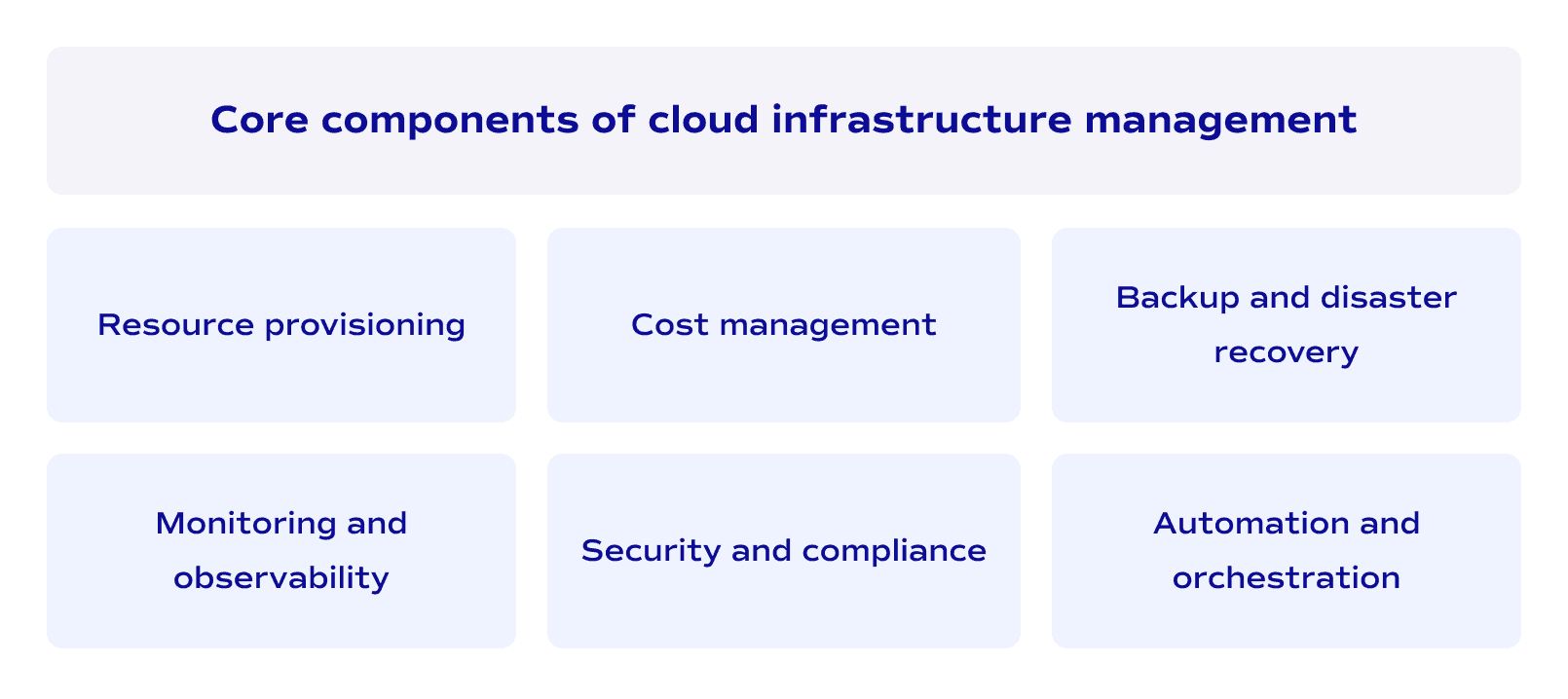
Resource provisioning
Resource provisioning controls how cloud resources get created. Here, standardization matters because manually configured environments drift apart over time. How does it work? Two engineers build what should be identical staging environments. One configures the database with slightly different timeout settings. The other uses a different version of the web server. These differences compound until the staging environment no longer matches production. Infrastructure-as-code solves this by defining cloud environments in version-controlled templates. The template specifies exact configurations. When someone needs a new environment, they execute the template. With infrastructure-as-code, every environment is created from a template that matches exactly. Because of this, configuration drift disappears.
Monitoring and DevOps-based observability
Monitoring and observability are essential for managing cloud infrastructure because you can't optimize what you can't measure. Monitoring tracks system health through metrics like uptime and response times. This tells you when problems occur. DevOps observability extends this by exposing internal system states. Consider a checkout flow slowdown. Monitoring shows elevated response times. Observability pinpoints the specific database query taking twelve seconds instead of fifty milliseconds. Without this visibility, you waste resources overprovisioning systems or miss optimization opportunities. Cloud infrastructure management depends on this data to make informed scaling decisions and identify waste.
Cost management
Cloud management requires tracking spending against actual business value. Cloud providers bill hourly for every resource you consume. Without visibility into these charges, monthly costs become unpredictable. Effective cost management tags cloud resources by project or customer. These tags power reports showing exactly which initiatives drive spending. For instance, the finance team sees that the mobile app refresh consumed 40% of the infrastructure budget while the legacy API modernization used only 15%. These numbers enable leadership to redirect spending toward high-impact initiatives. Resource allocation decisions improve when costs connect directly to business outcomes.
Security and compliance
Security and compliance protect cloud infrastructure from unauthorized access and data breaches. Cloud environments expose more attack surfaces than traditional data centers because resources are accessible over the internet. Identity management controls who can provision new resources. This prevents unauthorized users from spinning up expensive infrastructure or accessing sensitive data. Network segmentation isolates development environments from production systems. A compromised development credential can't reach production databases because network rules block that traffic path. Encryption ensures data remains protected even if the storage gets accessed improperly. These layers combine to create defense in depth, where breaching one control doesn't compromise the entire system.
Backup and disaster recovery
Backup and disaster recovery protect against data loss when cloud environments fail. Backups capture point-in-time snapshots stored separately from primary systems. Recovery time objectives define acceptable downtime durations. A customer-facing application might require a four-minute recovery while an internal reporting tool tolerates four hours. These objectives drive architecture choices. Meeting a four-minute RTO requires active-active configurations with load balancers distributing traffic across multiple regions. The four-hour RTO allows simpler backup-and-restore processes.
Automation and orchestration
DevOps infrastructure automation removes manual work from cloud operations. Scripts handle repetitive tasks like scaling servers when traffic increases or rotating access credentials on schedule. Orchestration coordinates these automated actions into cohesive workflows. Imagine this: traffic spikes during a product launch. Orchestration detects the load increase and begins scaling servers immediately. Load balancers receive updated configurations to distribute incoming requests. Monitoring thresholds adjust automatically to account for the new capacity. This coordination happens in seconds compared to the minutes or hours manual intervention would require.
Why it matters: Business impact and ROI
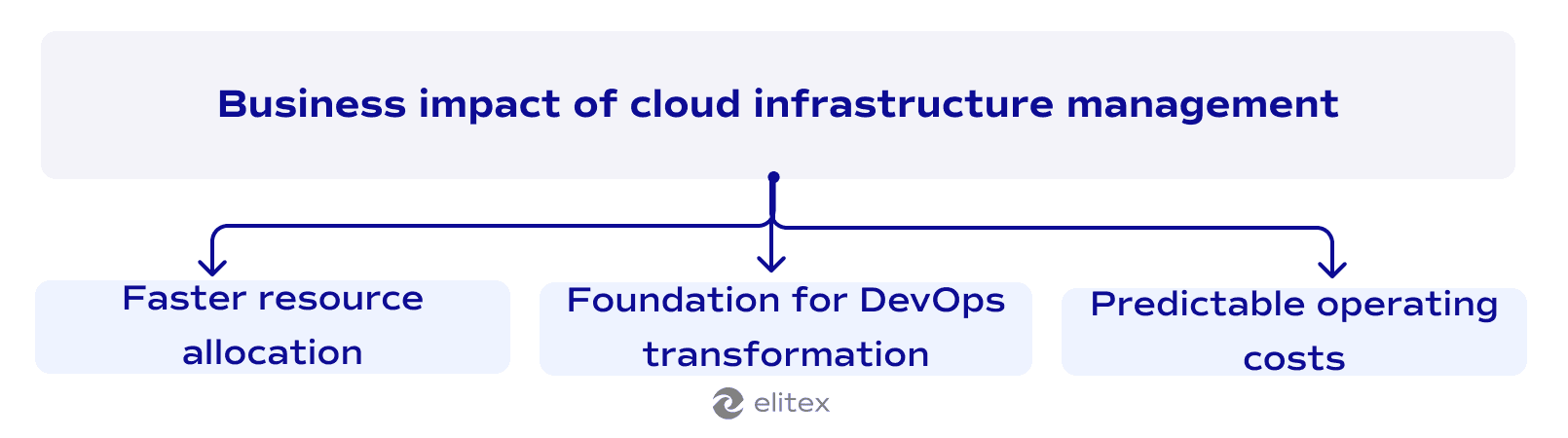
- Faster resource allocation: Cloud infrastructure management accelerates resource allocation by showing exactly where budgets go. With it, leadership sees which projects consume the most infrastructure spending. Additionally, high-priority initiatives get provisioned within hours instead of waiting weeks for capacity planning meetings. This speed matters when market opportunities have short windows.
- DevOps transformation foundation: DevOps transformation requires an elastic infrastructure that scales with demand. Cloud infrastructure management ensures the cloud ecosystem supports this elasticity without becoming a constraint. Mastering infrastructure operations removes deployment bottlenecks that slow feature releases. Such a technical foundation directly enables business agility.
- Predictable operating costs: Cloud infrastructure management converts variable spending into predictable budgets. Continuous tracking prevents monthly bill surprises that derail financial planning. Resource optimization identifies waste and redirects that spending toward new capabilities. The financial predictability lets leadership commit to growth initiatives with confidence.
How to manage cloud infrastructure: Step by step
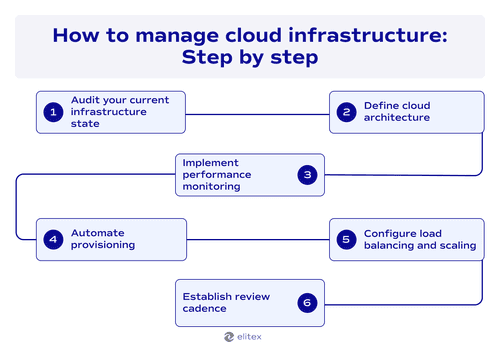
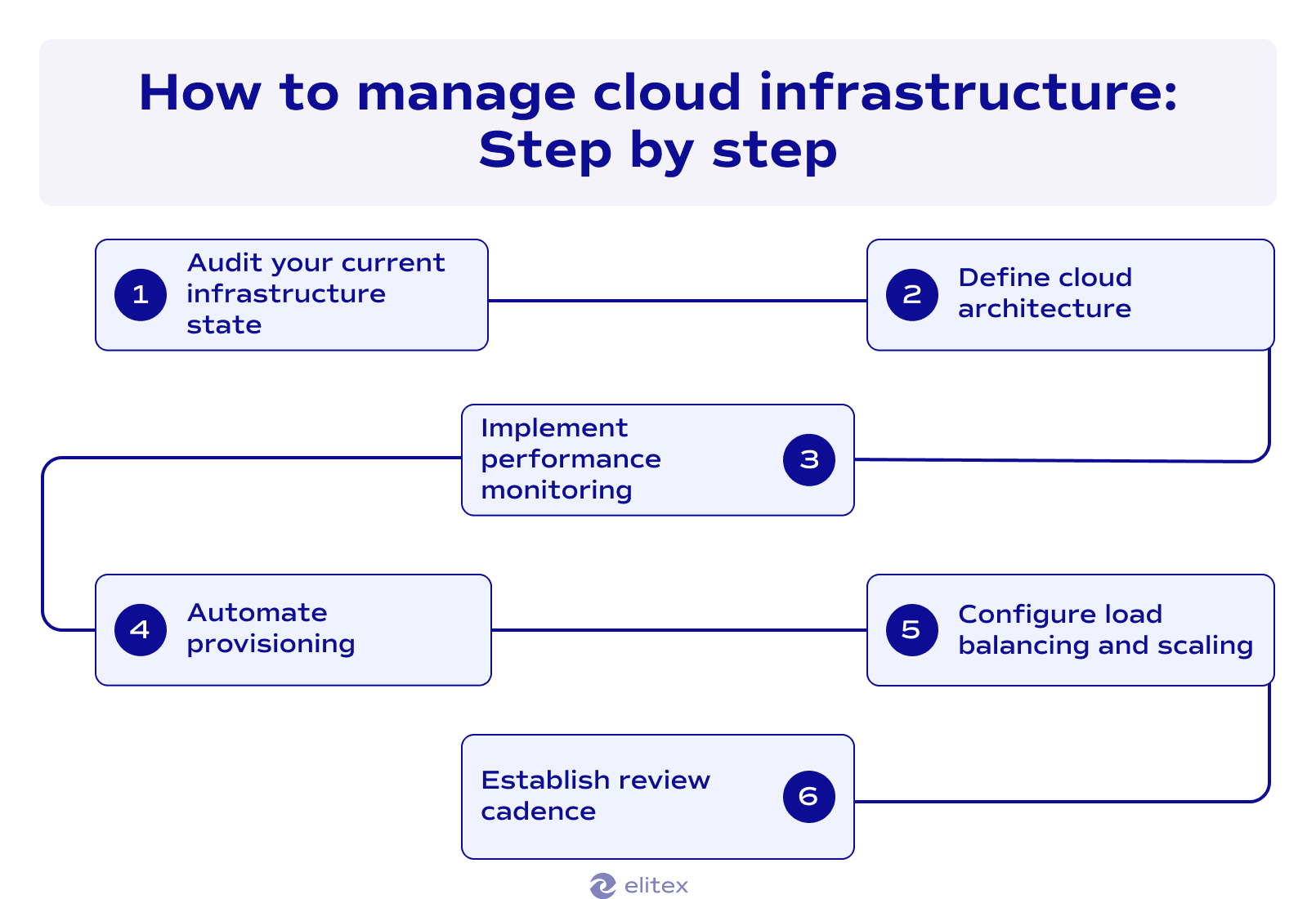
Step 1: Audit current state
Start by documenting all existing cloud resources across your organization. This inventory reveals duplicate virtual machines, forgotten test environments, and orphaned storage volumes. Understanding what you currently run establishes the baseline for improvement.
Step 2: Define cloud architecture
Cloud architecture determines how components connect and communicate. So, start with mapping your applications to identify dependencies between services. A typical web application needs virtual machines for the application tier, databases for data persistence, and load balancing to distribute traffic across multiple instances. Then, document the network topology showing which services can communicate and which remain isolated. This architecture will become the template for future deployments. Specifically for cloud migration roadmap and transition (if relevant), design an architecture that also specifies how data flows between your cloud environment and any remaining on-premises data centers.
Step 3: Implement performance monitoring and logging
Then, when you’ve done with the architecture, build performance monitoring and logging track system health in real time. Set up metrics collection for CPU usage, memory consumption, disk I/O, and network throughput across all virtual machines. Configure alerts that trigger when metrics exceed thresholds. Log aggregation centralizes application logs from distributed services into searchable storage.
Step 4: Automate provisioning
Then, create infrastructure-as-code templates that define cloud resources as version-controlled specifications. Provisioning new environments should involve executing a script instead of manual configuration.
Step 5: Configure load balancing and scaling
Set up load balancing to distribute traffic across your virtual machines. Configure health checks that automatically remove failing instances from rotation. Define autoscaling rules based on CPU utilization or request count. When traffic increases beyond your threshold, new virtual machines should provision automatically.
Note: Most cloud computing platforms offer managed load balancers that handle these operations without manual intervention during traffic spikes.
Step 6: Establish review cadence
Finally, remember that cloud infrastructure management requires ongoing optimization. Schedule monthly reviews examining how costs trend over time. Each review should identify opportunities to rightsize resources or eliminate waste.
Cloud infrastructure management tools & software
Now, let’s talk about cloud infrastructure management software. We’ve previously covered DevOps automation tools in a separate article, so this section focuses specifically on cloud management platforms and management software for infrastructure control.
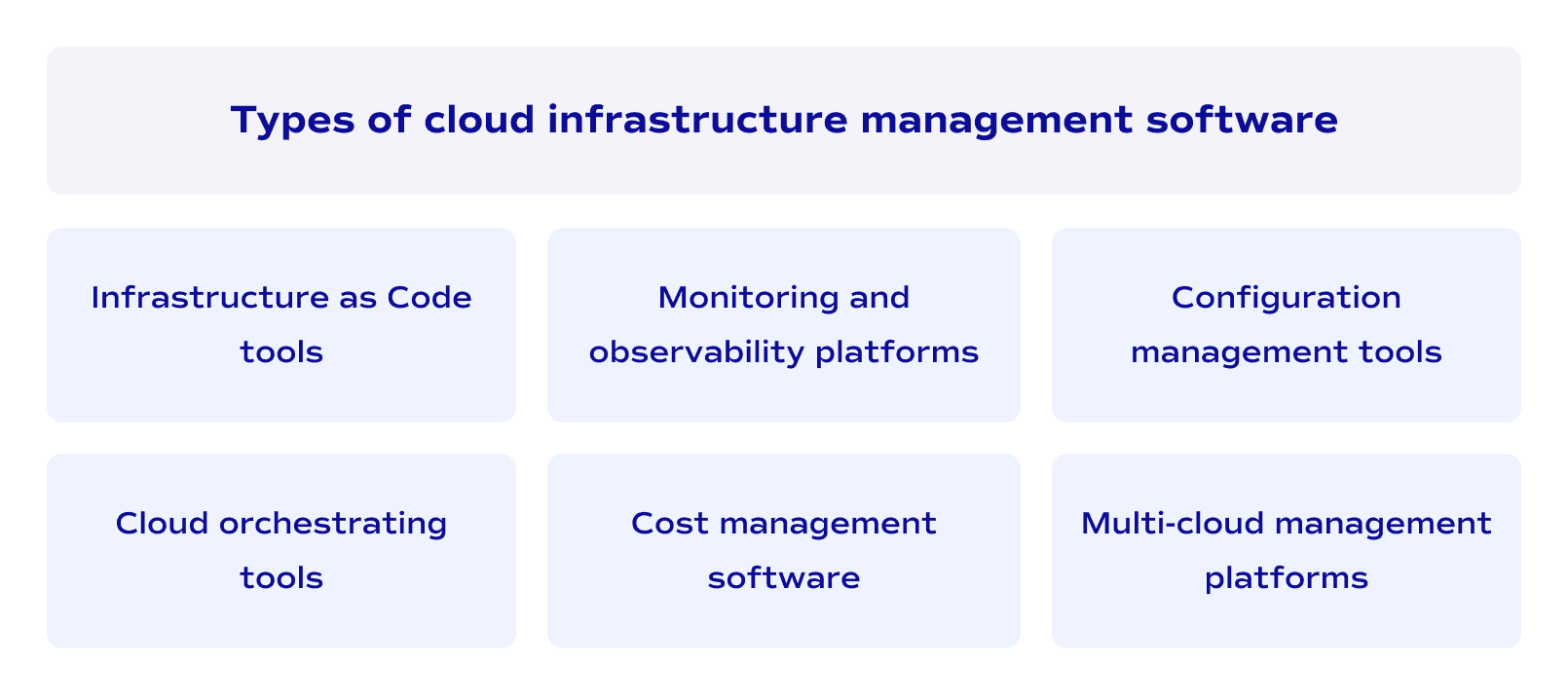
Infrastructure as Code tools
As mentioned above, the infrastructure as code approach defines your entire cloud setup in version-controlled files. There are several major tools that can help you implement IaC. Terraform enables multi-cloud provisioning through declarative configuration. AWS CloudFormation manages AWS resources natively. Pulumi lets you write infrastructure using standard programming languages like Python or TypeScript.
Cloud orchestrating tools
Cloud orchestrating tools coordinate how containerized applications run across multiple servers. Kubernetes has become the industry standard for this orchestration. It schedules workloads, scales capacity automatically, and restarts failed containers without manual intervention. Docker Swarm offers simpler orchestration integrated into Docker itself. The reduced complexity makes it accessible for teams new to container management.
Monitoring and observability platforms
These platforms collect metrics and logs from your infrastructure to show system health. Datadog provides unified dashboards across cloud environments with customizable alerts. Prometheus specializes in time-series metrics with powerful querying capabilities. New Relic combines infrastructure monitoring with application performance tracking. Grafana serves as a visualization layer on top of data sources like Prometheus. Splunk handles log aggregation at enterprise scale.
Cost management software
Cost management software analyzes cloud spending to identify waste. CloudHealth by VMware tracks expenses across multiple providers simultaneously. Cloudability focuses on cost allocation, breaking down spending by team or project.
Configuration management tools
Configuration management ensures servers maintain correct settings over time. Ansible uses agentless architecture to push configurations to systems. Chef defines infrastructure state using Ruby code. Puppet continuously monitors systems and corrects configuration drift automatically. SaltStack provides event-driven automation for configuration management.
Multi-cloud management platforms
Organizations running workloads across different cloud providers need unified management. HashiCorp Cloud Platform provides a single control plane for AWS, Azure, and Google Cloud. Google Anthos runs applications consistently across different environments. These platforms prevent vendor lock-in while maintaining operational consistency across diverse environments. Multi-cloud infrastructure introduces complexity that goes beyond tool selection, requiring distinct management approaches we'll examine separately in the following section.
Multi-cloud infrastructure management
Managing cloud infrastructure across multiple providers is achievable but demands more sophisticated coordination than single-cloud deployments. A multi-cloud environment increases complexity because each provider uses different APIs, pricing models, and service names. What AWS calls an EC2 instance, Microsoft Azure names a Virtual Machine. This inconsistency makes cloud infrastructure management harder in practice.
Cloud infrastructure management in multi-cloud environments requires unified tooling that abstracts provider differences. You need infrastructure-as-code templates that work across AWS, Azure, and Google Cloud without complete rewrites. Cost tracking must aggregate spending from multiple billing systems into coherent reports. Security policies must be enforced consistently, even though each provider implements controls differently. Monitoring becomes more complex because metrics come from disparate systems. The operational overhead justifies itself when multi-cloud prevents vendor lock-in or when specific workloads run better on particular providers. A machine learning pipeline might leverage Google Cloud's AI services while the web application runs on AWS for proximity to existing infrastructure. Managing cloud infrastructure this way requires accepting the complexity trade-off.
10 Cloud infrastructure management best practices & advanced strategies
- Implement automated resource cleanup policies: Configure policies that automatically delete cloud resources after specific timeframes. Test environments created for feature development should self-destruct after 30 days unless explicitly renewed.
- Establish a FinOps team for cloud infrastructure management: Create dedicated teams combining technical and financial expertise.
- Use spot instances for non-critical workloads: Cloud providers offer unused capacity at steep discounts through spot or preemptible instances. Batch processing jobs can tolerate interruptions and save 60-90% compared to standard pricing. The trade-off is that cloud computing providers can reclaim these instances with minimal notice when demand increases. Your workloads need automatic restart capabilities to handle these interruptions gracefully.
- Implement just-in-time access for cloud security: Grant elevated permissions only when needed, then automatically revoke them after a time window.
- Build self-service infrastructure catalogs: Create approved templates that teams can deploy independently. This accelerates development while ensuring cloud resources meet security standards from the start. The catalog approach reduces tickets to infrastructure teams while maintaining control over configurations.
- Optimize data transfer costs between regions: Cloud providers charge for data moving between regions. Architect applications to minimize cross-region traffic by colocating services that communicate frequently.
- Establish hybrid cloud connectivity with direct links: Hybrid cloud environments perform better with dedicated network connections. AWS Direct Connect and Azure ExpressRoute reduce latency while improving security by bypassing the public internet entirely.
- Implement chaos engineering for resilience testing: Deliberately inject failures into cloud infrastructure to verify systems recover correctly.
- Use cloud management tools for policy enforcement.
- Schedule regular rightsizing analysis for cloud server management: Managing cloud infrastructure requires continuous optimization as usage patterns change. Automated analysis tools identify instances running at low utilization that should be downsized. The savings compound because right-sized instances cost less while often performing better due to reduced resource contention.
As a bonus practice, you can always rely on one of the external cloud migration service providers, such as ELITEX.
Common challenges & solutions in cloud infrastructure management
Now, let’s take a look at how advanced cloud infrastructure management handles common challenges:
| Challenge | Solution |
| Visibility gaps across cloud services | Implement unified monitoring dashboards that aggregate metrics from all cloud services into a single view. Tag resources across environments to enable cost tracking and resource discovery |
| Private cloud integration complexity | Establish dedicated network connections between private cloud infrastructure and public cloud environments. Use hybrid cloud management platforms that provide consistent APIs across both deployment models. |
| Uncontrolled cloud storage growth | Configure lifecycle policies that automatically move infrequently accessed data to cheaper storage tiers. Schedule quarterly audits identifying orphaned volumes and outdated backups. Cloud storage optimization tools like Komprise and Lucidity can also help detect duplicate files that consume unnecessary space. |
| Inconsistent security protocols | Centralize security protocols through policy-as-code enforcement. Automated scanning helps catch violations before deployment reaches production. |
| Manual provisioning bottlenecks | Deploy cloud automation tools that provision infrastructure through self-service catalogs. Developers should access pre-approved templates without waiting for manual approval cycles. Cloud automation reduces provisioning time from days to minutes. |
| Compliance regulations tracking | Map cloud resources to specific compliance regulations through automated tagging. Continuous compliance scanning should generate audit reports showing which workloads meet regulatory requirements. Compliance regulations change frequently, so automated policy updates prevent violations. |
| Multi-cloud cost optimization | Use cost management platforms aggregating spending across public cloud infrastructure providers. Commitment-based discounts require analysis tools identifying which workloads justify reserved capacity versus spot instances. |
| Shadow IT proliferation | Implement governance policies requiring all cloud provisioning through centralized platforms. Finance integration shows department leaders their actual cloud spending, creating accountability. |
| Disaster recovery testing gaps | Schedule automated quarterly recovery drills restoring production data to isolated test environments. Document actual recovery times against stated objectives to identify architecture gaps requiring remediation. |
Cloud IT infrastructure management: Future outlook
Now, let’s take a brief look at what the future promises for cloud infrastructure management
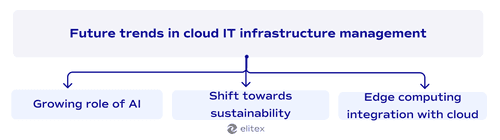
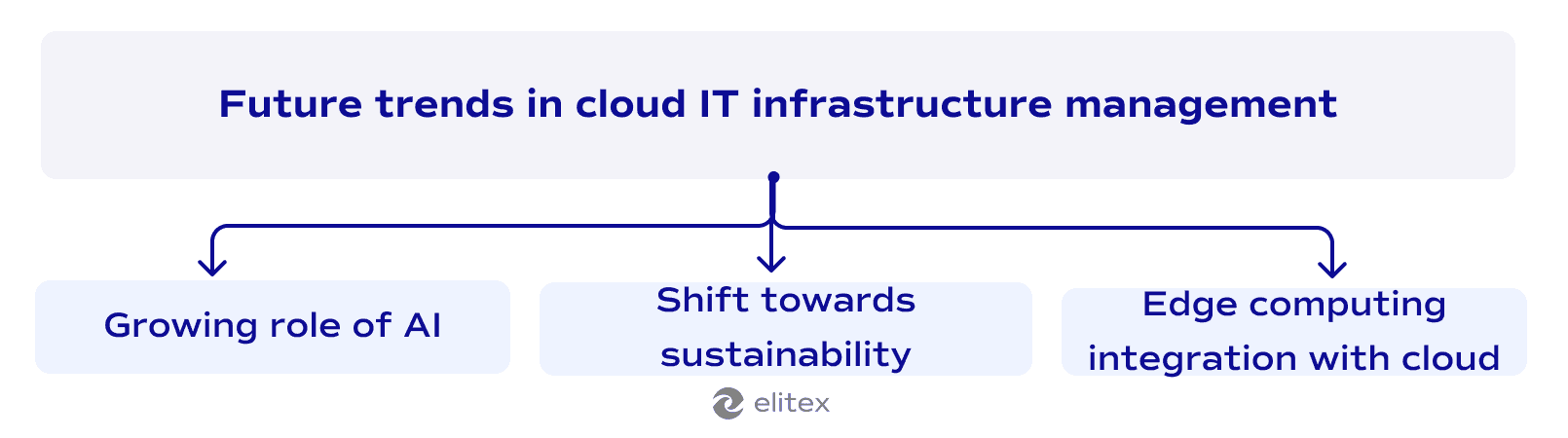
Growing role of AI in cloud infrastructure management
We see how AI is shifting from recommendation engines to autonomous decision-making in cloud infrastructure management. Current cloud management tools suggest rightsizing options or flag underutilized resources. Future systems will likely execute these optimizations automatically based on predicted demand patterns. This reduces manual intervention while maintaining performance standards.
Edge computing integration with cloud services
Edge computing brings cloud services closer to where data gets generated. Data centers at the network edge process information locally before sending results to the centralized cloud infrastructure. This architecture reduces latency for real-time applications that can’t tolerate round-trip delays to distant data centers. Manufacturing sensors exemplify this need with millisecond response times that long-distance cloud calls can’t provide. Healthcare monitoring provides another use case requiring immediate analysis without depending on internet connectivity. Cloud infrastructure management in these cases needs to coordinate resources across both centralized facilities and distributed edge locations. The complexity increases, but the performance benefits justify the operational overhead.
Sustainability-driven infrastructure decisions
Carbon footprint tracking will become a standard metric in cloud infrastructure management alongside cost and performance. Cloud service providers already publish sustainability data for their data centers, showing renewable energy percentages. Organizations will optimize workload placement based on this data. Regulatory requirements around carbon reporting will accelerate adoption. Cloud infrastructure management platforms will need to balance traditional metrics with environmental impact.
Looking for a fast way to build your infrastructure management?
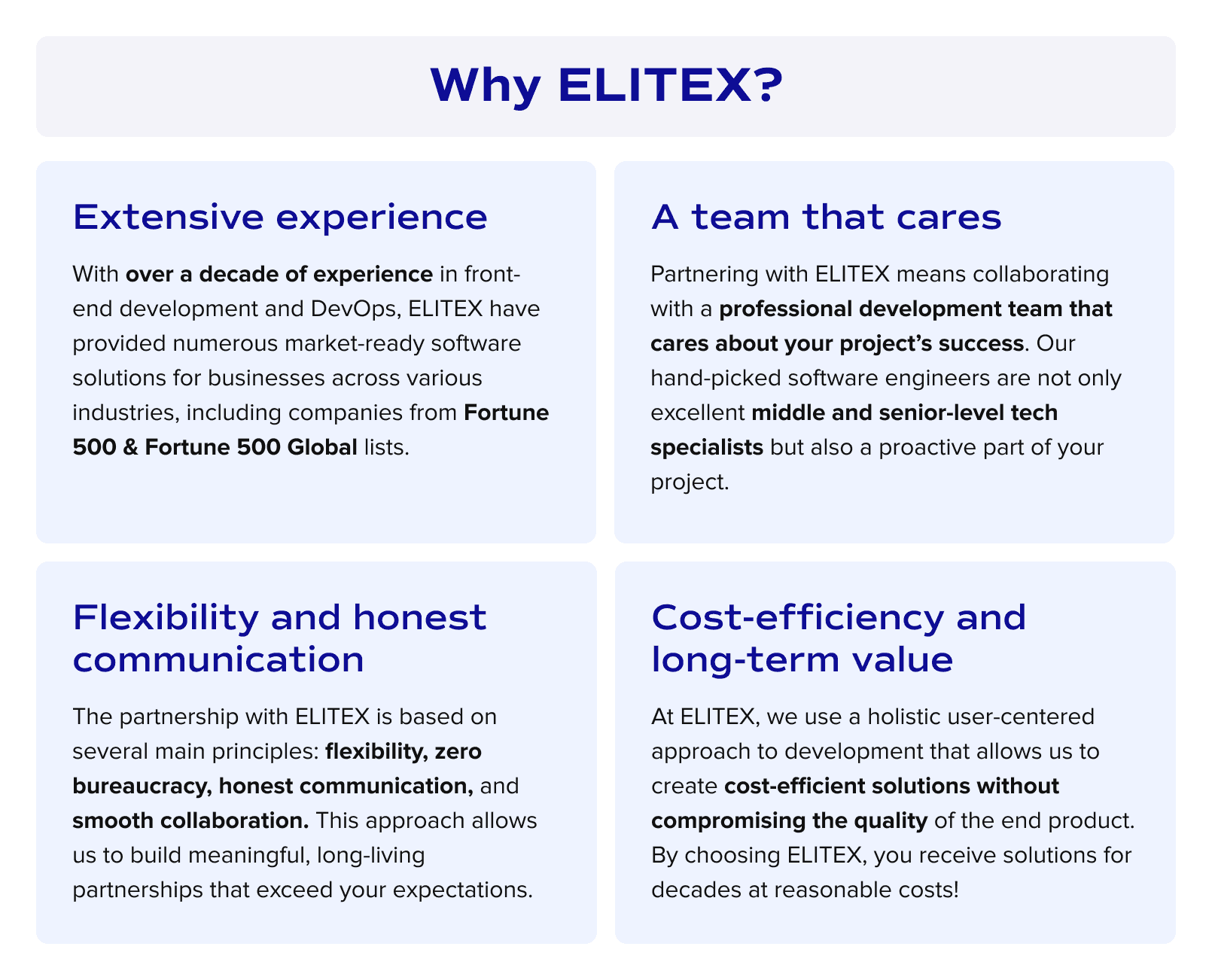
ELITEX provide cloud infrastructure management services with deep cross-industry expertise. We’ve worked extensively in healthcare and fintech, while also serving real estate, hospitality, ecommerce, publishing, and science sectors. The ELITEX team consists of 90% mid and senior-level engineers specializing in cloud cost optimization. Our results speak volumes: one of our fintech clients reduced infrastructure costs by 90% through our automated resource management approach.
Currently, we manage dozens of cloud infrastructures across various industries, delivering cost efficiency without compromising performance. If you need a tech partner who understands cloud infrastructure management from both technical and business perspectives, reach out ELITEX. With us, you’ll receive results beyond all initial expectations!
FAQs
What is cloud infrastructure management?
Cloud infrastructure management controls how computing resources get provisioned, allocated, monitored, and optimized in cloud environments. Cloud infrastructure management covers everything from server deployment to cost tracking.
How does cloud infrastructure management differ between public cloud and private cloud?
Public cloud infrastructure management relies on provider tools from platforms like Amazon Web Services or Google Cloud Platform. The provider handles physical infrastructure maintenance while you control resource provisioning through their APIs. Private cloud requires managing your own data centers with similar controls for provisioning and monitoring. You're responsible for hardware maintenance, capacity planning, and physical security. The management processes remain similar, but operational responsibility shifts. Public cloud lets you focus on workload optimization. Private cloud demands attention to underlying infrastructure health.
How do virtual networks fit into cloud infrastructure management?
Virtual networks segment cloud resources into isolated environments. Cloud infrastructure management defines which services can communicate across these network boundaries.
What’s the difference between cloud system management and cloud infrastructure management?
Cloud system management focuses on application-level operations. Cloud infrastructure management, in turn, handles the underlying compute, storage, and networking resources supporting those applications.
What security capabilities does cloud infrastructure management provide?
Cloud infrastructure management enforces access controls, determining who can provision resources. It also implements network segmentation, preventing unauthorized access between environments.
What are cloud infrastructure management best practices?
Cloud infrastructure management best practices center on automation and visibility. Automate resource provisioning through infrastructure-as-code to ensure consistency across environments. Tag every resource with project and owner information for cost tracking. Implement automated backup procedures with regular recovery testing to verify they actually work during disasters. Monitor resource utilization continuously to identify rightsizing opportunities. Enable security scanning in deployment pipelines to catch misconfigurations before production. Schedule regular cost reviews examining spending trends to prevent budget surprises.
POSTED IN: