



- TL;DR: Cloud migration means moving your digital infrastructure from on-premise environments to cloud-based ones. It's rarely a single event, and the decisions involved compound quickly without a clear plan.
- Cloud migration services cover the full project lifecycle, from infrastructure and application migration through to security setup and ongoing managed services after go-live.
- Partnering with external cloud migration service providers delivers faster time to value and access to DevOps automation tooling. Security features get embedded from the start, and experienced teams route around migration complexities before they become incidents. Post-cutover, good providers are accountable for performance improvements and knowledge transfer through cloud migration workshops.
- The article includes a 10-point checklist to understand whether you need external expertise for cloud migration implementation. If you match 3 or more items, bringing in an external partner is worth serious consideration.
- We profile 7 cloud migration service providers of various sizes and expertise. ELITEX and Gart Solutions serve startups and mid-sized organizations. Simform suits product companies that need engineering and cloud infrastructure delivered together. Nordcloud is the strongest fit for European enterprises with multi-cloud complexity. Accenture and IBM Consulting operate at a global enterprise scale. Capgemini specializes in regulated industries with SAP or Oracle environments.
Moving infrastructure to the cloud sounds straightforward until you're actually in it. Decisions pile up fast: which workloads move first, what happens to legacy systems, how you keep things running while everything shifts underneath. That's exactly where cloud migration service providers come in. They've done this enough times across enough industries to know where projects stall and why. So whether you're running a fintech platform that can't afford downtime or a healthcare system sitting on a decade of on-premise infrastructure, the right cloud migration services can mean the difference between a clean transition and a six-month recovery project.
Understanding cloud migration and cloud migration services
Cloud migration means moving your digital infrastructure from on-premise environments to cloud-based ones. That includes servers, storage, databases, and the applications running on top of them. In practice, it's rarely a single event. Application migration alone involves its own layer of decisions around compatibility, dependencies, and performance across different cloud platforms. If you want to understand how a full project unfolds from assessment to cutover, our cloud migration roadmap article covers the process in detail. We've also written separately about cloud migration for small businesses, since the constraints and priorities there look quite different.
Cloud migration services typically cover:
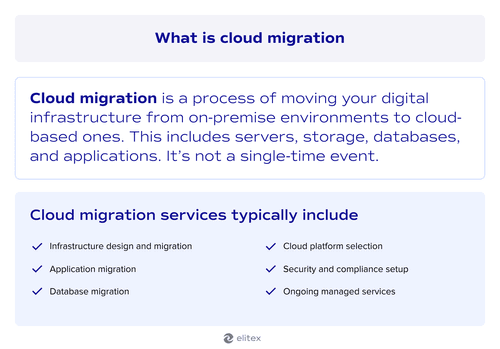
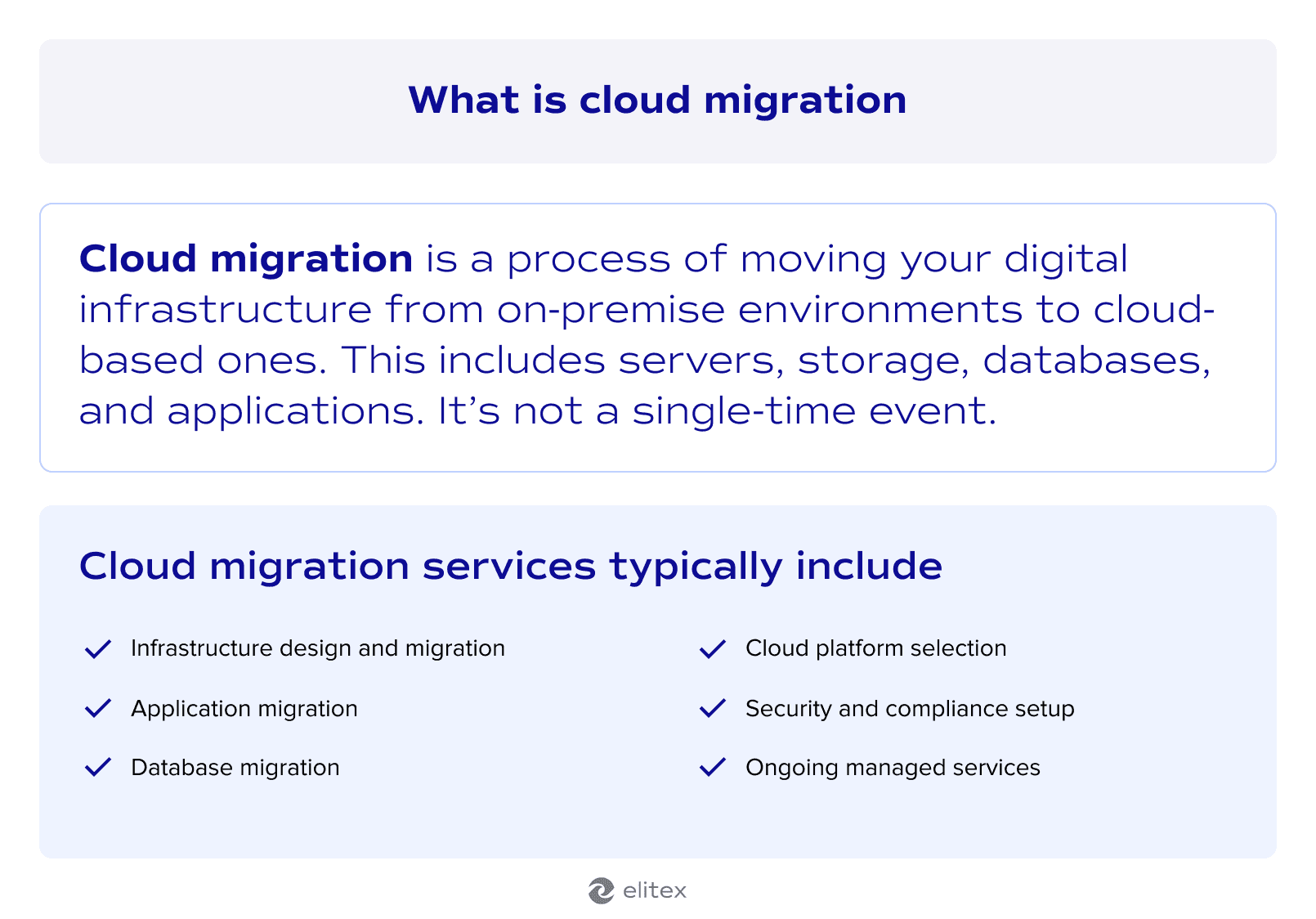
- Infrastructure migration: Moving servers and storage from physical hardware to cloud-based equivalents, often the first and most visible phase of any migration project.
- Application migration: Relocating existing software to run on cloud platforms. Depending on how the application was originally built, this can be as simple as a lift-and-shift or as involved as a full architectural rewrite.
- Database migration: Transferring databases with minimal data loss and downtime.
- Cloud platform selection and architecture design: Helping you decide between cloud providers, such as AWS, Google Cloud, or Azure, based on your workload profile, compliance requirements, and long-term cost model. This is where a lot of migrations quietly succeed or fail before a single server moves.
- Security and compliance setup: Configuring access controls, encryption, and audit logging in the new environment.
- Ongoing managed services: Some providers don't stop at migration. Models, such as managed DevOps services, cover post-migration, monitor infrastructure, handle updates, and optimize cloud spend as your usage patterns evolve.
What cloud migration does for your business
Cloud adoption tends to start as an infrastructure decision and end up touching much more. Here's what actually changes once you're operating in cloud environments:
- Cost structure shifts from fixed to variable. On-premise hardware means paying for peak capacity whether you use it or not. Cloud billing scales with actual consumption, which matters most for businesses with uneven or seasonal workloads.
- Application modernization becomes possible at a realistic pace. Legacy systems are hard to update when they're tightly coupled to physical infrastructure. Moving to the cloud creates the separation needed to refactor, rebuild, or replace applications (we’ll return to this point in the following section) without disrupting everything else running alongside them. That's where digital transformation stops being a talking point and starts being a project plan.
- Customer experience gets a more reliable foundation. Cloud environments offer redundancy and uptime guarantees that most on-premise setups can't match without significant additional investment. For product teams, that means fewer incidents. For customers, it means less friction at the moments that matter.
Cloud migration strategies
Most cloud migration service providers organize their approach around a framework called the 7 Rs. Choosing the right strategy depends on your application's architecture, your tolerance for risk, and how much you're willing to invest upfront. Data migration best practices shift depending on which path you take, so it's worth understanding each option before committing.
- Rehost (Lift and Shift): Move applications to the cloud without changing their architecture. It's the fastest path to migration, though it leaves most optimization gains on the table.
- Replatform: Make targeted adjustments so the application takes advantage of cloud-native capabilities, without a full rebuild. A middle ground between speed and optimization.
- Refactor / Re-architect: Redesign the application from the ground up to run natively in cloud environments. This is the most resource-intensive strategy, but it's the one that delivers the deepest long-term performance and cost benefits. Teams typically pursue this route when the existing codebase has become a genuine constraint on growth.
- Repurchase: Replace an existing application with a SaaS alternative. Common with CRM systems, HR platforms, and similar tools, where a ready-made cloud product already covers the use case.
- Retire: Decommission applications that are no longer needed. Running a proper audit before migration often reveals more of these than expected.
- Retain: Keep certain workloads on-premise, at least for now. Not everything belongs in the cloud, and good data migration best practices include knowing what you shouldn’t move.
- Relocate: Transfer infrastructure to the cloud with minimal changes at the hypervisor level, typically within the same cloud provider's ecosystem. Faster than refactoring, more controlled than a straight lift-and-shift.
Benefits of partnering with leading cloud migration service providers
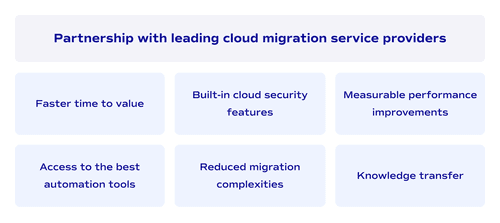
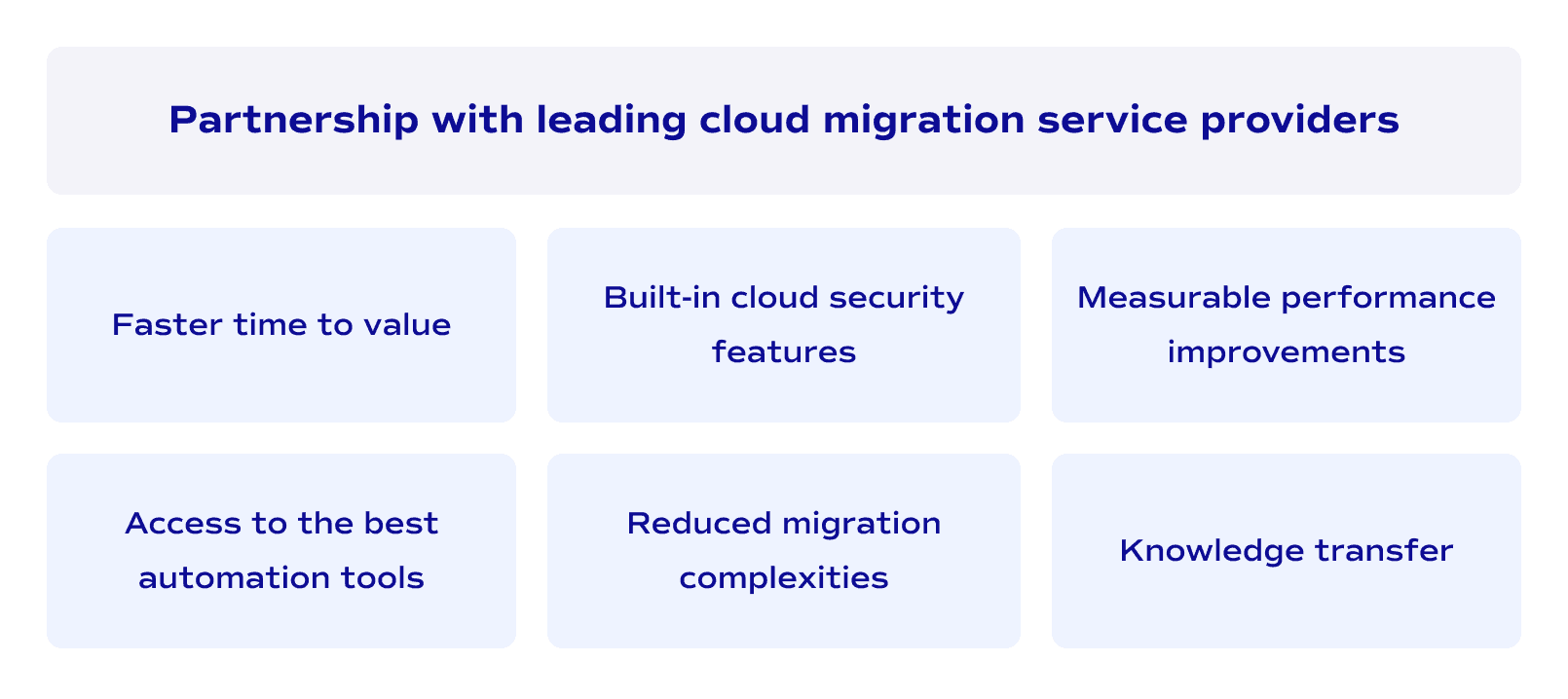
- Faster time to value. Cloud migration services companies bring pre-built playbooks and tooling that compress project timelines. What takes an internal team months to figure out is often a solved problem for an experienced partner.
- Access to the best DevOps automation tools. Established cloud migration firms maintain their own automation tooling for provisioning, monitoring, testing, and deployment. This reduces manual effort and cuts the margin for human error across the migration.
- Built-in cloud security features. Security configuration is where migrations most often go wrong without specialist input. A qualified partner embeds cloud security features from the start rather than retrofitting them after the fact.
- Reduced migration complexities. Legacy system modernization, compliance requirements, and multi-cloud environments all introduce friction that compounds quickly. Experienced providers have dealt with these migration complexities enough times to route around them before they become incidents.
- Measurable performance improvements. Beyond getting workloads into the cloud, good providers are accountable for performance improvements in speed, uptime, and infrastructure cost after the migration completes.
- Knowledge transfer through cloud migration workshops. The best engagements don't create permanent dependency. Cloud migration workshops run during or after the project leave your internal team genuinely capable of managing what was built.
Does your business need a partnership with cloud migration vendors?
If you match 3 or more of the following, bringing in external experts is worth serious consideration.
☐ Your engineering team has never executed a production migration before.
☐ Your application runs on infrastructure that hasn't been significantly updated in 5 or more years.
☐ You operate in a regulated industry where compliance requirements affect how data can move and where it can live.
☐ Your business can't tolerate more than a few hours of unplanned downtime.
☐ You're migrating more than one critical system at the same time.
☐ Nobody on your current team holds active certifications on your target cloud platform.
☐ Your codebase has significant undocumented dependencies that aren't fully mapped.
☐ You've already attempted a migration internally, and it stalled or was rolled back.
☐ Your cloud spend has been growing without a clear explanation of why.
☐ You need the migration completed within a fixed deadline tied to a contract, funding event, or infrastructure end-of-life.
Top 7 cloud migration service providers
Now, when the theory is done, let’s move to the practical part. Let’s start with a cloud migration service providers comparison. When comparing top cloud migration service providers, the differences come down to scale, specialization, and pricing transparency. Here's how the seven candidates from today’s list stack up:
| Provider | Founded | Best for | Cloud platforms | Pricing model |
| ELITEX | 2015 | Startups and mid-sized orgs needing senior-heavy teams | AWS, Azure, GCP | $30-70/hr |
| Accenture | 1989 | Large enterprises with multi-regional complexity | AWS, Azure, GCP | Outcome-based |
| IBM Consulting | 1991 | Organizations running IBM mainframe infrastructure | IBM Cloud, AWS, Azure | Structured multi-phase |
| Capgemini | 1967 | Regulated industries with SAP/Oracle environments | Azure, AWS, GCP, OCI | Custom |
| Simform | 2010 | Product companies needing cloud and engineering in parallel | AWS, Azure, GCP | $50–$99/hr |
| Nordcloud | 2011 | European enterprises with multi-cloud or sovereignty needs | AWS, Azure, GCP | Custom |
| Gart Solutions | 2020 | SMBs needing transparent pricing and hands-on DevOps | AWS, Azure, GCP | $45–$75/hr |
1 . ELITEX
- Core expertise: DevOps automation, cloud migration for small and medium businesses, DevOps infrastructure automation services, CI/CD implementation services, DevSecOps consulting, legacy software modernization, managed cloud services.
- Industries: Hospitality, fintech, healthcare, ecommerce, real estate, publishing
- Clutch rating: ★4.9/5
ELITEX is a DevOps automation and cloud infrastructure company founded in 2015, with a team that is 90% middle and senior-level engineers. That ratio matters in migration work. Cloud migrations fail at the edges, and having experienced engineers involved across the full engagement rather than only at the architecture stage is what keeps edge-case failures from turning into incidents.
The company's track record includes infrastructure cost reductions of up to 90% for a Swiss fintech client, alongside delivery work for clients like Smartrr, res:harmonics, and OA Switchboard. ELITEX work with startups and mid-sized organizations, which means their approach is calibrated for teams that don't have unlimited runway to absorb a migration that drags on.
2 . Accenture
- Core expertise: Cloud strategy, automation strategy consulting, application modernization, AI-driven migration, multi-cloud architecture.
- Industries: Financial services, healthcare, retail, manufacturing, public sector.
Accenture is one of the leading cloud migration service providers globally, running a dedicated "Cloud First" initiative that applies its own proprietary assessment tool, myNav, to map infrastructure before a single workload moves. The company operates across AWS and all major cloud platforms through formal strategic partnerships, applying migration strategies and longer-term modernization thinking to each engagement.
What sets Accenture apart at the enterprise tier is the combination of automation strategy consulting and deep industry knowledge. For clients running complex multi-regional systems, the company handles serverless architectures as part of its refactoring work, which reduces long-term IT costs by moving workloads off legacy compute models. Pricing is custom and outcome-based for large transformation programs, which suits organizations where the scope of the migration is tied directly to measurable business results.
3 . IBM Consulting
- Core expertise: Hybrid cloud migration, IBM Cloud, mainframe modernization, AI-powered infrastructure, cloud security.
- Industries: Financial services, government, healthcare, insurance, telecommunications.
IBM Consulting is among the best cloud migration service providers for organizations whose existing infrastructure runs on IBM systems. Their hybrid cloud approach is built around the Red Hat OpenShift ecosystem, and IBM Cloud acts as the primary platform for clients moving away from on-premise mainframe environments. Few providers carry comparable depth of knowledge for modernizing IBM-native architectures.
Beyond mainframe work, IBM Consulting covers end-to-end data transfer at enterprise scale, building migration plans that account for compliance requirements and data residency from the start. Their pricing model tends toward structured, multi-phase engagements, which makes them a strong fit for heavily regulated industries where governance requirements need to be documented throughout the entire project.
4 . Capgemini
- Core expertise: Security-led cloud migration, Microsoft Azure, SAP and Oracle modernization, DevSecOps, compliance architecture.
- Industries: Financial services, energy, retail, public sector, insurance.


Capgemini has built its cloud migration practice around a security-led framework that incorporates security check automation throughout the migration rather than treating it as a post-migration review. For regulated industries, this distinction matters more than most providers acknowledge upfront. The company's work on Microsoft Azure and Oracle environments is well-documented across its client base.
Capgemini migrated 242,500 workloads in 2024 and holds formal partnerships with all major hyperscalers. Their migration strategies tend toward thorough assessment phases before execution begins, which means slower starts but fewer surprises during cutover. Pricing is custom, and the engagement model is best suited to large organizations with defined compliance obligations.
5 . Simform
- Core expertise: Cloud-native services, serverless architectures, DevOps automation services, CI/CD pipelines, AI/ML engineering, application modernization.
- Industries: Fintech, healthcare, supply chain, retail, SaaS, professional services.
Simform is a digital engineering company founded in 2010, headquartered in the US, and ranked 3rd globally on Clutch's Spring Custom Software Development list across more than 41,000 competing firms. Their cloud migration work is tightly integrated with product engineering, which makes them a practical fit for product companies that need infrastructure and application work delivered in parallel rather than in sequence.
On the technical side, Simform's migration engagements include serverless architectures on AWS and CI/CD pipeline setup as standard deliverables. Verified client work includes backend development and cloud infrastructure for an enterprise AI supply chain SaaS platform, with a confirmed pricing model starting at $50 to $99 per hour. For mid-sized product teams looking for a partner that spans cloud infrastructure and software delivery without splitting those workstreams across two vendors, Simform's co-engineering model is worth a close look.
6 . Nordcloud
- Core expertise: Cloud migration, cloud-native application development, managed DevOps services, DevOps, multi-cloud DevOps strategy, FinOps.
- Industries: Financial services, manufacturing, automotive, healthcare, retail, public sector, telecommunications.
Nordcloud is a European cloud specialist founded in 2011, headquartered in Helsinki, and now operating as an IBM company. The acquisition gave Nordcloud IBM's global reach while keeping its cloud-native focus intact. The company holds AWS Premier Consulting Partner, Microsoft Azure Expert MSP, and Google Cloud Premier Partner status across all three major platforms, with over 1,300 engineers across 10 European hubs and more than 1,000 completed cloud projects on record.
Their industrialized migration approach uses proprietary tooling to automate discovery and VM migration at scale, which reduces manual effort and shortens timelines on large workload portfolios. Verified client work includes building BMW Group's multi-cloud governance platform, helping Syngenta save half a million euros per month after migration, and reducing Veolia's cloud spend by 12.5%. For European enterprises with data sovereignty requirements or multi-cloud complexity, Nordcloud's platform-neutral positioning and deep regional compliance knowledge are practical advantages that pure-play US providers often can't match.
7 . Gart Solutions
- Core expertise: Cloud-native services, DevOps automation services, CI/CD pipelines, software product enhancement services, AWS and Azure architecture, and Infrastructure as Code.
- Industries: Fintech, healthcare, ecommerce, SaaS, gaming, telecommunications.
Gart Solutions is a boutique cloud and DevOps provider founded in 2020, headquartered in Kyiv with a branch in Stockholm. Among cloud migration service providers at the SMB and mid-market tier, Gart stands out for its hands-on engineering model and transparent pricing. The company holds a 4.7 out of 5 rating on Clutch and was named a Clutch Global Leader in Fall 2024 across cloud security and Google Cloud consulting categories.
Verified client results include a 30-40% overall application performance increase for a gaming platform migrated to AWS, and a 90% reduction in Azure infrastructure costs for a software development company through targeted architecture improvements. Gart builds CI/CD pipelines and implements Infrastructure as Code as standard deliverables in its migration engagements, so DevOps automation services are embedded from day one rather than bolted on later. Their pricing model is transparent and resource-based, with Cloud Architect rates starting at $65 per hour and DevOps Engineer rates at $45 per hour, making cost forecasting straightforward from the discovery phase.
Get a free consultation directly from cloud migration service providers
Choosing between cloud migration service providers comes down to fit rather than reputation. The scale of your infrastructure, your compliance obligations, and how much internal capacity you have to manage the process will point you toward very different partners on this list. So before committing to a discovery call with anyone, get clear on what you actually need from the engagement. When you're ready, contact us, and we'll help you figure out where to start.
Best cloud migration companies FAQ
What is the difference between cloud migration and managed cloud services?
Cloud migration is the one-time process of moving infrastructure, applications, and data to the cloud. Managed cloud services cover what happens after — ongoing monitoring, optimization, and infrastructure management. Many cloud data migration companies offer both, but they're separate scopes with different timelines and cost structures.
How do I find a reliable cloud migration service providers list?
Clutch is the most reliable source for a verified cloud migration service providers list. Each profile includes client reviews, confirmed service offerings, and ratings based on actual project outcomes. Industry analyst reports from Gartner and ISG also publish rankings worth cross-referencing.
Are there strong cloud migration companies in the USA specifically?
Yes. Cloud migration companies in the USA range from large consulting firms like Accenture to mid-sized specialists like Simform, and boutique agencies like ELITEX. The US market is particularly well-served for AWS-native migrations, with many providers holding AWS Premier Partner status and MAP program credentials.
What should I look for in IT service management cloud migration providers?
IT service management cloud migration providers should be evaluated on three things: their track record in your industry, the seniority level of engineers assigned to client work, and their post-migration support model. A provider that hands off to a junior team after go-live is a different product than one that maintains continuity throughout.
How long does a typical cloud migration take?
It depends heavily on the migration strategy. A lift-and-shift of a small workload can be completed in weeks. A full refactor of a legacy application across multiple environments typically runs three to twelve months. Providers should be able to give a realistic timeline after an infrastructure assessment, not before.
Do cloud data migration companies handle compliance requirements?
The better ones do. Cloud data migration companies with experience in regulated industries build compliance requirements into the migration architecture from the start, covering frameworks like HIPAA, GDPR, and PCI DSS. It's worth asking any provider directly how compliance gets handled during data transfer, not just after the migration completes.
POSTED IN: