

Web Development for Hospitality Website
Modernizing travel & hospitality website while preserving the existing jQuery foundation.
Industry
Technology
JavaScript
jQuery
Services
Customer’s Location

the USA
A Brief Summary
- TL;DR: Our client is a US-based online travel agency (under NDA) listing 500,000 properties worldwide, primarily across North America. The company operates 24/7 phone support with over 500 travel advisors, a rare differentiator in an industry dominated by automated systems.
- The client wanted to modernize their booking flow and key pages but made a strategic decision to keep their JavaScript and jQuery foundation rather than risk a costly framework migration. They needed an external frontend partner plus UI/UX direction and SEO guidance.
- ELITEX assembled a dedicated frontend team that rebuilt the booking flow, landing pages, certain pages, and checkout within the existing jQuery codebase. We provided design consultants for visual direction, recommended a trusted SEO partner, and delivered desktop plus mobile responsive versions across the year-long engagement.
About the Project
Our client runs an online travel agency. The company books hotels primarily in North America, with some additional international coverage. Their platform lists 500,000 properties worldwide and employs over 500 travel advisors who handle customer bookings and provide travel planning assistance. The company maintains 24/7 phone support, offering direct human help when most competitors rely only on automated systems.
Due to contractual obligations and competitive sensitivity in the hospitality & travel industry, we cannot disclose the client’s identity. This case study involves proprietary booking algorithms and payment processing workflows that remain confidential. We’ve retained the technical and process details while obscuring identifying information.
The Challenge
The client approached ELITEX with an existing in-house development team but needed to accelerate website modernization efforts. The company wanted to improve user experience across their booking flow and rebuild key pages of the web platform with an updated design and functionality. Their internal team handled core platform development; however, they were looking for an external partner to focus specifically on front-end improvements.
A big nuance is that the project required working within an established codebase built on JavaScript and jQuery. Our client made a strategic decision not to migrate away from these legacy technologies. They prioritized stability and avoided the risks associated with major technical rewrites. So, ELITEX needed to deliver modern user experiences while respecting this constraint and working within the existing technical foundation. However, the challenge extended beyond frontend development. The client also needed UI/UX design guidance and SEO optimization to guide the visual refresh and search performance of their platform.
Our Solution
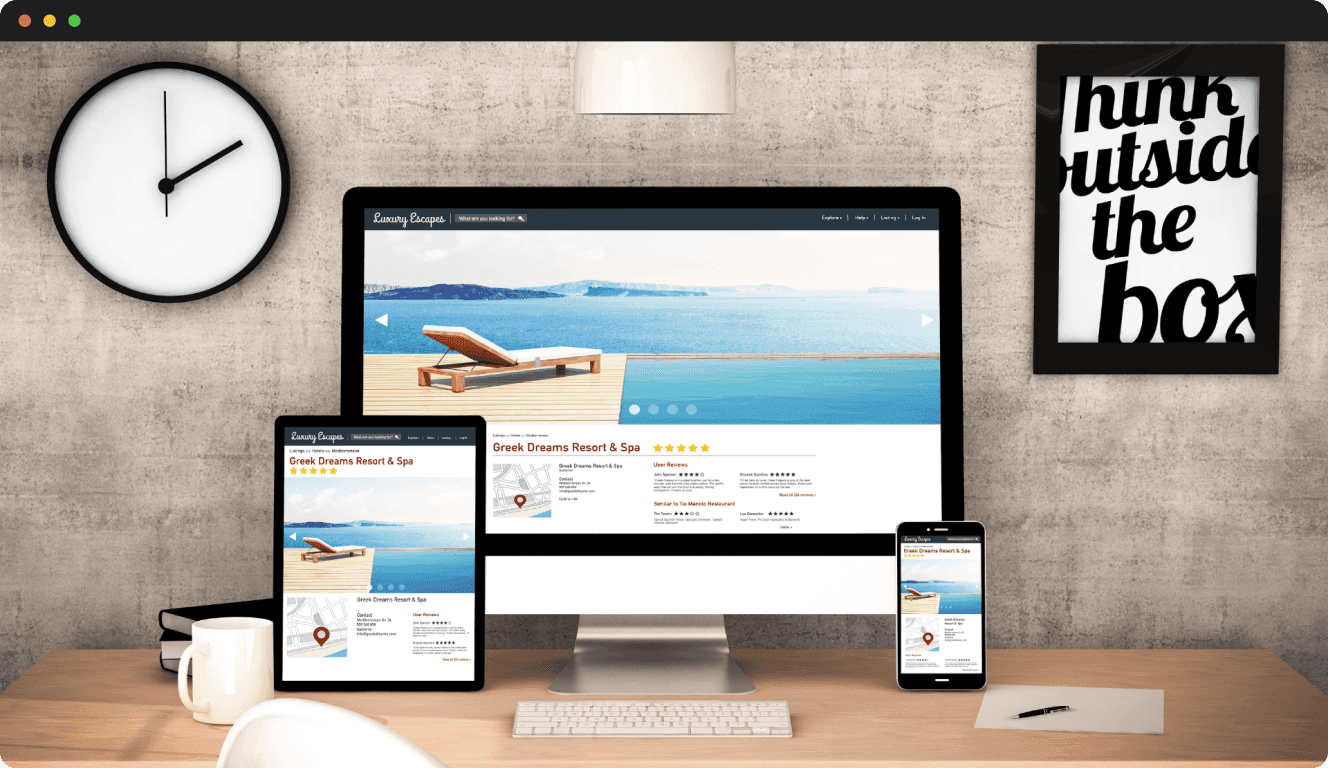
ELITEX assembled a dedicated frontend team to rebuild and modernize the client’s web platform. Beyond development resources, ELITEX provided design consultants who created the visual direction for the modernized interface. We also recommended a trusted third-party SEO provider to handle search optimization alongside the technical work. Our team implemented changes across the hotel booking flow, landing pages, and checkout process based on the client’s requirements. Development covered both desktop and mobile responsive versions of each component.
The scope of work included:
- Initial project setup and server configuration for showcase environments with query parameter handling
- Property landing pages with photo galleries and hotel information sections
- Date selection interfaces with calendar components and availability checking
- Accommodation comparison displays showing room options and pricing
- Checkout flows with payment processing integration and booking confirmation screens
- Navigation systems and CTA sections throughout the platform
- FAQ modules and review displays for user engagement
- Secure payment forms integrated with existing backend services
- Mobile-optimized versions of all components for responsive design
ELITEX worked within the client’s technical constraints while modernizing the user interface. The legacy JavaScript and jQuery foundation remained untouched. The development team applied current frontend practices for code organization, performance optimization, and responsive design. They coordinated with the design consultants provided by ELITEX to ensure visual standards matched functional requirements, creating modern experiences without the technical debt of framework migration.


Our Process
The collaboration operated through structured weekly calls with the client’s CTO, who handled all technical communication. ELITEX’s project manager maintained a detailed document tracking change requests and time estimations, ensuring full visibility into evolving requirements.
To manage the workflow, the team applied Kanban methodology: all tasks were organized in a continuously updated Kanban board, with clear columns such as Backlog, Ready, In Progress, In Review, and Done. Work-in-progress limits helped prevent bottlenecks, while tasks were pulled by developers based on priority and capacity rather than pushed. Regular reviews of the board allowed the team to reprioritize items dynamically, maintain a smooth development flow, and quickly adapt to scope adjustments throughout the overhaul work.
The overall communication frequency remained at 2 to 3 calls per week. This provided regular touchpoints for feedback and direction changes. The project management operated at quarter-time capacity, dedicating enough oversight to coordinate between the development team and client requirements without adding management overhead.
The Project Team
From the ELITEX side:
- 2 frontend developers (full-time) for the first phase
- 1.5 frontend developers + 1 QA engineer during the maintenance phase
- 1 UI/UX designer (hourly consultant, engaged as needed for design direction and review)
- project manager at roughly 0.25 capacity throughout the engagement
The engagement lasted a bit more than 1 year. Team composition adjusted as development moved from active feature building to refinement and quality assurance.
The Result
The client successfully modernized their website frontend through the partnership. The refreshed pages improved user experience across the booking flow while maintaining full integration with existing backend systems. The company gained a modernized interface that works across desktop and mobile without disrupting their core booking engine or requiring costly framework migrations.
Key facts and numbers:
- 1+ year engagement across active development and maintenance phases
- 9 work scope areas delivered (setup, landing pages, date selection, comparison views, checkout, navigation, FAQ, payment forms, mobile)
- ~40% faster page interaction times after frontend optimization within the legacy stack
- No framework migration required, preserving years of backend stability.
Why Partnering With ELITEX?
- Transparent communication without overhead. The client worked directly with the development team through their CTO. ELITEX avoided adding layers of account managers or project coordinators that inflate costs. The team addressed technical questions immediately, adjusted to feedback within days rather than weeks, and maintained a clear view of progress without status report bureaucracy.
- Vast front-end development experience. ELITEX have been working with JavaScript for over a decade across various tools and frameworks. Our team has seen codebases evolve from early jQuery implementations to modern frameworks and back. This exposure gives our developers the perspective on working with older code without dismissing it as outdated, understanding that stability often outweighs novelty in production environments.
- Flexible team structure. Our partnership scaled naturally as project needs changed. ELITEX adjusted team composition from a heavy development focus to maintenance and quality assurance without forcing fixed team sizes.
- Cost efficiency with quality delivery. The client received production-ready frontend improvements that met their quality standards while staying within budget. The combination of technical capability, even in a mature tech stack, clear communication, reasonable pricing, and reliable delivery made ELITEX a practical choice for their first outsourcing initiative.
Our Other Case Studies


Let's talk about your project
Drop us a line! We would love to hear from you.