



- TL;DR: Today, we’re examining hotel management software costs for both ready-made solutions and custom development. It can be challenging when you choose between off-the-shelf systems with $1,000 monthly FOR YEARS, and custom builds beginning at $100,000 upfront. We compared both approaches and covered scenarios when custom development is a better choice, and when it’s better to use third-party software.
- We started with an off-the-shelf software overview. In this article, we took a detailed look at six key features that drive prices across the vendors, splitting them into two groups: basic ones that go standard, and advanced capabilities.
- We analyzed 10 major vendors, including Hotelogix, Cloudbeds, Mews, Visual Matrix, Oracle OPERA, Infor HMS, Lighthouse, RateTiger, IDeaS, Duetto, and Canary Technologies, and took a look at their pricing structure.
- We also covered hidden costs that inflate the real hotel management software price beyond advertised rates (payment processing fees, compliance requirements, etc).
- We made a complete cost breakdown for 3 scenarios (small hotel, a mid-sized chain, and a big chain) based on the prices from major vendors.
- Additionally, we explained how to choose a vendor based on your budget and feature requirements.
- Also, we offered a complete cost breakdown for a custom software development scenario, discovering all major benefits and disadvantages of such a decision.
Running a hotel involves countless daily tasks that need careful coordination. Modern property management systems automate most daily hotel operations. Skipping this software today is like refusing computers in the early 2000s. The delay costs you money and a competitive edge.
And that’s where hotel owners face a critical choice: buy ready-made property management software or build custom. What’s very interesting is that both paths have wildly different costs. Off-the-shelf systems advertise simple monthly fees. These look predictable, but only at first glance. In reality, hidden costs multiply really quickly. Vendors add charges for integrations and premium features. Because each provider structures pricing differently, direct comparison becomes nearly impossible.
Custom hospitality software offers another route. You get software built specifically for your property’s workflow. However, hotel management software cost for custom builds starts at $100,000 and climbs from there to space. And that’s just the initial development. Maintenance demands ongoing budgets. Updates and hosting add recurring expenses on top.
The math gets complex either way. That’s why ELITEX, a hospitality custom software development company with a decade of market experience, broke down both approaches with real vendor quotes and development estimates. Today, we’ll tell you what you’ll actually pay for hotel management software. Let’s go!
Key features affecting hotel management software pricing
First, let’s take a look at what most modern property management systems offer in 2026:
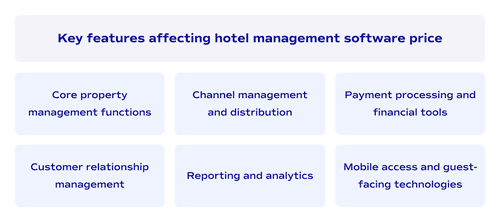
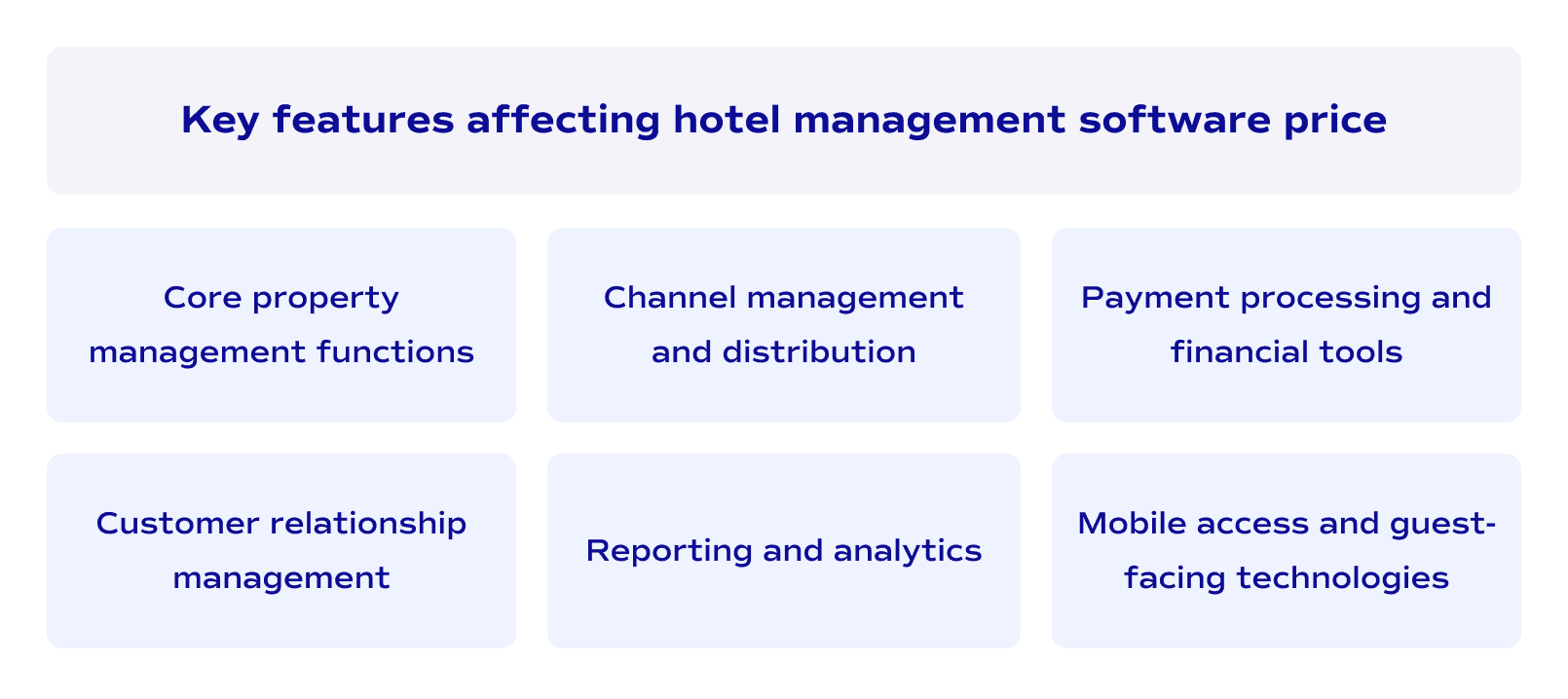
- Core property management functions: Reservations handling, room assignment, and check-in/check-out automation form the foundation of any modern hotel management software. Systems like Mews, Cloudbeds, and Oracle OPERA include these baseline features. However, advanced room management with dynamic pricing algorithms typically costs extra. That’s where the hotel management software price starts climbing.
- Channel management and distribution: Connecting to booking platforms like Booking.com and Airbnb requires integration work. Cloudbeds and RateTiger include basic channel managers. Others charge separately for each connection or take commission percentages on bookings.
- Payment processing and financial tools: Transaction fees hit hard here. Vendors either charge per transaction (usually around 1%) or require you to use their preferred payment processor. Mews Payments, Stripe integrations, and Heartland connections each have different fee structures. However, accounting integrations and automated invoicing often live behind premium
- Customer relationship management: Guest profiles, booking history, communication tools, preference tracking, and loyalty program integration can all help you personalize your service. Platforms like Oracle OPERA and Hotelogix offer basic CRM features, but advanced segmentation and automated marketing campaigns typically require upgrades. This directly impacts long-term hotel management software cost.
- Reporting and analytics: Generic reports often come free. STR market benchmarking starts at $750 annually and climbs based on property count and data frequency. Revenue management systems like IDeaS or Duetto operate as separate products entirely, often requiring thousands in monthly fees. Market intelligence tools like Lighthouse and RateTiger track competitor pricing based on how many hotels you monitor and how often you need updates. AI-powered demand forecasting through tools like Atomize sits in premium tiers or requires third-party integrations. The gap between basic occupancy summaries and competitive intelligence can easily add $200-500 monthly to the price of your hotel management software, even in the case of small businesses.
- Mobile access and guest-facing technology: Staff mobility features also live in different pricing tiers across vendors. Hotelogix Mobile PMS, Visual Matrix mobile app, and Infor HMS mobile solutions allow managers to handle check-ins and housekeeping updates remotely. Basic mobile dashboards come in standard/basic plans. Full-featured staff apps with task management typically require mid-tier plans. Guest-facing technology, if relevant, adds another layer of costs. Cloudbeds offers contactless check-in as part of their platform. Canary Technologies operates as a separate add-on for digital guest experience. Self-service kiosks require hardware investment plus monthly software fees. Mobile concierge services, keyless entry integrations, and guest messaging platforms each carry separate licensing costs ranging from $1-3 per room monthly.
Price ranges for hotel management software
So, what do we have when it comes to price? In general, the cost of hotel management software varies dramatically across vendors and property sizes. Entry-level cloud systems start under $100 monthly for small properties. Enterprise solutions demand thousands per month plus substantial implementation fees. We have already mentioned several major software providers, so now, let’s take a look at what they actually charge:
Best hotel management software providers to explore in 2026
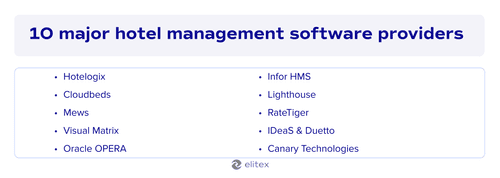
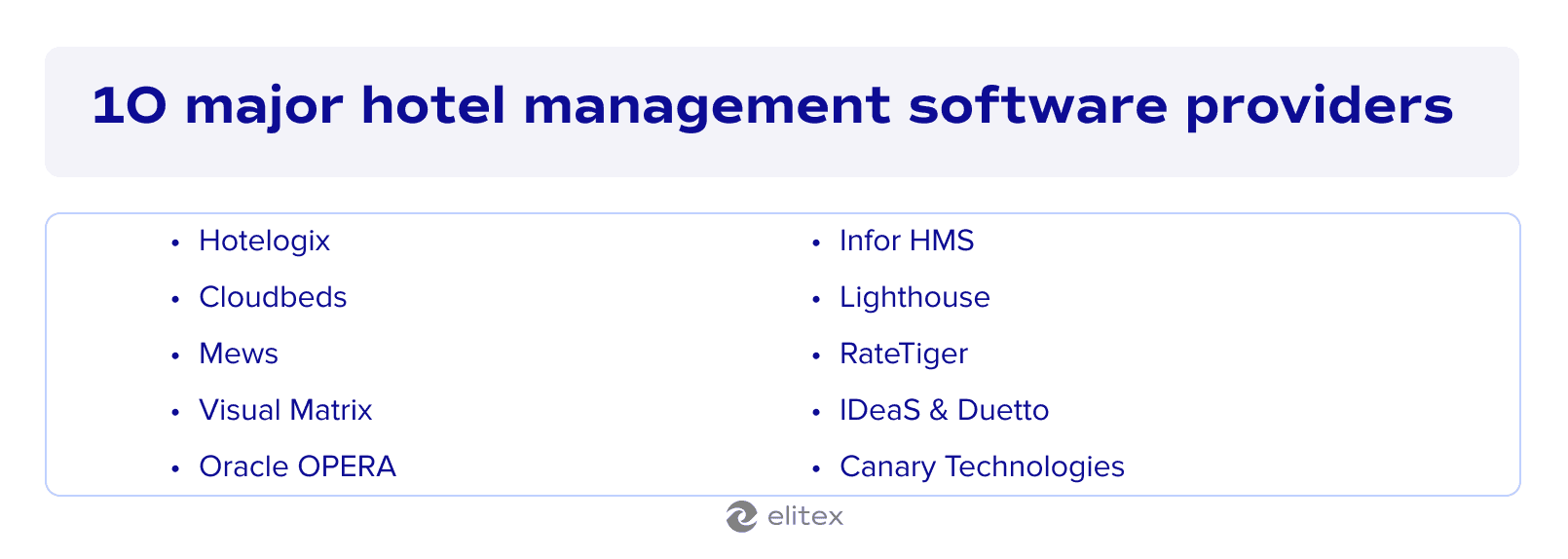
Hotelogix
Basic Premium plan starts at $3.99-$7.99 per room monthly and includes front desk, housekeeping, web booking engine, POS, and 24/7 support. Premium Plus ($11.99/room) adds three integrations for GDS, channel manager, or payment gateway. Platinum tier ($17.99/room) includes six integrations. Setup costs $350.
Cloudbeds
Entry plans start at $99-600 monthly for properties under 10 rooms. The mid-tier One plan costs around $220/month. Experience plan runs $320/month with full features. Larger 100-room properties pay up to $1,000/month. Implementation ranges from $500 for basis setup to $5,000+ for complex customization.
Mews
Standalone PMS starts around $330/month without a channel manager, based on third-party estimates. The platform offers Essentials, Advanced, and Enterprise tiers with typical 2-year contracts. Atomize revenue manager integrates as a premium add-on. Exact prices aren’t disclosed publicly and require custom quotes.
Visual Matrix
Most transparent enterprise pricing with VM Core at $378/month (2 concurrent users, essential features). VM Plus costs $450/month and adds unlimited users plus revenue management. VM Enterprise runs $506/month with hardware interfaces for PBX, WiFi, and locks. Mobile Operations platform adds $97/month. Annual billing saves up to 20%.
Oracle OPERA
Cloud-hosted options for OPERA PMS start around $2.25 per room monthly with license and support included. Total implementation costs $22,855-$26,500 for 80-room limited-service hotels and $38,025-$44,250 for 200-room full-service properties. Third-party interface licenses add $1,500-$5,000 per interface with $300-500 annual support.
Infor HMS
Enterprise pricing starts at $15 per room monthly on subscription basis. It includes front desk, yield management, central reservations, CRM, BI analytics, and mobile functionality. Customization costs range from several thousand to several hundred thousand dollars based on complexity.
Lighthouse
Premium tier costs $59/month and includes rate shopping for 60 days daily 365 days monthly, 3 competitive sets, 10 competitors, event calendar, and RMS integration. Enterprise tier ($139/month) adds real-time OTA shopping, review analytics, and a dedicated account manager. Setup is free.
RateTiger
Channel management starts at $64/month. Booking engine costs $72 with annual flat-fee billing. Premium tiers scale based on room count and channel volume. Add-ons like RateTiger Shoper, GDS distribution, and multi-property CRS require custom quotes.
IDeaS & Duetto
Both revenue management systems require custom enterprise quotes with no public pricing. IDeaS serves 16,000 clients, including Hilton and Radisson. Duetto powers 3,000+ hotels, including casinos and resorts. Premium add-ons include forecasting, group pricing, and MICE optimization modules.
Canary Technologies
The modular guest experience platform starts around $99/month based on third-party estimates. Includes unlimited users, unlimited data storage, unlimited training, 24/7 support, and white-glove implementation with no separate setup fees. Bundles mobile check-in, messaging, upsells, smart checkout, and AI capabilities.
Additional cost factors to consider
Scaling for growth and multi-property operations
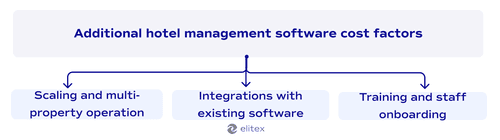
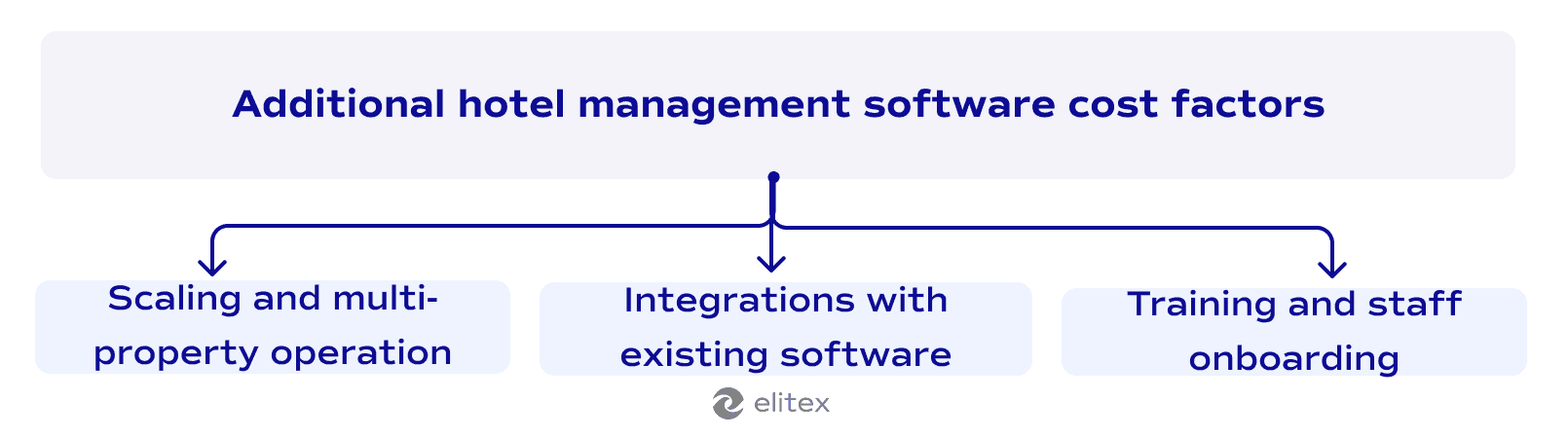
As we see from the previous sections of the article, hotel management system software prices typically increase as you add rooms or locations. Most vendors charge per-room or tiered pricing that jumps at specific thresholds. Hotel chains managing multiple properties face additional costs for centralized dashboards, unified reporting, and chain-level controls. Expect costs to double or triple when expanding from a single property to 3-5 locations, even with the same vendor.
Integration capabilities with existing systems
Connecting your PMS to accounting software, POS systems, door locks, and energy management requires paid integrations. Oracle OPERA PMS, for instance, charges $1,500-$5,000 per third-party interface. Some vendors bundle common integrations in premium tiers, while others charge separately for each connection. Budget $200-500 monthly for a typical mid-sized hotel’s integration needs across 5-8 systems critical to hotel operations.
Training and staff onboarding programs
Although initial staff training often comes free, ongoing education for new hires costs extra. Enterprise systems like Oracle’s OPERA charge $850-$1,500 daily for on-site training sessions. Cloud PMS providers typically include video tutorials and documentation, but dedicated training for complex features or customizations requires paid consulting hours at $150-300 per hour. Large properties should budget $3,000-$10,000 annually for comprehensive staff training.
Hidden costs of hotel management software
Payment processing and transaction fees
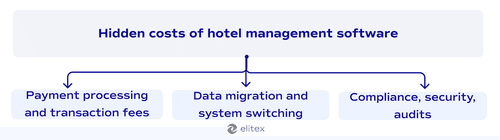
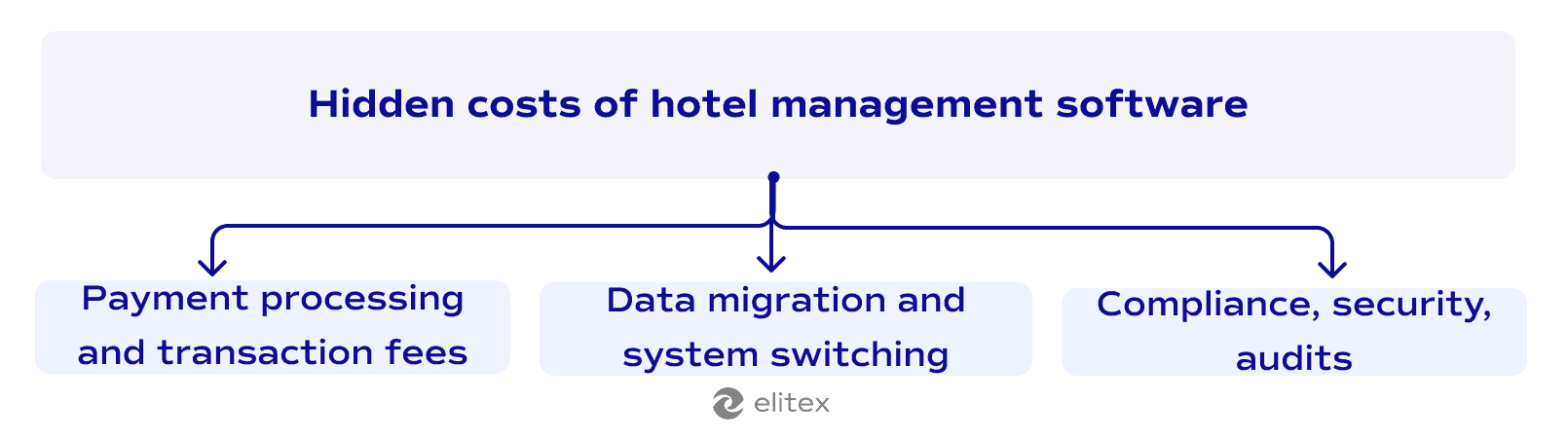
Many hospitality industry vendors embed payment processing with unclear fee structures. Mews and Cloudbeds include payment solutions that charge 1-3$ per transaction plus $0.15-$0.30 per swipe. These fees seem small, but they add up quickly. A 100-room hotel processing $2 million annually pays $20,000-$60,000 in transaction fees alone. Some vendors require the use of their payment processor, eliminating negotiation leverage.
Data migration and system switching penalties
Moving from your current property management system to new software requires data migration services. Vendors charge $2,000-$15,000 depending on database complexity and historical data volume. Early contract termination often triggers penalties equal to 30-50% of the remaining contract value. Factor in 2-4 weeks of reduced operational efficiency during the transition. These switching costs create vendor lock-in that artificially inflates the long-term hotel management system software price.
Compliance, security solution upgrades, and audit requirements
PCI compliance, GDPR adherence, and local data protection laws demand regular security updates. Base subscriptions often exclude advanced security features like two-factor authentication, encryption at rest, or SOC 2 certification. These security solution upgrades may cost $50-200 monthly per property. Annual security audits required by payment card companies add $1,500-$5,000. Budget an additional 15-20% of base software costs for compliance-related expenses.
A short conclusion: Total cost of ownership by hotel type
Now that we’ve broken down individual software components and hidden expenses, let’s examine what different property types actually pay. Your total cost depends on property size, operational complexity, and growth plans. Here’s what the math looks like for three common scenarios.
Small independent hotels (under 50 rooms)
In most scenarios, basic configurations run $200-500 monthly. This typically covers cloud property management systems like Hotelogix ($200-400/month for 50 rooms), basic channel management, and payment processing. Guest management stays simple with standard check-in tools and basic CRM features.
Complex setup reaches $800-1,500 monthly. Add revenue management tools ($200-400), advanced rate intelligence from Lighthouse ($59-139), a keyless entry system ($50-150 for 50 rooms at $1-3/room), and premium integrations for accounting and POS systems. Total cost over three years: $28,800-54,000.
Mid-sized properties with multiple locations (50-200 rooms across 2-5 hotels)
In this scenario, hotel operations require standardized processes that scale across properties. Basic configuration costs $1,500-3,000 monthly. Multi-property management through systems like Cloudbeds or Visual Matrix ($800-1,500), centralized reporting dashboards, and unified guest management across locations drive the base price.
Complex setup jumps to $5,000-10,000 monthly. Enterprise PMS software like Oracle Opera or Infor HMS ($2,000-4,000), dedicated revenue management systems from IDeaS or Duetto ($1,500-3,000), comprehensive market intelligence, staff training programs, and full integration suites push costs higher. Implementation fees add $10,000-25,000 upfront. Three-year total cost of ownership $190,000-385,000.
Hotel chains and enterprise operations (200+ rooms, 5+ properties)
Basic enterprise configuration starts at $8,000-15,000 monthly. Oracle OPERA or a similar enterprise property management system can handle complex hotel operations across dozens of properties. Centralized guest management, chain-level analytics, and corporate integration from the foundation.
Premium enterprise setup exceeds $25,000-50,000 monthly. Full RMS deployment across all properties, AI-powered forecasting through Atomize, comprehensive market intelligence, dedicated account management, custom API development, and 24/7 priority support drive premium pricing. Implementation costs $50,000-250,000 depending on property count and customization needs. Three-year total cost of ownership $950,000-2,000,000+
How to choose the right hotel management software for your budget
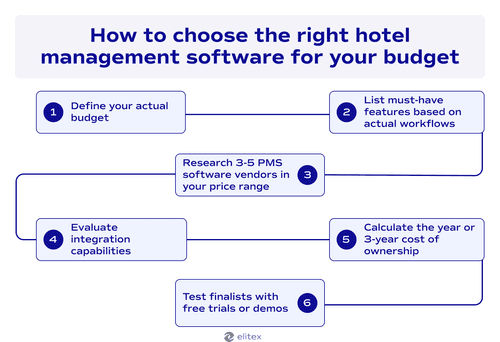
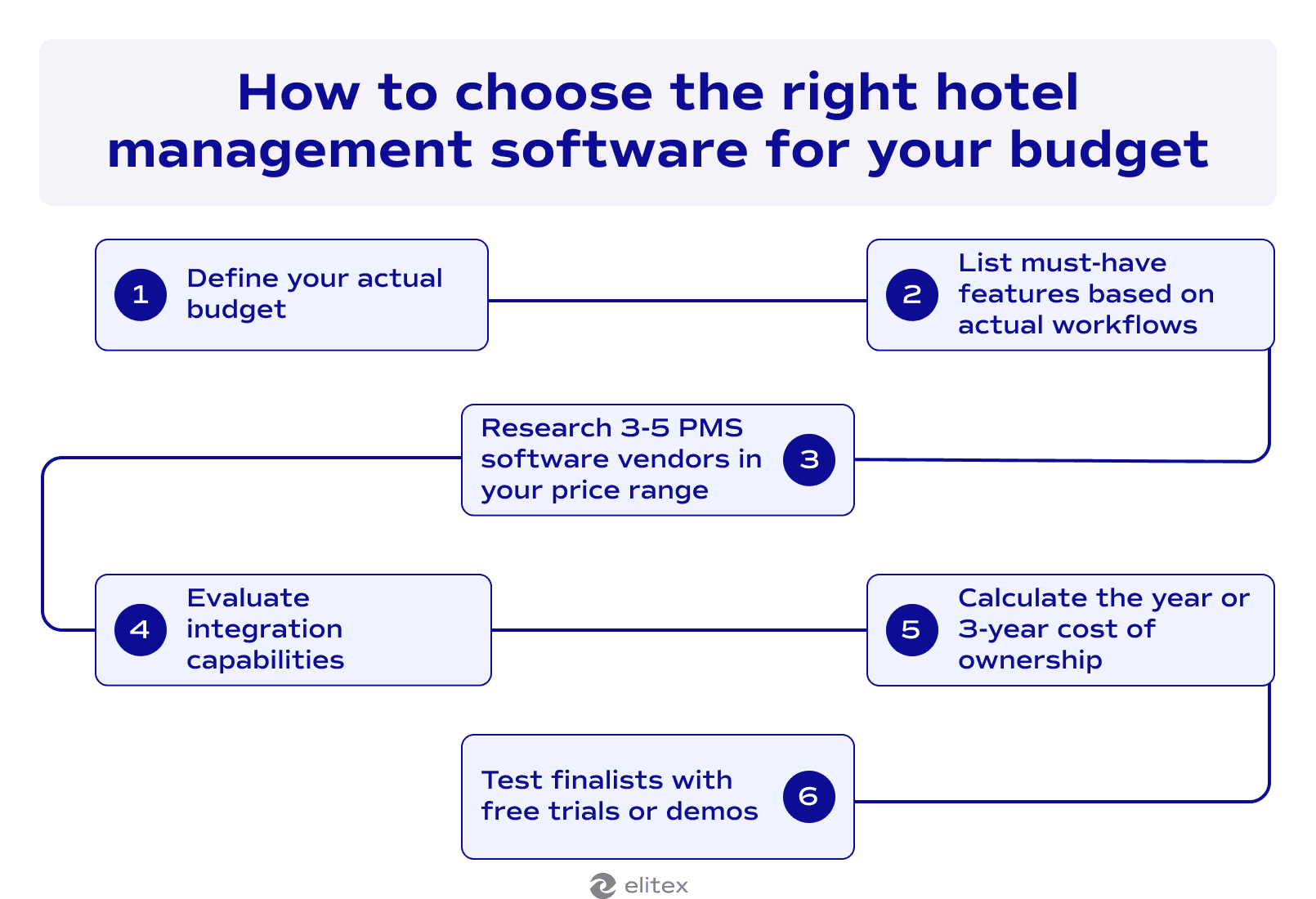
- Step 1: Define your actual budget, including hidden costs. Calculate total available spent, including implementation, training, integrations, and monthly fees. Account for a 20-30% buffer beyond base subscription costs for unexpected expenses.
- Step 2: List must-have features based on your actual operations. Identify your core needs like reservation management, channel distribution to third-party platforms, booking engine, customer relationship management, or tools for handling guest requests. Separate essential features from nice-to-have upgrades that can wait.
- Step 3: Research 3-5 PMS software vendors in your price range. Use the pricing examples from this guide to shortlist realistic options. Request custom quotes from vendors that match your property size and hospitality industry segment.
- Step 4: Evaluate integration capabilities with existing systems. Verify each vendor connects to your accounting software, POS, door locks, and booking channels. Factor integration costs ($200-500 monthly) into your decision.
- Step 5: Calculate the year or 3-year cost of ownership. Consider implementation costs, training budgets, and transaction fees. Compare final numbers across vendors.
- Step 6: Test finalists with free trials or demos. Run real scenarios through demo environments with your staff. Verify the system handles your daily workflow before signing any contract.
An alternative path: Building your own hotel management software
Standard vendors cover common needs, but they often miss specific requirements. Maybe you need real-time reporting features that consolidate data from multiple revenue streams. Maybe your resort requires a complex inventory management system that works across restaurants, spas, and activities that standard PMS systems can’t handle. Or you might require a custom reservation system that handles unique booking rules for membership programs or fractional ownership.
When off-the-shelf solutions workarounds instead of fitting your workflow, custom development becomes the answer. Building specialized software that matches your exact operations represents true digital transformation in the hospitality industry rather than simply adopting generic tools.
However, this is a complex process that takes at least 6-12 months and involves market analysis, requirement gathering, UI/UX design, development itself, testing, deployment, and ongoing maintenance. During this period, you work with a development partner to create an on-premise hotel PMS or any other type of software built specifically for your business. And here we have two sides of the coin. Let’s take a look at them:
Pros of building custom hotel management software
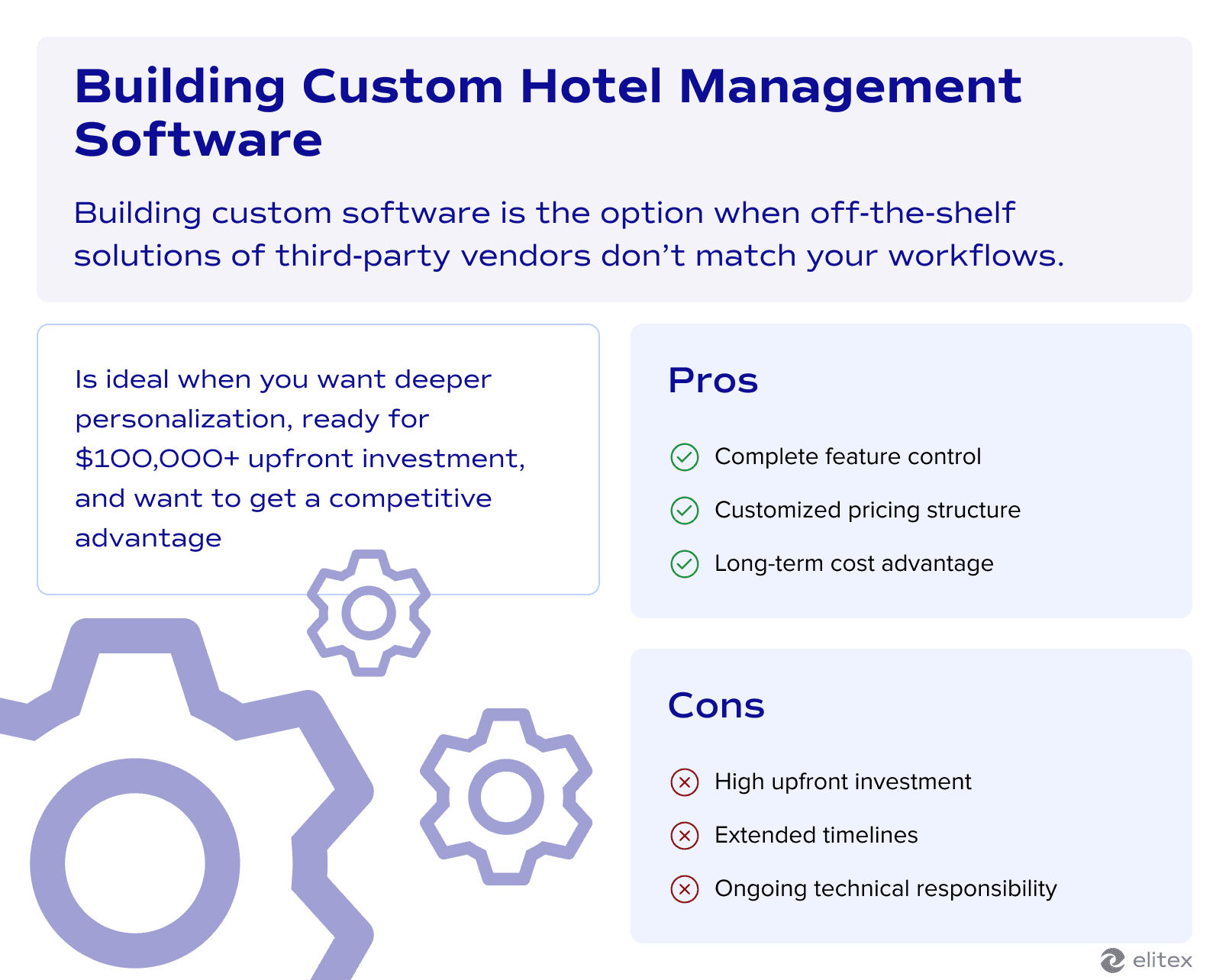
- Complete feature control: You build exactly what you need without paying for bloated feature sets you’ll never use
- Customized pricing structure: You completely eliminate per-room fees and transaction percentages that compound costs as you grow
- Long-term cost advantage: One-time development investment of $200,000-300,000 beats paying $3,000-10,000 monthly in a long-term perspective
Cons of building custom hotel management software
- High upfront investment: $100,000+ starting cost makes custom builds unrealistic for properties with tight budgets
- Extended timelines: 6-24 months development delays implementation compared to deploying ready-made systems within 2-4 weeks
- Ongoing technical responsibility: You own all maintenance, security updates, and feature additions requiring dedicated IT staff or a continued vendor contract requiring additional expenses.
When to consider building your own hotel management software
- Your property has a unique operational workflow. Standard property management solutions force workarounds for core processes like split-stay bookings, complex group allocations, or multi-currency pricing.
- Personalization drives your competitive advantage. Often, personalization in the hospitality industry demands purpose-built tools. In this case, if your brand requires custom CRM integrations, automated communications, advanced booking engine, sophisticated housekeeping management, or something else, custom software is the answer.
- You manage 5+ properties with different business models. Running mixed portfolios of boutique hotels alongside spa resorts requires unified reporting that standard property management solutions can’t deliver effectively.
- You have a $100,000 upfront budget and a 6+ month timeline. Custom development only makes financial sense when you can absorb the initial investment and extended build time.
- Your current system costs exceed $3,000 monthly. Paying $36,000+ annually for 3-5 years may justify a one-time $100,000-150,000 custom build.
- You need proprietary features as a competitive moat. Building exclusive capabilities like AI-powered pricing or integrated loyalty programs creates advantages that competitors using standard software can’t replicate.
Hotel management software development cost breakdown
Now, let’s talk about price check for custom hotel management software development.
Custom hotel management software development follows clear cost patterns based on technical complexity and feature scope. The base investment starts around $100,000 for minimal viable products but scales significantly with advanced capabilities. Several factors drive these costs beyond simple formula development hours*cost/hour.
Technical foundation matters enormously. Native cloud architecture costs 40-50% more upfront than basic server setups but reduces long-term infrastructure expenses. API-first design adds $15,000-25,000 to initial development but enables easier integrations later. Using open-source libraries and existing solutions dramatically reduces costs. Leveraging established payment processing SDKs saves $20,000-40,000 compared to building custom solutions. Pre-built authentication systems eliminate $10,000-15,000 in security development.
Integration requirements with existing hotel systems push costs higher. Connecting to legacy POS systems, door lock hardware, and accounting software each demands custom middleware development. Budget $8,000-15,000 per major integration depending on API quality.
Development hours determine your final investment. The best hospitality custom development companies in Eastern Europe charge $30-80 hourly, delivering projects for $500,000, which would cost $1,500,000 with North American developers at $150-200 hourly. When it comes to hour estimates, here, from our practice, a typical 6-month hotel PMS project consumes 1,500-2,500 development hours, including frontend (400-600 hours), backend systems (600-900 hours), database architecture (200-300 hours), and testing (200-400 hours).
Common custom hotel management software development scenarios
Basic MVP (3-4 months, $100,000-150,000): That’s the price for software with core reservation management that handles bookings and room assignments. Here, a basic online booking engine connects to your website. Simple channel manager links to 2-3 major OTAs. Guest profiles store contact information. Staff manage check-ins and housekeeping status. No advanced analytics or revenue management.
Mid-tier platform (6-8 months, $200,000-300,000): Everything from MVP plus automated communications, advanced reporting, multi-property support for 3-5 locations, POS integrations, mobile apps for staff, rate management tools, and API access for third-party integrations. Serves growing hotel groups needing standardized operations.
Enterprise solution (12-18 months, $400,000-600,000+): Complete platform that includes AI-powered revenue management, predictive analytics, automated maintenance scheduling, comprehensive CRM with marketing automation, custom loyalty programs, advanced financial reporting, IoT integration for smart rooms, and white-label capabilities.
Additional features and development time
| Feature | Development hours | Cost impact ($30-80/hr) |
| AI revenue management | 300-400 | $9,000-32,000 (closer to the higher edge, as AI development services are generally expensive) |
| Multi-property dashboard | 200-280 | $6,000-22,400 |
| Advanced channel manager | 180-240 | $5,400-19,200 |
| Mobile check-in system | 160-200 | $4,800-16,000 |
| Automated guest communications | 140-180 | $4,200-14,400 |
| Predictive maintenance AI | 280-350 | $8,400-28,000 (closer to the higher edge) |
| Custom loyalty program | 200-250 | $6,000-20,000 |
| IoT smart room integration | 240-300 | $7,200-24,000 |
Total investment by complexity level
Basic MVP with essential reservation management, online booking, and guest profiles requires $100,000-150,000 (Eastern Europe) or $250,000-375,000 (North America). Development takes 3-4 months with 4-5 developers.
Production-ready platform with advanced features, multi-property support, and comprehensive reporting demands $200,000-300,000 (Eastern Europe) or $500,000-750,000 (North America). Expect 6-8 months with 6-8 developers.
Enterprise-grade systems with AI capabilities, predictive analytics, and IoT integration exceed $400,000-600,000 (Eastern Europe) or $1,000,000-1,500,000 (North America). These projects span 12-18 months with teams of 10-15 specialists.
Infrastructure costs add $200-2,000 monthly. Annual infrastructure expenses can reach up to 10% of initial development toasts for actively used systems.
Why choose ELITEX as a hospitality software development company?
ELITEX bring a decade of experience in hospitality software development. We’ve built booking engines, property management systems, hospitality websites, custom CRMs, and analytics platforms for hotels across various market segments. Our team has developed proprietary libraries for common hotel operations like reservation management and channel distribution, which reduce development time by 30 to 40% compared to building from scratch. We’ve worked with independent hotels, boutique chains, and reservation platforms, gaining a practical understanding of seasonal demand, pricing complexities, and multi-property coordination. Our rates are comparable to Eastern European ones, while our standards remain comparable to North American teams. The combination of specialized industry experience and cost efficiency helps us deliver versatile and reliable hospitality solutions within realistic budgets.
FAQs
How much does hotel management software cost for a small independent hotel?
Small properties under 50 rooms typically spend $200 to 500 monthly for basic setups. This covers cloud PMS like Hotelogix, basic channel management, and payment processing. Complex configurations with revenue management tools and advanced integrations reach $800 to $1,500 monthly. Total three-year ownership costs in such a scenario range from $28,800 to 54,000 depending on the features needed.
What’s the difference between cloud-based and on-premise hotel management software costs?
Cloud systems charge $4 to 15 per room monthly with no upfront hardware costs. Oracle OPERA Cloud starts around $2,25 for the most basic functions. On-premise solutions require $20,000 to 100,000 upfront for servers and licenses, plus $10,000 to 30,000 annually for maintenance. Cloud wins for properties under 100 rooms, while on-premise makes sense for large chains with existing IT infrastructure and data sovereignty requirements.
Are there hidden costs in “free” hotel management software?
Yes. Free systems limit room count, charge per booking (often 2 to 5%), restrict integrations, or lack the front office module entirely. Transaction fees alone cost a 50-room property $5,000 to 15,000 annually. Free plans typically exclude channel management system access, forcing manual updates across OTAs. Budget $200 to 500 monthly for “hidden” costs that make free software expensive long-term.
What affects the price for hotel management software most significantly?
Property size drives base costs through per-room pricing models. Feature complexity matters more for total investment. Adding revenue management, advanced analytics, and multi-property dashboards increases monthly costs by 200 to 400%. Integration requirements with existing POS, accounting, and door lock systems add $200 to 500 monthly. Implementation and training fees contribute $5,000 to 250,000 upfront, depending on property count and customization needs.
How do I find the best hotel management software price for my property type?
Request quotes from 3 to 5 vendors matching your segment. Calculate 1-3 year total ownership, including implementation, training, integrations, and transaction fees. Verify each system includes front desk management, housekeeping coordination, and reporting. Test finalists with free trials before committing.
How much does custom hotel management software development cost?
Basic MVP with reservation management and online booking starts at $100,000 to 150,000 and takes 3 to 4 months. Production-ready platforms with multi-property support and advanced reporting cost $200,000 to 300,000 over 6 to 8 months. Enterprise solutions with AI revenue management and IoT integration exceed $400,000 to 600,000 for 12 to 18 months of development. Eastern European development rates of $30 to 80 hourly makes custom builds cost-effective compared to $150 to 200 hourly North American rates.
POSTED IN: