



- TL;DR: This article reviews the best MVP development companies in the USA to help founders find the right development partner for their startup projects.
- We defined clear selection criteria: mid-sized firms that balance technical capability with personalized attention, specialize in building custom software, and have verified client results on the industry-specific platforms.
- Here are the 5 best MVP development companies in the USA: ELITEX, Cleveroad, Codal, thoughtbot, and Fingent.
- We also highlighted 3 MVP development companies specifically for startups: ELTIEX, Django Stars, and Netguru.
- We covered several key MVP development trends and technologies for 2026.
- Additionally, we outlined a 6-step MVP development process and broke down MVP development costs ($5,000-$40,000 for simple MVPs, $40,000-$100,000 for medium complexity, and $100,000-$200,000+ for complex MVPs).
- Eventually, we provided a separate guide for choosing the right MVP development company on your own.
Finding the right partner for your MVP can make or break your startup’s trajectory. We spent weeks researching MVP development companies across the USA, talking to founders who’ve been through the process, and analyzing what separates effective MVP development services from expensive mistakes. And here’s what we found.
The market feels overwhelming when you’re sorting through thousands of MVP software development companies competing for your attention. We spent weeks cutting through the noise to understand what matters and how one can navigate through this noise, eventually finding the right tech match. Here’s why the landscape feels so chaotic. The pricing models vary widely. Some companies quoted $50,000 for the same scope, while others priced it at $150,000. But price isn’t the only inconsistency. Communication styles differ just as much. Some teams respond in hours with detailed technical feedback. Others took days to send generic proposals. But the biggest challenge runs deeper. Most companies showcase identical tech stacks and promise similar outcomes, making it nearly impossible for non-experts to spot meaningful differences.
That’s why we looked beyond surface-level metrics to build this guide. We believe our MVP development companies list can save you that research time by focusing on teams that consistently help founders reach their next milestone, and provide essentials about the topic. So, without any further ado, let’s go!
What is an MVP, and why does your business need it?
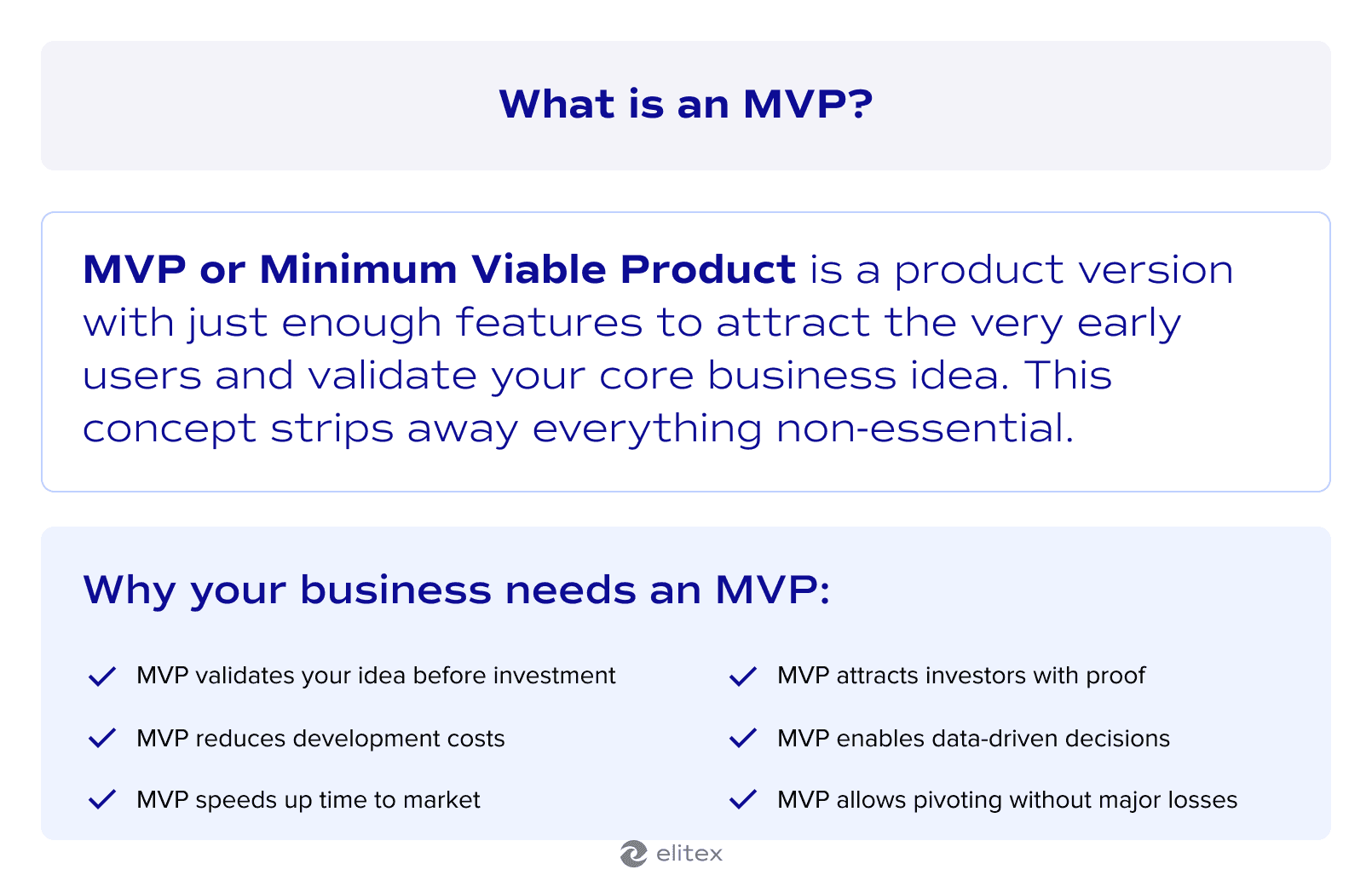
MVP is a product version with just enough features to attract early users and validate your core business idea. MVP (Minimum Viable Product) strips away everything non-essential. You launch faster, spend less, and learn what actually matters to your customers before investing in full-scale development.
Why your business needs an MVP:
- MVP validates your idea before a major investment: You test market demand with real users instead of assumptions. This approach saves you from building features nobody wants.
- MVP reduces development costs: Building less means spending less. With MVP, you invest in proven concepts rather than untested features.
- MVP speeds up time to market: You launch in weeks or months instead of years. Early entry lets you capture market opportunities competitors might miss.
- MVP attracts investors with proof: Investors fund traction, not ideas. An MVP with real users demonstrates market validation.
- MVP enables data-driven decisions: You collect actual user behavior instead of guessing preferences with MVP. This feedback shapes your product roadmap based on evidence.
- MVP allows pivoting without major losses: When something doesn’t work, you adjust quickly. Small iterations cost less than complete rebuilds.
How we selected the MVP development companies in the USA for our list
Now that we’ve covered the essentials, let’s explain our selection process in more detail. As we mentioned earlier, finding the right providers among countless options requires focused criteria. So, first, we targeted mid-sized companies that either operate from the USA or actively serve American businesses. Why mid-sized? From practical experience, we can say that mid-sized firms balance technical capability with personalized attention. They assign cost-efficient dedicated teams without the bureaucracy of enterprise agencies.
Then, we excluded the product vendors and focused on custom software development specialists. Our research primarily drew from GoodFirms, Clutch, The Manifest, and TechReviewer to identify the companies with proven track records. We prioritized companies with verified client results and detailed user feedback that went beyond generic praise.
The top 5 MVP development companies from the section below met these criteria consistently. Each one demonstrated actual delivery capabilities rather than just polished marketing. Let’s examine who made our final list.
5 best MVP development companies in the USA (2026)
| Company | Clutch rating | Hourly rate | Team size | Industry focus | Key strengths | Location |
| ELITEX | 4.9/5 | $30-70 | 50+ (90% mid/senior) | Healthcare, fintech, e-commerce, hospitality, real estate | DevOps automation, cost-efficient enterprise-quality code, cross-industry experience, zero bureaucracy | Multi-location |
| Code District | 4.9/5 | $25-49 | 150+ | Finance, healthcare, manufacturing, insurance, retail | MVP development, app modernization, product validation, experience building own products | Multi-location |
| Cleveroad | 4.9/5 | $25-100 | 250+ | Healthcare, real estate, automotive, education, finance | Mobile app development, rapid prototyping | International |
| Codal | 4.9/5 | $50-99 | 200+ | Healthcare, e-commerce, retail, fintech software development services | US-based Fortune 500 clients, strong product discovery workshops | Chicago, USA |
| thoughtbot | 4.9/5 | $150-199 | 80 | SaaS, healthcare, fintech, non-profit, energy | Design sprints, complex technical requirements, 20+ years of experience | New York, USA |
| Fingent | 4.9/5 | $25-100 | 350+ | Education, fintech, logistics, manufacturing, custom real estate software development services | 1,200+ projects completed, scope flexibility, transparent pricing | Multi-location |
1 . ELITEX
Clutch Rating: 4.9/5
Hourly Rate: $30-70
Industry Focus: Healthcare, fintech, e-commerce, hospitality, real estate, printing, packaging, media, entertainment, telecommunications
Founded in 2015, ELITEX helped dozens of startups build their first MVPs. The team maintains a 90% ratio of middle and senior developers across 50+ person staff, allowing young businesses receive enterprise-quality software solutions at cost-efficient rates. ELITEX’s cross-industry experience spans healthcare, fintech, e-commerce, real estate, and a dozen other domains. ELITEX is especially well-known as a hospitality software development company. Such a diverse portfolio means they’ve seen what works and what fails across different markets.
Beyond MVP development, ELITEX offers DevOps automation services and solutions that help teams streamline their deployment pipelines, enabling business acceleration. The software engineers, QA engineers, DevOps specialists, project managers, and UI/UX designers from ELITEX always maintain transparent communication throughout the project. They flag potential issues before they become costly and explain technical decisions in business terms. This directness helps founders make informed choices early. The result is a product that launches quickly and scales without requiring infrastructure rebuilds.
2 . Code District
Clutch Rating: 4.9/5
Hourly Rate: $25-$49 / hr
Industry Focus: Finance, healthcare, manufacturing, insurance, retail
Key strengths: App modernization & product validation
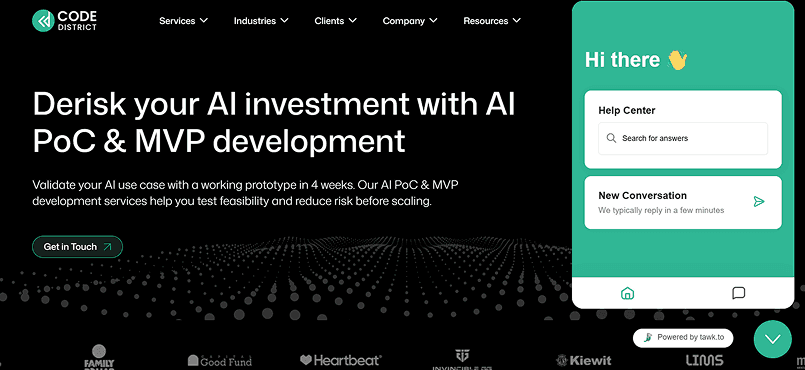
Code District is an AI-first digital transformation company that uses agile methodologies to create customer-centered minimum viable products. The company serves the USA and other global clients. They act as a true tech co‑founding partner, not just a vendor, for startups in the USA that need MVP development services and beyond.
The company has built, launched, and scaled its own products, so they understand investor pressure, burn rates, and the challenges of early-stage growth. Moreover, their track record speaks for itself. Startups that have partnered with Code District have grown from zero to multi-million-dollar businesses.
3 . Cleveroad
Clutch Rating: 4.9/5
Hourly Rate: $25-100
Industry Focus: Healthcare, real estate, automotive, education, finance
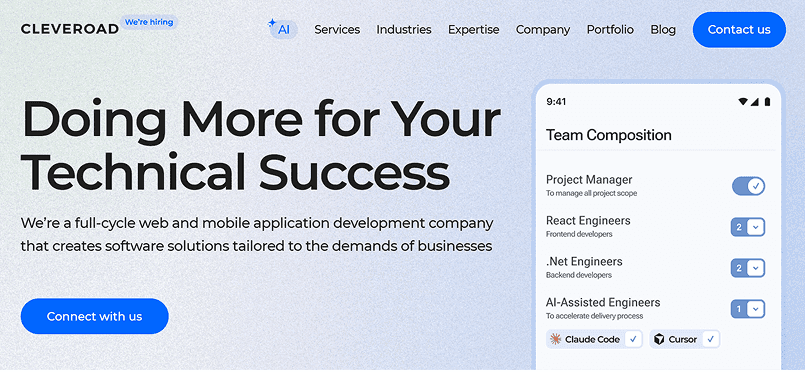
Cleveroad specializes in mobile app development and MVP development for startups. The company employs 250+ developers across design and engineering roles. Their software product development services focus on rapid prototyping and iterative releases. Cleaveroad structures projects around achieving product-market fit through user feedback loops. Their team has delivered market-ready products for clients in the USA and 40 other countries. Also, Cleveroad combines UI/UX design expertise with back-end development across cloud technologies.
4 . Codal
Clutch Rating: 4.9/5
Hourly Rate: $50-99
Industry Focus: Healthcare, e-commerce, retail, financial services, food
Codal operates mostly from the United States, from their main office in Chicago. The company employs 200+ designers and developers focused on MVP development projects. Their process starts with product discovery workshops that define core value propositions before any code gets written. This upfront work typically saves clients months of rework later. Codal has helped clients achieve successful product launches across both web platforms and mobile applications. The Codal team integrates UI/UX design from day one to ensure market readiness from the very beginning of the collaboration. Their portfolio includes work with United Airlines, Anheuser-Busch, and SC Johnson. Clients highlight the company’s collaborative approach and technical problem-solving skills.
5 . thoughtbot
Clutch Rating: 4.9/5
Hourly Rate: $150-199
Industry Focus: SaaS, Healthcare, fintech, government, non-profit, energy
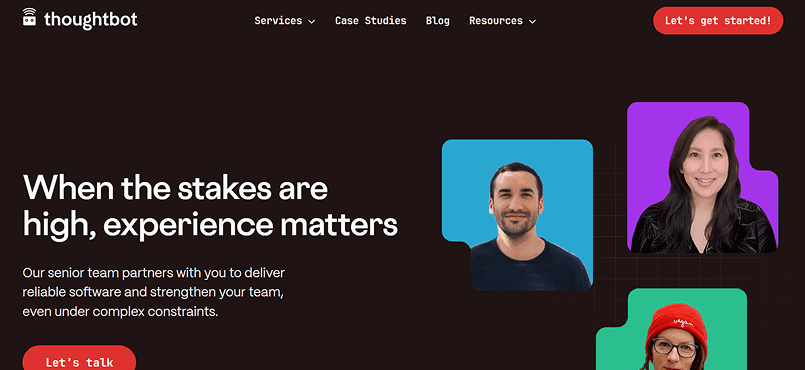
Thoughtbot is one of the top US MVP development companies, headquartered in New York, NY. The company specializes in product development for early-stage startups with complex technical requirements. Their software development process emphasizes weekly iterations with continuous improvement and validation. Thoughtbot has launched hundreds of MVPs since 2003. The team combines UI/UX design with engineering from project kickoff. They select the tech stack based on your specific scaling needs and team capabilities. Client collaboration happens through daily standups and weekly demos. This transparency helps founders understand exactly what’s being built and why. Thoughtbot also offers design sprints for teams still validating their product concepts before committing to full-scale development.
6 . Fingent
Clutch Rating: 4.9/5
Hourly Rate: $25-100
Industry Focus: Education, FinTech, real estate, logistics, manufacturing, healthcare, non-profit, retail
Fingent operates with 350+ developers handling product development across web and mobile app platforms. The company focuses on turning business ideas into working products within tight timelines. Their software development approach combines business analysis with technical prototyping. Fingent has completed over 1,200 projects since 2003. The team applies UI/UX design principles throughout the build process. Business founders appreciate how Fingent handles scope changes without derailing timelines. The company maintains transparent pricing structures with no hidden costs. Weekly progress reviews keep everyone aligned on priorities and next steps.
Also read our Top 7 Software Product Enhancement & Development Companies in the USA
Top 3 MVP development companies for startups
Now, let’s take a look at 3 MVP development companies in the USA that specialize in working with startups and early-stage companies.
| Company | Clutch rating | Hourly rate | Team size | Industry focus | Key strengths |
| ELITEX | 4.9/5 | $30-70 | 50+ | Healthcare, fintech, e-commerce, hospitality, real estate, printing & packaging development services | Resource-constrained startups, transparent communication, flexible budgets, DevOps and UI modernization expertise |
| Django Stars | 4.8/5 | $50-99 | 75+ | Fintech, healthcare, edtech, logistics, e-commerce | 130+ projects since 2008, $1B+ in client funding, product discover workshops, scalable MVPs |
| Netguru | 4.8/5 | $50-99 | 800+ | Retail, fintech, real estate, healthcare, e-commerce software development services | 1,000+ projects, 50+ countries, seed-stage to enterprise clients. |
1 . ELITEX
Clutch Rating: 4.9/5
Hourly Rate: $30-70
Industry Focus: Healthcare, fintech, e-commerce, hospitality, real estate, printing, packaging, media, entertainment, telecommunications
ELITEX have built a strong reputation among US MVP development companies through consistent delivery for resource-constrained startups. The Climate Karma case demonstrates this perfectly. The client arrived with tight deadlines and a limited budget but needed a complete full-stack MVP to pitch investors. ELITEX delivered a functional platform within 500 development hours, implementing complex scoring algorithms and custom UI components. The Standard Practice collaboration shows similar patterns. This healthcare AI startup needed frontend development and DevOps expertise to build an MVP and move to the following stages of the product. ELITEX helped them evolve from seeking an MVP to serving thousands of clinics nationwide. Both use cases highlight what makes ELITEX effective for early-stage companies: transparent communication through regular check-ins, flexible team structures that match project budgets, and technical depth that handles complex requirements without premium agency pricing.
2 . Django Stars
Clutch Rating: 4.8/5
Hourly Rate: $50-99
Industry Focus: Fintech, healthcare, edtech, logistics, e-commerce
Django Stars specializes in building scalable MVPs for venture-backed startups since 2008. The company helped Molo Finance transform from a concept to a mobile app and raised $368 million in funding. Their team redesigned the product architecture and supported active market entry. Django Staars also built the Diviac platform that later became PADI Travel, the world’s leading dive travel platform uniting 200,000+ divers. Their approach combines product discovery workshops with agile development cycles. The company has delivered 130+ projects and helped clients collectively raise over $1 billion in funding. Client satisfaction consistently ranks high due to transparent communication and business-driven technical decisions that prioritize features around the riskiest assumptions.
3 . Netguru
Clutch Rating: 4.8/5
Hourly Rate: $50-99
Industry Focus: Retail, e-commerce, fintech, healthcare, real estate
Netguru delivers MVP development for both seed-stage startups and established companies testing new concepts. The company built Candis’ mobile app MVP that reduces invoice approval time from 3-4 days to under 2 days. For Moove, a Nigerian mobility startup, Netguru developed a scalable architecture for vehicle financing that expanded across multiple geographies. Their Codex102 project creates a legal knowledge platform for lawyers and law students. Netguru employs 800+ professionals and has completed 1,000+ projects across 50 countries.
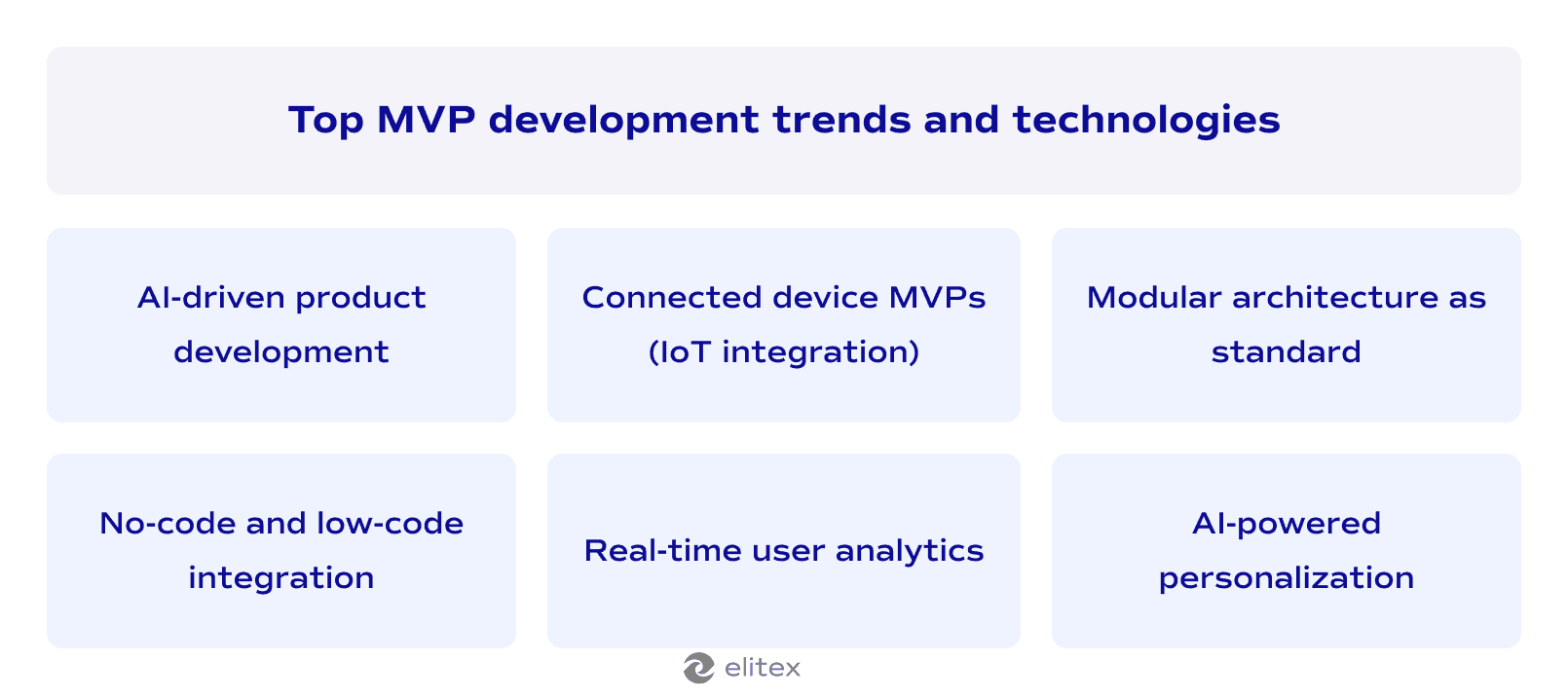
Top MVP development trends and technologies in 2026
AI-driven product development
Of course, we’ll start with artificial intelligence. Generative AI has changed how startups build their first products. Founders now feed user feedback directly into machine learning models that suggest feature priorities and architectural decisions. AI-based MVP development tools generate working code from natural language decisions. What once took three months of development now happens in three weeks.
No-code and low-code integration
Beyond AI, another trend that shapes software development in 2026 is low-code/no-code. The technology stack for modern MVPs blends visual builders with custom development. Founders test core assumptions using drag-and-drop interfaces before writing any code. Once validation happens, developers replace no-code components with scalable architectures piece by piece. MVP software development companies report cutting delivery timelines by 40-60% through this hybrid approach. The cost savings let bootstrapped founders reach product-market fit without raising capital.
Connected device MVPs
IoT development no longer requires hardware expertise or manufacturing partnerships to launch. Startups ship smart home devices, health wearables, and industrial sensors within 12-week cycles. Off-the-shelf connectivity modules integrate with cloud platforms through pre-built APIs. The digital landscape now treats physical products as software distribution channels.
Real-time user analytics
In 2026, behavioral data flows into product strategy within hours of feature releases. Founders watch user insights accumulate during live sessions and adjust their roadmaps the same day. Agile methodologies now operate on daily cycles based on actual usage patterns. This immediacy has killed the traditional quarterly research phase. Startups using embedded analytics pivot three times faster than those relying on user interviews alone.
Modular architecture as standard
Scalable architectures start from the first line of code written. Developers build MVPs with microservices and API-first designs that support the replacement of individual components. (Previously, we’ve written a separate article about DevOps and microservices architecture, where we discuss this architecture pattern in detail.) In practice, microservices mean that when a startup needs to swap its payment processor to upgrade its recommendation engine, the changes take days instead of months. Investors now audit technical debt during the diligence because they’ve seen too many promising products collapse under their own success.
AI-powered personalization.
AI-driven MVPs customize interfaces for each user from their first session. Machine learning models detect preferences within minutes and reshape the user experience accordingly. Early adopters see different feature layouts than analytical users, different content priorities than casual browsers. This adaptation happens automatically without manual segmentation or A/B testing infrastructure.
MVP development process used by the top US companies
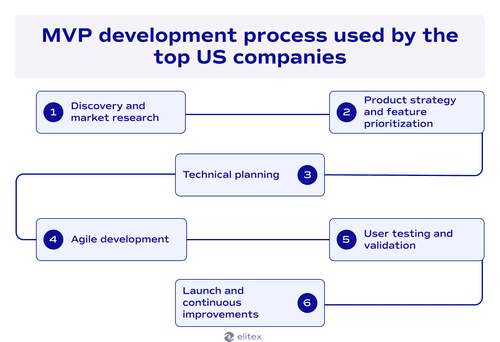
Step 1: Discovery and market research
Top MVP development companies in the USA always start by identifying who will actually use the product and whether it’s already presented in the market. Such a market research reveals what the target audience struggles with daily and how much they’ll pay to solve those problems. This phase combines user research interviews with competitive market analysis to spot gaps in the current market.
Step 2: Product strategy and feature prioritization
At this stage, founders work with developers to define which features validate the core hypothesis. The product strategy phase allows you to focus your product on market demands that competitors ignore or handle poorly.
Step 3: Technical planning
Once priorities are clear, developers choose the tech stack based on scaling requirements and team capabilities. This decision affects everything from hosting costs to hiring needs once the MVP gains traction.
Step 4: Agile development
From here, full-cycle MVP development happens in two-week sprints with working features delivered at each milestone. Why agile? Quite simple: agile development makes it easy to keep founders involved in daily decisions about trade-offs between speed and functionality. In case of MVPs, developers built only what’s essential for the first user cohort to complete their core tasks.
Step 5: User testing and validation
Before launch, beta users interact with the MVP while developers watch for friction points and confusion. User testing reveals which assumptions were wrong and which features need immediate fixes. This feedback shapes the last development sprint before public launch.
Step 6: Launch and continuous improvement
Finally, the MVP goes live to a small group before expanding to broader audiences. Real usage data drives weekly updates based on how people actually interact with the product.
How much does the MVP development cost in the USA?
MVP development pricing varies wildly based on complexity and your chosen approach. Founders building their first product face quotes ranging from $5,000 to $200,000 for the same basic feature set. Here, the difference comes down to whether you’re working with a US-based tech partner, offshore developers, building with no-code platforms using off-the-shelf elements, and many other aspects.
When it comes to coding-based MVP development, here’s how the budget typically ranges by the complexity of the project:
- Simple MVP ($5,000-$40,000): Basic web applications/mobile apps with standard features like user authentication and straightforward interfaces built on no-code platforms or by offshore developers.
- Medium MVP ($40,000-$100,000): Custom functionality requiring API integrations, payment processing, and real-time features developed by mid-tier agencies or by nearshore software development teams.
- Complex MVP ($100,000-$200,000+): Advanced products with AI features, complex data processing, regulatory compliance requirements, or custom algorithms built by experienced firms.
What drives the price difference?
Developer location accounts for the biggest cost variance. A senior developer in San Francisco charges $150-200 per hour, while comparable talent in Eastern Europe costs $30-70 per hour. So, a three-month MVP development project runs $90,000 with a tech partner that relies on US developers versus $30,000 with offshore software developers. The trade-off shows up in communication speed, timezone alignment, and cultural understanding of your target market. Some solutions, like AI and no-code platforms, reduce costs further by eliminating custom coding, though you sacrifice flexibility and often face scaling limitations once you gain traction.
How to choose the right MVP development company?
Now, here’s an algorithm for choosing the right fit on your own:
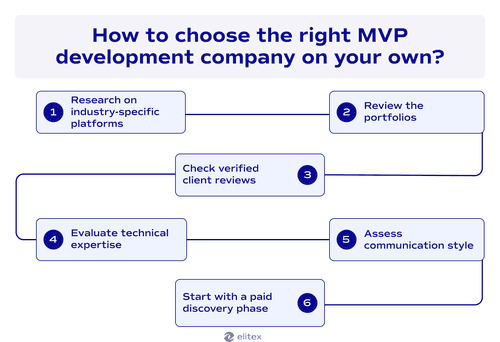
- Research on industry-specific platforms. The easiest way to create a pool of companies-candidates is to start with platforms like Clutch, GoodFirms, and The Manifest. It will allow you to identify the best MVP development companies with verified ratings above 4.5 stars.
- Review the portfolios. Once you have several options, examine at least five completed software projects to verify they’ve built MVPs similar to your product concept.
- Check verified client reviews. Then, read detailed testimonials focusing on communication quality, timeline adherence, and post-launch support experiences.
- Evaluate technical expertise. At this stage, confirm the team’s experience with your required tech stack (if you already defined it) and ask specific questions about architecture decisions they’ve made in the past.
- Assess communication style. Next, schedule calls with actual developers who will work on your project to gauge responsiveness and clarity.
- Start with a discovery phase. Finally, test the partnership with a paid two-week discovery engagement before committing to full development.
Why is ELITEX an MVP development company you were looking for?
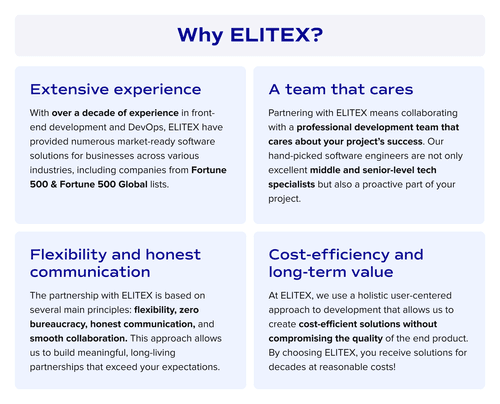
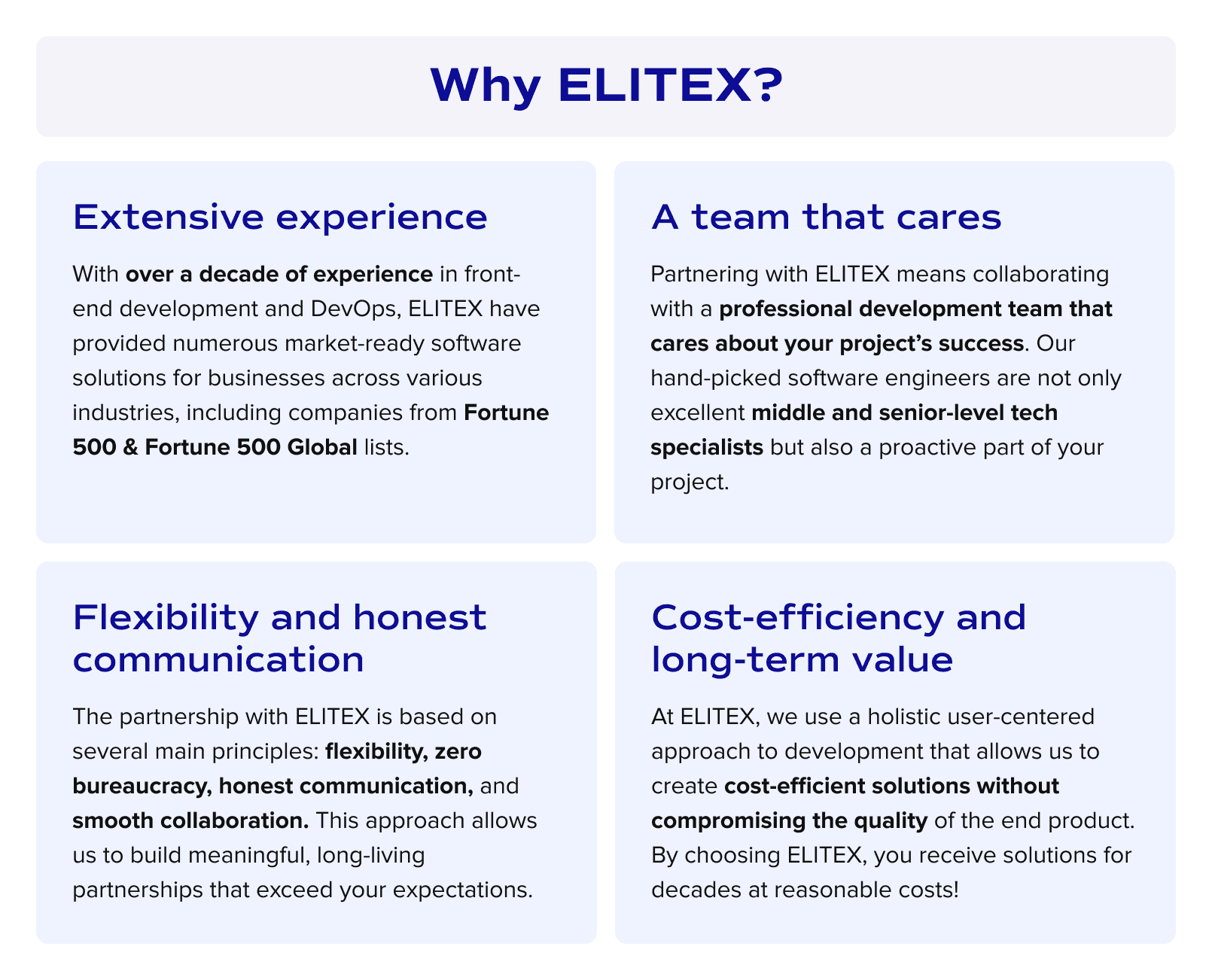
For over a decade, ELITEX deliver enterprise-quality software solutions at startup-friendly rates. ELITEX’s team maintains a 90% ratio of middle and senior developers with proven experience building MVPs across healthcare, fintech, ecommerce, hospitality, real estate, and other domains. This cross-industry background means ELITEX have already solved most problems you’re just about to encounter. The transparent communication style keeps you informed through daily updates and honest assessments when features need rethinking. The extensive expertise in DevOps and UI modernization ensures your MVP launches with infrastructure that scales and a visually appealing interface that keeps users engaged. Choosing ELITEX, you choose the tech partner beyond your initial expectations: your MVP will pack more capability and polish into your budget than you thought possible!
FAQs
What should I look for when choosing between MVP software development agencies?
Look for verified client reviews on platforms like Clutch. Do it for companies showing ratings above 4.5 and portfolios showing projects similar to yours. The best MVP development companies in the US will ask detailed questions about your business model before quoting any prices. Check their technical expertise matches your required features and confirm they assign dedicated teams rather than rotating developers.
How do US MVP software development companies differ from offshore teams?
US-based agencies charge $100-200 per hour versus $25-100 for offshore teams. With US-based teams, you get faster communication, timezone alignment, and a deeper understanding of American market expectations. Offshore development may take longer due to coordination delays, but costs significantly less overall. Best MVP development companies for startups often offer hybrid models with US project management and offshore development.
When should startups hire MVP app development companies instead of building in-house?
Hire external teams when you lack technical co-founders or want to test market demand before committing to full-time hires. Also, when you want to start fast (3-6 months), external development may be a good idea. Building in-house makes sense when you have strong technical leadership and plan to iterate continuously post-launch. Most early-stage startups benefit from agencies that have solved similar problems before.
Do MVP development agencies provide post-launch support?
Most agencies offer 30-90 days of bug fixes and minor adjustments after launch. Ongoing development requires separate retainer agreements or project-based contracts. Clarify support terms before signing and ask about response times for critical issues.
POSTED IN: