



Web developers face several important questions building a software solution: How should they structure the application? Which front-end architecture best fits the specific project needs? How will the frontend connect to the backend? And eventually, how will all parts work together? The Backend for Frontend, also known as the BFF pattern, offers answers to these challenges. This approach offers an alternative to traditional one-size-fits-all APIs. The Backend for Frontend pattern tailors backend services to specific front-end needs, helping developers enhance performance and user experience. But let’s go in order.
Introduction to the Backend for Frontend (BFF) pattern
Basically, the BFF pattern is an architectural approach where developers create a dedicated server-side layer for each type of user interface. This layer acts as a bridge between the frontend application and the core backend services. Here’s what the traditional microservices architecture looks like:


And here’s what it looks like with the Backend for Frontend pattern:
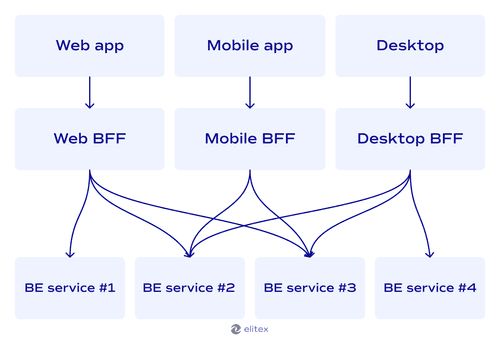

As we can see, the BFF pattern tailors the API to the specific needs of each client, whether it’s a web app, mobile app, desktop, or any other type of device. This architectural approach simplifies the overall front-end development process by allowing for the handling of complex operations and API calls on the server side.
The BFF architecture solves common web development issues like over-fetching data or making multiple API calls for a single view. It allows frontend teams to work more independently, as they can adjust their specific dedicated backend without affecting other parts of the system. While this pattern may add a certain complexity, it offers greater flexibility and efficiency for large-scale applications with diverse frontend needs.
Understanding frontend and backend architecture in BFF pattern
In the case of using a BFF architecture pattern, the frontend typically looks as usual. It consists of client-side code running in browsers or native apps. This layer handles UI components, user input, and data display. However, this frontend communicates with a single, dedicated backend service tailored to the specific needs.
However, the backend is split into two parts. The first part is the BFF layer itself, which acts as a middleman between the frontend and core backend services. It handles UI-specific server-side logic, API transformations, and data aggregation. The second part consists of the core backend services, which manage business logic, data storage, and processing. This backend separation allows development teams to independently optimize each layer, improving performance and maintainability.

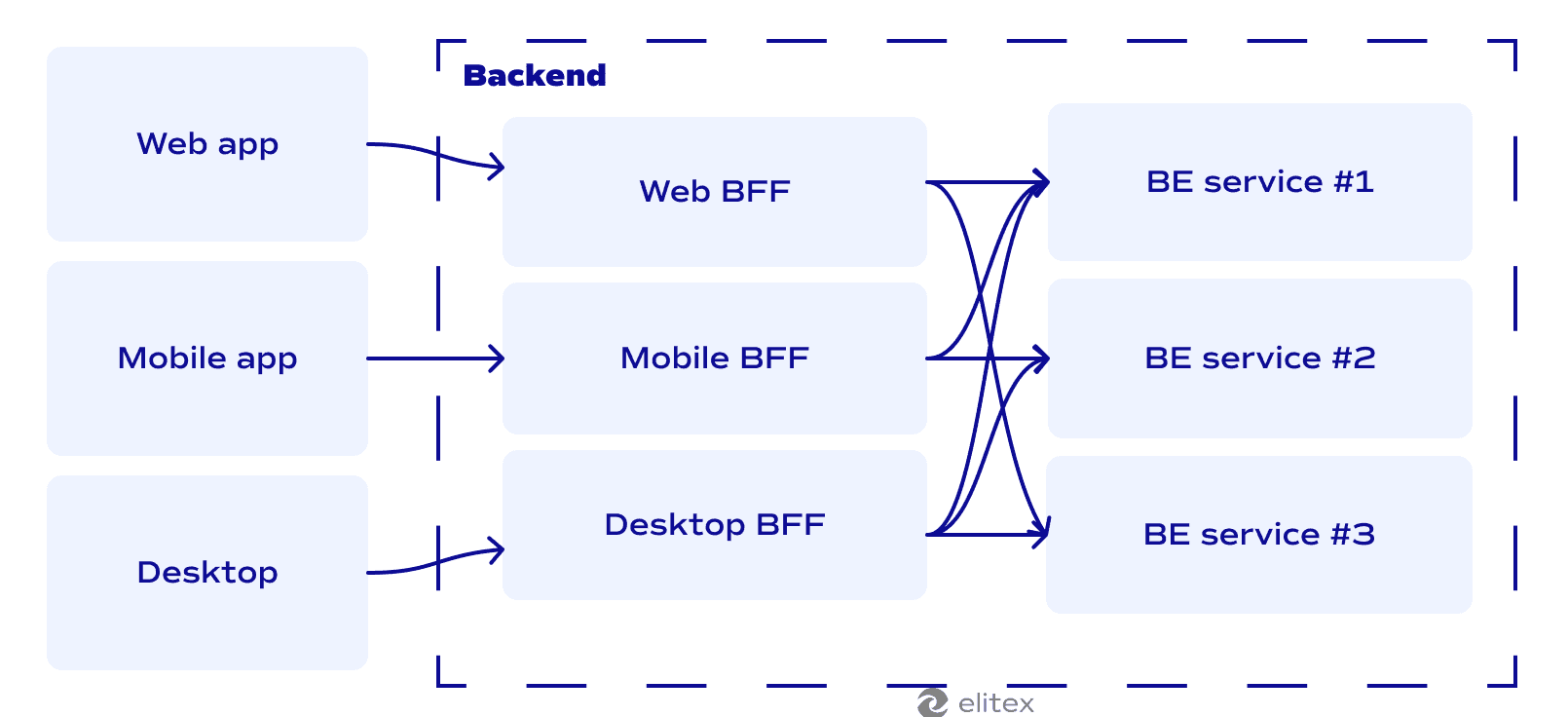
BFF vs. traditional API gateway
Now, let’s examine the details. Here’s a comparison of the Backend for Frontend pattern with traditional architecture using a single API gateway.
| Aspect | Backend for Frontend Pattern | Traditional API Gateway |
| Purpose | Each BFF serves specific frontend needs | A single API gateway manages all API traffic. |
| Customization | Highly tailored to each client | Generic for all clients |
| Complexity | Simpler for individual clients, but it requires building several BFFs | More complex due to handling all scenarios, but it only needs to be built once |
| Team ownership | Typically owned by a frontend development team | Often managed by a separate backend development team |
| Data transformation | Extensive and client-specific | Limited and general-purpose |
| Protocol support | Can be client-specific | Usually supports multiple protocols |
| Performance | Specifically optimized for particular clients | General optimization for all traffic |
| Maintenance | Multiple BFFs to maintain | Single point of maintenance |
| Security | Can implement client-specific measures | Applies uniform security policies |
| Development effort | Requires more effort to maintain multiple backends | Easier to manage with a single codebase |
Benefits of implementing the BFF pattern
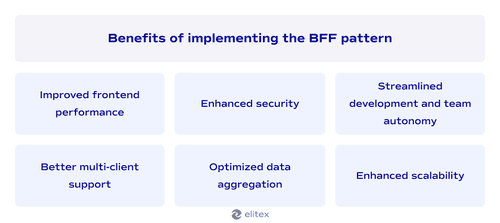
The Backend for Frontend pattern offers numerous advantages in modern web development by addressing common challenges in building complex, multi-client applications. Here are several particular benefits of implementing the BFF.

Improved frontend performance
First of all, BFF slightly improves frontend performance in most cases. BFF optimizes data transfer between the server and the client. This logic helps tailor responses to each frontend’s specific needs, reducing payload size, API calls, and other unnecessary data transmission. Such efficiency is particularly beneficial for mobile applications, where network conditions may be less reliable.
Enhanced security
The BFF architectural pattern adds an extra layer of security to the application. It acts as a buffer between the client and the core backend services, filtering sensitive data before it reaches the frontend. This setup allows for the implementation of client-specific security measures, such as rate limiting or request validation. The BFF can also handle authentication and authorization, reducing the exposure of sensitive processes to the client side. By centralizing these security functions, the BFF simplifies the overall security model of the application.
Streamlined development and team autonomy
BFF simplifies frontend code and empowers teams to manage their specific backend requirements. It reduces complexity by handling data operations on the server side while allowing frontend teams to work independently. This dual benefit is particularly valuable in large organizations with products tailored to diverse platforms. For example, an e-commerce company could use BFF to simplify product catalog management across web and mobile platforms, with separate teams efficiently handling each interface’s unique requirements.
Better multi-client support
BFF excels in scenarios with multiple client types, such as web, mobile, and desktop applications. Each client can have its own BFF, optimized for its specific requirements and constraints. This setup allows for the efficient handling of device-specific features and limitations. It also enables easier management of different API versions for various clients. The BFF design pattern thus provides a scalable solution for supporting a diverse ecosystem of client applications.
Optimized data aggregation
Additionally, BFF excels at combining data from multiple backend services. It can fetch data from various sources and compose it into a single, coherent response for the frontend. This aggregation reduces the number of API calls the client needs to make, thus improving performance. The BFF can also implement caching strategies to further optimize data retrieval. This centralized data composition can significantly simplify complex data operations that would otherwise need to be performed on the client side.
Enhanced scalability
BFF allows independent scaling for each client interface. This is valuable for applications with varying load patterns across different platforms. An event ticketing system could scale its mobile BFF during peak mobile usage without affecting resources for the web interface.
Common use cases for BFF
Streaming services
Netflix utilized the BFF pattern to create dedicated backends for each client platform (Android, iOS, TV, and web). This approach allowed their Android team to maintain their own backend, giving them more control and visibility over data retrieval. By migrating from a monolithic service to a microservice architecture, Netflix improved local development, enhanced observability, and gained end-to-end ownership of requests. BFF enabled Netflix to optimize performance and tailor the API experience for each client platform, leading to better user experiences across various devices. Another example of using BFF for streaming services development is SoundCloud.
Retail businesses
BFF offers retail businesses the opportunity to create tailored, high-performance user experiences across virtually any platform. For instance, Decathlon, a global retail company, adopted BFF to improve their e-commerce platform. They created a middleware layer that allows frontend teams to control their specific backend needs. This approach improved data handling, enhanced security, and enabled better server-side rendering. By implementing BFF, Decathlon reduced frontend complexity, optimized network usage, and gained more flexibility in supporting different user experiences. The company found that BFF helped separate concerns and reduce coupling between system components, leading to more efficient development across their web and mobile applications.
Best practices for BFF implementation

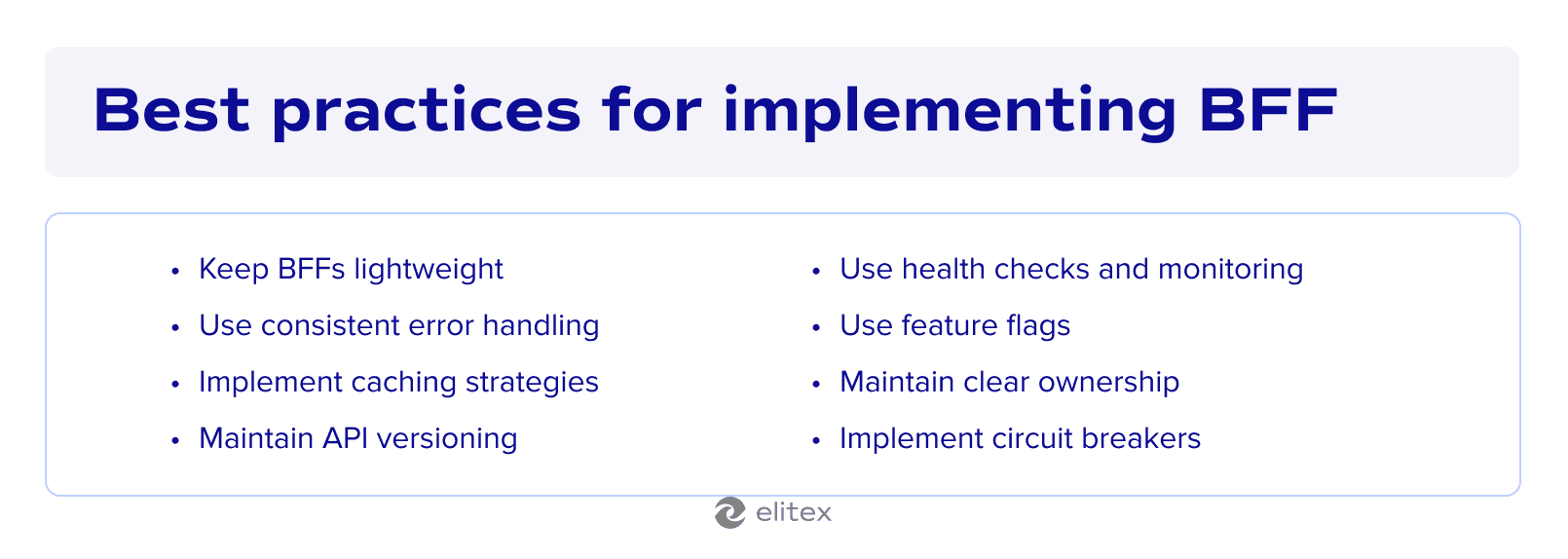
Keep BFFs lightweight: Focus on data aggregation and transformation, not business logic.
This practice prevents BFFs from becoming mini-monoliths. Use this approach when you need to maintain a clear separation of concerns. It helps with easier maintenance and reduces the risk of duplicating core business logic across multiple BFFs.
Use consistent error handling: Implement uniform error handling across all BFFs.
This approach ensures a consistent user experience across various platforms. Apply this method when dealing with multiple client types. It simplifies debugging and improves the overall reliability of the system.
Implement caching strategies: Use caching in BFFs to reduce load on backend services.
This practice improves response times and reduces network traffic. Implement it for frequently accessed, relatively static data. It is particularly useful in high-traffic applications for maintaining performance under load.
Maintain API versioning: Implement versioning for BFF APIs to manage changes without breaking client applications.
This practice allows for smooth updates and backward compatibility. Apply this when you expect frequent changes or have long-lived client applications. It helps manage the evolution of your API without disrupting existing users.
Use health checks and monitoring: Implement comprehensive health checks and monitoring for each BFF.
This ensures quick detection and resolution of issues. Set this up from the start of your BFF implementation. It is crucial for maintaining high availability and quickly identifying performance bottlenecks.
Use feature flags: Implement feature flags in BFFs to easily toggle functionality.
This allows for gradual rollouts and A/B testing. Use this approach when introducing new features or making significant changes. It provides flexibility in feature management and helps gather user feedback before full deployment.
Maintain clear ownership: Assign clear ownership of each BFF to a specific team.
This ensures accountability and faster issue resolution. Implement this practice in organizations with multiple teams working on different client platforms. It helps maintain consistency and quality across different BFFs.
Implement circuit breakers: Use circuit breakers in BFFs to handle failures in downstream services gracefully.
This prevents cascading failures and improves system resilience. Apply this pattern when your BFFs depend on multiple backend services. It helps maintain a responsive user experience even when some backend services are experiencing issues.
Challenges and solutions in BFF implementation
| Challenge | Effective solution |
| Increased system complexity | Implement clear documentation and establish service boundaries. Use API gateways for unified entry points. |
| Code duplication across BFFs | Create shared libraries for common functionalities. Maintain a centralized repository for reusable components. |
| Maintaining consistency | Establish coding standards and design guidelines. Implement automated testing and continuous integration. |
| Increased operational overhead | Set up robust monitoring and logging. Use containerization and orchestration tools such as Docker and Kubernetes. |
| Versioning and backward compatibility | Implement semantic versioning for BFFs. Use feature flags for gradual rollouts. |
| Security concerns with multiple entry points | Implement consistent authentication across all BFFs. Use API gateways for centralized security management. |
| Performance bottlenecks | Implement efficient caching strategies. Use performance monitoring tools to identify and address issues. |
| Managing dependencies between BFFs and backend services | Employ service discovery mechanisms. Implement circuit breakers for graceful failure handling. |
Future of Backend for Frontend (BBF) pattern
Here are some trends and tendencies in BBF and the tech world surrounding this architecture that we expect to see soon.
Increased integration with microservices
BFFs will increasingly support systems with multiple backend microservices. This approach will enable frontend teams to work even more independently. Therefore, it will lead to faster development cycles and an improved focus on user experience. Teams can create tailored frontend interfaces without being slowed down by backend complexities.
Support for more complex user interfaces
Today, BFFs allow developers to handle real-time data updates and complex interactions. As we see more complex frontend application interfaces, dedicated BFFs can help efficiently manage specific requirements for these sophisticated UIs. This will ensure smooth data handling for advanced applications. Users, in turn, will benefit from more responsive and feature-rich interfaces across different platforms.
Rise of DevOps and API-first approaches
DevOps and API-first strategies will drive BFF into wider use. Organizations will use BFFs to optimize API delivery for different frontends. Continuous integration and delivery will make BFF services easier to deploy and update. This will enable faster development and more efficient system management.
Convergence with GraphQL
Backend for Frontend solutions may integrate more closely with GraphQL in the future. This combination will provide frontends with greater control over the data they receive. BFFs could optimize GraphQL queries for specific clients, ensuring efficient data retrieval from microservices. The result will be a more flexible and efficient API design and consumption.
Predicting the future is always a sort of magic. At ELITEX, we aren’t sorcerers; however, we are seasoned technology experts who keep a close eye on the industry trends. Our team combines deep technical knowledge with a decade of practical experience to guide our partners through the complexities of software architecture. Whether you’re looking for further consultation regarding the architecture of your future software solution or seeking software engineering experts to expand your development capabilities, don’t hesitate to contact ELITEX! With ELITEX, you will always receive results beyond your expectations.
FAQs
What is Backend for Frontend?
Backend for Frontend or BFF is a software architectural pattern in which a separate backend service is created for each frontend or specific client type, whether mobile, web, or desktop. Each BFF is specifically tailored to the particular type of frontend interface.
Why use the Backend for Frontend pattern?
A BFF helps optimize responses for different client types, enhances security, improves performance, makes frontend and backend teams more independent, and offers overall better multi-client support.
How does BFF differ from a traditional API gateway pattern?
A BFF is a flexible solution that allows the creation of a special layer for different client types, while a single API backend consists of one solution serving all clients. BFFs generally allow for more customized data aggregation and transformation but require more resources to be built.
Is BFF suitable for small applications?
While BFF excels in larger, complex systems, it may introduce unnecessary complexity for small, simple applications. However, you can certainly try.
How does BFF integrate with a microservice architecture pattern?
BFF integrates well with microservices architecture. It acts as an intermediary layer between the frontend and the microservices, aggregating data from multiple services. BFF can simplify the frontend’s interaction with a complex microservice ecosystem by providing a tailored BFF API for each client type. This setup allows for more efficient data fetching and a better separation of concerns.
POSTED IN: