



React has been hitting the global developer charts for five years in a row, remaining at the top of the most wanted JS frameworks. Undoubtedly, the reasoning for this is steel-proof, and we will go into more detail about why React.js development is so popular, what the library can do, and what makes React.js the best choice for mobile app development. We have previously written about the React development outsourcing market and why businesses use it. However, today, we will focus on the very essence of React.js and its role for web developers around the globe.
What is React JS
React’s history began in 2013. It was developed by Facebook in order to facilitate the building of solid user interfaces (UIs) for web and mobile applications. Since its release, React has quickly gained a reputation as one of the most popular front-end frameworks. In fact, most companies seeking to hire JavaScript developers are looking for React developers.
However, even though React is often called a framework even by experienced developers, in fact, it isn’t. In a few words, React.js is a library for mobile and web development. React is a lightweight but powerful open-source JavaScript library for building dynamic elements in web and app development. Like any JS library, React is a set of pre-written code for everyday UI-related tasks. It generally allows developers to avoid the time-consuming manual coding process due to the wider range of benefits of React.js. The main idea behind React.js is to make creating reusable UI components and managing the state of applications more accessible.
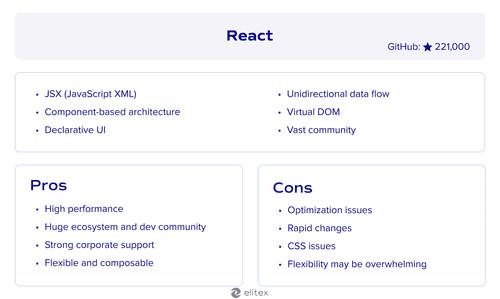
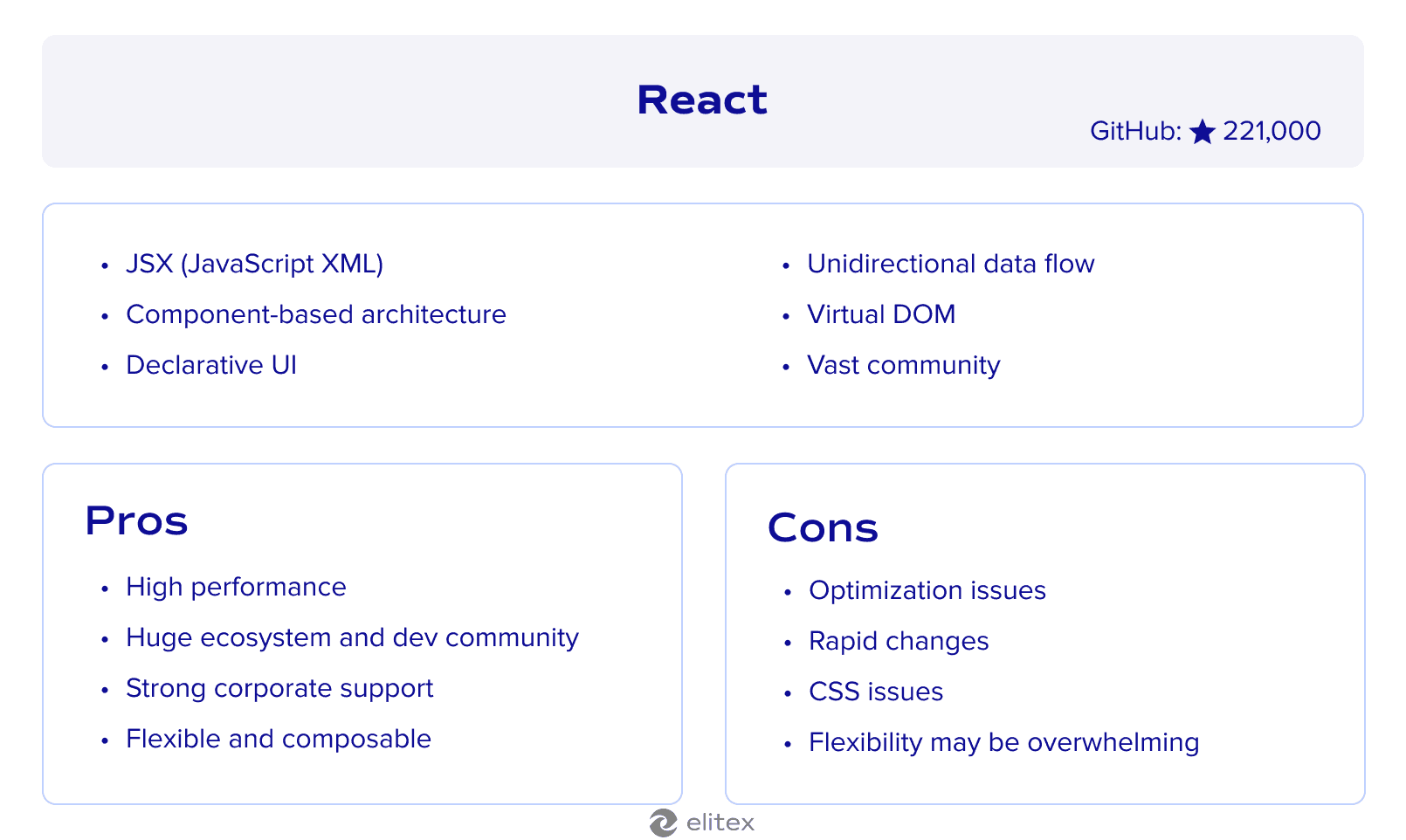
Main React.js features are syntax JSX, Virtual Document Object Model (DOM), XSS protection, Functional React components, and Basic state management with setState and Context API. A component is a reusable combination of HTML and JavaScript code that includes the logic required in order to display a small part of a more extensive UI as a tree. Each of them can be built up into successive aspects in the case of developing complex applications.
Why Use React JS
What are React.js development services used for? Before starting the React.js era over a decade ago, coders faced significant challenges in building UIs manually with raw JavaScript or React’s predecessors like jQuery. The process was long, error-full, and cumbersome. So, the development needed automation and simplification. When Facebook engineer Jordan Walke created the library, it significantly improved the overall UI development process. And the era of React’s frontend began.
Thus, there are two frequent scenarios where React.js is a decent tool: creating large web applications (including apps working without overloading the page) and mobile app development.
In the first case, it is a reasonable choice due to relative easiness, good performance, and code reusability in React. It has a built-in state management system, allowing the creation of a state object with the possibility to update it without any interruptions in the application’s running. A lot of dynamic web applications on the Internet today were built with React.
React Native, based on the original React, is a good choice for mobile app development due to a series of factors. React Native is inherently built and optimized for this particular sphere of development, simultaneously sharing all the advantages of the React.js basic version. Its cross-platform compatibility allows devs to build applications for both iOS and Android with a single codebase. Additionally, Native applications have a hot reloading feature, making debugging and updating quicker than other mobile app development frameworks.
Benefits of React.js
Whether you’re building a web application or a mobile app, React’s modular architecture and powerful toolset make it a go-to choice for a huge number of software engineers worldwide. To explain why thousands of companies choose this JavaScript library, let’s go over some of the numerous benefits of using React.
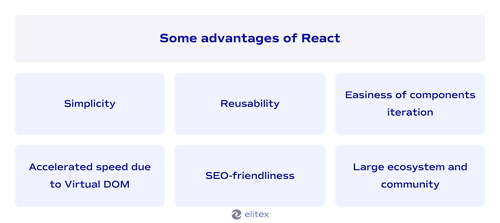
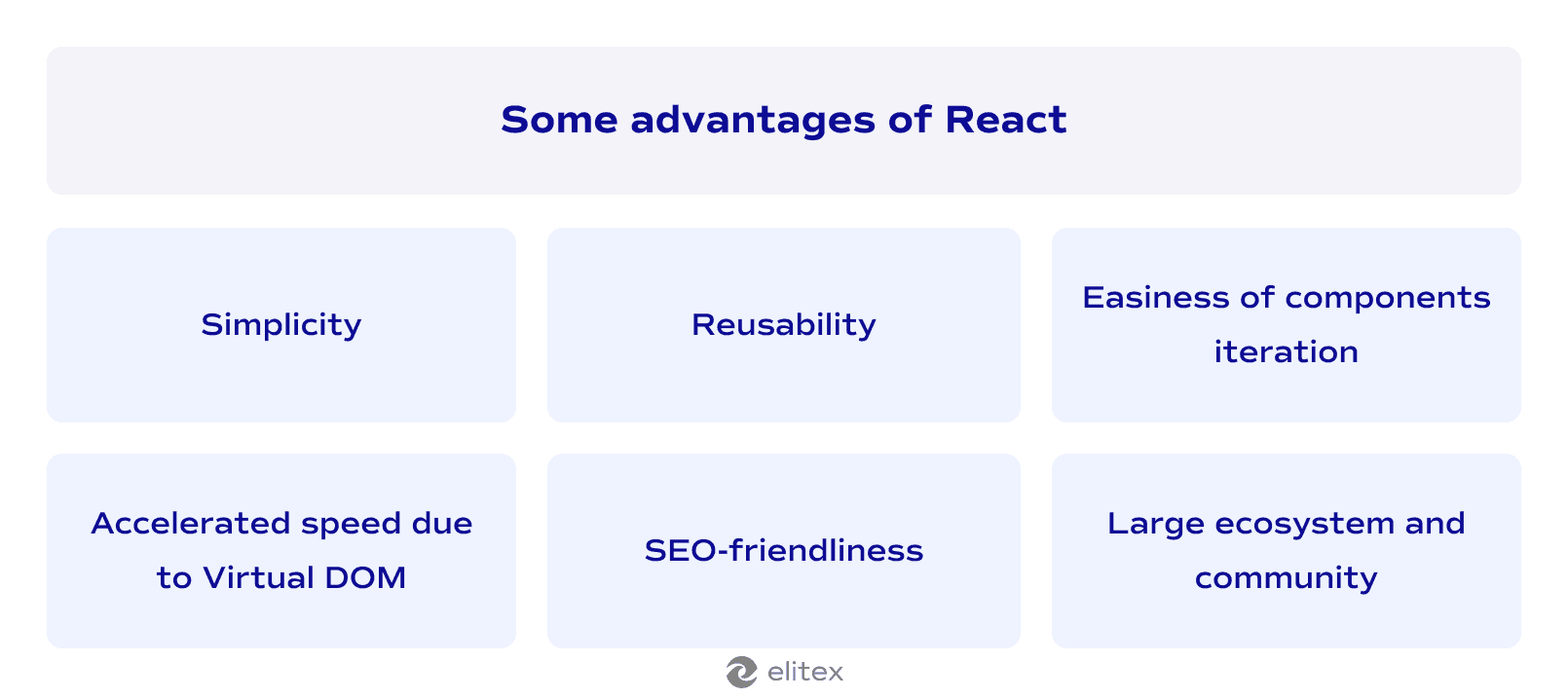
It is surprisingly simple
The first and one of the most apparent React advantages over other JS libraries is its simplicity of use. If you have been using the JavaScript coding language previously and learned a few essential functions, it is easy to start developing, even not being a high-level JS expert. Overall, it doesn’t require an extensive experience for JS developers to use it.
It is reusable
React enables developers to create reusable components. Each UI element you’ve already written can be used anywhere else at any time. The library allows you to group these elements into sections or pages and insert them anywhere needed in the current projects with the same functions. Eventually, you get less code, less time, simpler testing, and more consistency.
Easy iteration of components
You can quickly update any component in React in just a few seconds. The developer needs to define each component’s logic just once and maintain the selected items’ changes in bulk or individually.
Accelerated Speed due to Virtual DOM
At the same time, React.js optimizes this by leveraging its Virtual DOM to speed up the websites. The virtual representation of DOM significantly cuts the time of the operation. The reconciliation algorithm calculates the minimal set of changes to be applied to the actual DOM. So, instead of updating dozens of elements with every single change, React.js updates only one modified item.
SEO-friendliness
The server-side rendering capabilities make it easier to optimize applications to the specific needs of search engines like Google or Bing. It can be a significant competitive advantage for those who rely on search traffic.
Large ecosystem and community
It has a massive community because of its widespread popularity and reputation as a high-quality framework. Many resources available for learning and troubleshooting are available, combined with the fact that it is a highly-used open-source JavaScript library, making a significant impact on the community size. Additionally, fully compatible third-party libraries can make accessible extensions for the basic set of React dev tools.
Some of the disadvantages of using React.js
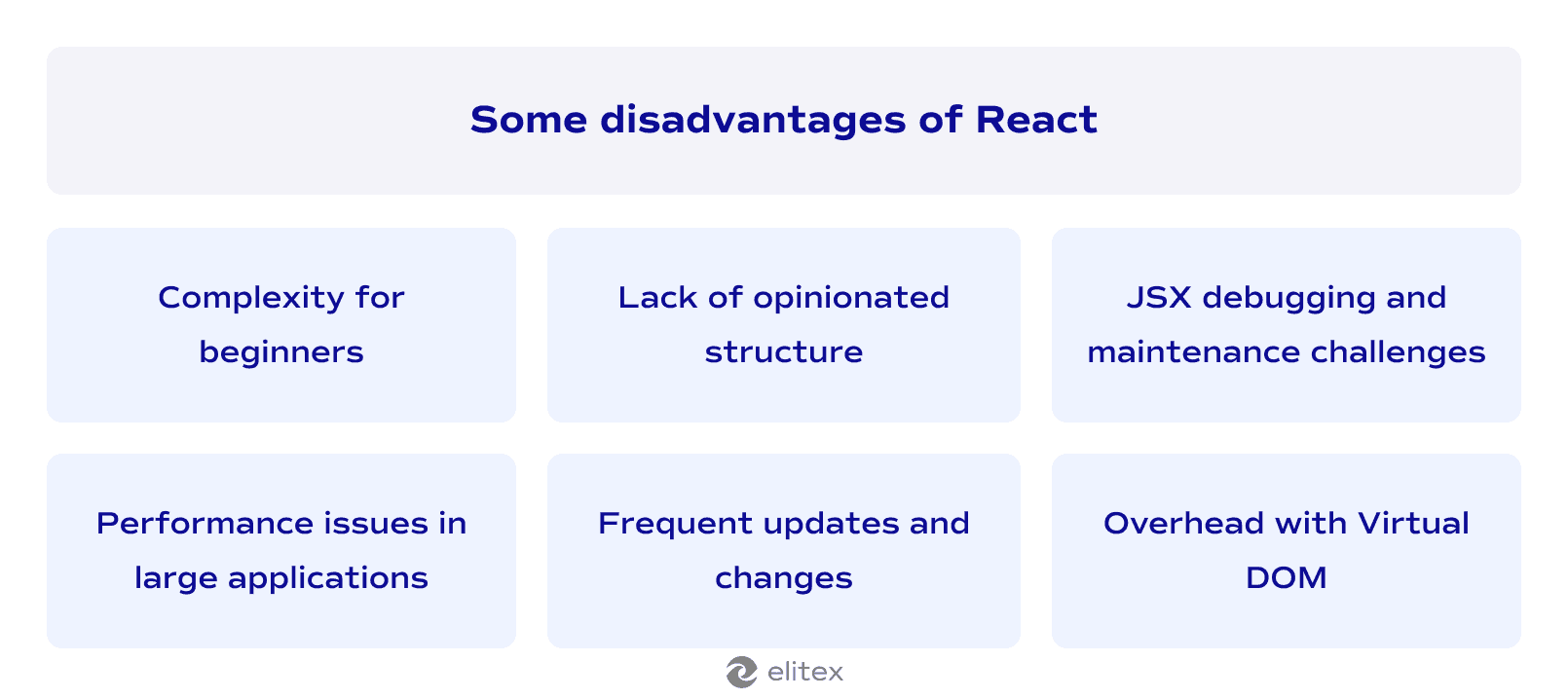
While there are a lot of advantages of React.js, at the same time, there are a couple of limitations you should be aware of. The learning curve may be quite steep for those unfamiliar with JavaScript’s basic principles. Although the syntax is relatively easy, the component-based architecture and reliance on JS can be daunting for beginners who aren’t familiar with JavaScript. Additionally, a lack of opinionated structure may complexify consistency across separate app parts.
Another thing that can be problematic during the development process is JSX. JSX itself is a powerful tool for creating reusable components. However, debugging and maintenance using JSX may require decent expertise. Also, large sizes of ReactJS applications can slightly slow the load times, especially on mobile devices. Finally, it is a rapidly evolving technology, so devs should stay up-to-date with the often changing practices.
Reasons why React.js can be the best choice for your project
React is a powerful and versatile tool that can be perfect for a wide range of projects. Let’s check some of the particular situations where the key benefits of React make it a perfect choice for real-life projects:
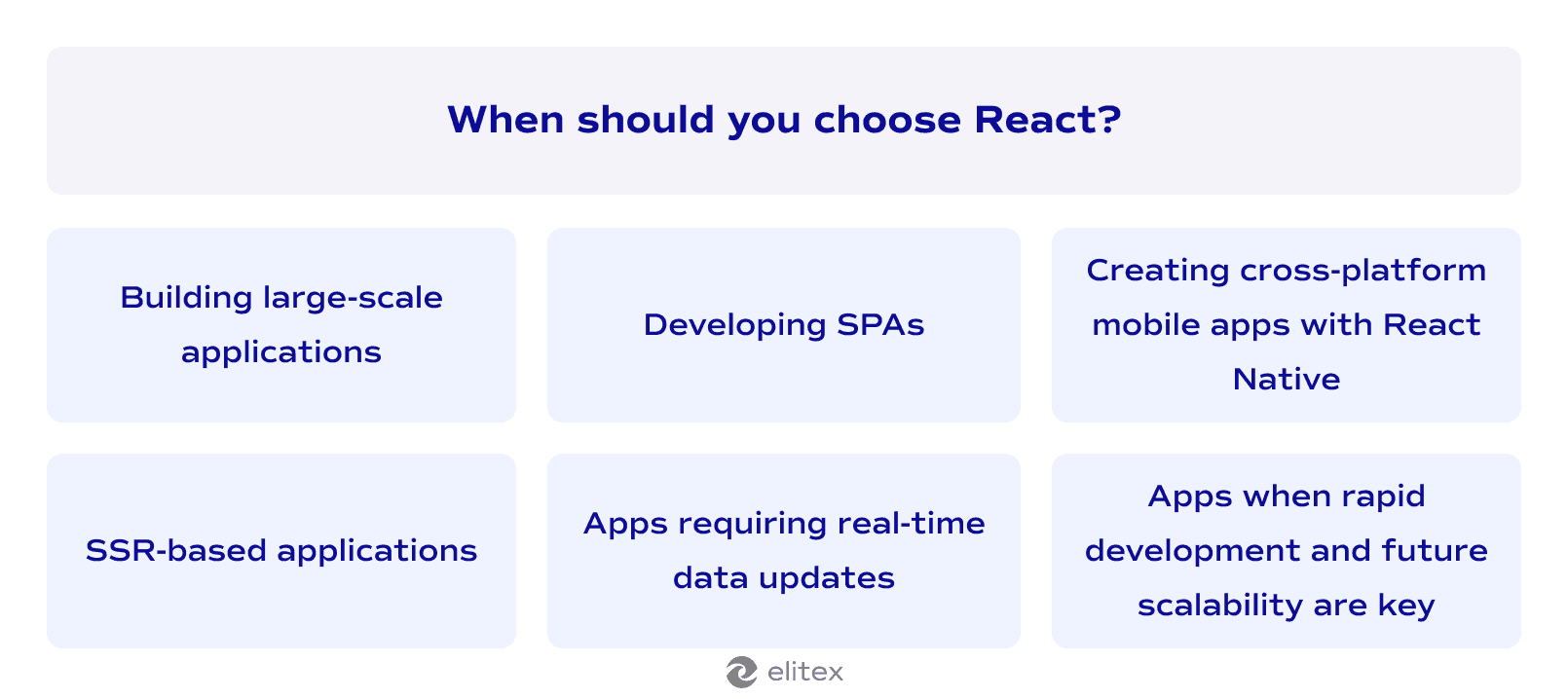
Building large-scale applications
You may build your ideal ReactJS web application with complex user interfaces. Component-based architecture facilitates breaking down large applications into smaller and more manageable parts.
Developing single-page applications (SPAs)
Together with Angular, it is an excellent choice for building robust SPAs, allowing users to interact with a web application without having to refresh the page or navigate to different pages. It reduces the server load times and improves the overall UX.
Creating cross-platform mobile apps
React Native framework allows developers to create native mobile apps compatible with both iOS and Android. Such a solution saves development time and leads to a more consistent customer experience across platforms.
Server-side rendering
It has excellent server-side rendering capabilities, improving the SEO performance of the product, so it can easily be used for server-side development.
Apps requiring real-time data updates
React was designed to be a tool for implementing real-time data updates in your applications. Trading platforms, social media, or chat applications are usually fast and responsive precisely due to leveraging the power of React and its DOM.
React JS app development
Saying that React was a revolution in mobile app development is not an exaggeration. React implementation is not limited to mobile games; Facebook is an example of the social media written with this library. The advantages of React lead to the growth of the number of complex SPAs as well as web and mobile apps based on the technology.
Developers build mobile iOS and Android apps without hiring additional talent. They can reuse the existing code from the website instead of writing it from scratch. It significantly cuts development costs, not to mention that Native allows a comfortable experience, reducing spent time for developers.
React vs. Angular
React.js is often compared to Angular.js as soon as they share a lot of common features, being two of the most popular JavaScript frameworks. Developers often implement React in its ecosystem with another library to turn the result into a complete framework.
Let’s compare React.js with Angular.js, another popular JS-based framework, by some of their key features.
| Angular | Feature | React |
| Support | ||
| TypeScript + HTML | Language | JavaScript + JSX |
| JavaScript Framework | Technology | JavaScript Library (View) |
| Two-way data binding (however, supports one-way data binding with “[ ]”) | Preferred Data Flow | One-way data binding (but supports two-way data binding with ReactLink) |
| By scoping selector, template, style, and other properties that make up the metadata required to process a component. | Componentization | By encapsulating all the HTML and JavaScript needed for a UI component in a single JSX file. Supports both class and functional components. |
| Automatic Dependency Injection | Dependency Management | Needs additional tools |
| Extends the functionality of HTML. Prefers client-side rendering. Uses the real DOM. | Front-end Development Approach | Uses hybrid JavaScript and HTML files called JSX. Slight preference for server-side rendering. Uses a virtual DOM. |
| SPAs that update a single view at a time. Apps where dependency management and consistency are essential (e.g., enterprise apps). | Optimal Use-case | SPAs that update multiple views at once. Apps that require heavy DOM manipulation (e.g., social media apps, image galleries). |
The future of React
As of today, at least one million pages are estimated to be examples of React solutions implemented into life. Thousands of developers are actively implementing React in their development cycle. Prominent market players such as PayPal, Facebook, Instagram, Uber, WhatsApp, Airbnb, and others assessed the advantages of React by basing their web and mobile platforms on React.
React JS has overcome many shortcomings, and very few popular front-end development frameworks can be comparable with React, considering the productivity of application development with this framework. Powered by helpful developer tools, quicker rendering, and simplifying the component scripting process, React is here to stay in the development environment.
Final thoughts
React.js is a popular and versatile JavaScript library for building visually appealing user interfaces. React.js advantages include various features specific to the technology, such as high performance, flexibility, and SEO-friendliness. Many types of projects can be built using React, including SPAs, large-scale applications, cross-platform mobile apps, and apps requiring real-time updates.
Of course, as with any technology, it also has some limitations, including reliance on third-party tools and low productivity in using it for projects that require extensive server-side functionality, as well as for projects heavily reliant on HTML and CSS. Nevertheless, due to the fact that the React benefits outweigh its limitations, it’s still a preferable choice for thousands of projects across the world.
At ELITEX, we combine Ukraine’s TOP professionals and a Western approach, adhering to JavaScript’s best coding standards. Give us a call to receive comprehensive software consulting before you make any decision. Our deep understanding of React.js’ advantages and limitations, combined with a decade of market experience, can make a significant difference for your project regardless of its scale and complexity.
FAQs
How does React JS work, and what are its key features?
React.js is a JavaScript library that allows developers to create reusable UI components and manage the state of the applications. It shares key features with most other JS frameworks and libraries, e.g., component-based architecture, a virtual DOM, and a declarative programming model.
What are the extraordinary benefits of using React.js for web and mobile development?
It offers a wide range of benefits for web and mobile app development, including gaster rendering, efficient data flow management, reduced development time, and cross-platform compatibility for mobile development.
What makes React so popular?
The key to success is quite obvious in this case. It is relatively easy to use, flexible, and scalable. And yes, it allows developers to create complex user interfaces faster, reducing the required code amount and offering a vast array of pre-made solutions.
Is React Native a framework or a library?
While we have previously defined React.js as a library, the framework’s definition can easily be used for React Native. It leverages the power of React to create cross-platform mobile apps with native performance and functionality.
Is React.js a simple framework for the beginner?
The difficulty of learning React.js will largely depend on your previous experience with JavaScript. If you had one, you would probably perceive React as a straightforward library; however, the learning curve can be challenging if it is your first coding experience.
What are some examples of successful React.js projects and use cases?
Some successful React.js examples include Facebook, Instagram, Netflix, and Airbnb.
POSTED IN: