



- TL;DR: This article explores major companies using JavaScript to run their platforms and why they made that choice. Here's what we'll cover:
- How Meta, Google, and Microsoft built their products around JavaScript and created tools like React, React Native, V8 Engine, and TypeScript that changed web development forever.
- Why financial giants like PayPal and Capital One moved their critical systems to Node.js for better performance and faster development cycles.
- The technical reasons these companies chose JS over other programming languages from real-time capabilities to cross-platform mobile development.
- Practical guidance on finding JavaScript development partners if you’re considering building or modernizing your own platform with this technology.
JavaScript runs a huge portion of the modern web. Open any website, launch any app, and you'll likely encounter JS code working behind the scenes. This language powers everything from simple interactive buttons to complex real-time applications that serve millions of users around the globe daily.
But why does JS dominate web development? The answer lies in its flexibility. Developers can build entire applications using JavaScript alone. The language works on both the frontend (what users see) and the backend (server operations). This means smaller teams can move faster because they work with one consistent technology throughout the entire development process.
Speed matters too. JavaScript delivers quick load times for end users. Pages feel responsive. Applications react instantly to user input. These performance benefits explain why businesses choose JS when they need their digital products to feel smooth and professional.
The rise of JavaScript has created a booming market. Demand for JavaScript development services keeps growing as more companies recognize they need expert help building their platforms. Development teams worldwide now specialize in JS because the opportunities are there.
But what does it all mean in practice? Do you know these companies that use JavaScript? Of course you do. You probably even used their services today. Netflix streamed your show. PayPal processed your payment. LinkedIn connected you with colleagues. All of them run on JavaScript. These platforms chose the most popular JavaScript frameworks because they needed technology that could scale fast and handle millions of concurrent users. Let's look at what companies use JavaScript and how it benefits them.
| Company | JavaScript Use | Key Technology |
| Meta | Powers Facebook, Instagram, and WhatsApp interfaces and user interactions | Created React and React Native frameworks |
| Runs Google Maps real-time processing, Google Docs collaboration, and Chrome browser | Built a V8 Engine that powers Node.js | |
| Microsoft | Office 365 productivity suite, Teams communication, and Azure cloud management | Created TypeScript for enterprise JS development |
| PayPal | Payment processing systems and transaction handling | Migrated critical systems to Node.js |
| Professional networking platform, mobile app, and real-time messaging | Rebuilt mobile application with JS technologies | |
| Uber | Ride-matching platform processing millions of simultaneous requests | Runs entire backend on Node.js |
| Walmart | E-commerce platform handling peak-season traffic and checkout | Rebuilt an online shopping platform with JS |
| eBay | Marketplace with real-time auctions, bidding, and seller tools | Pioneered JS performance optimization techniques |
| Capital One | Digital banking infrastructure and customer account management | Open-sourced JavaScript tools for finance |
| Citibank | Global banking operations across dozens of countries | Web platforms processing millions of daily transactions |
Top companies using JavaScript
Meta


Meta runs Facebook, Instagram, and WhatsApp. Billions of people use these platforms daily. JavaScript became so central to their operations that Meta's engineers created their own tools to work with it better. They built React, which quickly became the most popular front-end framework in the world. Then they developed React Native to bring the same approach to mobile applications. This framework lets developers write code once and deploy it across mobile devices on different operating systems. Today, thousands of companies seek React development services because Meta has proven that the framework can handle massive scale. The company's investment in JavaScript fundamentally shaped how modern web and mobile apps get built.


Google runs dozens of web services that depend on JavaScript. Google Maps processes location data in real time. Google Docs enables collaborative editing through JS-powered interfaces. The company's engineers needed better performance optimization, so they built the V8 Engine. This JavaScript engine executes code faster than anything that came before it. Other developers recognized V8's power and used it to create Node.js. Anyone asking what Node.js is used for should know it runs on Google's V8 Engine, enabling JavaScript to handle server-side operations at scale. Google's work on performance fundamentally changed how JavaScript gets executed across the web. V8 now powers Chrome and millions of applications that need fast JS processing.
Microsoft


Microsoft transformed its entire product ecosystem around web technologies. Office 365 runs on JavaScript. Teams relies on it for real-time communication features. Azure's cloud services use JS extensively for their management interfaces. The company went from building desktop-only software to creating web-based platforms that work anywhere. This shift happened because JavaScript enabled cross-platform functionality that traditional approaches couldn't match.
The impact extends beyond Microsoft's own products. Companies using JavaScript now build their digital transformation projects on Microsoft's platforms. Legal and professional services firms run their operations through Microsoft 365, which means they're using JavaScript whether they realize it or not. Microsoft even created TypeScript to make JavaScript more reliable for enterprise applications. The company's embrace of JS proved that even traditional software giants need modern web technologies to stay relevant.
PayPal


PayPal made headlines when it moved critical payment processing systems to Node.js. The company became one of the most prominent companies using Node.js for production services. Their software development teams found that JavaScript on the server reduced complexity because frontend and backend engineers could work with the same language. Backend performance improved while development speed increased. PayPal's success with Node.js encouraged other financial platforms to consider JavaScript for operations that traditionally relied on Java or .NET.


LinkedIn rebuilt its mobile application using JavaScript technologies to improve performance. The platform serves hundreds of millions of professionals who check job listings, network updates, and messages throughout the day. Their engineering team needed faster load times and smoother interactions. JavaScript enabled them to deliver those improvements while keeping development efficient. LinkedIn joined other major companies using JavaScript to power both web and mobile experiences. The switch proved that JS could handle professional networking at scale, even with complex features like real-time messaging and feed algorithms.
Uber


Uber runs its massive ride-matching platform on Node.js. The company processes millions of requests simultaneously as riders book trips and drivers accept them. Their engineering team chose Node.js because it handles real-time data efficiently. Uber's success with JavaScript on the backend pushed more Node.js companies into the mainstream. Today, businesses seeking Node.js development services often point to Uber as proof that JS can power high-traffic, mission-critical applications. The platform's ability to scale while maintaining speed demonstrated that Node.js works for operations far beyond simple web servers.
Walmart


Walmart invested heavily in web development to compete with Amazon. The retail giant rebuilt its online shopping platform using JavaScript. Their web applications handle millions of transactions during peak shopping seasons. The company needed technology that could scale quickly while keeping checkout processes smooth. JavaScript delivered both speed and reliability.
Companies that use JavaScript for e-commerce often study Walmart's approach. The retailer proved that traditional brick-and-mortar businesses could build digital platforms that rival tech-native competitors. Their focus on fast page loads and responsive interfaces directly improved client satisfaction. Customers abandoned fewer shopping carts. Sales increased. Walmart's success showed that JavaScript works for high-stakes retail operations where every millisecond of load time affects revenue.
eBay


eBay built one of the web's largest marketplaces on JavaScript. The platform handles auctions, instant purchases, and seller tools through complex web applications that need to update in real time. Bidding wars happen in seconds. Prices change dynamically. JavaScript makes these interactions feel immediate. JavaScript experts should know that eBay's engineering team pioneered many performance techniques that later became industry standards. The company processes billions in transactions annually, proving that JS can power commerce at the highest levels. Their architecture demonstrates how JavaScript handles both the complexity of marketplace operations and the scale of millions of concurrent users.
Capital One


Capital One pioneered JavaScript adoption in the banking sector. The company rebuilt its digital infrastructure around JS technologies to deliver faster, more responsive services. Capital One engineers recognized that modern customers expect instant access to their accounts. Mobile applications became a priority, and JavaScript enabled the bank to deploy features quickly across platforms. Capital One even open-sourced some of its JavaScript tools to help other developers build better financial applications.
Citibank


Citibank operates one of the world's largest global banking networks. The institution needed technology that could handle transactions across dozens of countries simultaneously. JavaScript provided the flexibility Citibank required for its international operations. Anyone asking who uses JavaScript in finance will find Citibank among the most committed. The bank's web platforms process millions of transactions daily, proving that JS works for industries where security and reliability aren't negotiable.
Why Are Top Companies Choosing JavaScript?
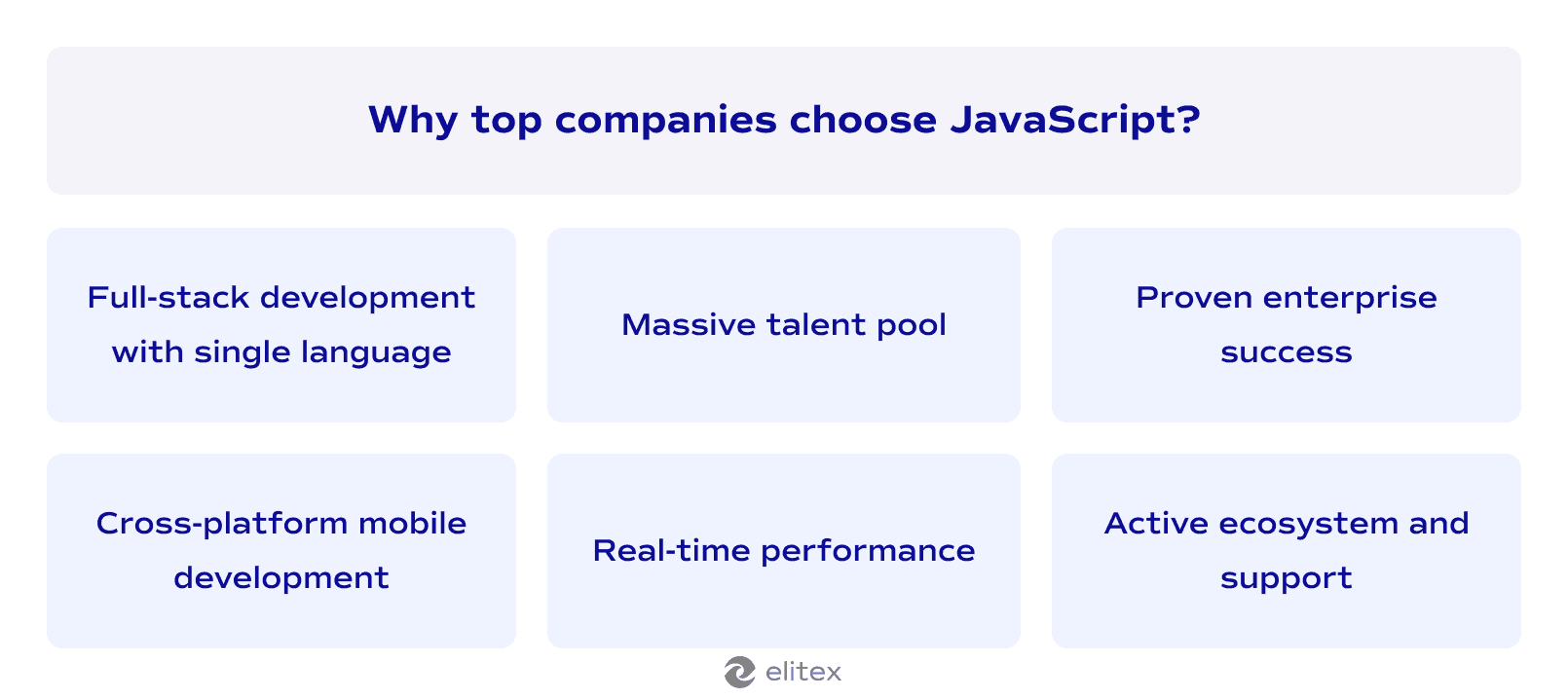
- Full-Stack development with one language: JavaScript runs on both frontend and backend. Teams work faster because developers share the same technology across the entire application.
- Massive talent pool: More developers know JavaScript than any other programming language, making hiring easier for businesses worldwide.
- Real-time performance: Node.js handles millions of simultaneous connections without slowing down. This capability matters for platforms that need instant updates like ride-sharing apps or financial trading systems.
- Cross-platform mobile development: React Native lets companies build iOS and Android apps from a single codebase, cutting development time in half.
- Proven enterprise success: JavaScript development companies have delivered solutions for the world's largest platforms. Top world IT services companies consistently choose JS because it's been tested at the highest scales.
- Active ecosystem and support: Thousands of open-source libraries solve common problems, so developers don't build everything from scratch.
Where to Hire a JavaScript Development Company
We've written extensively about the best countries and destinations to outsource software development. Our articles cover top IT service companies in the UK and specifically top IT staff augmentation companies that allow you to reinforce your project with highly-specialized software engineers. These guides explain how to evaluate potential partners and highlight companies worth considering. The companies that use JavaScript at the highest levels prove that the language works for any scale. Whether you need front-end development services or full-stack solutions, choosing the right partner determines project success.
Why ELITEX for your JavaScript project
ELITEX has delivered a full spectrum of custom software development from DevOps automation to web development services for over a decade across international markets. We specialize in JavaScript and its frameworks because we've seen how they accelerate development while maintaining quality. Our team handles everything from React frontends to Node.js backends. We work with startups launching their first product and established companies modernizing legacy systems. If you're ready to build with JavaScript, we'll match you with developers who know the technology inside out.


What companies use JavaScript FAQ
Which major companies build their web platforms using JavaScript?
The modern web is hard to imagine without JavaScript. Giants such as Meta, Google, Microsoft, PayPal, LinkedIn, Uber, Walmart, eBay, Capital One, and Citibank all run core products on JavaScript. In 2026, this language reaches from social media to finance.
What are examples of large-scale web applications built with modern JavaScript frameworks?
Facebook and Instagram run on React, the framework Meta created. Google Docs handles collaborative editing through JS interfaces, powered by the V8 engine Google built. Uber matches millions of rides on Node.js, and Walmart rebuilt its shopping platform on the same runtime. LinkedIn rebuilt its mobile app with JS technologies, while eBay runs real-time auctions through complex JS applications.
What industries heavily rely on JavaScript for their primary software?
Finance leans on it through PayPal, Capital One, and Citibank. Retail runs on it at Walmart and eBay. Social and professional platforms like Google, Meta, and LinkedIn depend on it too.
Does JavaScript work for industry-specific features?
JavaScript adapts to any sector's needs. Banks build secure payment systems with it. Healthcare platforms create HIPAA-compliant patient portals. Retailers develop real-time inventory tracking. The language's flexibility lets developers build industry-specific features without switching technologies.
How do I find development agencies specializing in JavaScript-based solutions?
Start by checking a partner's portfolio for work close to what you need. You can use software development companies' own websites or industry platforms like Clutch or G2. One of the companies specializing in the JS technology, ELITEX, has delivered JavaScript projects for over a decade, covering React frontends and Node.js backends across web, mobile, and desktop products. ELITEX's vast JavaScript portfolio speaks volumes.
Where can I find consulting firms expert in modern JavaScript best practices?
Look for firms that show production experience, not framework names on a homepage. Verified platforms like Clutch and G2 surface that track record through real client reviews. ELITEX, for example, works across the full JS stack and pairs clients with engineers who know the frameworks deeply. So you can judge a firm by what it has shipped before you reach out.
What software companies sell products built primarily with JavaScript?
Microsoft Office 365 runs on JavaScript. Salesforce uses it for multi-tenant SaaS. Both handle real-time updates at enterprise scale.
How do large corporations integrate JavaScript into their product ecosystems?
Most build custom tooling around the language. Meta is the clearest case: its engineers created React to handle Facebook and Instagram interfaces, then built React Native so the same code could run on mobile. Google took a different route, engineering the V8 engine to execute JS faster, which later became the foundation for Node.js. So the biggest players don't just adopt JavaScript. They reshape it to fit how their own platforms run.
POSTED IN: